
You notice a spider in the basement corner, or a trail of ants moving across the kitchen counter, and the first instinct is simple. Grab a can, spray the area, and hope the problem ends before dinner.
That reaction is normal. It's also where a lot of homeowners in Crown Point get into trouble. Spraying pest control in a home isn't just about killing the bug you can see. It's about choosing the right place, the right amount, the right timing, and the right safety steps so you don't turn a pest problem into an exposure problem.
A lot of online advice makes DIY spraying look easy. In real homes across Northwest Indiana, it rarely is. Basements stay damp. Garages collect clutter. Utility lines leave tiny entry gaps. Kids, pets, food prep areas, and finished living spaces all change how a treatment should be handled. If you're searching for how to spray pest control in home settings safely, you need more than a quick perimeter tip from a short video.
Your First Line of Defense Against Pests in Crown Point
A Crown Point homeowner sprays along the back door after seeing a few ants. For a day or two, the traffic slows down. Then the ants show up by the dishwasher, and a few spiders turn up in the basement a week later. I see that pattern all the time.
The problem usually is not the spot that got sprayed. It is the gap under the door sweep, the moisture around a sump area, the pipe opening under the sink, or the insect activity already established in a wall void or crawlspace edge. In Northwest Indiana homes, those trouble points often show up around basement windows, sill plates, attached garages, and attic access areas.
If you have also heard scratching overhead or found droppings near storage, it helps to identify and exclude attic invaders before assuming every pest issue should be handled with spray alone. Rodents, insects, and moisture issues often stack on top of each other.
Why the quick spray response is so common
Store-bought sprays give fast visible results. That is why homeowners reach for them first. The trouble is that a quick knockdown can hide the underlying source long enough for the infestation to spread to another part of the house.
I tell neighbors to slow down and inspect before they spray. Look for where pests are entering, what is feeding them, and whether the issue is even a spray issue to begin with. Ants trailing to a grease spot need a different response than spiders living off insect activity in a damp basement. Occasional beetles near a garage door call for a different plan than roaches around plumbing lines.
Practical rule: If the plan is to spray an entire room, stop and reassess. Broad indoor spraying often misses the hiding place and increases the chance of putting product on the wrong surfaces.
What actually helps first
Start with the pattern, not the product.
- Kitchen pests usually track back to crumbs, grease, plumbing moisture, or small entry gaps near utility lines.
- Basement spiders often mean there is already insect pressure in that space.
- Garage pests build around weatherstripping gaps, slab cracks, and cardboard storage.
- Activity on upper floors can point to attic access, wall voids, or roofline entry.
- Recurring sightings in one room often mean the nest or harborage is nearby, not necessarily where you first saw the insect.
Local experience matters in these situations. Homes in Crown Point deal with freeze-thaw cracks, damp basements, and seasonal pest pressure that online DIY videos rarely account for. Before any treatment starts, it helps to review a solid home prep checklist for pest control service so you do not create a safety problem while trying to solve a pest problem.
Preparing Your Home for Pest Treatment
Preparation does more for safety and results than is often assumed. A rushed spray job over clutter, pet bowls, and exposed food usually misses the pest and contaminates the wrong surfaces.

The U.S. EPA advises homeowners to try pest prevention first, remove food, water, shelter, and entry points, and use baits as a first line of chemical defense after preventive steps are taken. It also warns that pesticides not contained in baits or traps should generally only be applied to targeted locations, not sprayed over the whole room (EPA pest control guidance).
Clear what blocks the treatment
Move items away from baseboards, under sinks, and around utility penetrations. Pests use those tight, undisturbed areas. If boxes, laundry, storage bins, or pet beds stay packed against the wall, you can't treat the places where insects travel.
A few practical prep points matter a lot:
- Put away food and dishes. Don't leave fruit, bread, pet treats, or open pantry items exposed.
- Remove pet bowls and water dishes. Those areas should stay free of spray.
- Pick up toys and floor items. Kids' toys, chew toys, and anything handled often should be removed before treatment.
- Reduce clutter. Cardboard, stacked paper, and overfilled storage areas give pests hiding spots.
Clean first, not after
Spraying over grease, crumbs, and dust doesn't solve the source. Wipe counters, vacuum edges, and deal with standing water before treatment. If ants are being drawn by a sticky spot behind a toaster or roaches are using moisture under a sink, the chemical alone won't carry the job.
If you want a room-by-room checklist before service or DIY treatment, The Green Advantage has a practical guide on how to prepare for pest control.
A quick visual walkthrough can help if you're deciding what to move and what to protect:
Think like a pest before you spray
Preparation isn't just housekeeping. It's diagnosis.
If insects are living behind clutter, feeding from spills, or entering through gaps around pipes and doors, a spray without prep is mostly a surface-level fix.
For residential pest control in Crown Point, IN, the homes that respond best to treatment are usually the ones where the prep work removed the pest's food, moisture, and shelter first.
Core Techniques for Applying Pest Control Spray
A Crown Point homeowner usually reaches for a can or pump sprayer after seeing bugs in the open. The better results usually come from treating the places insects use. In practice, that means tight placement in cracks, seams, and entry gaps, not a general coating across the room.
Earlier in the article, I noted that spray products are common in homes and often misused. I see the same pattern on service calls across Northwest Indiana. The issue usually is not effort. It is placement, product choice, and using too much material in the wrong spots.
Interior work should be precise
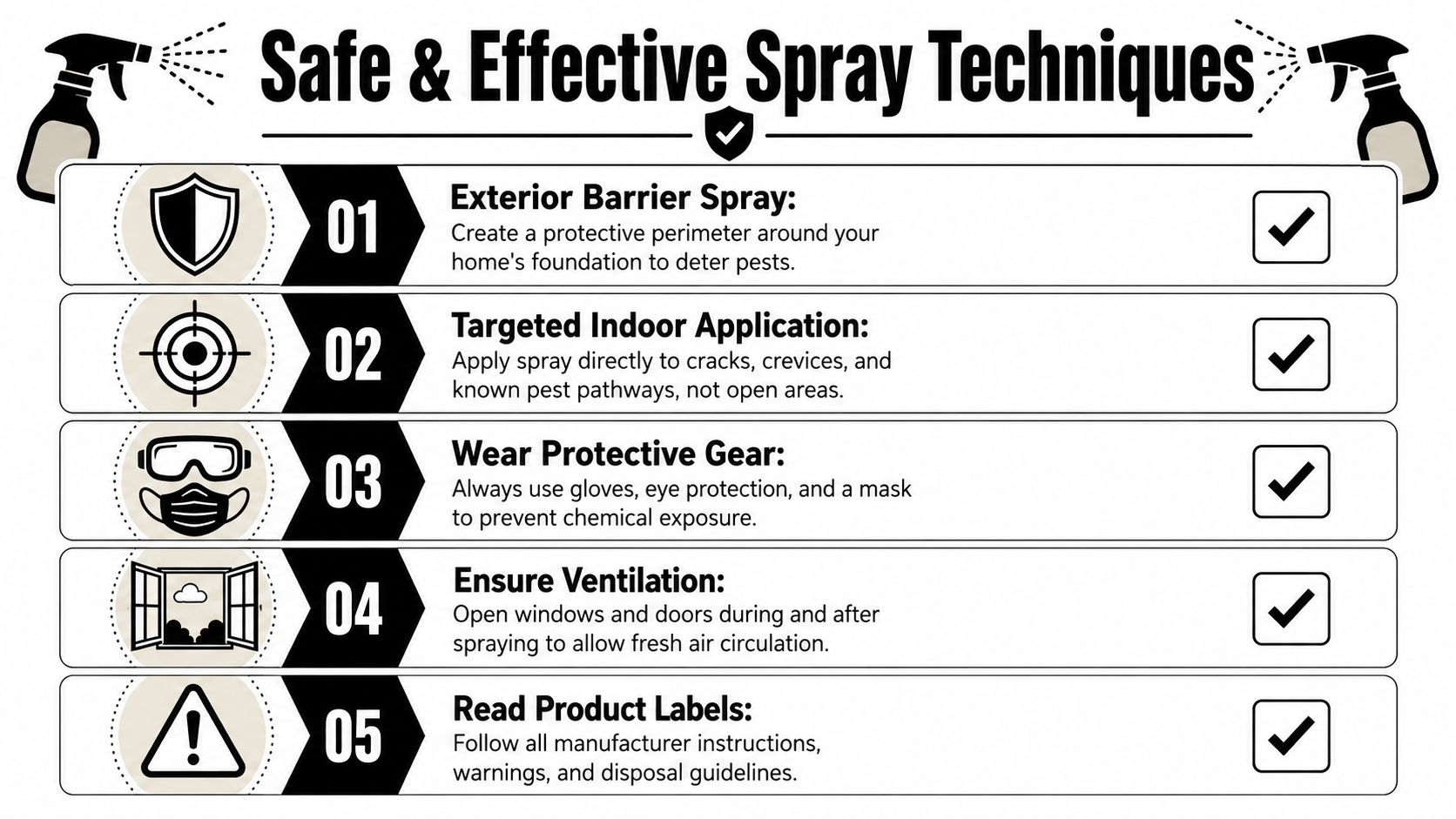
Indoor spraying should stay focused on pest traffic and harborage. Good target areas often include baseboard gaps, pipe penetrations under sinks, the void around door trim, window edges with visible activity, and labeled crack-and-crevice areas behind appliances.
Avoid broad surface spraying indoors. Open floors, counters, food-prep areas, furniture, bedding, and children's play spaces should not be treated unless the label specifically allows it. Spraying a wall because you saw one ant or spider on it usually wastes product and increases contact risk without fixing the reason the pest showed up there.
That trade-off matters in real homes. A light, controlled treatment in the right gap can help. A heavier treatment on the wrong surface leaves residue where people and pets live.
Exterior barriers work differently
Outside, the goal is interception. A perimeter treatment is usually applied in a narrow band around the foundation and at likely entry points such as door thresholds, garage edges, utility penetrations, and lower window areas if the label allows it.
Consistency matters more than coverage for its own sake. If the band is broken, washed out, or blown off target by wind, pests route around it. In Crown Point, I also tell homeowners to pay attention to mulch, downspouts, and siding lines near shaded foundation walls, because those conditions often hold moisture and insect activity longer than people expect.
If you're using a hand sprayer and want better control than a sputtering trigger bottle, some homeowners prefer an effective spray bottle for sensitive homes because a steadier mist can help reduce puddling and overspray. The container doesn't replace label instructions, but the right tool can make careful placement easier.
Technique matters more than people think
A careful application follows a few rules:
- Use the label as the job plan. It tells you where the product can go, how much to apply, and what surfaces to avoid.
- Keep each pass short and controlled. Wide sweeping motions create drift and uneven coverage.
- Watch how the surface reacts. Concrete, unfinished wood, vinyl, and fabric absorb or hold product differently.
- Treat routes and hiding spots. Focus on where pests enter, travel, and settle.
- Stop if the pest is not identified. Ants, spiders, roaches, stinging insects, and rodents do not respond to the same treatment approach.
This is the part short videos usually skip. They show the spray. They do not show the call a week later when the ants are still active because the colony was under the slab, or when a bathroom was overtreated and now the homeowner is worried about what the kids touched. A customized treatment plan costs more upfront, but it usually reduces repeat spraying, lowers exposure concerns, and fixes the problem closer to the source.
Post-Spray Safety and Essential Cleanup
The spray isn't the end of the job. The safety steps afterward are just as important.
A solid benchmark is to treat the area as off-limits until the product is fully dry and the space is ventilated. For exterior perimeter treatments, guidance recommends spraying one foot up the wall and one foot out, then waiting roughly 30 to 60 minutes for drying before allowing children and pets back into the treated area (application and drying guidance).
Ventilation comes first
Open windows and doors if the label allows it. Use fans to move fresh air through the treated area. If you sprayed inside a bathroom, laundry room, mudroom, or basement corner, don't close the door and hope for the best.
Wet product presents the greatest immediate concern. Until treated surfaces are dry, keep children and pets out. That includes cats that walk baseboards, dogs that nose corners, and toddlers who touch low surfaces without warning.
Don't judge re-entry by smell. Judge it by dryness, ventilation, and label instructions.
Clean the right things
If there's a spill or visible misapplication, clean it as directed on the label. For small accidental drips on non-target surfaces, warm soapy water is commonly recommended in consumer guidance. Empty containers also need proper disposal according to the product label and local rules.
Use common sense on contact items:
- Wash exposed dishes or utensils if spray drift reached them.
- Wipe food-prep surfaces before using them again.
- Launder washable items if they were accidentally contaminated.
- Replace pet bowls and toys only after the area is dry and clean.
Watch what happens next
After a proper treatment, you may still see some pest activity for a short period. That doesn't automatically mean the product failed. It may mean hidden pests are moving through treated areas.
What matters is the pattern. If activity keeps restarting in the same room, or spreads to multiple areas, the issue usually needs a closer inspection instead of another round of broad spraying.
Why DIY Spraying Fails and When to Call a Pro
Most DIY spraying fails for one simple reason. Homeowners treat the symptom they can see, not the condition causing it.
If bugs are entering because of moisture, clutter, or structural gaps, the spray becomes a repeating chore instead of a lasting fix. Independent guidance on perimeter treatment and prevention stresses that long-term control depends on removing attraction and access points, not just applying chemical barriers. If the issue stems from moisture, clutter, or structural entry points, spraying alone is often the wrong answer and won't provide a lasting solution (independent pest prevention guidance).
The common failure points
A recurring ant, spider, or occasional invader problem usually breaks down in one of these areas:
Wrong pest ID
Spraying for “bugs” isn't a strategy. Ant control differs from spider control. Mosquito control, rodent control, and termite control are completely different jobs.Wrong location
Homeowners often spray exposed flooring or open rooms instead of entry seams, voids, and exterior access points.Root cause stays active
Leaks under sinks, overgrown foundation lines, open utility gaps, attic access issues, and garage door gaps keep feeding the infestation.Too much product
Overspraying creates residue and risk without fixing the route pests are using.
DIY pest spray vs professional treatment
| Factor | DIY Approach | The Green Advantage Professional Service |
|---|---|---|
| Pest identification | Often based on a quick visual guess | Inspection-based identification tied to pest behavior and site conditions |
| Treatment placement | Commonly broad or inconsistent | Targeted application around entry points, harborage areas, and risk zones |
| Safety planning | Frequently limited to “spray and leave” | Includes treatment decisions around pets, children, food areas, and occupied spaces |
| Root-cause correction | Often skipped | Looks at moisture, clutter, exclusion, sanitation, and structural access |
| Long-term control | Usually reactive | Built around prevention and follow-up when needed |
When spraying is the wrong answer
If pests keep coming back after you spray, that's a sign to stop repeating the same method. Spray is also a poor choice when the problem involves:
- Persistent moisture
- Wall void or attic activity
- Rodents
- Sensitive homes with pets or small children
- Large or hard-to-reach infestations
- Commercial pest control needs where documentation and consistency matter
For homeowners comparing options, a general Guide on pest control costs for homeowners can help frame the decision between repeated store-bought attempts and a service visit. If you're weighing the trade-offs locally, this article on DIY or hire a pro for pest control gives a practical breakdown of when each path makes sense.
The Green Advantage Promise for Crown Point Homes
In Crown Point, a pest problem rarely starts and ends with the spot where you see the bug. Ants may be trailing from a wall void. Spiders often show up because another insect population is already established. Mice in an attached garage can turn into activity in the basement once temperatures shift.
That's why the first question at a service visit is about the conditions in the home, not just where to spray. A good treatment plan is built around how the pest is living on that property, what's allowing it in, and how to correct the problem with the least disruption to the people and pets who live there.

What homeowners should expect
A sound service process is usually simple to understand, even when the pest issue is not.
A real inspection
The technician checks current activity, likely entry points, moisture issues, harborage areas, and the rooms or exterior zones that matter.A clear explanation
Homeowners should hear what pest is present, why it is there, and whether spray is the right tool or only one part of the fix.A treatment plan tied to the property
One home may need a limited crack-and-crevice application. Another may need exterior perimeter work, exclusion repairs, rodent control, mosquito service, or follow-up for recurring seasonal pests.Straight safety instructions
You should know where treatment was applied, how long treated areas need to dry, and what precautions apply for children, pets, food areas, and stored items.
Why a careful approach matters in occupied homes
Occupied homes need restraint. Broad indoor spraying can create unnecessary exposure without solving the source of the problem.
The ASPCA advises keeping pets out of treated areas until products are dry and avoiding applications near food or water bowls, which supports a more targeted approach in homes with animals and children (ASPCA insecticide safety guidance).
That matters in Northwest Indiana homes with finished basements, mudrooms, crawl-adjacent utility areas, and attached garages where people and pets move close to baseboards, thresholds, and storage edges every day.
A practical local option
For homeowners looking for pest control in Crown Point, IN, The Green Advantage provides residential and commercial pest control, inspections, mosquito services, and site-specific treatment plans based on the conditions at the property.
Store products can kill what they hit. A professional inspection answers a different question. Why are the pests there in the first place?