
You hear scratching in the wall after midnight. In the morning, there's a trail of ants along the baseboard, or a wasp keeps circling the same soffit corner outside. Most Ottawa homeowners don't need help identifying the feeling. You want the problem gone, and you want to know whether this is a nuisance, a health issue, or the start of expensive damage.
That's where pest control ottawa searches usually begin. Not with curiosity. With stress.
The good news is that most pest problems follow patterns. Ottawa's climate, housing stock, and dense urban neighbourhoods create recurring trouble spots, but they also make prevention and treatment more predictable than many people think. Professional pest control in this city isn't a fringe service either. Canada's pest control industry is projected to reach about $2.7 billion in revenue in 2026 across 1,554 businesses, according to IBISWorld's Canadian pest control industry profile. That scale exists because residential and commercial demand is steady, and because pest issues rarely solve themselves for long.
Your Guide to Navigating Pest Problems in Ottawa
A lot of calls start the same way. A homeowner says they noticed “something small” a few days ago and hoped it would pass. Then the signs multiply. One mouse becomes droppings in the pantry. A few ants turn into a visible line across the kitchen. A rustling sound in the attic becomes impossible to ignore once the house quiets down at night.
That delay is understandable. People don't want to overreact. They also don't want a stranger spraying products through the house unless it's necessary. But most serious pest work isn't about random spraying. It's about identifying the pest correctly, finding out why it's there, and stopping the access, food, water, or shelter conditions that let it stay.
What Ottawa homeowners usually need first
The first thing needed isn't treatment. It's clarity.
They want answers to practical questions like these:
- What am I dealing with: Mice, rats, ants, bed bugs, cockroaches, wasps, spiders, termites, and wildlife all require different methods.
- How urgent is it: A single wasp outside and scratching in an attic call for different timelines.
- Can I handle any of this myself: Sometimes yes, especially with prevention. Often no, once breeding or nesting has started.
- Will this keep coming back: It will if the root cause stays in place.
Practical rule: If you're hearing movement inside walls, finding repeated droppings, or seeing recurring insect activity in the same area, you're usually past the stage where a store product fixes the problem for good.
What actually works
In Ottawa homes, the long-term fix usually comes down to three things:
| Problem area | What works | What usually fails |
|---|---|---|
| Entry points | Inspection and sealing gaps, cracks, roofline openings, utility penetrations | Treating indoors without closing access |
| Food and moisture | Garbage control, food storage, leak repair, reducing humidity | Surface cleaning alone |
| Active infestation | Pest-specific treatment and follow-up | One-time DIY sprays used without inspection |
That's the part many homeowners don't get told early enough. You're not just hiring someone to remove pests. You're hiring someone to break the cycle that allowed them in.
Ottawa's Common Pests and Seasonal Threats
Ottawa pests don't stay constant all year. Activity shifts with temperature, moisture, and shelter needs. If you know what tends to show up in each season, you can react earlier and make better decisions about urgency.
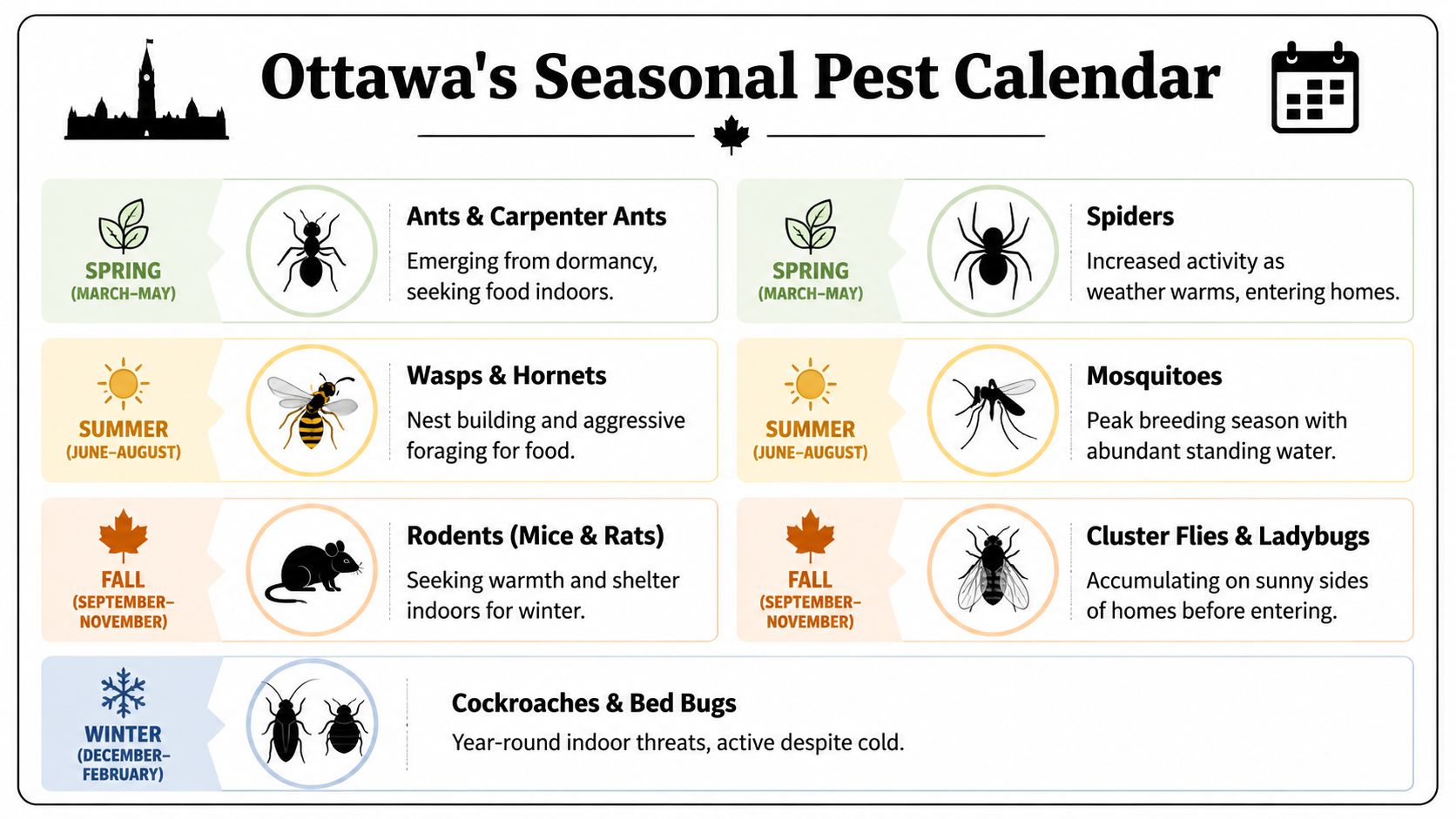
Seasonal Pest Activity Calendar for Ottawa
| Season | Common Pests | Primary Risk |
|---|---|---|
| Spring | Ants, carpenter ants, spiders | Indoor foraging, nest expansion, early entry through small openings |
| Summer | Wasps, hornets, mosquitoes, cockroaches | Nesting, biting, food contamination, outdoor activity pressure |
| Fall | Mice, rats, cluster flies, ladybugs | Indoor shelter seeking, wall and attic entry, overwintering |
| Winter | Bed bugs, cockroaches, rodents already inside | Ongoing indoor activity, hidden spread, repeated sightings |
Spring and summer pressure
Spring exposes weaknesses in a house. Freeze-thaw movement opens gaps around foundations, siding joints, rooflines, and utility penetrations. Ants start foraging. Carpenter ants become more noticeable. Spiders become more active as insect movement increases around the structure.
By summer, outdoor pressure climbs. Wasps and hornets build and defend nests. Mosquitoes breed where water lingers. Cockroaches remain an indoor concern but become easier to sustain when warmth and moisture are available.
A practical mistake homeowners make in warm months is treating every insect sighting as the same problem. It isn't. Ant activity often points to access and food. Wasps point to nest location. Cockroaches point to sanitation, moisture, and hidden harbourage. If the treatment doesn't match the pest's biology, you get a short lull and then the problem resumes.
Fall and winter pressure
Fall is when rodent calls spike in many neighbourhoods. As temperatures drop, mice and rats look for warmth, food, and stable nesting space. That's when tiny gaps around foundations, vents, doors, and roof transitions start to matter.
Winter doesn't mean pest-free. It just shifts the battlefield indoors. Bed bugs stay active because they live with people, not weather. Cockroaches keep reproducing in heated spaces. Rodents already inside continue nesting, chewing, and contaminating hidden areas.
If pests are living off your heat, food, and water supply, outdoor temperature won't solve the problem for you.
The pests that deserve faster action
Some pests are more forgiving than others. A few pavement ants on a counter may allow a short window to correct sanitation and inspect entry points. Bed bugs, rodents, and cockroaches usually don't reward waiting. They hide well, spread discreetly, and become harder to contain once established.
That's why urgency in pest control ottawa work should be based on pest type, not panic. Fast response matters most when delay changes the scale of the job.
Your Pest Control Service Options in Ottawa
You call three Ottawa pest control companies about the same mouse problem and get three very different recommendations. One offers a spray package. One talks about traps and sealing gaps. One pushes a year-round plan before anyone has seen the house. That difference is why service options confuse homeowners. The label sounds familiar, but the work behind it can vary a lot.
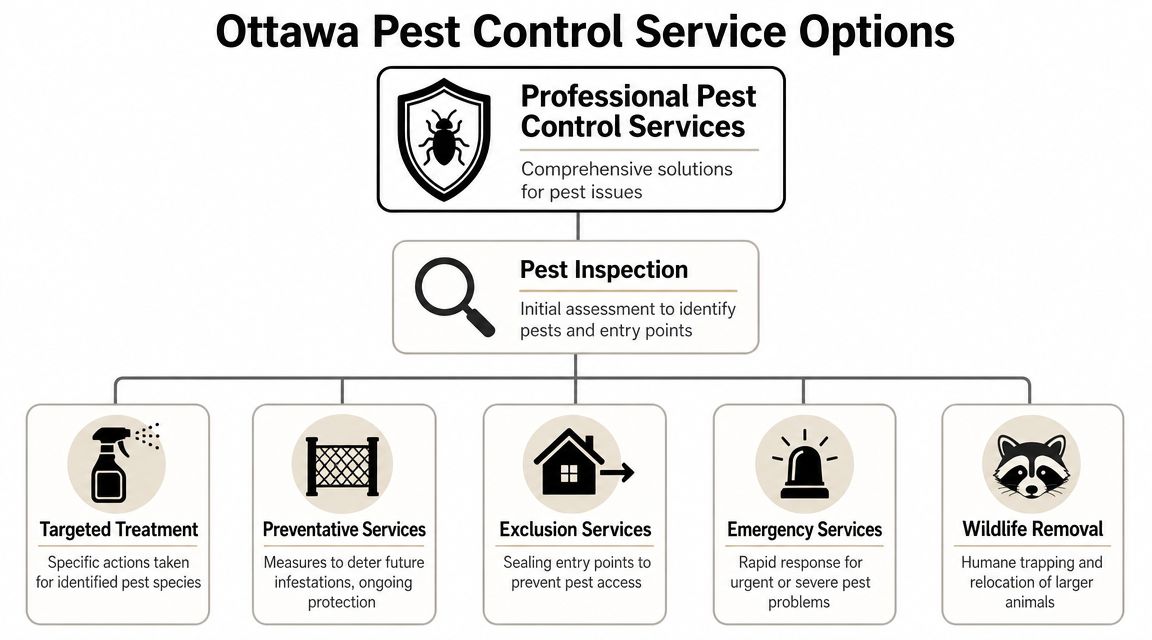
Inspection comes first
Before you compare prices, compare the inspection.
A proper inspection identifies the pest, maps where activity is happening, checks likely entry points, and looks at the conditions keeping the problem active. In practice, that means a technician should be able to tell you whether you are dealing with a one-room issue, a wall void issue, or a house-access issue. Those are very different jobs.
A useful inspection should answer:
- Which pest is active
- Where it's entering, nesting, or hiding
- What is feeding or supporting it
- Whether treatment alone will solve it, or whether repairs and sanitation changes matter too
If a provider skips that step and goes straight to a standard spray, be careful. You may get a quick drop in visible activity and still keep the nest, harbourage, or access point that caused the problem.
The main service categories
Ottawa homeowners usually end up choosing between four service types.
Targeted treatment
This is pest-specific work based on the insect or animal involved. Ant jobs often rely on baiting and precise placement rather than broad spraying. Rodent work usually combines traps, monitoring, and recommendations for sealing gaps. Bed bug work is more involved and usually includes room-by-room inspection, preparation steps, and follow-up visits because one treatment rarely fits every case.Preventative service
These plans are meant for homes that deal with recurring pressure through the year. They can be reasonable for older homes, properties near ravines or green space, and houses with repeated ant, spider, wasp, or rodent issues. The trade-off is simple. Preventative service can reduce surprise infestations, but it is only worth the cost if the provider is actually inspecting and adjusting the plan, not just showing up on a schedule.Exclusion work
This is the repair side of pest control. It includes sealing utility penetrations, screening vents, correcting door sweeps, and closing other small access points. For mice, squirrels, and many repeat invaders, exclusion often decides whether the result lasts past this month.Urgent response
Some calls should move faster. Mice in a kitchen, active wasps near an entry door, or suspected bed bugs in sleeping areas usually deserve a quicker appointment window. Fast service matters most when delay gives the pest time to spread, breed, or create a safety issue.
What eco-friendly and humane really mean
These terms get used loosely, so ask what the company will do.
In pest control, eco-friendly rarely means chemical-free. It usually means the technician uses inspection, sanitation advice, exclusion, habitat correction, and limited product placement before reaching for broad routine application. That can be a good approach, but it still may include pesticides. The better question is where the product goes, how much is used, and why that method fits the pest.
For example, an eco-conscious ant service may rely on bait placed in targeted areas so the colony carries it back, instead of coating baseboards and hoping for contact. A rodent service marketed as eco-friendly may focus first on entry-point sealing, trap placement, and food-source correction. Those are real differences homeowners can measure.
Humane wildlife control also needs a plain-language explanation. Some companies mean live removal only. Others mean removal plus one-way doors, barrier installation, and repairs so the animal cannot get back inside. Removal without exclusion often leads to the same call a few weeks later, especially with squirrels and raccoons.
A useful outside example of how Ottawa companies frame those terms appears in this discussion of eco-friendly and humane pest control positioning in Ottawa.
One practical option homeowners can compare when evaluating service styles is The Green Advantage, which provides residential and commercial pest control along with inspections and prevention-focused service.
The Professional Pest Control Process Explained
The first call feels bigger than it is. Most companies begin by asking what you've seen, where you've seen it, and how long it's been happening. That conversation helps sort urgent calls from routine ones.
The Ottawa market puts real weight on speed. Some providers advertise 24/7 or same-day service, and that matters most for pests like bed bugs or rodents because early action can interrupt breeding and keep a localized issue from spreading, as noted in HomeStars' Ottawa pest treatment listings.
A quick visual can make the process easier to picture.
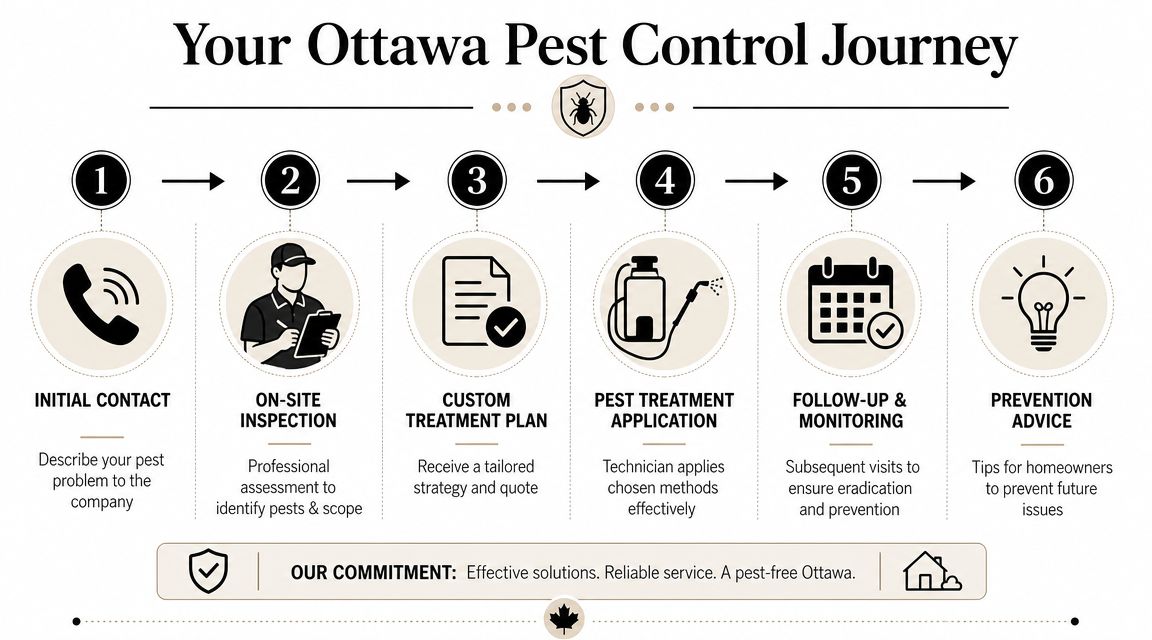
What happens from call to treatment
A typical service path looks like this:
| Stage | What you should expect |
|—|—|—|
| Initial contact | Questions about signs, timing, location, and urgency |
| Inspection | Pest identification, access-point check, scope assessment |
| Treatment plan | Clear explanation of methods, prep, and follow-up |
| Service visit | Targeted work, not mystery spraying |
| Monitoring | Recheck activity, adjust if needed, confirm control |
Some companies can inspect quickly but schedule treatment later. Others can do both in the same window, depending on the pest and the prep required. That's why “same-day service” doesn't always mean “same-day resolution.”
This walkthrough shows the same sequence in motion:
What homeowners should ask before the visit
Preparation matters. If it's bed bugs, you may need laundering, bagging, or room access steps before treatment starts. If it's rodents, the technician may need full access to the basement, attic, utility room, or garage perimeter. For cockroaches, clutter reduction and kitchen access often matter more than people expect.
The smoother the prep, the more precise the treatment. Technicians can't treat what they can't access or inspect.
Why follow-up matters
Many pests aren't solved in one visit. That's normal, not a sign the treatment failed. Rodents require monitoring and exclusion confirmation. Bed bugs often require repeat work. Cockroaches may need additional treatment once hidden activity becomes visible or eggs hatch.
The most reliable companies explain that upfront. They don't promise instant perfection. They explain the timeline, the checkpoints, and what signs tell you the program is working.
DIY Pest Prevention Tips for Ottawa Homes
Most homeowners can do more than they think before a problem starts. Prevention isn't complicated, but it does require consistency. The goal is simple. Remove food, water, and shelter, then make entry difficult.
Ottawa homes benefit from an exclusion-first approach. Sealing cracks in foundations, walls, and roofs, and trimming vegetation away from the home physically blocks pest access and removes travel routes. That approach is especially effective in Ottawa's climate, where seasonal moisture and freeze-thaw movement can widen small openings over time, as outlined by Nature's Way Pest Services on exclusion and habitat modification.
Start outside the house
Most indoor pest problems begin as outdoor access problems.
Focus on these areas:
- Foundation gaps: Seal visible cracks and utility penetrations.
- Roof and soffit lines: Check for loose sections, openings, and damaged vents.
- Vegetation contact: Trim branches and shrubs back so they don't touch siding or roof edges.
- Water buildup: Clear gutters and dump standing water from containers, trays, or low spots.
- Garbage control: Keep bins closed tightly and away from easy access points when possible.
Fix what supports pest survival indoors
Inside the home, pests are looking for calories, moisture, and quiet shelter. Small habits matter.
- Food storage: Use tightly sealed containers for dry goods and pet food.
- Kitchen cleanup: Wipe crumbs and spills quickly, especially under appliances and around the stove.
- Moisture correction: Repair plumbing leaks and reduce dampness in basements, laundry rooms, and under sinks.
- Decluttering: Reduce packed storage where rodents and insects can hide unnoticed.
- Garage discipline: Don't leave bird seed, grass seed, or pet food in easy-to-chew packaging.
For a homeowner-focused checklist, this guide to home pest control DIY is a useful companion.
Know when DIY stops being enough
Prevention is a homeowner job. Infestation control often isn't.
If you're seeing repeat signs after cleaning and sealing, or if activity is inside walls, attics, or multiple rooms, the issue usually needs inspection and a species-specific plan. DIY is strongest at prevention and early interruption. It's weaker once nesting, breeding, or hidden spread is underway.
How to Vet and Choose an Ottawa Pest Control Company
Choosing the right company often matters more than choosing the fastest ad result. Pest control ottawa providers can sound similar online, but the difference between a proper program and a temporary patch job usually shows up in the questions they ask and the process they explain.

The non-negotiables
Start with the basics. If a company can't clearly address these points, move on.
- Licensing and insurance: Confirm they're properly licensed and carry liability coverage.
- Pest-specific experience: Ask how they handle your exact pest, not pests in general.
- Inspection before treatment: A serious provider should want to identify access points and scope.
- Follow-up policy: Ask what happens if activity continues after the first visit.
- Clear preparation instructions: Good companies explain what you need to do before service.
For Ottawa landlords and property managers, compliance matters even more. Ottawa's rental housing rules under By-law No. 2020-255 require landlords to maintain an integrated pest management plan, including standing treatment plans for bedbugs, cockroaches, ants, rats, mice, and other known infestation risks. The City's guidance also outlines preventive inspection, tenant reporting procedures, and practical prevention measures like sealed food storage and regular garbage removal in its Integrated Pest Management Plan for rental housing.
The questions that reveal real expertise
Don't ask only about price. Ask how they think.
A strong shortlist question set looks like this:
- How do you confirm the pest before treatment starts
- What part of your plan is treatment, and what part is exclusion
- What prep do I need to do before you arrive
- How many follow-ups are common for this pest
- What does your eco-friendly or humane approach mean in practice
A reliable provider explains trade-offs. They won't pretend every pest can be solved with one visit or one product.
Look for structural thinking, not spray-only thinking
The best pest companies tend to think like building diagnosticians. They want to know how pests entered, where moisture is collecting, what construction detail is being exploited, and whether the issue will recur after treatment.
That's one reason homeowners often benefit from broader property maintenance habits too. If you're comparing service providers for any exterior work, this checklist on how to protect your roofing investment is a useful reminder that good contractors in any trade should welcome detailed questions, not dodge them.
If you're comparing local service styles more broadly, this page on pest control companies near me can help frame what to look for in a provider.
Protecting Your Property and Peace of Mind
Pest control is rarely just about the pest. It's about protecting wiring from chewing, insulation from contamination, food storage from exposure, and bedrooms from the stress of not knowing what's active after dark. It's also about restoring confidence in your own home.
The practical takeaway is simple. Fast action matters for the right pests, exclusion matters more than many might realize, and vague promises aren't enough. You want a provider who can identify the pest, explain why it showed up, and show you what prevents a repeat.
Homeowners can and should handle prevention basics. Seal openings, control moisture, trim exterior vegetation, and keep food and garbage secured. But once the signs become persistent, hidden, or widespread, the smartest move is a professional inspection.
If you suspect a rodent issue, recurring ant activity, bed bugs, cockroaches, or wildlife entry, don't wait for clearer proof. By the time the proof is obvious, the work is usually larger.
If you're dealing with a pest problem and want a clear next step, contact The Green Advantage to schedule an inspection or request a quote. Their team handles residential and commercial pest control with a prevention-focused approach, straightforward communication, and service suited to the conditions at your property.