
The technician has just pulled away from your Crown Point driveway. The paperwork is on the counter, the house smells different, and you're wondering whether to let the dog back in, open every window, or start cleaning. That moment is exactly when good aftercare matters.
What to expect after pest control treatment depends on what was applied, where it was applied, and what the product label requires. The Green Advantage serves Crown Point, Indiana and surrounding Northwest Indiana communities with residential pest control and commercial pest control, but responsible service doesn't end when the technician leaves. Use a two-track decision guide: follow routine aftercare when conditions are normal, and call promptly when safety symptoms or ongoing pest activity point to a problem.
The First Hours at Home After Treatment
The technician has left, but your first decision is not whether to open every window or start cleaning. Check the service record. Confirm the product name, treated areas, application method, drying instructions, and re-entry directions before anyone returns.
A targeted ant treatment, exterior perimeter spray, rodent service, and indoor fogger can require different aftercare. Treat them as two tracks: routine recovery when the instructions are clear and conditions are normal, and a prompt callback when you cannot confirm safe re-entry or someone develops symptoms.
For an exterior foundation application, people and pets may generally remain indoors, but everyone must avoid wet treated surfaces. After an indoor liquid application, keep people and animals out of the treated rooms until the product has dried and the label permits re-entry. The EPA-approved product label states that people and animals must remain out of treated areas until sprays have dried.
Use the first hour to confirm four details
- Treatment location: Record every treated room, baseboard, crack, cabinet, garage edge, and exterior band.
- Re-entry rule: Ask when adults, children, pets, and other occupants may return.
- Ventilation direction: Confirm whether windows or fans are appropriate and when you may use them.
- Callback plan: Save the contact instructions for strong odors, symptoms, unclear directions, or continued pest activity.
Do not apply another pesticide over the technician's work. Keep the invoice and service notes accessible, and keep children, pets, toys, food, and pet bowls away from restricted areas.
Practical rule: A dry floor answers only one question. Follow the product label and technician's directions, then use the callback plan when conditions do not look right.
Some insects stay visible in the days after treatment. Section 5 explains what that activity means.
Understanding Re-Entry Times and Ventilation
There is no universal “wait a few hours” rule for pest control in Crown Point, IN. Re-entry is controlled by the specific product label, the treatment method, ventilation requirements, and the people or animals returning to the space. Clemson Extension notes that some labels require occupants to wait until spray dries, some specify 24 hours, and others require a room to remain closed before it's ventilated and reused. See its pesticide application guidance for the important distinction.
The technician should tell you what was applied and when you may return. If you don't have that information, call before re-entering. Don't rely on the absence of odor, a dry-looking surface, or advice from a neighbor whose home received a different service.
Match the method to the instruction
| Treatment Type | Typical Re-Entry Window | Ventilation Needed | Common Uses |
|---|---|---|---|
| Targeted crack-and-crevice application | Until treated spray is dry and the label allows return | Only as directed by the label or technician | Ant control, spider control, localized indoor work |
| Indoor broadcast application | Label-specific, sometimes requiring a closed period before ventilation | Open doors and windows and use suitable fans when permitted | Broad indoor pest treatments |
| Exterior perimeter treatment | Stay away from wet treated surfaces | Usually not an indoor ventilation issue | Preventative pest treatments, ants, spiders, seasonal pest issues |
| Total-release fogger | Usually two to four hours, with the exact label controlling, according to EPA fogger safety guidance | Open doors and windows after the waiting period; fans can help exchange air | Space treatments and fogging |
For indoor applications, ventilation means exchanging indoor air with outdoor air. Once the label permits it and treated surfaces are dry, open suitable windows and doors, then use window, whole-house, or overhead fans as directed by EPA indoor-air guidance. Ventilation reduces airborne concentrations, but it doesn't replace the required re-entry interval.
If you're comparing indoor air advice from another source, Mesa indoor air quality offers broader information about indoor air conditions. It shouldn't override the pesticide label, but it can help explain why air exchange matters.
Foggers require extra care. Everyone, including pets, must leave the treated space after activation, doors should be closed, and ignition sources must be controlled because aerosol propellants can be flammable. Never enter early to “check the smell.”
Keeping Kids, Pets, and Food Safe
A child reaches for a toy beside a treated baseboard. A dog noses the same corner. Until the product has dried and the technician or label permits re-entry, keep both away. Children and animals explore with hands, mouths, paws, and noses, so recently treated areas need stricter control than they may appear to require. The EPA product label notes that exposure risk for children and animals decreases once liquid pesticide has dried.
Before the visit, move anything that could touch treated surfaces. After treatment, keep the following out of restricted areas:
- Children: Keep them away from wet floors, baseboards, cracks, and treated outdoor bands. Clean toys left in the application area before returning them.
- Pets: Remove dogs, cats, birds, reptiles, and other animals during the restricted period. Wash bowls before refilling them, and launder exposed bedding.
- Fish and aquariums: Ask the technician how to protect the tank. Aquariums and their occupants can be sensitive to airborne products, so follow the product-specific covering and ventilation directions.
- Food: Remove or protect uncovered food. Wash exposed dishes, utensils, and food-contact items before use.
- Pet food: Seal it away from treated areas. Keep bowls, treats, and open bags away from baseboards and cracks.
Re-entry depends on the treatment. A fogger requires everyone, including pets, to remain out until the label permits return and the space has been ventilated as directed. Crack-and-crevice work may restrict only specific locations, while exterior treatment requires avoiding wet outdoor surfaces. Follow the product label and the technician's instructions for the actual application, not a generic waiting rule.
Once ventilation is allowed, air out the room as directed. A faded smell does not prove the area is ready, and “eco-friendly pest control” does not remove the need for precautions. Every pesticide product has approved use directions.
Households with animals can use The Green Advantage's guide to safe pest control for pets to prepare questions before the visit. Ask exactly where pets may walk, sleep, eat, and drink afterward. Put toys and bowls in a clean, untreated location, protect food-contact items, and tell every adult which rooms remain restricted.
Cleaning the Right Way After a Treatment
The biggest cleaning mistake is treating every surface as if it has the same job. Counters and dining surfaces may need cleaning before food use, while treated baseboards, cracks, and perimeter bands often need to remain undisturbed so the residual product can keep working.
EPA guidance recommends avoiding wiping treated baseboards or cracks unless the technician directs you to do so, because cleaning can remove the residual treatment. It also recommends ventilating only after treated surfaces are dry. The EPA homeowner pesticide safety guide explains why label directions should control both cleaning and ventilation.
Clean by surface, not by instinct
Wipe food-preparation surfaces according to the technician's instructions before preparing meals. Wash exposed dishes, cutting boards, and utensils. Sweep or vacuum visible dead insects, but avoid dragging a wet mop along treated edges.
Leave these areas alone unless the service record says otherwise:
- Treated baseboards and floor-wall joints
- Cracks and crevices
- Areas behind or beneath appliances
- Garage perimeters and exterior treatment bands
- Bait placements or treated cabinet edges
If you need general housekeeping ideas that don't interfere with pesticide aftercare, you can find house cleaning advice for ordinary home maintenance. Still, a regular cleaning routine isn't a substitute for the technician's treatment-specific directions.
Don't hire a deep cleaner immediately and assume more scrubbing means better protection. If the technician treated a perimeter, wiping it can remove the very residue intended to intercept ants, spiders, or other insects. Ask for written cleaning instructions before you mop, move appliances, or wipe cabinet interiors.
How Long Before You Notice Results
Same-day results are the wrong benchmark for most pest services. Some insects contact treated areas quickly, while others remain hidden, emerge later, or occupy locations that take longer to reach. A dry surface also doesn't mean every pest has disappeared.
Purdue University Extension reports that after turf insecticide treatment, above-ground insects may require two to three days to die, while below-ground insects may require two to three weeks. Some biological controls may take a month or more. Those figures apply specifically to turfgrass insects, but they show why pest location and treatment type matter. See the Purdue turfgrass insect management guidance.
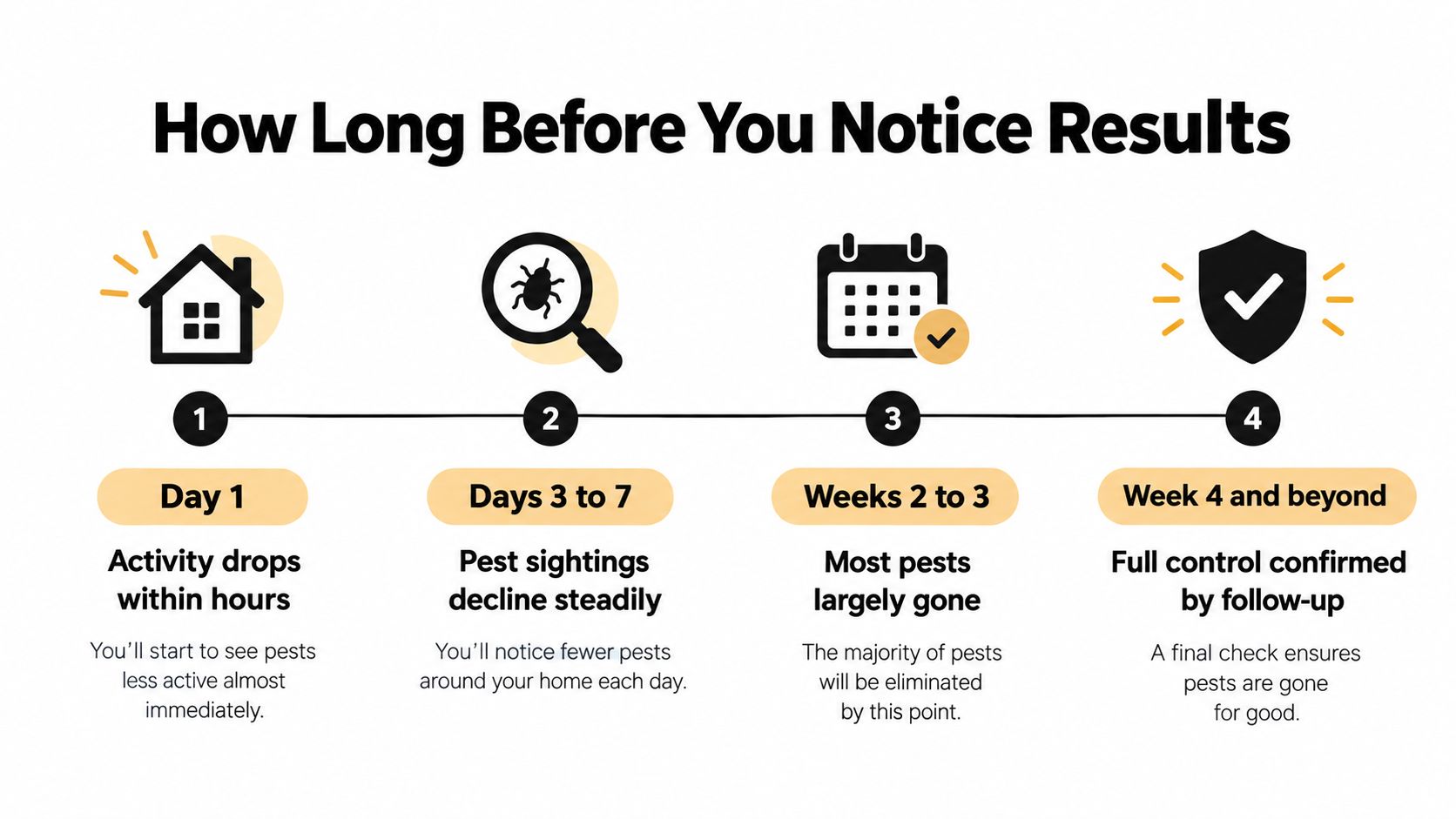
Ants may continue following established trails before the colony responds. Spiders may remain visible where webs were built. Rodent control often depends on exclusion, trap monitoring, and removal of food or shelter, not on a single application alone. Mosquito control and seasonal pest issues can also shift with outdoor conditions and new arrivals from surrounding areas.
Watch the direction of change
The useful question isn't “Did I see one pest?” It's “Is activity declining, staying flat, or spreading?” Record the date, pest type, room, and whether you saw live insects, dead insects, fresh droppings, new damage, or new trails.
After a treatment, a short burst of visible activity can occur as pests move from hidden areas. That doesn't prove failure. However, unchanged heavy activity, activity spreading into untreated rooms, or fresh evidence after the expected evaluation period deserves a technician review.
For more detail about treatment timelines, read how long pest control takes. Don't add store-bought pesticide during this period unless a qualified professional tells you to. Extra products can interfere with bait, complicate the technician's assessment, and increase exposure risk.
Normal Recovery Versus a Call-Now Situation
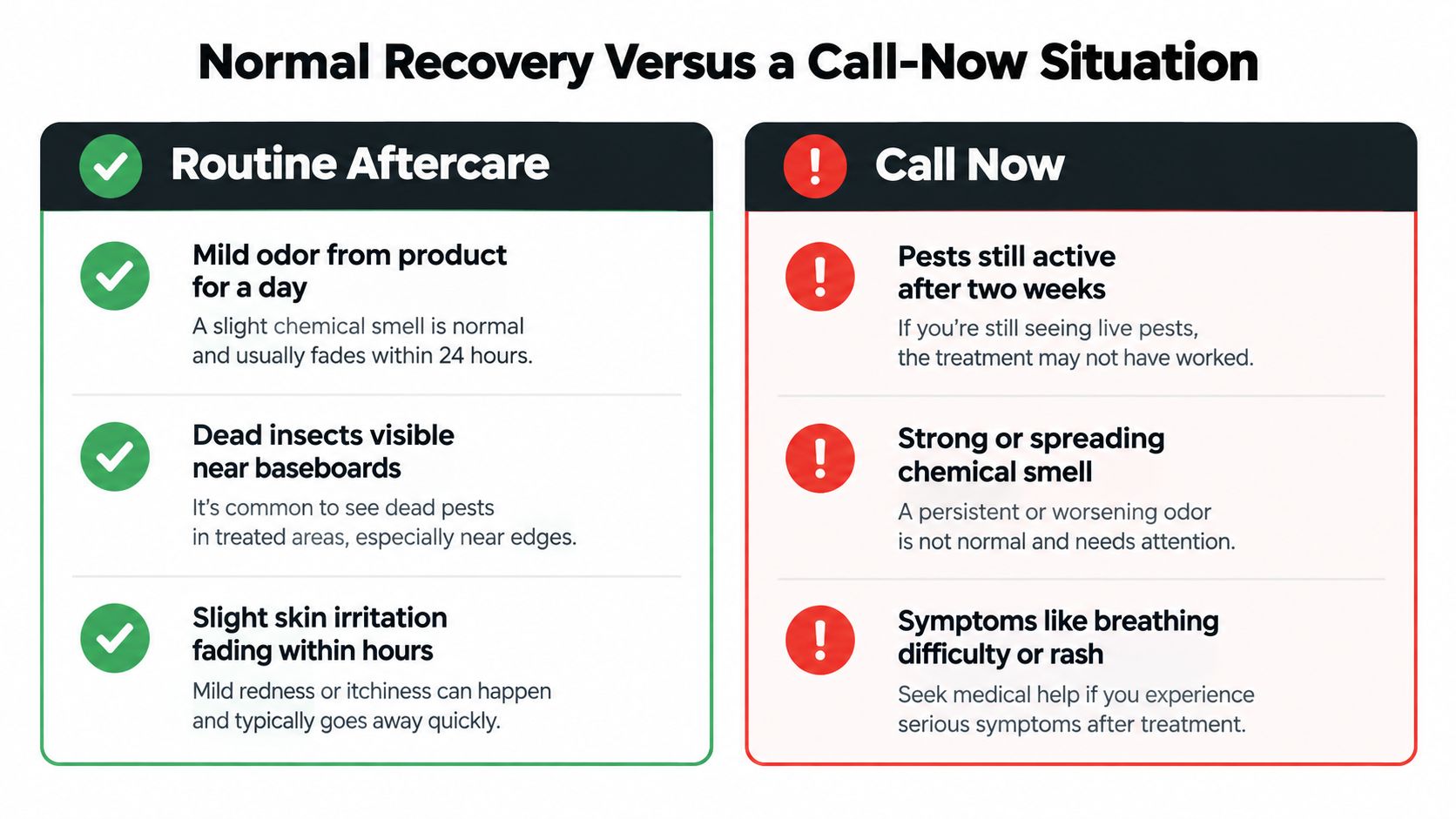
You find a few live insects after treatment and wonder whether the service failed. Use two tracks instead. Routine recovery means the home is safe to re-enter, occupants feel well, and pest activity is declining or changing as expected. A call-now situation involves symptoms, unsafe conditions, or evidence that requires a technician's review.
Routine aftercare
A mild, temporary odor can follow some applications. Dead insects near treated edges, or a few live pests emerging from hidden areas, can also be normal. Follow the product instructions, leave treated zones undisturbed, and record the pest, room, and time.
Treatment type matters. Fogging may require the specified re-entry and ventilation steps, crack-and-crevice work may leave activity at nearby edges, and exterior treatment can take time to affect pests indoors. Follow the technician's instructions rather than judging the service from one sighting.
A brief irritation that fades still deserves attention if it persists, worsens, or affects a child or animal. Do not diagnose the cause or try to neutralize pesticide with household chemicals.
Call now
Leave the treated area and contact a healthcare provider or Poison Control if anyone feels ill after exposure. The EPA-approved label recommends removing contaminated clothing, washing exposed skin with soap and warm water, and contacting Poison Control at 1-800-222-1222. EPA-approved label guidance
Breathing difficulty, seizures, loss of consciousness, severe vomiting, worsening symptoms, or serious respiratory or neurologic effects require emergency help. Do not wait for the pest company to respond.
Call the provider when live activity stays heavy, spreads into new rooms, fresh damage appears, or the agreed follow-up condition is not met. Continued sightings alone do not prove failure, but unchanged or expanding activity deserves a professional review.
When in doubt: Do not apply another pesticide. Keep the product information, note the room and time, record symptoms or pest evidence, and contact the appropriate professional.
Follow-Up Visits, Monitoring, and Warranty Coverage
A serious infestation rarely gets judged by one visit. Professional pest management uses inspection, monitoring, and adjustment. Purdue University Extension describes integrated pest management as detailed initial inspections combined with routine ongoing inspections, while Utah State University recommends checking monitoring devices every two to four weeks and recording pest identity, life stage, trap counts, and whether catches rise or fall.
Your provider should explain what happens after the initial service. Expect a written or verbal plan that identifies the next inspection, what you should monitor, what sanitation or exclusion work matters, and which conditions qualify for a retreatment or warranty visit.
What a useful follow-up plan includes
- A measurable baseline: Sightings, trap counts, droppings, damage, or other evidence that can be compared later.
- A defined review point: The technician should tell you when to report findings or schedule another inspection.
- Site-specific prevention: Recommendations may include sealing entry points, correcting moisture problems, improving food storage, or reducing outdoor harborage.
- Clear coverage terms: Ask whether the agreement includes callbacks, retreatments, inspection-only visits, or exclusions for new infestations and untreated areas.
Bed bug work shows why follow-up matters. University of Minnesota Extension reports that control in one residence can range from approximately 4 hours to repeated applications over 2 to 4 days spanning 3 weeks, depending on infestation size and treatment method. It recommends another inspection about 2 weeks after initial inspection and treatment because insecticides may not kill eggs and another treatment may be necessary if evidence returns. Review its bed bug control guidance.
Between visits, keep a simple log. Note the pest, location, time, quantity, and whether the evidence is increasing or decreasing. Share that record with the technician, and don't apply additional pesticide on your own.
Your Next Step With The Green Advantage
The practical answer to what to expect after pest control treatment is straightforward:
- Read the service record and follow the product label.
- Keep people and pets away until re-entry is permitted and treated surfaces are dry.
- Ventilate only when directed.
- Clean food-contact surfaces as instructed, but leave treated baseboards, cracks, bait, and perimeter bands alone unless told otherwise.
- Expect monitoring, not instant disappearance, and report activity that stays heavy or spreads.
- Leave immediately and seek medical or Poison Control advice if exposure symptoms become serious or persistent.
Those rules apply whether you're dealing with ant control in a Crown Point kitchen, spider control around a Northwest Indiana home, rodent control in a garage, termite concerns, mosquito reduction, or commercial pest control at a local facility. The treatment method changes, but the decision process stays the same: identify what was applied, follow the label, measure the trend, and call when the evidence demands a review.
The Green Advantage provides residential and commercial pest control, pest inspections, mosquito reduction programs, and prevention-focused service for Crown Point, IN and nearby Northwest Indiana communities. Homeowners, property managers, landlords, and local businesses can ask for a clear aftercare plan before treatment begins.
If pests are still active or you're unsure whether your home is ready for re-entry, schedule a pest inspection or request a quote from The Green Advantage. The team can assess the problem, explain the treatment and aftercare requirements, and guide you through the follow-up process for your Crown Point property.