
You open the front door in Crown Point, flip on the lights, and see what no business owner wants to see. Droppings near dry storage. A cockroach by the mop sink. A customer mention online about “something crawling near the counter.” At that point, the question isn't whether pests are annoying. The question is how much disruption you're willing to risk before you treat pest management like a real operating priority.
That's what what is commercial pest control comes down to. It isn't a one-time spray. It's a structured, documented, ongoing system that protects your building, your inventory, your staff, your customers, and your ability to stay open without ugly surprises.
For businesses in Crown Point, IN and nearby Northwest Indiana communities, that matters even more than many owners realize. Restaurants, warehouses, retail spaces, offices, and mixed-use properties all give pests what they want: warmth, shelter, food sources, water, and steady human traffic. Once pests settle in, they don't just create a maintenance problem. They create a business problem.
Protecting Your Crown Point Business from Unwanted Guests
A commercial pest problem usually starts without warning. A restaurant manager notices flies near a floor drain. A warehouse supervisor finds gnaw marks on packaging. A retail owner hears from an employee who spotted a mouse in the stockroom before opening. Nobody wants to overreact, so the first response is often to clean it up, set a trap, and hope it was isolated.
That's the wrong move.
Commercial infestations rarely stay small on their own. They spread into wall voids, storage areas, utility penetrations, break rooms, and loading zones. Then the damage expands from nuisance to reputation, compliance, and lost time. Once your staff is reacting to pests during the workday, you're already behind.
Why businesses treat pest control as an operations issue
A lot of owners still think pest control is something you call for after a visible problem. Serious operators know better. The U.S. professional pest control market was valued at approximately $24.9 billion in 2023, and the commercial sector posted a nearly 7.0% increase in service revenue in 2025 alone, outpacing residential growth, according to PestPac's pest control statistics and industry trends. Businesses are spending on commercial pest management because they've learned the hard way that waiting costs more.
A pest control company for a business isn't just there to kill pests. They're there to help prevent interruptions.
That's the practical definition I'd give any Crown Point business owner. Commercial pest control is a prevention-first service plan built around your facility, your risk points, and your inspection exposure.
What that means for Crown Point owners
If you run a restaurant, warehousing operation, storefront, healthcare office, or property portfolio in Northwest Indiana, you need more than a technician with a sprayer. You need a process that accounts for sanitation issues, structural gaps, employee habits, delivery schedules, dumpster placement, and seasonality.
That's why professional service matters. A commercial plan should help you answer questions like:
- Where are pests getting in
- Why are they staying
- What needs immediate treatment
- What needs correction so the issue doesn't return
If your current approach doesn't answer those questions, it isn't commercial pest control. It's just temporary cleanup.
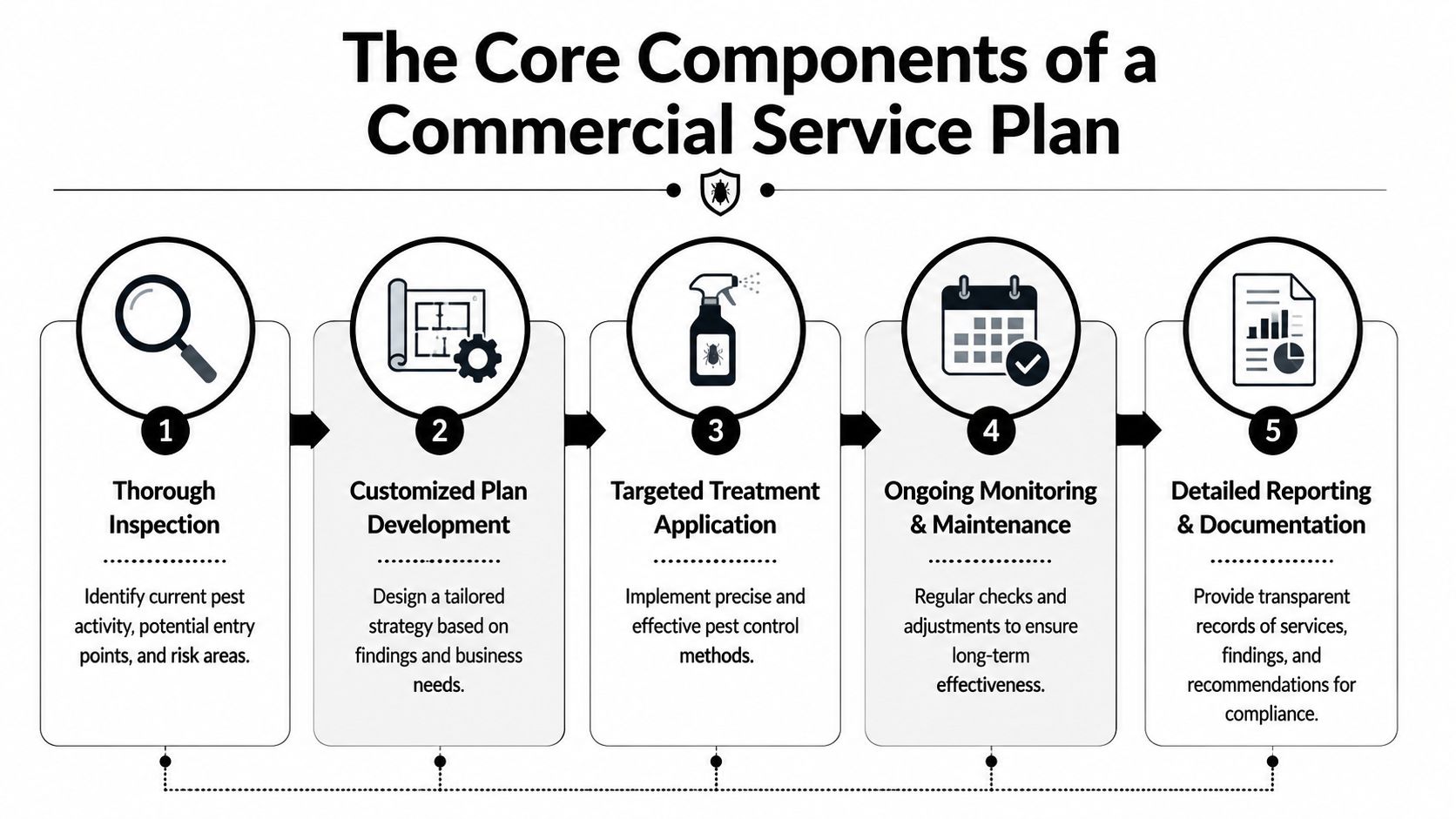
The Core Components of a Commercial Service Plan
A real commercial plan works best when it follows Integrated Pest Management, or IPM. That means prevention and monitoring come first, and treatment is applied with purpose instead of guesswork. According to the EPA, IPM can achieve up to a 70-90% reduction in pesticide usage in facilities, and sealing cracks greater than 1/4 inch wide can prevent up to 80% of rodent incursions through proactive exclusion methods, as noted in the EPA IPM guidance.
That's the standard business owners should expect. Less random spraying. More inspection, correction, and tracking.
Inspection comes first
Every strong program starts with a close look at the property. Not a quick glance. A real inspection.
A technician should check entry points, door sweeps, receiving areas, storage practices, drains, wall penetrations, utility lines, moisture issues, clutter zones, and exterior conditions. In a warehouse, that often means docks and pallet storage. In a restaurant, it usually means kitchen edges, under-equipment voids, trash zones, and floor drains.
You can't fix what nobody has identified.
Monitoring tells you what's actually happening
Monitoring matters because pests don't always show up in open view. Glue boards, rodent stations, insect monitors, and trend notes help catch activity early and show where pressure is building.
That's where a service program becomes useful instead of reactive. Patterns matter. If one side of a building keeps showing activity, you don't just keep treating it. You investigate what keeps feeding the issue.
Practical rule: If your provider can't show you where activity is happening and whether it's improving, you're paying for motion, not management.
For companies that want stronger internal systems, it also helps to understand how service documentation and scheduling support accountability. Resources on optimizing pest control business processes are useful because they show how reporting, recurring visits, and communication become part of a reliable commercial workflow.
Exclusion and sanitation do heavy lifting
Most pest problems aren't solved by product alone. They're solved by making the site harder to invade and harder to live in.
That includes:
- Sealing structural gaps so rodents and insects lose access points
- Correcting storage habits so cardboard, food residue, and spills don't become shelter
- Improving waste handling around dumpsters, liners, and pickup timing
- Addressing moisture around drains, leaks, and condensation-prone areas
If you want a practical local checklist, The Green Advantage has a helpful guide on pest prevention strategies for commercial spaces in Crown Point.
Treatment should be targeted, not broad
Once inspection and monitoring identify the problem, treatment should fit the pest and the site. Baits, dusts, crack-and-crevice applications, rodent control devices, and exterior perimeter work all have a place. Blanket treatments usually signal lazy planning.
The right question isn't “Did you spray?” It's “Did you treat the actual source and remove the conditions that let it continue?”
Ongoing service keeps you out of crisis mode
Commercial service plans work because they continue. One visit might knock down visible activity. It won't protect a business long term unless someone keeps checking the weak points, adjusting the plan, and documenting what changed.
That ongoing cycle is the difference between pest control and pest management.
How Commercial Service Differs from Residential Pest Control
A lot of business owners assume pest control is pest control. It isn't. Residential service and commercial service may use some of the same tools, but the goals are different, the documentation is different, and the consequences are very different.
If you're protecting a home, the focus is comfort and household safety. If you're protecting a business, the focus expands to operations, sanitation, customer experience, staff exposure, and audit readiness.
The stakes are higher in commercial settings
A homeowner can often schedule a visit during a normal weekday and deal with the issue privately. A business may need discreet service before opening, after closing, or around deliveries and customer traffic. A home usually doesn't need detailed service logs for third-party review. A food facility, restaurant, or managed property often does.
Commercial environments also create more pressure points. More doors open and close. More goods move in and out. More people bring in food, packaging, and clutter. More chances for pests to establish themselves without being noticed right away.
| Feature | Commercial Pest Control | Residential Pest Control |
|---|---|---|
| Treatment goal | Protect operations, brand reputation, sanitation, and compliance | Protect household comfort and property |
| Service design | Customized to business type, risk areas, hours, and workflows | Usually built around common home pest pressures |
| Documentation | Detailed records, findings, recommendations, and service history | Typically simpler visit summaries |
| Scheduling | Often discreet, flexible, and built around staff and customer traffic | Usually standard appointment windows |
| Pest pressure | Higher due to deliveries, storage, food handling, and foot traffic | Lower and more contained |
| Response standard | Built to prevent disruption and support inspections | Built to resolve household nuisance and prevent recurrence |
Why your home provider may not fit your facility
Some residential companies do excellent home work and still aren't the right fit for a commercial account. That's not an insult. It's a scope issue.
A business needs a provider who understands access restrictions, food handling sensitivity, storage flow, employee reporting, vendor entrances, and recurring risk zones. If a provider can't speak clearly about inspection records, corrective actions, or service frequency, they're probably not set up for serious commercial work.
Commercial pest service should fit the building and the business model. If it doesn't, you'll keep chasing the same problem in a different spot.
That's why business owners in Crown Point should treat commercial pest control as a specialized service category, not an add-on.
Common Pests Threatening Northwest Indiana Businesses
The pests that hit businesses in Northwest Indiana aren't random. They follow food, shelter, moisture, and access. In Crown Point, that often means activity around restaurant kitchens, warehouse loading areas, retail stockrooms, office break rooms, dumpster enclosures, and older buildings with structural gaps.
The exact pest changes by industry, but the business risk is always the same. Contamination, complaints, damage, and disruption.
Cockroaches, ants, and flies in food-facing spaces
Restaurants, cafés, convenience stores, and employee kitchens deal with constant attractants. Grease residue, crumbs, spills, drains, cardboard, and late-night moisture all create ideal conditions.
Cockroaches are especially serious because they hide well and multiply in protected spaces. Ants become a recurring headache when sanitation slips or exterior access points stay open. Flies turn small housekeeping issues into obvious customer-facing problems fast. In a dining or checkout area, one visible pest can undo a lot of hard-earned trust.
Rodents in warehouses, retail, and mixed-use properties
Warehouses and retail back rooms give rodents what they want: quiet shelter, packaging material, food residue, and convenient entry points around utility lines, dock doors, and damaged seals. Once they establish a route, they tend to keep using it.
The danger isn't just what customers see. It's what happens behind shelving, in storage, above drop ceilings, and around receiving areas. Gnawing, droppings, nesting, and product contamination create cleanup costs and operational drag that owners often underestimate.
Spiders, stinging insects, and perimeter invaders
Not every pest creates a health-code issue, but plenty still create a business problem. Spiders at entryways make a property feel neglected. Wasps near storefronts, patios, or loading areas create a safety issue for employees and visitors. Seasonal invaders can move indoors as temperatures shift, especially around foundations, cracks, and door hardware.
These pests matter because appearance matters. Customers notice what owners stop seeing.
Termites are the high-cost structural threat
Termites deserve separate attention because they aren't just unsanitary. They're destructive. Subterranean termites cause over $5 billion in annual U.S. structural damage, and commercial properties are very much part of that risk, according to this commercial termite service guide.
For business owners, the important point is practical. Structural damage doesn't stay invisible forever. It turns into repair costs, tenant complaints, renovation delays, and insurance headaches. Advanced liquid termiticides can form a protective barrier around a structure, and bait systems work over time to disrupt colony development. If your building has conditions that invite termites, waiting is a poor strategy.
Protecting Your Business Health, Safety, and Compliance
Most commercial owners call after they see pests. The smarter reason to maintain service is to protect the business before a sighting becomes an inspection issue, an employee complaint, or a customer story that spreads faster than the facts.
That's why professional pest control belongs under risk management. It supports sanitation standards, helps maintain a safer work environment, and gives you a documented response when someone asks what your company is doing to prevent pest activity.

Compliance is easier when your program is proactive
The U.S. pest control industry generated $13.416 billion in total service revenue in 2025, a 6% year-over-year increase, with the commercial segment growing faster at 7.0%. That growth reflects how pest services are tied to the operating and compliance frameworks of over 33,000 U.S. businesses, based on Statista's U.S. pest control industry overview.
That's not abstract market talk. It means businesses across the country have already accepted what some local owners still resist. Pest control is part of staying inspection-ready.
Where local businesses feel the pressure
In Crown Point and surrounding Northwest Indiana communities, commercial pest control matters most for businesses that can't afford sanitation questions or disruptions, such as:
- Restaurants and commercial kitchens where pest sightings can quickly trigger concern from customers and inspectors
- Warehouses and logistics spaces where rodents and stored-product issues can spread without notice
- Retail stores where visible pest activity damages trust fast
- Healthcare and office environments where cleanliness and employee confidence matter every day
If your business includes food handling, prep areas, or grease and drain activity, targeted prevention matters even more. For that setting, this guide to commercial kitchen pest control is worth reviewing.
If an inspector, client, or property owner asks what you're doing about pests, “we call someone when we see one” is a weak answer.
Documentation protects you
Good commercial service creates a paper trail. That matters because memories are unreliable, staff changes happen, and recurring issues need follow-up.
A serious provider should document findings, treatments, problem zones, and recommendations. That gives managers something concrete to act on. It also helps when a site has multiple decision-makers and nobody wants blame-shifting after a failed inspection or tenant complaint.
Pest control doesn't replace sanitation, maintenance, or training. It supports all three. When those functions work together, businesses stay steadier and problems stay smaller.
Choosing a Pest Control Partner in the Crown Point Area
If you're hiring for commercial pest control in Crown Point, IN, don't start with price. Start with fit. Cheap service that misses entry points, skips documentation, or treats the same recurring issue every month is expensive in all the ways that matter.
You want a provider who understands business environments in Northwest Indiana and can work within your hours, your staff routines, and your risk profile.

What to ask before you sign
A commercial provider should be able to answer basic questions plainly. If they dodge, get vague, or overpromise, move on.
Use this checklist:
- Industry experience. Ask whether they handle businesses like yours, whether that's food service, warehousing, retail, office space, or property management.
- Inspection process. Ask how they identify entry points, harborage areas, moisture issues, and repeat risk zones.
- Reporting standards. Ask what records you receive after service and how recommendations are communicated.
- Treatment approach. Ask whether they rely on broad routine applications or targeted measures tied to actual findings.
- Scheduling flexibility. Ask how they handle service around opening hours, receiving windows, and staff access.
- Follow-up expectations. Ask what happens if activity shows up between regular visits.
What eco-friendly service really means
Many businesses want greener options. That's reasonable. But “eco-friendly” means nothing if it's just a label.
According to this discussion of commercial eco-friendly pest control and IPM, true green service is rooted in Integrated Pest Management, which can reduce chemical reliance by 30-90% through sanitation, monitoring, and barriers rather than depending on harsh pesticide-heavy routines. That's the right standard for Northwest Indiana businesses that want to protect employees and customers without treating every issue like a chemical problem first.
Ask a provider what they do before they apply product. Their answer tells you whether they practice real IPM or just use the term.
One option in the Crown Point area is The Green Advantage, which offers commercial pest elimination programs, inspections, and targeted service plans for local businesses in Northwest Indiana.
Logistics matter more than owners think
Service quality depends partly on consistency. If a company struggles with dispatching and route planning, you'll feel it in missed windows, rushed visits, and uneven technician familiarity. If you want a simple look at why scheduling efficiency matters in field service businesses, understanding route optimization gives useful background.
That may sound like an internal vendor issue. It isn't. It affects your business when access windows are tight and response time matters.
Your Partnership with The Green Advantage
Working with a commercial pest provider should feel organized from the first contact. If the intake process is sloppy, the field work usually follows the same pattern.
With The Green Advantage, the process starts with a conversation about your facility, your pest concerns, and how the building operates day to day. That matters because a restaurant, warehouse, office, and retail space shouldn't be treated like the same account with a different address.
What the process should look like
A proper commercial relationship usually includes:
- Initial discussion about pest history, building use, problem areas, and scheduling needs.
- Site assessment to identify active pressure, access points, sanitation risks, and structural conditions.
- Service recommendations based on the actual property, not a generic package.
- Ongoing visits and documentation so conditions are tracked and adjusted over time.
That's the kind of process business owners should expect from any serious commercial pest company in Crown Point.
Why this matters for local business owners
You don't need a dramatic infestation to justify professional service. You need a building people use every day. That alone creates pest pressure.
If you wait for visible activity, online complaints, or inspection stress, you're already paying the price in distraction and risk. The better move is to put a structured plan in place before pests get a vote in how your business runs.
If you need commercial pest control in Crown Point, IN or nearby Northwest Indiana communities, contact The Green Advantage to schedule an inspection or request a quote. A clear service plan now is a lot easier than dealing with contamination, property damage, or an avoidable shutdown later.