
What to Plant to Get Rid of Mosquitoes in Crown Point, IN
A calm July evening in Crown Point can turn annoying in a hurry. The patio is set, dinner is coming off the grill, and then the mosquitoes find ankles, shins, and the back steps before anyone settles in.
That is usually when homeowners ask what to plant to get rid of mosquitoes. It is a smart place to start, but it helps to set expectations early. Scented plants can make seating areas, entry points, and container groupings more pleasant. On their own, though, they rarely solve an active mosquito problem across a Northwest Indiana yard.
If you are also thinking about selecting the right outdoor plants for your yard, choose varieties that fit your growing conditions and how you use the space.
The plants below are the ones we most often discuss with homeowners in Crown Point and nearby communities. We’ll cover where each one performs well, what it can realistically do, and where the limits are, especially in our short growing season and humid summer conditions. That gives you a practical DIY starting point and a clearer sense of when plantings help, when cleanup matters more, and when professional mosquito control is the better next step.
1. Citronella Grass (Cymbopogon nardus)
Citronella grass often comes to mind first when considering mosquito control plants, and for good reason. The scent is familiar, it looks great in containers, and it fits naturally around patios and deck corners.
It’s also important to separate citronella grass from the heavily marketed “mosquito plant.” A University of Guelph study found the promoted Mosquito Plant, Pelargonium citrosum ‘Van Leenii,’ had no repellent properties against Aedes aegypti, and Colorado State University Extension says popular garden plants don’t repel mosquitoes passively when grown in the yard because the oils need to be crushed or burned to be active, with no supporting data for passive repellency in the garden (Colorado State University Extension PlantTalk).
Where it makes sense in Crown Point
For Northwest Indiana homeowners, citronella grass works best as a warm-season container plant. Put it where people gather:
- Patio corners: Frame a sitting area with matching pots.
- Entry points: Place containers near back doors, garage man doors, or pool gates.
- Outdoor dining areas: Keep it close enough that brushing past the foliage releases scent.
This isn’t a set-it-and-forget-it plant in our climate. Crown Point winters are too cold for it to stay outside year-round, so most homeowners either treat it as seasonal or move containers indoors before frost.
Practical rule: Use citronella grass to support comfort in small-use areas, not as your entire mosquito control plan.
How to get the most from it
Citronella grass likes heat, sun, and regular watering with decent drainage. If the soil stays soggy, it struggles. If the pot is too small, it dries out fast in July.
A few homeowner-friendly ways to use it well:
- Choose a movable pot: A container lets you shift it closer to where mosquitoes are bothering you most.
- Group it with seating: A plant twenty feet away won’t help much at the table.
- Disturb the foliage lightly: The scent is more noticeable when leaves are brushed.
In real yards around Crown Point, citronella grass is best thought of as a patio companion plant. It adds atmosphere and supports a layered outdoor setup. If your property has shade, standing water, dense foliage, or a low area that stays damp after storms, this plant alone won’t keep mosquitoes from breeding nearby. That’s where residential pest control and a true mosquito reduction program make the difference.
2. Lavender (Lavandula angustifolia)

Lavender earns its spot because it’s one of the better-looking, longer-lasting options for Northwest Indiana gardens. Unlike tropical choices that need babysitting, English lavender can fit into a real Crown Point planting plan if you give it the right drainage and sun.
Homeowners like it because it does double duty. It looks clean, smells great, and softens the edges of patios, walkways, and mailbox beds.
Why homeowners keep choosing it
Lavender contains oils associated with insect deterrence, but the honest version is this: planting it alone won’t create a mosquito-free yard. University of Florida IFAS experts noted in 2025 that plants such as eucalyptus, citronella, mint, basil, lavender, and marigolds contain deterring oils, but those oils must be extracted and applied as concentrated sprays for real efficacy. Planting them in the garden offers negligible protection on its own.
That doesn’t make lavender useless. It makes it a support plant.
Use it where you want a tidy, dry, sunny border near places people linger. Around a patio slab or along a front walk, lavender brings scent and structure without looking like a gimmick.
If you want more detail on scent-based deterrence, The Green Advantage has a helpful guide on what scent repels mosquitoes.
Best use around patios and walkways
Lavender usually performs better in raised beds, berms, or containers than in heavy, wet soil. In Crown Point, that matters. Many yards hold moisture longer than people expect.
A good setup looks like this:
- Raised planting zones: Better drainage usually means better survival.
- Clusters instead of singles: A grouped look is stronger visually and more useful near seating.
- Sunny placement: Lavender won’t reward a shady side yard.
Lavender is a good landscaping choice first, and a mosquito-support plant second. That’s exactly why it lasts in real yards.
For upkeep, prune lightly in spring, remove spent blooms if you want a tidier look, and avoid overwatering. If you’re new to growing it, this guide on how to take care of lavender covers the basics well.
Lavender also fits commercial pest control properties that want an attractive entrance bed or outdoor seating border without constantly replanting annuals. Restaurants, offices, and managed residential properties in Northwest Indiana often benefit from that mix of appearance and function. Just don’t expect the fragrance alone to solve a heavy mosquito issue hiding in shrubs, gutters, or wet low spots.
3. Basil (Ocimum basilicum)
Basil is one of the most practical plants on this list because people use it. It belongs on outdoor dining tables, near grill stations, and in sunny container gardens where fresh herbs are already part of summer life.
That usefulness matters. If a plant is going to be part of your mosquito strategy, it helps if you’ll keep it healthy.
Best for decks, porches, and outdoor dining
Basil performs well in pots and window boxes through the Crown Point growing season. It likes warmth, direct sun, and steady watering. If you’re planting near a back patio, a few full pots of basil make more sense than scattering a single plant across the yard and hoping for the best.
It’s especially handy in these spots:
- Near a grill or outdoor kitchen: Easy to harvest while cooking.
- On a deck railing or table-height planter: Keeps the aroma close to where people sit.
- At a sunny apartment or condo patio: Good for smaller outdoor spaces.
This is still a seasonal annual for most homeowners in Northwest Indiana. If you let it flower too soon, leaf growth slows, and the plant gets leggy. Pinching off flower buds keeps it fuller and more useful.
What it can and can’t do
Basil is often listed as a mosquito-repelling plant, and it does contain aromatic compounds people associate with insect deterrence. But the same problem shows up here as with other herbs. The plant itself isn’t a substitute for real mosquito management.
Consumer Reports has echoed that marigolds, catnip, and chrysanthemums contain phytochemicals that help prevent insect feeding, but they aren’t enough for yard-wide mosquito control without added measures. Basil falls into the same practical category in most home gardens. Helpful around activity zones, not enough by itself for the whole property.
That’s why we often tell homeowners to think small and intentional. Put basil where people gather, and let professional mosquito control handle the broader pressure coming from breeding sites and resting areas.
A simple patio setup can work well:
- Use multiple pots: One plant gets lost. A group feels intentional.
- Harvest often: Regular trimming keeps plants bushier.
- Keep leaves dry when watering: Basil can struggle in humid conditions if foliage stays wet.
For a family in Crown Point, a row of basil near a dining set can make the space more pleasant and more useful. But if mosquitoes rise out of the back fence line every evening, it’s time to think beyond herbs and call for an inspection.
4. Marigolds (Tagetes species)

By late July in Crown Point, a lot of patios need two things at once. More color and fewer mosquitoes around the chairs. Marigolds are one of the easiest annuals to add for the first job, and they can support the second in a limited, realistic way.
That balance matters.
Marigolds have a strong scent, long bloom season, and very few demands beyond sun, decent drainage, and regular deadheading. For Northwest Indiana homeowners who want fast summer impact, they make sense in porch pots, along a walk, or tucked into the edge of a patio bed where people sit.
They also get oversold.
Research on marigolds usually looks at concentrated plant extracts, not a few bedding plants from the garden center. In practice, I treat marigolds as a helpful companion plant near activity zones, not as a yard-wide mosquito answer. If your property has clogged gutters, shaded holding water, or a damp fence line, flowers alone will not change the pressure much.
Where marigolds fit best in a Crown Point yard
Marigolds earn their space because they are easy to place and easy to maintain through our summer season. French marigolds usually stay compact and behave well in containers. Taller African types have more presence in beds, but they can look coarse if the planting area is small or the irrigation keeps the soil too wet.
Good spots include:
- Containers by seating areas: Better use of their scent and color where people gather.
- Along patio edges or steps: Simple seasonal definition without a lot of upkeep.
- Near vegetable gardens: A practical choice for homeowners already planting annuals for summer use.
If you want more planting ideas with realistic expectations about mosquito reduction, The Green Advantage breaks that down in this guide to mosquito-repelling plants.
Practical care tips
Full sun keeps marigolds compact and blooming. In heavy or soggy soil, they fade fast, especially in stretches of Indiana humidity. Deadheading helps, and so does giving them enough spacing for airflow instead of packing them too tightly into a bed.
For homeowners, the best use is concentrated placement. A few grouped pots near a back door or dining area do more than scattering isolated plants across the property.
For commercial properties in Northwest Indiana, marigolds are often worth using around entrances and outdoor seating because they stay cheerful and low maintenance through much of the season. The trade-off is simple. They improve the look of the space and may help a little at close range, but they do not replace treatment when mosquito activity is being driven by breeding sites and shaded resting areas nearby.
5. Rosemary (Rosmarinus officinalis)
A lot of Crown Point homeowners want a mosquito-repelling plant that also looks tidy by the patio and earns a place in the kitchen. Rosemary checks those boxes better than most.
It has a clean, upright habit, a strong scent when touched, and enough structure to work with formal entry pots or more casual deck containers. In our area, that last point matters. Rosemary usually performs better as a seasonal container plant than as a reliable in-ground shrub, especially after a Northwest Indiana winter.
Best used where people actually spend time
Rosemary makes the most sense near outdoor living areas, where its fragrance gets released as people brush past it, trim it, or clip a few stems for cooking. Passive scent in the middle of the yard is not the best use.
Good placements include:
- By a back door: Easy to clip for the kitchen and easy to notice if the soil stays too wet.
- Near a grill or outdoor kitchen: Practical, attractive, and close to where people gather.
- In larger pots on a patio: Better root control and better drainage than heavy garden soil usually gives.
I usually steer people away from forcing rosemary into dense clay or low spots. That is where it declines fast. If the site stays damp after a rain, use a container and a fast-draining mix instead.
Useful plant, limited mosquito impact on its own
Rosemary offers value in a mosquito-conscious planting plan, but its practical impact is local and close-range. The aromatic oils are strongest when the foliage is handled, so it works better around seating, doors, and cooking areas than as a broad property solution.
That trade-off is important. Homeowners often like rosemary because it looks more polished than some loose-growing herbs, but appearance and plant chemistry are not the same as active mosquito control across the yard. If mosquitoes are coming from standing water, neighboring drainage, or shaded brushy edges, rosemary will not offset that pressure.
A better approach is to use it as one piece of the setup. Keep it healthy, place it near activity zones, and pair it with the basics that reduce mosquito numbers, such as removing water-holding containers, improving airflow, and addressing heavy resting cover.
Care that fits Crown Point conditions
Rosemary wants full sun and sharp drainage. Overwatering is the failure point I see most often.
A few practical tips help:
- Use a pot with strong drainage: Decorative containers are fine if water can escape freely.
- Water thoroughly, then let the top layer dry: Constantly damp soil causes more trouble than brief dryness.
- Bring it indoors before frost: Rosemary can hang on in a bright window, but it should come in before cold weather settles in.
For commercial properties, rosemary works well in planters near entrances and outdoor dining spaces because it stays neat and looks intentional. The limit is the same for businesses as it is for homeowners. It can support a better outdoor environment, but it does not solve breeding sites or mosquito harborage. When activity stays high around a Crown Point property, professional treatment is the step that addresses the source of the problem.
6. Lemongrass (Cymbopogon citratus)
Late July in Crown Point is when this plant makes sense. The patio is hot, containers are growing fast, and homeowners want something that looks substantial instead of another small herb disappearing in the border.
Lemongrass earns its spot because it does two jobs well. It gives a planter real size and movement, and its citrusy foliage fits the conversation around mosquito-repellent plants. The trade-off is simple. What helps most in research is the concentrated oil, not the untouched plant sitting ten feet away.
That distinction matters in real yards. A healthy clump by a seating area can add some practical value, especially where people brush past it and release more scent. It does not create a protective bubble over the whole property, and it will not keep up with mosquito pressure coming from wet areas, dense shade, or nearby standing water.
For Northwest Indiana, I usually treat lemongrass as a seasonal container plant instead of a permanent garden plant. It likes heat, sun, and steady summer growth. It does not like our winter.
Here’s a quick visual if you’re considering lemongrass for containers:
Where it works best
Placement makes the difference between a plant that looks good and one that contributes something near outdoor living spaces.
- Large pots near patios and seating areas: Best use for both appearance and scent release.
- Poolside corners with full sun: Adds height and a clean summer look without feeling heavy.
- Along walkways or near steps: Brushing the leaves releases fragrance more than leaving it untouched in the back yard.
- Outdoor kitchens or dining areas: Works well where you want a softer screen and a more finished planter design.
A full, well-placed pot of lemongrass near the patio is useful. A small plant tucked into a distant bed is mostly decorative.
Give it rich soil, regular water, and room for the roots to expand. In containers, it dries out faster than homeowners expect during hot stretches, especially in black or dark decorative pots. Feeding it through active growth helps keep the stalks thick and the foliage dense.
For Crown Point properties, that polished look is part of the appeal. Lemongrass can make a deck, pool terrace, or front entry planter feel finished by midseason. It is one of the better choices on this list if you want mosquito-conscious planting that also reads as intentional garden design.
Still, good planting only handles part of the problem. If mosquitoes are breeding off-site or resting in heavy cover around the property, lemongrass will not reduce populations on its own. The Green Advantage’s mosquito reduction services work best alongside steps like this, especially for yards near drainage areas, wooded edges, or persistent summer moisture.
7. Catnip (Nepeta cataria)

By late July in Crown Point, this is the kind of plant homeowners ask about after a few rough evenings on the patio. Catnip is hardy, easy to grow, and often mentioned in mosquito research because of nepetalactone, the compound that gives the plant its distinctive effect on cats and its interest in repellency studies.
It also comes with a practical trade-off. Cats may roll in it, chew it down, or flatten it if you place it right beside a seating area.
Catnip earns its spot on this list because it handles Northwest Indiana conditions far better than tropical herbs that need to be replaced every year. In many local gardens, it comes back reliably, fills in fast, and works well in informal herb beds, pollinator plantings, or mixed borders where a slightly loose habit does not look out of place.
Placement matters more than people expect. I would not use catnip as a polished focal plant near a formal front entry unless it is kept trimmed and contained. It performs better where a little spread is acceptable and where you can manage the plant without fighting it all season.
A few setups work especially well:
- Containers near patios: Easier to control, easier to move, and less likely to spread through nearby beds.
- Raised beds with edging: Good for homeowners who want perennial herbs without letting them wander.
- Outer edges of gathering spaces: Close enough to include in a mosquito-conscious planting plan, far enough away that visiting cats are less of a nuisance.
Research interest around catnip is real. Iowa State University Extension notes that nepetalactone has shown mosquito-repelling potential in laboratory work: https://yardandgarden.extension.iastate.edu/faq/what-nepetalactone
That does not mean a catnip plant in the ground will protect a whole back yard. In practice, the gap between a live plant and a tested extract matters. Homeowners in Crown Point should treat catnip as a supporting plant, not a stand-alone answer.
That is the right expectation for most yards.
Catnip makes sense if you want a hardy perennial herb, a useful filler for a pollinator-friendly bed, or a low-cost plant to add around outdoor living areas. It makes less sense if you want a tight, formal look or if neighborhood cats already treat your garden like a second home.
For mosquito reduction, I put it in the helpful but limited category. Use it as one layer. Then handle standing water, cut back dense resting cover, and get professional help when mosquitoes are breeding off-site or pressure stays high through Crown Point’s humid summer stretches.
8. Scented Geraniums (Pelargonium graveolens and related species)
Scented geraniums are often sold with a promise. Rub the leaves, smell the fragrance, and it’s easy to believe they’ll solve your mosquito problem.
They are attractive plants. They’re also one of the best examples of why homeowners need realistic advice.
The plant is pleasant. The myth is bigger than the result
Scented geraniums grow well in containers, look charming on patios, and release fragrance when touched. Lemon-scented types are especially popular in garden centers because they sound like a natural mosquito answer.
But the research record has pushed back on the marketing around these plants. The University of Guelph study mentioned earlier found that the marketed Mosquito Plant had no repellent properties against Aedes aegypti. That distinction matters because many homeowners buy these plants expecting passive protection just from having them nearby.
That’s not the same as saying all geranium-related extracts are useless. In the controlled Aedes aegypti experiment already noted, citrosa extract at 17% provided 4:37 of protection, again showing that concentrated plant extracts can behave very differently from an intact potted plant.
How to use scented geraniums without overexpecting
If you like them, plant them. They’re excellent seasonal container plants for Crown Point porches, decks, and sunny seating areas. Just don’t treat them like a substitute for mosquito service.
They work well in these scenarios:
- Decorative porch pots: Fragrant and easy to move.
- Outdoor coffee or bistro areas: Pleasant to brush past.
- Mixed herb containers: Nice texture alongside basil or rosemary.
For care, give them sun, avoid overwatering, and pinch growth tips to keep them fuller. Most homeowners in Northwest Indiana either bring them indoors before frost or replace them seasonally.
This is one of those plants that can still be worth planting even after the myth is stripped away. Why? Because a useful outdoor area doesn’t have to be based on fantasy. Scented geraniums bring fragrance, texture, and seasonal color to the places where people spend time.
For homeowners searching “pest control near me” or “exterminator near me” after trying every plant trick online, this is usually the turning point. Once you realize the plant looks good but the bites keep coming, it’s time for a professional plan that targets where mosquitoes breed and rest, not just where you’d like them to stay away.
8 Mosquito-Repellent Plants Compared
A Crown Point yard usually needs two things at once in mosquito season. You want plants that fit the way you use the space, and you want realistic expectations about what those plants can and cannot do.
This comparison is the practical version. Some of these plants make more sense in deck pots than in long-term garden design. Some smell strong enough to notice only when you brush past them. A few are worthwhile mostly because they look good, cook well, or handle our Northwest Indiana growing season without much fuss.
| Plant | Implementation complexity | Resource requirements | Expected outcomes (mosquito reduction) | Ideal use cases | Key advantages |
|---|---|---|---|---|---|
| Citronella Grass (Cymbopogon nardus) | Moderate, usually best in containers and moved indoors before cold weather | Full sun, regular moisture, containers, winter storage | Helpful close to seating when foliage is nearby and conditions are calm | Patios, deck corners, entry areas, movable planters | Strong scent, bold texture, good container presence |
| Lavender (Lavandula angustifolia) | Low to moderate, perennial with pruning and good siting | Well-drained soil, full sun, lighter watering, seasonal pruning | Mild background benefit, more dependable as a durable ornamental than as mosquito control | Borders, perennial beds, long-term garden design | Hardy, attractive blooms, pollinator friendly |
| Basil (Ocimum basilicum) | Low, quick annual for pots or beds | Warm weather, steady watering, replanting each year | Best around close-use spaces where leaves get handled and plants stay lush | Kitchen gardens, dining patios, window boxes | Edible, fast-growing, easy to replace |
| Marigolds (Tagetes species) | Low, simple from seed or transplant | Full sun, regular watering, deadheading | Light supporting role, especially as part of mixed seasonal plantings | Bed edges, mass color plantings, beginner gardens | Affordable, long bloom period, easy seasonal color |
| Rosemary (Rosmarinus officinalis) | Moderate, often easier in containers here because winter is the issue | Full sun, sharp drainage, larger pots, indoor winter protection | Useful near patios when healthy and mature, but usually limited by climate in Northwest Indiana | Patio pots, herb groupings, courtyard containers | Fragrant foliage, culinary use, drought tolerance once established |
| Lemongrass (Cymbopogon citratus) | Moderate, tropical habit means container growing works best locally | Large containers, full sun, regular moisture, feeding during active growth | Strong fragrance nearby, especially in warm weather and protected seating areas | Container patios, outdoor kitchens, specialty herb plantings | Big seasonal growth, culinary use, noticeable scent |
| Catnip (Nepeta cataria) | Low to moderate, hardy but needs control so it does not wander | Containment, raised beds or managed edges, sun to part shade, modest watering | One of the more promising plant options, though still not a standalone fix | Contained beds, utility areas, low-care plantings | Tough perennial, aromatic foliage, easy to grow |
| Scented Geraniums (Pelargonium graveolens and related species) | Moderate, seasonal container plant for this region | Containers, bright light, pruning, occasional feeding, winter protection if kept | Best treated as a pleasant patio plant with limited mosquito value | Porch pots, balconies, seating areas, mixed containers | Fragrant leaves, flexible container use, ornamental appeal |
A few local takeaways matter more than the plant list itself.
For Crown Point properties, container placement often beats in-ground planting for mosquito-related use. Pots let you position aromatic plants where people sit, eat, and enter the house. That matters more than scattering them across the yard and hoping the scent carries.
Perennials also come with trade-offs here. Lavender and catnip can return well with the right placement, while rosemary, citronella grass, lemongrass, and scented geraniums usually make more sense as seasonal or overwintered container plants in Northwest Indiana. If a plant struggles in our conditions, its mosquito value drops fast because stressed plants do not give you much growth, fragrance, or coverage.
If I were advising a homeowner who wants the best effort-to-payoff ratio, I would usually start with basil near dining areas, lavender in sunny well-drained beds, lemongrass or citronella grass in large patio containers, and catnip only where spread is easy to control. That mix gives you useful placement, decent seasonal performance, and plants you may still enjoy even on a buggy summer.
The main point is simple. Choose plants for the space, the season, and the way your family uses the yard. Then judge them as support tools, not as the whole mosquito plan.
When Plants Aren't Enough: Professional Mosquito Control in Crown Point
The best thing these plants do is improve the edges of your mosquito strategy. They make patios more pleasant. They help you build useful container groupings around decks, doors, and seating areas. They support a more thoughtful outdoor environment.
What they don't do, by themselves, is eliminate the conditions that keep mosquito populations active around your property.
That’s the part many generic gardening articles leave out. Mosquitoes don’t care how nice the planters look if there’s standing water in clogged gutters, low spots near the fence, wet tarps, neglected birdbaths, or dense shaded foliage where they can rest during the day. A homeowner can plant basil, lavender, citronella grass, marigolds, rosemary, lemongrass, catnip, and scented geraniums and still get bitten every evening if the source of the problem is somewhere else on the property.
That’s especially true in Crown Point and nearby Northwest Indiana communities where summer moisture, shade, drainage issues, and neighboring lots all affect mosquito pressure. One yard can be maintained well and still deal with mosquitoes drifting in from nearby breeding sites.
Professional mosquito control offers a different approach.
At The Green Advantage, we approach mosquito reduction the way it should be handled. Start with the property itself. Identify where mosquitoes are breeding, where they’re sheltering, and where people use the yard. Then build a treatment plan around those realities. That may include inspections for standing water sources, guidance on correcting conducive conditions, and targeted applications to outdoor areas where adult mosquitoes rest.
For homeowners, that means a more dependable result than relying on plant folklore alone. For property managers and businesses, it means outdoor spaces that are more usable for tenants, customers, staff, and guests. If you manage a restaurant patio, office entry, multi-family property, or event space in Northwest Indiana, mosquito pressure affects comfort and first impressions fast. Commercial pest control needs to account for that.
Plants still have a role. We encourage homeowners to keep using them strategically. A few containers of rosemary or basil near a dining area, lavender in a sunny border, or lemongrass flanking a patio can all support the overall experience of the space. They just work best when they’re paired with actual mosquito management.
That full-picture approach also fits homeowners who are looking for broader residential pest control in Crown Point, IN. Mosquitoes are often only one part of the outdoor pest picture. The same property may also need help with ants around the patio, wasps near rooflines, spiders around entry lights, or rodent activity near sheds and fences. Working with one trusted local team makes that simpler.
If you’ve been searching for pest control in Crown Point, IN because your yard is no longer enjoyable, it’s worth getting an expert assessment instead of spending another season guessing. The Green Advantage provides environmentally mindful mosquito reduction services built around local conditions, real property use, and practical expectations. We’ll tell you what’s helping, what isn’t, and what needs to be addressed so you can use your yard again.
You don’t have to choose between a beautiful outdoor space and effective pest management. The right combination gives you both. Plant smart. Reduce breeding areas. And when mosquitoes keep winning, bring in a local Crown Point exterminator who can solve the actual problem.
If you're ready to enjoy your yard without planning your evenings around mosquito bites, contact The Green Advantage for a free inspection or quote. We help homeowners and businesses in Crown Point and across Northwest Indiana with mosquito control, residential pest control, commercial pest control, and practical prevention plans that are effective.
Expert Pest Control in Crown Point, IN: Does Lavender Oil Repel Mosquitoes?

As a Crown Point homeowner, enjoying a summer evening outdoors can quickly turn into a battle against buzzing, biting mosquitoes. You might wonder, does a natural remedy like lavender oil actually repel these pests? The short answer is yes, it can provide some personal protection, but it's not a whole-yard solution. For lasting relief from mosquito infestations in Northwest Indiana, a professional pest control strategy is essential.
At The Green Advantage, we help families across Crown Point, IN, reclaim their backyards. While lavender oil has its place, understanding its limitations is key to keeping your property comfortable and safe all season long.
How Lavender Oil Works as a Mosquito Repellent
Many homeowners in Crown Point prefer natural pest solutions, and lavender oil is a popular choice. Its repellent power comes from a compound called linalool, which confuses a mosquito's senses, making it harder for them to find you. Essentially, it masks the carbon dioxide you exhale, which is what mosquitoes use to track their targets.
However, its effectiveness varies dramatically depending on where you use it. For those humid Northwest Indiana evenings, the difference between indoor and outdoor use is significant.
This infographic breaks down the scientific findings.
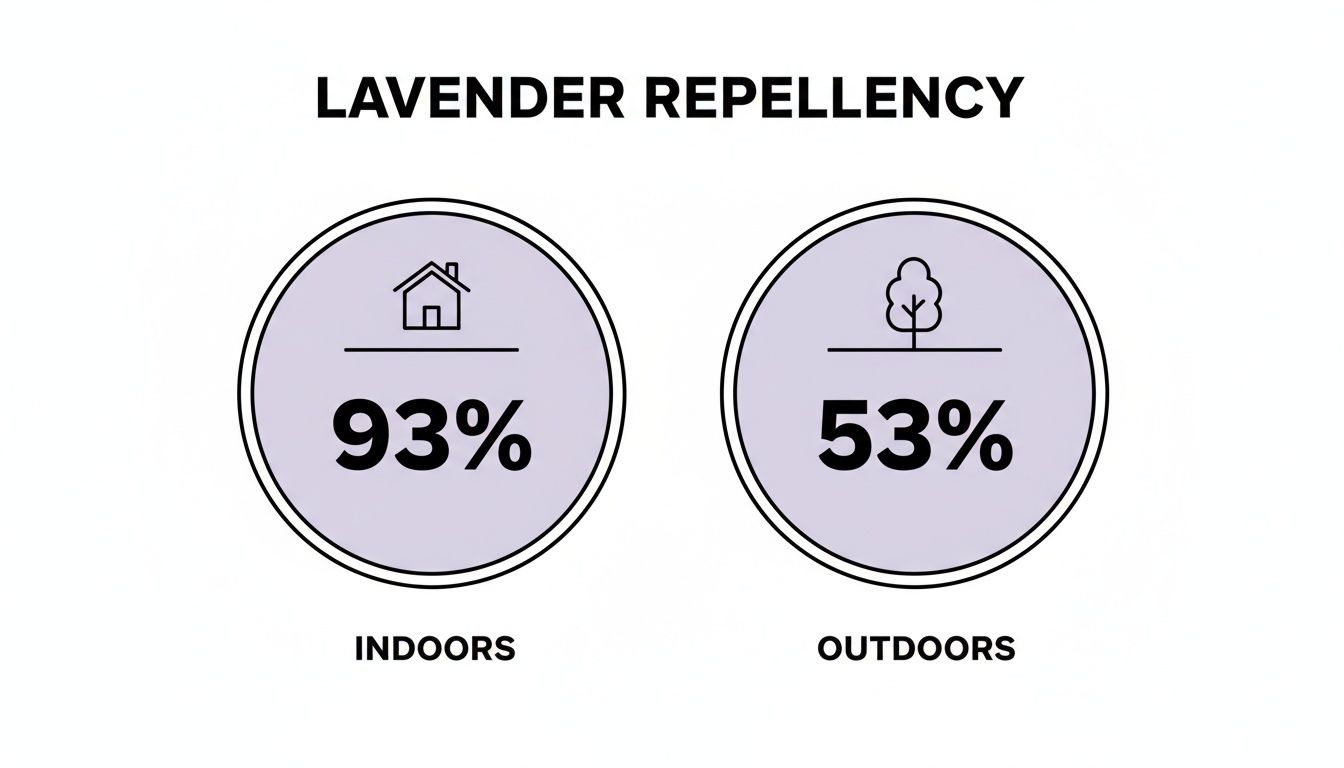
As you can see, lavender oil is highly effective indoors but loses nearly half its potency outdoors where elements like wind and humidity interfere.
The Science Behind the Scent
How does a pleasant floral scent deter pests? Lavender oil works by creating a "scent smokescreen" that makes you effectively invisible to mosquitoes.
When a mosquito is hunting for a meal, it’s following the trail of carbon dioxide you exhale. The powerful aroma of linalool in lavender creates a kind of "scent smokescreen," making it nearly impossible for the mosquito to zero in on its target. It's like you've suddenly become invisible to them.
Lab studies confirm this. Indoors, lavender oil showed an impressive 93% repellency rate. However, when tested outdoors, its effectiveness dropped to 53%. For a Crown Point homeowner, this means wind and open air can quickly dilute the scent, reducing its protective power. You can read more about the research behind lavender oil's effectiveness and its implications for outdoor use.
To see what you can expect, here is a simple breakdown of the research.
Lavender Oil Mosquito Repellency at a Glance
| Setting | Reported Repellency Rate | Effective Duration | Best Use Case |
|---|---|---|---|
| Indoors | Up to 93% | Several hours | Diffusing in a room or applying to skin before bed. |
| Outdoors | Around 53% | Short-term (reapply often) | Personal protection on a calm evening with little wind. |
This table shows that while lavender is a useful tool for personal protection, it's just one part of a comprehensive pest control strategy.
For homeowners interested in other natural deterrents, our guide on what scents repel mosquitoes offers more options. However, for complete backyard protection against mosquito swarms, a professional service from a trusted exterminator in Crown Point, IN, like The Green Advantage, is the most effective solution.
How Lavender Overwhelms a Mosquito's Senses

To understand why lavender oil is a useful tool for homeowners in Crown Point, it helps to know how mosquitoes find us. These pests are sophisticated hunters that use carbon dioxide, body heat, and skin chemicals to locate their next meal.
The secret to lavender oil's power is its primary compound, linalool. This natural alcohol, abundant in lavender, produces a strong scent that is overwhelming and confusing for mosquitoes. It's like trying to hear a whisper at a rock concert—the powerful aroma of linalool jams their delicate scent receptors, making it almost impossible for them to find you.
Creating a Protective Scent Barrier
At its core, lavender oil works by masking the very smells that attract mosquitoes. When you apply diluted lavender oil to your skin or use a diffuser, you create a personal bubble of fragrance that mosquitoes find disorienting. Instead of targeting you, the confused mosquito will typically move on to find an easier meal. This is what makes lavender oil a true repellent—it doesn't kill them, it simply encourages them to stay away by creating a scent barrier.
The Science Backing It Up
This isn't just folklore; research has demonstrated lavender's ability to fend off mosquitoes in controlled settings. One key study highlighted how different concentrations of lavender oil affected mosquito behavior.
In the lab, researchers counted 43 mosquito landings on the untreated surfaces in just ten minutes. But on the surfaces treated with lavender oil—even at 25%, 50%, and 100% concentrations—there were zero landings. That’s a perfect 100% repellency rate, which speaks volumes about the oil's deterrent effect.
This powerful result shows how effectively lavender's scent can stop a mosquito. You can explore the full study and its findings on lavender's repellency for a closer look. It’s this effectiveness that leads many Crown Point families to use natural options for personal protection.
Key Compounds That Drive Mosquitoes Away
While linalool is the star player, lavender oil contains other compounds that contribute to its repellent properties.
- Linalyl Acetate: Adds to the sweet, floral scent and enhances the repellent profile.
- Camphor: Known for its strong odor, camphor adds another layer to the protective barrier.
- Eucalyptol: This compound has well-documented insect-repelling properties that boost lavender's overall effectiveness.
For us here in Northwest Indiana, this science explains why lavender can be a good first line of defense. However, its reliance on aroma means it can easily dissipate in the wind, making it more of a temporary fix than a whole-yard solution for persistent pest problems.
Putting Lavender Oil to Work in Your Home
If you're a Crown Point homeowner who prefers a natural approach, lavender oil can be a fragrant addition to your mosquito-fighting toolkit. The key is proper application. For the oil to be effective, its aromatic compounds must be present in the air or on your skin. Below are three practical methods for using lavender oil.
Create a Gentle Skin-Safe Repellent
Applying a repellent directly to your skin is one of the best ways to create a personal shield against bites. The most important rule is to never apply pure essential oils directly to your skin, as their high concentration can cause irritation. Always dilute them first.
Blending lavender oil with a carrier oil creates a formula that is both gentle and effective, perfect for an evening on the deck.
Simple Lavender Repellent Recipe:
- Choose a Carrier Oil: Start with about 2 tablespoons of a skin-friendly oil like coconut, jojoba, or sweet almond oil.
- Add Lavender Oil: Mix in 10-12 drops of high-quality lavender essential oil.
- Combine Thoroughly: Stir until the lavender oil is completely blended.
- Apply to Skin: Rub a small amount onto exposed skin. For best results, reapply every hour or so.
Craft a Patio and Furniture Spray
You can also create a broader zone of protection for your outdoor living areas. A simple spray works well on patio furniture and cushions to make the area less inviting for mosquitoes. This is a great option when entertaining, but remember that a Northwest Indiana breeze can carry the scent away, requiring reapplication.
DIY Patio Spray Recipe:
- In a spray bottle, combine 1 cup of distilled water and 1 tablespoon of witch hazel.
- Add 15-20 drops of lavender essential oil.
- Shake well before each use and lightly mist outdoor furniture and the air around your seating area.
Use an Indoor Diffuser for Living Spaces
As studies show, lavender oil excels in enclosed spaces. An essential oil diffuser is perfect for creating a mosquito-repelling scent barrier throughout a room, making it ideal for protecting bedrooms or living rooms.
An indoor diffuser continuously releases a fine, lavender-infused mist into the air. This maintains a consistent level of the repellent compounds that mosquitoes hate, giving you passive, long-lasting protection without putting any chemicals on your skin.
To use a diffuser, fill it with water and add 5-7 drops of lavender oil for an average-sized room. It not only helps keep mosquitoes away but also fills your home with a calming fragrance.
When DIY Mosquito Solutions Fall Short in Crown Point
While DIY lavender oil repellents are a great natural step, homeowners in Crown Point need to recognize their limitations. Think of lavender oil as a personal shield—effective in a light drizzle but insufficient in a downpour. When you're facing a serious mosquito problem, a broader, professional strategy is necessary.
The Problem of Staying Power
A major drawback of essential oil repellents is their short lifespan. The aromatic compounds in lavender oil evaporate quickly, meaning you must reapply it constantly—often every 30 to 40 minutes—to maintain a protective barrier. This becomes impractical for a family cookout or a long summer evening.
Fighting the Northwest Indiana Elements
Here in Crown Point, our local weather can render a scent-based repellent ineffective. A pleasant summer breeze can whisk away the protective scent, while humidity and rain can wash the oil right off your skin. This leaves you vulnerable to bites when you most want to enjoy your yard.
The core issue with any topical repellent, natural or synthetic, is that it only hides you from the existing mosquito population. It does absolutely nothing to reduce the number of mosquitoes breeding and swarming in your yard.
You're Not Getting to the Root of the Problem
This is the most critical limitation: repellents treat a symptom, not the source. A large mosquito population is a clear sign of standing water where they breed. Mosquitoes can lay hundreds of eggs in a puddle the size of a bottle cap. Your lavender spray can't eliminate larvae from clogged gutters, neglected birdbaths, or low spots in your yard. While lavender is a nice touch for a Deck And Patio Backyard Retreat, it can't solve the underlying problem.
Effective mosquito control requires breaking their lifecycle. That's where professional pest control services make a significant difference. If you're weighing your options, our guide on deciding between DIY pest control or hiring a professional can help. To truly reclaim your yard, you need a solution that actively reduces the mosquito population on your property.
Our Comprehensive Mosquito Control for Crown Point, IN
When DIY methods like lavender oil aren't enough, it's time for a professional solution. For homeowners in Crown Point, IN, tired of the constant battle with mosquitoes, The Green Advantage offers a comprehensive service that disrupts the entire pest lifecycle for lasting relief.
We use an Integrated Pest Management (IPM) approach, a smart, targeted strategy that tackles mosquitoes at every stage—from egg to adult. This allows your family to enjoy the outdoors without the constant annoyance of bites.
The Green Advantage Process: A Step-by-Step Look
Our professional mosquito control is a systematic process designed to eliminate the problem at its source. Here's what you can expect when our team provides residential pest control in Crown Point.
First, our experienced technicians perform a thorough inspection of your property to identify mosquito hotspots that homeowners often miss. This allows us to create a custom treatment plan for your yard's specific challenges.
During the inspection, we look for:
- Standing Water Sources: We pinpoint and help you eliminate breeding grounds like clogged gutters, forgotten toys, and areas with poor drainage.
- Vegetation and Shady Areas: We identify shrubs and dense plants where adult mosquitoes rest during the day.
- Property-Specific Risks: We assess any unique factors on your Northwest Indiana property contributing to your mosquito problem, such as proximity to wooded areas or ponds.
Our primary goal is source reduction. By eliminating or treating their breeding grounds, we stop the next generation of mosquitoes before they can hatch. This proactive step is key to long-term control.
Targeted Barrier Treatments for Lasting Protection
After identifying problem areas, we apply a specialized barrier treatment. This eco-friendly product is applied to foliage and other resting spots, creating an invisible shield that eliminates adult mosquitoes on contact. The treatment adheres to leaves and vegetation, providing continuous protection for weeks and turning your landscaping into a line of defense. This professional service is far more effective than a personal repellent. While lavender oil offers a small, temporary shield, our barrier treatments provide whole-yard protection by actively reducing the mosquito population on your property.
Why Choose Professional Mosquito Control?
For Crown Point families, choosing a professional exterminator is about achieving real results and peace of mind. The Green Advantage uses professional-grade, eco-friendly products applied safely by certified technicians. We schedule follow-up treatments throughout the peak mosquito season in Northwest Indiana to ensure the protective barrier remains strong, allowing you to enjoy your backyard from spring through fall.
If you're looking for an exterminator near me, it's time to bring in the experts for reliable pest control in Crown Point, IN.
A Few Common Questions We Hear About Lavender Oil
As a Northwest Indiana resident, you've likely heard about using natural remedies for pest control. At The Green Advantage, we provide clear, honest answers to help you make the best decision for your family. Here are some common questions about using lavender oil for mosquitoes.
Is Lavender Oil Safe for My Kids and Pets?
When properly diluted with a carrier oil, lavender oil is generally considered a safer topical option for short-term use on people compared to chemicals like DEET. However, never apply undiluted essential oils directly to the skin, as they can cause irritation.
For pets, the situation is different. Essential oils, including lavender, can be toxic to dogs and cats if ingested. Always consult your veterinarian before using essential oil products around your animals. For worry-free protection, our professional mosquito control treatments are a reliable alternative. Our technicians apply products that are safe for your family and pets once fully dried.
How Does Lavender Oil Stack Up Against Repellents with DEET?
Lavender oil and DEET are tools for different situations. Lavender oil is a natural choice for low-pressure environments, like a calm evening on your porch. It works by masking your scent. DEET is a powerful, long-lasting synthetic compound ideal for high-risk areas where mosquito-borne diseases are a concern.
The real difference comes down to staying power. Lavender oil is effective, but it's also volatile, meaning it evaporates fast. You'll likely need to reapply it every hour, maybe even more frequently. DEET can give you solid protection for several hours. For consistent, property-wide defense here in Northwest Indiana, neither one is a substitute for a professional program that actually knocks down the local mosquito population.
Will Planting Lavender Bushes Keep Mosquitoes Away From My Yard?
Planting lavender adds beauty and fragrance to your garden, and the plants have a very mild repellent effect on pests in their immediate vicinity. However, a few lavender bushes will not create a mosquito-free zone around your entire yard. The repellent properties come from the highly concentrated essential oil, and the scent from a few plants isn't strong enough to provide significant protection.
A better strategy is to enjoy lavender for its beauty while relying on a robust solution like our mosquito control service for true protection.
Why Isn’t My Homemade Lavender Spray Working Very Well?
If your DIY lavender spray isn't effective against our local mosquito population, several factors could be at play:
- Weak Concentration: The ratio of lavender oil to water may be too low to be effective.
- The Weather Factor: Northwest Indiana's wind can disperse the scent quickly, while humidity can affect how long it lasts.
- An Overwhelming Population: This is the most critical point. If your yard has active breeding sites, a repellent only hides you; it does nothing to reduce the number of mosquitoes hatching on your property.
When your yard is a breeding ground, no amount of spray will be enough. This is a clear sign that you need an expert to identify the source and treat the problem effectively.
For a mosquito control solution that addresses the root of the problem, trust the experts at The Green Advantage. We offer comprehensive mosquito reduction programs for homeowners throughout Crown Point and Northwest Indiana, helping you take back your yard for good.