
Why Are There Mosquitoes in My House?
You're getting ready for bed, the lights are low, and one mosquito is still buzzing around the bedroom like it owns the place. Then another shows up in the bathroom, and now you're wondering if the problem is outside, inside, or both. In Crown Point, that's the kind of call The Green Advantage hears all the time, and it usually comes down to more than a single open door or a stray bite.
Mosquitoes are a public-health issue, not just a nuisance. The World Health Organization identifies mosquitoes as vectors for several serious illnesses, including malaria and dengue, and it notes that indoor mosquito presence is shaped by factors such as housing type, mosquito control measures, nearby water, the number of people in the home, and how attractive a person is to mosquitoes (WHO vector-borne disease fact sheet). Indoors, mosquitoes are usually looking for blood meals, shelter, and resting sites, and houses with entry points or moisture can make that easier.
For Northwest Indiana homeowners, that means the question isn't only why are there mosquitoes in my house, it's where they're getting in, where they're resting, and whether there's a hidden water source keeping them around. Local weather and yard conditions matter too, especially in areas where standing water and humid pockets let mosquitoes build up around the home. If you're also worried about mosquito-borne illness, see this local overview of mosquito-borne illnesses in Indiana for a practical local perspective.
The Unwanted Houseguest in Your Crown Point Home
A homeowner calls because the mosquitoes “aren't that bad,” then mentions they've killed three in the kitchen, one in the hallway, and another near the baby's room. That is usually the point where the problem stops feeling like a small annoyance and starts affecting how the whole house feels. In Crown Point, that can happen fast when summer humidity, shaded yards, and easy entry points all work together.
Why mosquitoes keep showing up indoors
Mosquitoes do not drift inside by mistake and then stay because they are confused. They move toward heat, carbon dioxide, shelter, and moisture, and a house can give them all four when it stays warm, damp, or easy to enter. A few mosquitoes indoors often point to a bigger pattern, especially when the property outside gives them places to breed and rest.
Entry is often tied to the outdoor conditions around the home, not just one bad screen. The same mosquito problem that starts in a yard can keep feeding itself indoors if water collects in planters, gutters, low spots, or other hidden places around the property. In Northwest Indiana, that connection matters because local weather, shade, and damp areas can keep mosquito pressure high around the house, then push the insects inside.
For a local perspective on the health side of the issue, see this Crown Point guide to mosquito-borne illnesses in Indiana.
Practical rule: if mosquitoes keep showing up in more than one room, treat it like a source problem until proven otherwise.
The concern is comfort, but the reason people call for pest control in Crown Point, IN is usually peace of mind. A house with mosquitoes rarely feels clean or restful, and families do not want to guess whether the problem is coming from outside, inside, or both. A local pest inspection helps sort out where the pressure is coming from and whether the house itself is part of the cycle.
How Mosquitoes Are Getting Into Your House
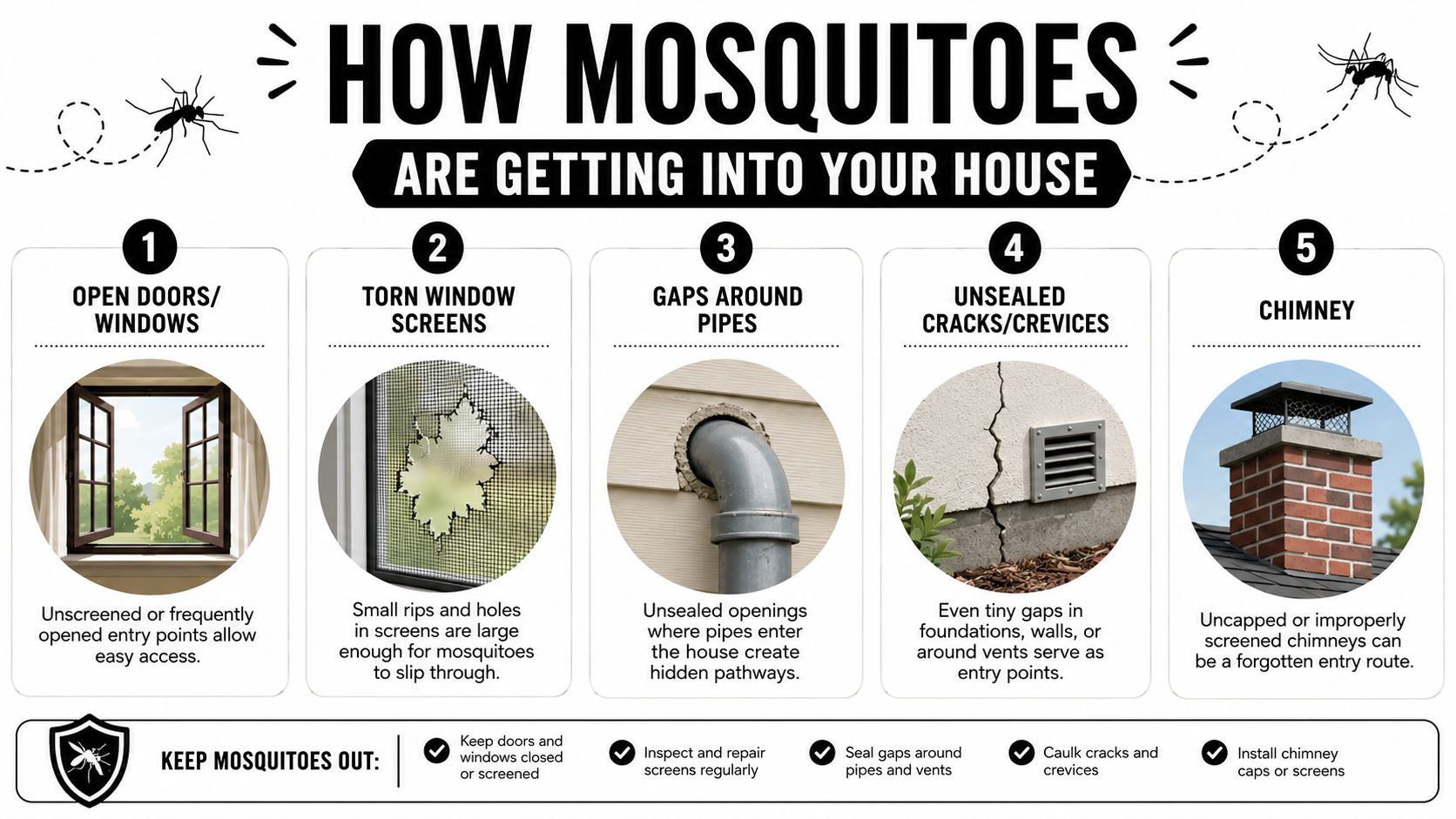
The most common mistake is assuming mosquitoes only come in through a wide-open door. In reality, they use small, boring-looking openings that homeowners walk past every day. Damaged screens, loose weather stripping, utility gaps, and unsealed vents can all become routes inside.
The entry points people miss
A quick walk-around often reveals the same trouble spots. Mosquitoes can slip through small gaps around doors and windows, damaged screens, vents, garages, chimneys, and utility openings, and they can even hitchhike indoors on clothing, pets, or people returning from outside (Agile Pests). That's why a home can seem sealed up and still have a steady mosquito problem.
Here's the homeowner checklist I'd use first:
- Door and window edges: Look for daylight, loose sweeps, or gaps where the frame doesn't seal tightly.
- Screen condition: Check for tears, bent frames, or screens that pull away when touched.
- Utility openings: Inspect where cables, pipes, or lines enter the house, especially near basements and garages.
- Vent and chimney screens: These get forgotten because they're higher up or out of sight.
- Garage and mudroom traffic: Mosquitoes can ride in when doors stay open during loading, unloading, or yard work.
Why entry control alone sometimes falls short
A homeowner can repair a screen and still see mosquitoes the next night. That usually means the house has more than one access route, or the insects are already inside and resting in a cool, shaded spot. A single fix helps, but it doesn't always solve a pattern that's coming from multiple weak points.
A sealed house matters, but a sealed house with moisture still gives mosquitoes somewhere to survive.
For readers comparing exterminator near me options, an experienced inspection pays off. If you want a deeper look at how indoor mosquito service works, The Green Advantage's interior mosquito control page gives a useful local reference.
The Hidden Breeding Sites Inside Your Home
Not every mosquito in a house flew in from outside. Some are born right there, in water you may barely notice. That's the part many homeowners miss, and it's why a few bites can become a recurring indoor problem.
Small water, big problem
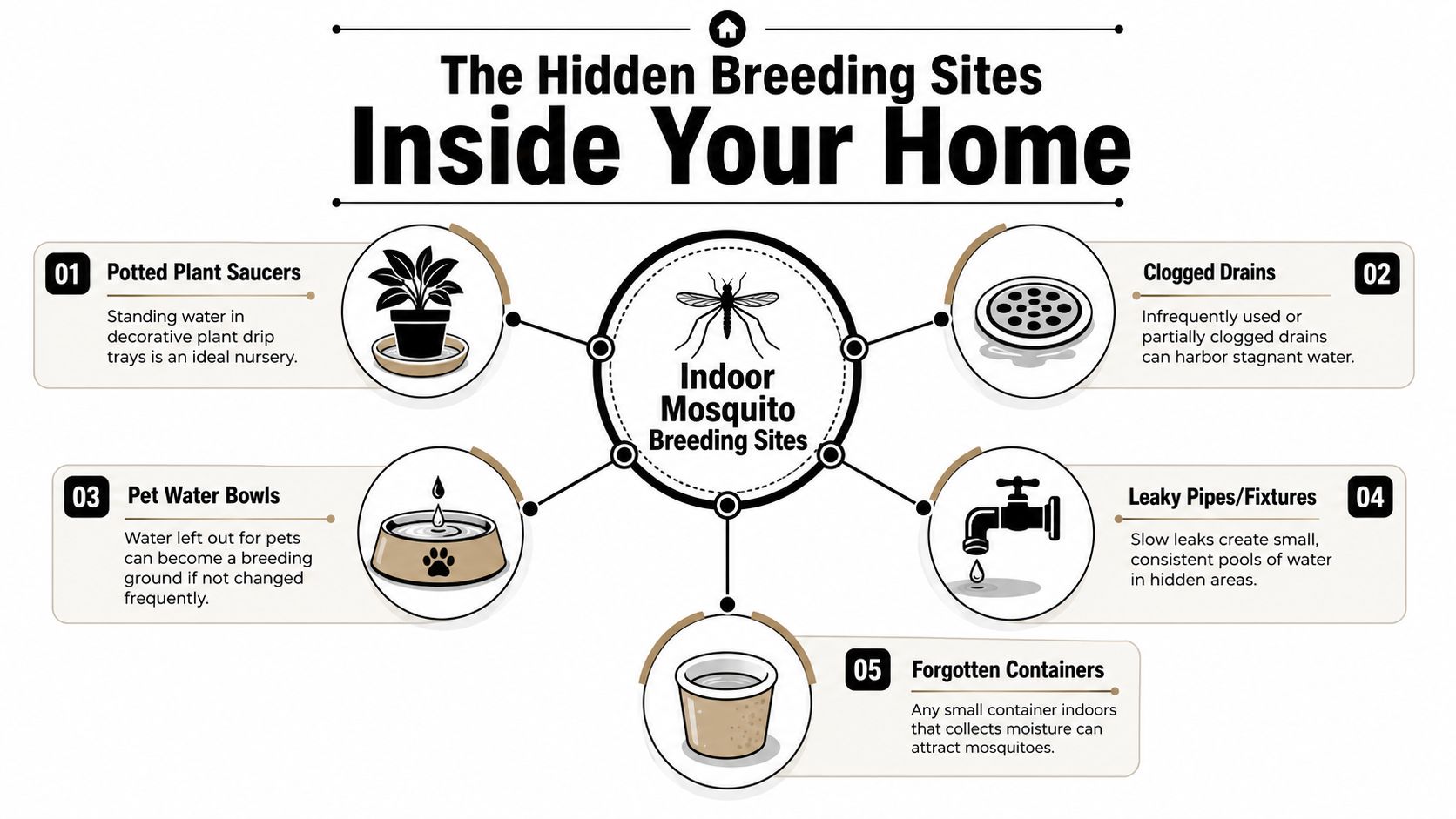
Mosquitoes do not need much water to breed. Female mosquitoes can lay eggs in very small standing-water sources, and one source notes that even a tablespoon of water can be enough for a breeding site (Engineer Fix). That means the usual suspects, plant saucers, drip trays, and small forgotten containers, can turn into indoor nurseries if the water sits long enough.
The older assumption is that breeding only happens in big puddles or swampy yard water. In practice, indoor sources are often tiny and persistent. A plant tray near a window, a pet bowl left unchanged, a slow leak under a sink, or a drain that doesn't get much use can all hold enough moisture for mosquitoes to cycle through again and again.
The rooms that deserve a closer look
Bathrooms, laundry rooms, basements, kitchens, and utility spaces are the places I'd inspect first. Those rooms often combine humidity, shade, and hidden water, which makes them attractive resting spots even when the source is small. A good home humidity guide, like this one from Sunset Shine Home Cleaning, can also help homeowners understand why damp indoor air keeps pests comfortable.
Rule of thumb: if a space stays damp, shaded, or underused, don't assume it's harmless just because it looks clean.
The bigger takeaway is simple. If mosquitoes remain after you've looked at doors, screens, and obvious entry points, the house may already be supporting an indoor cycle. That's the point where mosquito control becomes less about chasing adults and more about finding the water source they're using to keep coming back.
Your First Line of Defense Against Mosquitoes
The best homeowner defense is still the basic one. Clean out water, keep screens intact, and make the house less inviting. Those steps matter because they cut off the easiest survival conditions, and they're worth doing even if you plan to call for help.
What to do every week
The CDC says to once a week empty and scrub items that hold water, and it also notes that if mosquitoes remain after screen repair and container cleanup, professional treatment inside the home may be needed (CDC mosquito control at home). That advice is plain, practical, and hard to beat.
A homeowner can start with a short routine:
- Empty standing water: Check saucers, buckets, pet dishes, and anything that catches rain or condensation.
- Scrub water-holding items: Eggs can cling to surfaces, so dumping water alone isn't always enough.
- Repair screens quickly: Small tears are easier to ignore than they are to live with.
- Improve airflow: Stagnant, damp rooms tend to be more attractive resting spots.
- Watch the basement and garage: These areas often stay cooler and moister than the rest of the home.
Where DIY ends
DIY prevention works best when the issue is minor and the source is obvious. It's less effective when mosquitoes are coming from multiple access points, or when one hidden water source keeps replenishing the problem. That's why persistent indoor activity often needs a more complete inspection.
If you're comparing residential pest control providers, it helps to look at the whole home, not just the obvious window problem. A resource like identify household health risks can also help homeowners think more broadly about the conditions that make indoor spaces uncomfortable or unhealthy.
The practical line is this. If you've cleaned, repaired, and still see mosquitoes indoors, you're past the point where a spray can solve everything. At that stage, source identification matters more than guesswork.
The Green Advantage Solution for Mosquito Control

The strongest mosquito treatment starts with a full inspection, not a single product. A trained technician looks for entry points, moisture sources, and resting areas inside and around the structure, then matches the response to what's driving the problem. That matters because a house with mosquitoes needs source control, not just a quick knockdown.
What a professional service looks for
A proper visit usually focuses on the places homeowners miss. That includes utility openings, crawl spaces, basement moisture, shaded corners, and any indoor or outdoor source that can keep water in place long enough for mosquitoes to breed. The point is to find the chain, not just the symptom.
In the field, that can also include mosquito control around the property to reduce pressure from outside. For many homes in Crown Point and nearby Northwest Indiana neighborhoods, the issue is a mix of indoor access and outdoor activity. A complete plan may include targeted treatment, source reduction, and follow-up guidance for the season.
The Green Advantage also handles related commercial pest control and residential pest control needs, which helps when a home, rental property, or business all need consistent service standards. For homeowners who want a practical local option, The Green Advantage can provide a focused mosquito inspection and treatment plan suited to the structure and surrounding property.
Why timing matters
Mosquito breeding moves fast. New York State health guidance says many mosquitoes lay eggs in even small amounts of standing water, and eggs can develop in water that remains for more than four days (New York State health guidance). That short timeline is why a delay gives mosquitoes room to rebuild.
A professional approach breaks that cycle by treating the problem at the source, not just the adult mosquitoes you happen to see flying by. For families in Crown Point, that usually means less guessing, less repeat cleanup, and a clearer plan for keeping mosquitoes out of living spaces.
Working With Your Local Crown Point Exterminator
When a mosquito problem keeps coming back, homeowners usually want three things. They want the house to feel comfortable again, they want to know the problem was handled correctly, and they want a plan that doesn't turn into another seasonal headache. That's a fair expectation.
What you can expect from service
A good inspection should feel straightforward. The technician should look at the structure, identify likely sources, explain what's making the house attractive to mosquitoes, and recommend the next step in plain language. You shouldn't have to guess what was found or why the treatment matters.
That's especially important for pest control in Crown Point, IN, where moisture, season changes, and property layouts can vary a lot from one home to the next. A local team understands that mosquito pressure doesn't come from one cause every time. Sometimes it's a screen issue. Sometimes it's indoor moisture. Sometimes it's both.
Here's what usually helps most:
- Clear diagnosis: You know whether the issue is entry, breeding, or both.
- Targeted treatment: You're not paying for blanket work that doesn't match the problem.
- Prevention guidance: You get practical steps to reduce the chance of a return visit.
- Local follow-through: You can work with a company that understands Northwest Indiana homes and seasons.
The right service makes the house easier to live in, not just quieter for one night.
That's the reason people call an exterminator in Crown Point, IN instead of trying to chase mosquitoes room by room. Professional mosquito control protects comfort, supports better indoor conditions, and gives you a plan that fits the property instead of a generic answer.
If mosquitoes keep turning up in your home, schedule a pest inspection with The Green Advantage and get a local plan built for Crown Point and Northwest Indiana. Visit The Green Advantage to request a quote, ask about mosquito control, and take the next step toward a more comfortable home.
Outdoor Ultrasonic Pest Control: Facts vs. Fiction for 2026
You can stand on a Crown Point patio with a drink in one hand and still watch mosquitoes work your ankles like nothing is plugged in at all. That's why outdoor ultrasonic pest control keeps selling. It promises an easy fix, no sprays, no mess, no poison, just a little box and a quieter backyard.
I understand why homeowners keep trying it. A low-chemical option feels safer, especially when the garage has a mouse problem, the deck has mosquitoes, or the fence line keeps attracting ticks and other pests. But the honest question is simple, does the device pull its weight, or is the money better spent on pest control in Crown Point, IN that holds up in the real world?
The Green Advantage has seen these gadgets come and go around Northwest Indiana yards. The pattern doesn't change much. People buy them, hope for a clean perimeter, then call when the insects, rodents, or wildlife never got the memo.
The Patio Problem Every Crown Point Homeowner Knows
A summer evening in Crown Point usually starts the same way. The grill's hot, the kids are outside, the citronella candle is smoking away, and there's a little ultrasonic box glowing near the deck railing. Then the mosquitoes show up anyway, and somebody is back inside swatting at ankles and asking why the “fix” didn't fix anything.
That's the part most shoppers recognize right away. They are not buying a gadget because they love gadgets. They're buying it because they want to keep pests off the patio without turning the yard into a chemical zone. That instinct makes sense, especially for families looking for residential pest control options that feel practical and simple.
Outdoor ultrasonic pest control sits in that exact emotional lane. It sounds modern, discreet, and easy. Plug it in, stake it in the ground, and let the sound do the work. For homeowners searching for pest control near me or an exterminator near me, it looks like a cheap first step before calling a pro.
The problem is that outdoor pests don't care about marketing copy. They respond to food, water, shelter, and access. If a device can't change those conditions, it usually can't deliver dependable control. That's why this topic matters for anyone comparing a patio gadget with real mosquito control, rodent control, or preventative pest treatments.
Practical rule: if a product promises perimeter control outdoors, but it doesn't change the habitat, the result is usually disappointment.
For a yard in Crown Point, the better question isn't whether the box lights up. It's whether it keeps pests from getting comfortable where you live, relax, and entertain.
What Outdoor Ultrasonic Pest Control Actually Does
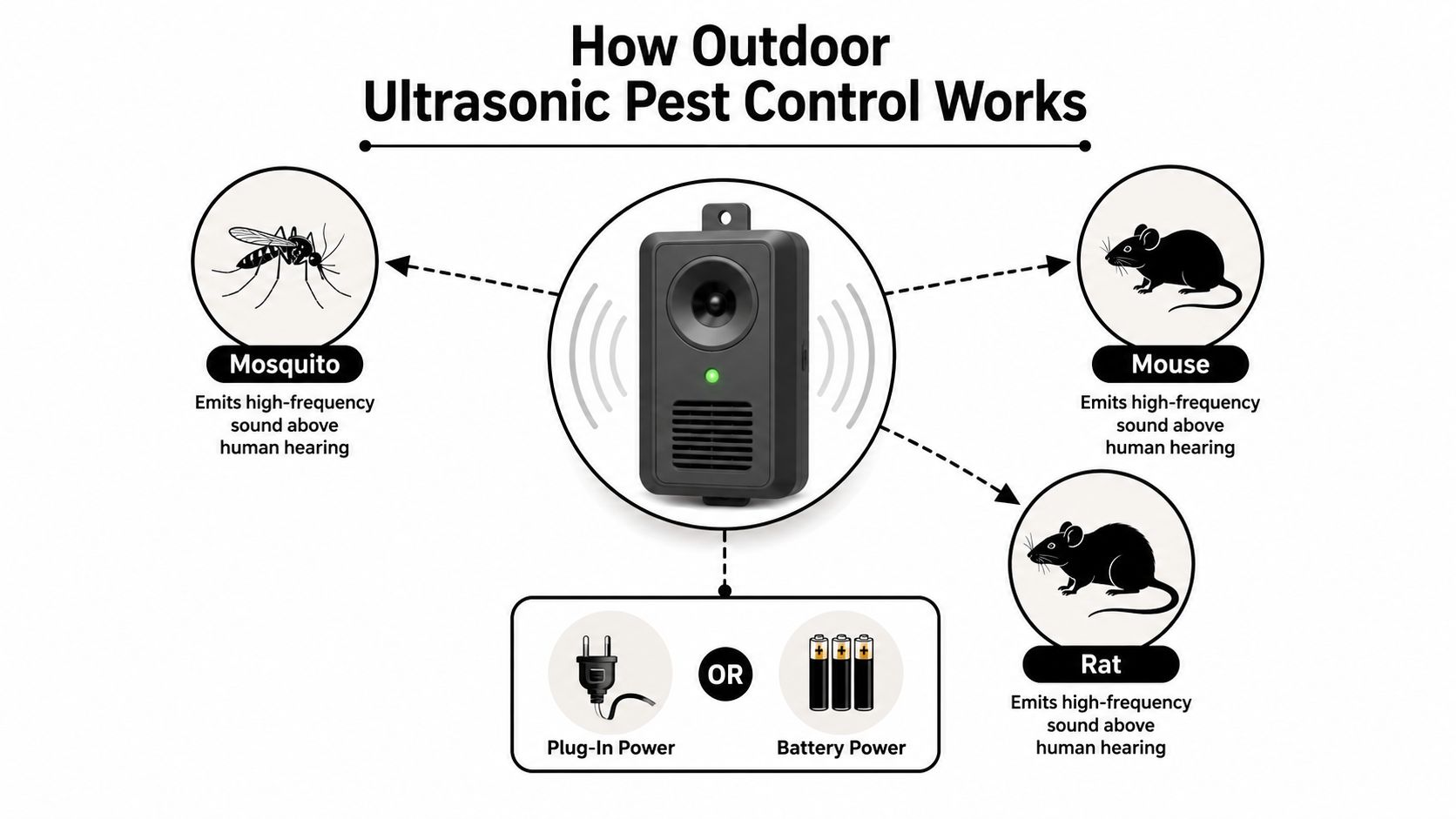
Outdoor ultrasonic pest control refers to plug-in or battery-powered devices that emit high-frequency sound above human hearing. Manufacturers sell them as a way to repel mosquitoes, rodents, raccoons, deer, ticks, and other pests around yards, patios, garages, sheds, and gardens. Newer models often include solar charging, motion activation, wider emission angles, and weatherproof housings.
The sales pitch is simple. The sound is supposed to be irritating enough that pests leave the area. That is why these products are usually marketed as a perimeter solution rather than a trap or bait system. The label sounds straightforward, but the category is broad, and the claimed effects vary from one unit to the next.
Core promise, core limit: the device emits sound pests may dislike, but the question is whether that sound changes pest behavior enough to matter outdoors.
What buyers are really comparing
| Pest | Finding | Evidence Strength |
|---|---|---|
| Rodents | Some short-term movement reduction, but effects fade fast | Weak for dependable outdoor control |
| Mosquitoes | No demonstrated field efficacy | Weak |
| Ticks | Too little repellency to prevent bites | Weak |
| Other pests | Claims vary widely, with inconsistent real-world results | Weak |
That table says it plainly. Some products may create a brief nuisance, but that is not the same as reliable control. For readers who care about tick pressure in the yard, the practical option is a proven yard strategy, not another hope-and-pray device, and that is why yard tick control guidance from The Green Advantage belongs in the conversation.
The key difference is species and setting. A device that looks impressive on a package can still perform poorly against mosquitoes in open air, rodents along a fence line, or ticks in leaf litter. Ultrasonic is a category, not a guarantee.
What the Science Actually Shows for Rodents, Mosquitoes, and Ticks
Rodents don't stay bothered for long
The clearest takeaway from the extension literature is that ultrasonic rodent devices can look decent for a moment and then fall apart. A Nebraska Cooperative Extension review reported only marginal repellency in controlled tests, with 30% to 50% reductions in movement activity in some cases, but also rapid habituation after just 3 to 7 days of exposure. That means the animals get used to it fast.
A later synthesis cited 27 peer-reviewed studies and found no statistically significant reduction across 19 controlled experiments, with reported significance values of p > 0.42 versus placebo devices, which is a long way of saying the devices did not outperform a fake unit in a dependable way. The University of Arizona Cooperative Extension also says commercially available sonic pest devices have not been shown effective in scientific studies.
Rodents are a serious issue in Northwest Indiana because garages, sheds, decks, and storage areas create easy shelter. That's why a blinking box is not a plan. Sealing access, removing food sources, and using actual exclusion methods are the tools that hold up.
Mosquitoes and ticks need better tools
For mosquitoes, the technical consensus is blunt. Commercial ultrasonic devices have no demonstrated field efficacy, and recent review work says the field evidence remains consistently low across categories. In plain terms, if your yard has biting mosquitoes, the sound from a repeller is not the lever that changes the outcome.
Ticks are no better. A peer-reviewed PLOS ONE study tested nine commercial devices against the paralysis tick Ixodes holocyclus and found less than 19.5% repellency, which the authors said was too low to recommend for preventing bites. That is not a yard solution. It is a weak signal at best.
A Cornell University IPM blog also reported “no effect” in scientific evaluations on pests including German cockroaches, bed bugs, and rodents, and it noted that some manufacturers' claimed frequency and intensity don't match actual output. The species matters, and the evidence keeps pointing in the same direction.
Why Yards Are Harder Than Living Rooms
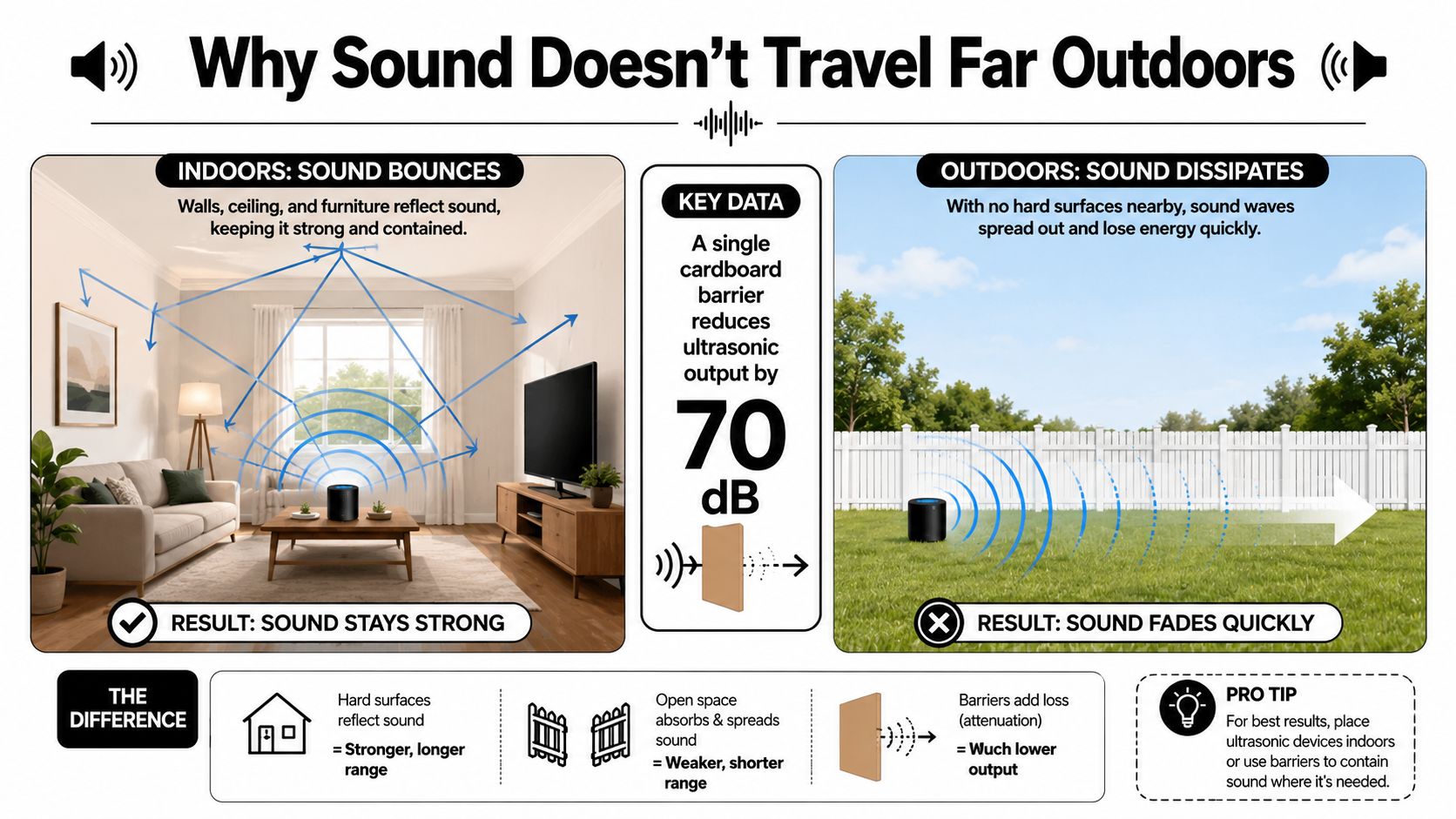
A yard in Crown Point is not a sealed room. That's the first thing product pages leave out. Sound outdoors gets interrupted, scattered, and weakened by whatever is in the way, and the published acoustical testing backs that up. In a classic evaluation of commercial ultrasonic pest devices, a single 0.30 cm cardboard barrier reduced output by about 70 dB, and the devices underperformed manufacturer claims in both intensity and peak frequency regions.
That matters because real yards are full of barriers. Siding, fences, patio furniture, shrubs, garden sheds, and even simple changes in layout can break the line of sight. Add wind and humidity, and the actual coverage gets smaller and more uneven than the box suggests. The result is dead zones, which is exactly where pests keep moving.
What “coverage” really means outdoors
A lot of shoppers read a square-foot claim and assume it means a hard perimeter. It doesn't. It usually assumes open air, clean sightlines, and ideal placement that most Northwest Indiana properties don't have. The practical range is far more variable than the packaging implies.
Newer models with solar charging, motion activation, and multi-directional emitters can improve convenience. They can also make installation easier. But convenience is not the same as outcome data, and independent proof that those features cut pest activity outdoors is still thin.
Homeowner rule: if the environment can block, absorb, or scatter the sound, the device's real-world coverage is already compromised.
That's why “how far does it reach?” is the wrong question by itself. The better question is whether the yard has enough open, unobstructed space for the device to matter at all. In most Crown Point yards, the answer is no.
The Honest Pros and Cons for Homeowners
Here's the fair version, not the sales version. These devices do have some appeal, but the tradeoffs are real, and every Crown Point homeowner should weigh them before buying.
What makes people keep trying them
- Low chemical footprint: Some families want to avoid sprays first, and a plug-in unit feels cleaner than a yard treatment.
- Low maintenance: Once installed, there's little day-to-day effort.
- No bait or poison handling: That matters for homes with children, pets, or frequent guests.
- Simple setup: Many units are easy to stake in the ground or plug into a weatherproof outlet.
Those are real conveniences. They explain why ultrasonic devices still show up on patios, porches, and garden edges even after the science let them down.
Where they fall short
- Weak evidence base: University extension sources keep saying the products have not been shown effective, and the broader study record is not encouraging.
- Fast habituation: Rodents can get used to the sound quickly, so any early reaction may not last.
- Inconsistent outdoor coverage: The yard environment works against the device.
- Questionable marketing history: The University of Arizona Cooperative Extension notes the FTC charged several companies with false advertising in the 1980s and required refunds.
- Possible sound exposure concerns: Cornell's IPM note says some devices exceed OSHA limits for human tolerance of sound exposure.
- Cost versus payoff: A device can cost enough to feel like a wasted service call if it doesn't change the pest pressure.
That is the comparison hardware stores rarely walk through with customers. If your main goal is peace on the patio, a little less hassle, and fewer bugs at dusk, a gadget with shaky performance is a poor bet.
If You Still Want to Use One, Do It This Way
A homeowner who already owns one should at least use it intelligently. Put it where the manufacturer can't pretend the environment is perfect. That means a weatherproof outlet, clear line of sight to the area where pests travel, and placement away from dense vegetation whenever practical.
Stake-mounted units make more sense when a cord would otherwise stretch across a walkway. Solar units can work for convenience, but the panel needs to stay clean, and batteries still need seasonal checks. Do not bury the device under snow, leaves, mulch, or patio clutter and expect it to perform.
Use it as a supplement, not a shield
The better setup is still the boring one that works:
- Remove standing water so mosquitoes have fewer breeding spots.
- Trim vegetation away from the home so pests lose cover near entry points.
- Seal gaps and cracks where rodents and insects get inside.
- Clear leaves and clutter where ticks and other pests hide.
- Use the device only as a secondary layer if you insist on keeping it.
That is the smartest way to think about it. A repeller might sit in the mix, but it does not replace exclusion, sanitation, or targeted treatment. For homeowners comparing device promises with a structured prevention plan, The Green Advantage's integrated pest management approach fits the way real yards work.
If the goal is a patio that stays usable, the device is a maybe. The habitat work is the part that matters.
What Actually Works in Northwest Indiana Yards
Start with the stuff pests are already using
Source reduction comes first because pests need something to live on, drink, or hide in. For mosquitoes, standing water is the obvious target. For raccoons and other nuisance wildlife, unsecured trash and pet food are invitations. For ticks, leaf litter and thick ground cover create the kind of edge habitat they love.
Block the easy entry points
Exclusion is the next layer. Seal gaps around the foundation, repair torn screens, install door sweeps, and close up vents that don't need to stay open. That works because it attacks access instead of hoping pests will get uncomfortable and leave on their own. If rodents are finding their way into a garage or crawl space, the problem gets real.
Use direct control where it fits
Mechanical traps and other targeted methods are still the right call for many rodent problems. They are not flashy, but they're direct. For mosquitoes, professional reduction programs can reduce pressure around outdoor living areas, especially when paired with habitat cleanup and smart placement around the property.
The Green Advantage offers mosquito control, rodent control, commercial pest control, and residential pest control for Crown Point and surrounding Northwest Indiana properties. It also handles pest inspections and preventive service plans, which matters when the issue is seasonal and keeps coming back.
Bottom line: the winning plan is layered. One gadget cannot do the job of source reduction, exclusion, and targeted treatment.
If you want fewer ants in spring, fewer spiders in corners, fewer wasps around eaves, and fewer rodent headaches going into fall, the fix is a consistent service plan, not a box that hopes pests hate sound enough to move out.
Talk to a Crown Point Pest Pro Before You Buy Another Gadget
If you've read this far, you probably aren't just curious. You're tired of mosquitoes chewing up the yard, worried about rodents in the garage, or trying to protect a property before a sale or inspection. That's exactly when a local pro makes more sense than another device on the patio.
The Green Advantage works the way busy homeowners need. You call once, reach knowledgeable office staff, and get scheduled without a lot of back-and-forth, which is more practical than waiting on generic pest control receptionist solutions that don't know your property. Then a technician comes out, checks the site, and builds a treatment plan around what's happening there, not around a one-size-fits-all package.
That matters for pest control in Crown Point, IN because every property is different. Some yards need mosquito reduction. Some homes need rodent exclusion. Some businesses need commercial service plans. And some people just need a pest inspection before a closing so they know what they're walking into.
If you want a real answer instead of a gadget gamble, call The Green Advantage and ask for a pest inspection or quote. You'll get a clear plan for the problem in front of you, not another promise that sound alone will solve it.
If you're ready to stop guessing, visit The Green Advantage and ask for a pest inspection, a quote, or a service plan built for your Crown Point property. The right fix starts with a real look at your yard, your home, and the pests that are present.
Standing Water Mosquitoes: A Crown Point Homeowner Guide
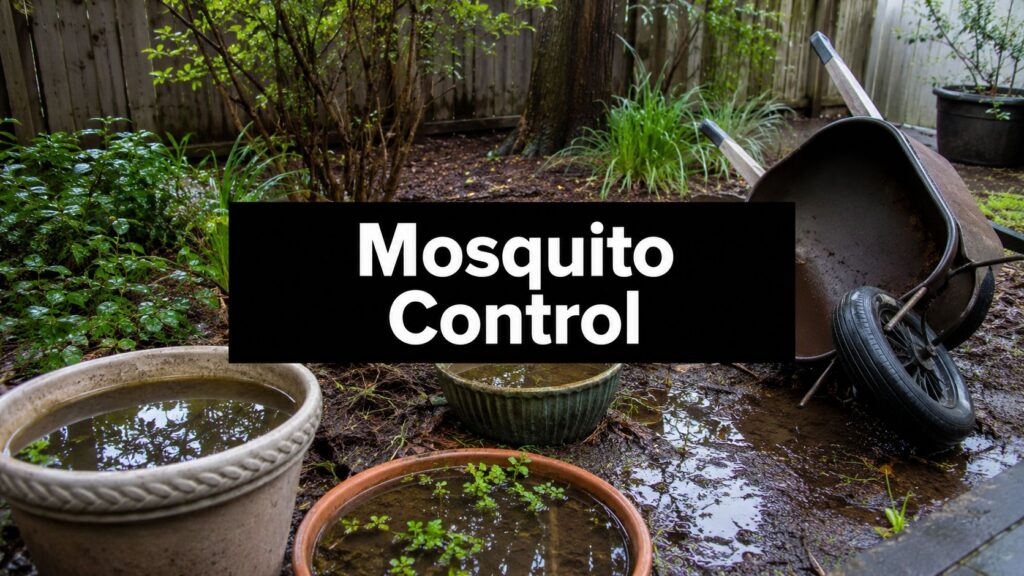
A wet yard in Crown Point can turn into a mosquito problem fast. One storm leaves water in the low spot by the patio, the bird bath sits untouched, and the downspout keeps spilling onto clay that doesn't dry out the way you want it to. By the time you notice the bites, the breeding spot has already done its work.
That's why standing water mosquitoes aren't a random nuisance, they're usually a sign that a few small yard habits and drainage issues have lined up at the same time. For homeowners looking for pest control near me or pest control in Crown Point, IN, The Green Advantage works the way a good field technician should, by finding the overlooked water sources, fixing what can be fixed, and treating what can't. The same damp conditions that favor mosquitoes can also make ants, termites, and rodents more likely to show up around a house, especially in Northwest Indiana's wet seasons.
Why Crown Point Yards Keep Attracting Mosquitoes
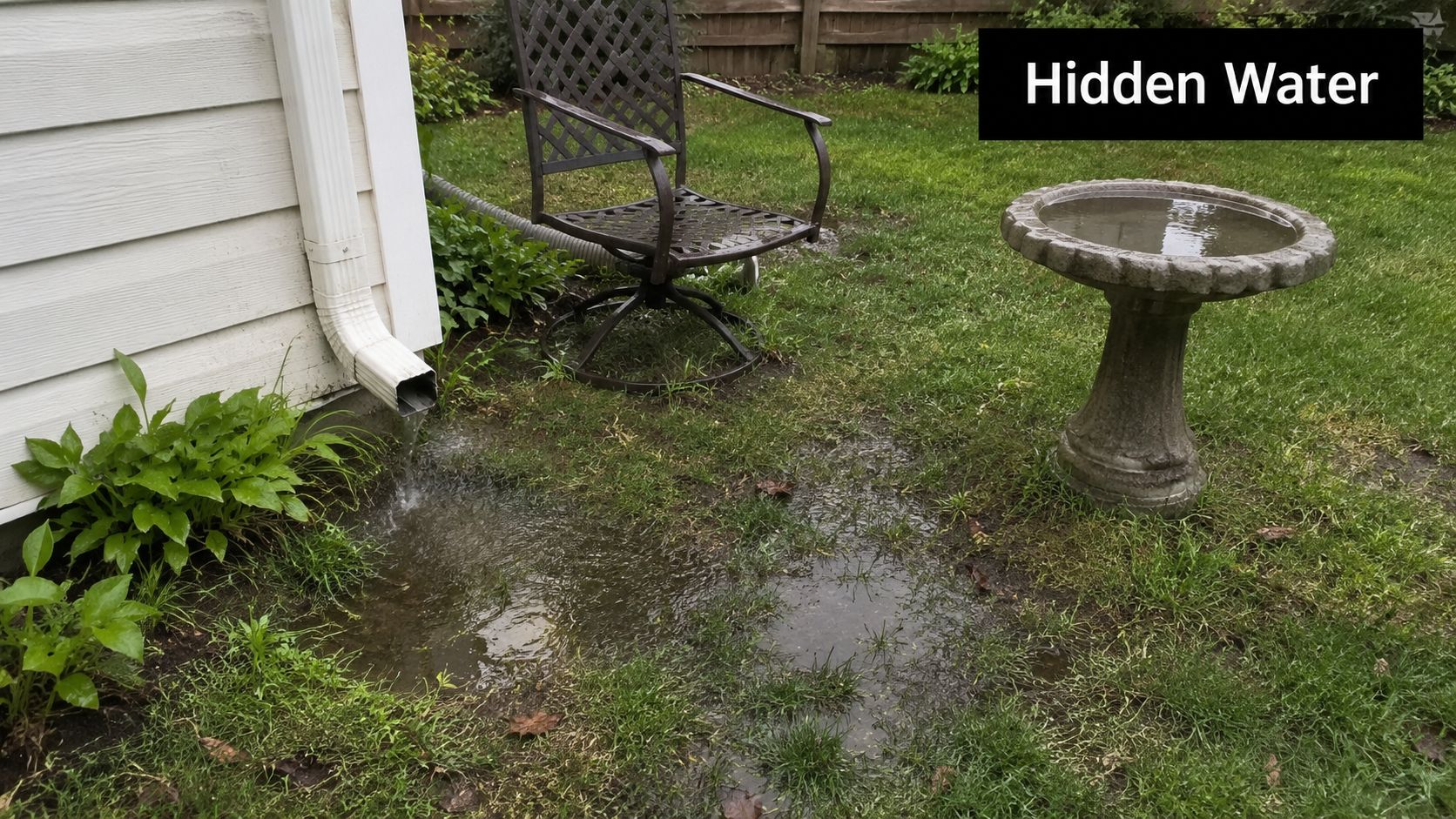
A lot of Crown Point yards look fine from the driveway and still hold water where mosquitoes breed. Spring snowmelt settles into low spots, gutters load up with leaves, and a downspout keeps feeding a patch of lawn that stays soft long after the rain stops. Add a bird bath, a pet bowl, a folded tarp, or a decorative pond that is not moving enough, and the yard gives mosquitoes the quiet water they want.
The pattern homeowners miss
Mosquitoes do not need a swamp. They use small, still water sources just as readily as a soggy corner of lawn or a clogged container by the garage. That is why a yard can look clean from the street and still turn into a mosquito problem after one wet stretch, especially when shade keeps the water from drying out.
Crown Point yards also deal with the way local ground holds water. Clay-heavy soil, snowmelt, and spring gutter overload can leave moisture sitting in the same places again and again. Once that happens, the issue is no longer just a puddle. It becomes a repeat breeding site, and the practical answer is source control, cleanup, and drainage work done on time. The Green Advantage explains that approach in its guide to mosquito breeding and control.
Practical rule: if water sits long enough for you to stop thinking about it, mosquitoes have already had time to use it.
Why this also points to bigger pest pressure
The same damp areas that support mosquito breeding also create the kind of moisture conditions that draw in other pests around a house. That is why a mosquito complaint often shows up alongside questions about residential pest control, commercial pest control, or even termite control and rodent control. A yard that drains poorly does more than feel buggy. It stays attractive to pests that like shelter, moisture, and easy access to a structure.
For homeowners who keep searching exterminator near me or exterminator in Crown Point, IN, the problem is usually repeated water management, not bad luck. A local inspection from The Green Advantage starts by tracing where the water is collecting, then deciding what needs cleanup, what needs treatment, and what needs a drainage fix so the problem does not keep coming back.
How Standing Water Mosquitoes Actually Work
A yard can look dry enough at a glance and still keep feeding mosquitoes. In Crown Point, that usually means water sitting in the places people stop checking, a bird bath that never fully empties, a gutter that holds a thin line of water, or a low spot that stays wet after snowmelt and spring rain. Mosquito control starts to make sense once you follow the water, because that is where the cycle keeps restarting.
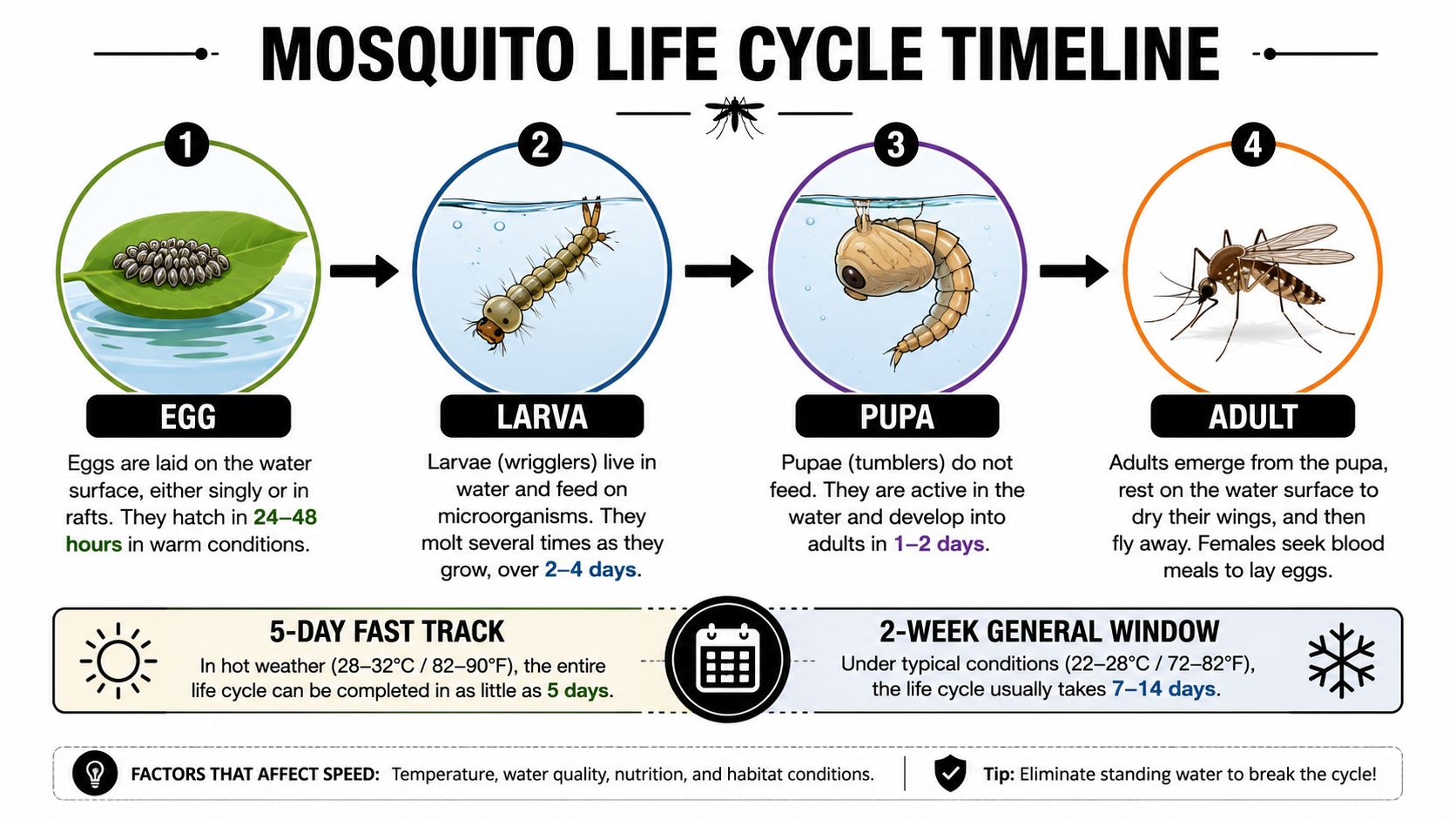
Mosquitoes use still water for two life stages before they become biting adults. Eggs hatch into larvae, larvae change into pupae, and pupae turn into adults once conditions are right. In practical terms, that means a small container of warm, stagnant water can keep the cycle going faster than many homeowners expect, especially if it sits in shade or gets ignored for a few days.
That speed is the reason source control matters so much. San Diego County says the full shift to adult can happen in as little as 5 days (San Diego County). North Carolina State Extension also warns that mosquitoes can develop in water that remains undisturbed long enough to support a life cycle, while the University of Florida IFAS Extension notes that even temporary water can become a breeding site if it is left in place instead of drained or dumped (North Carolina State Extension, University of Florida IFAS Extension).
Once that source stays in place, spraying adults only treats the visible part of the problem. The yard keeps producing more mosquitoes from the same spot. The practical fix is to break the cycle where it starts, then keep checking the places that refill after every rain or melt.
A bird bath that sits untouched through the week can turn into a nursery before the homeowner realizes the water never moved.
Why timing matters more than volume
It does not take much water for mosquitoes to get started. The Northeast IPM Center notes that they can breed in containers as small as a bottle cap (Northeast IPM Center). That is why a saucer under a planter, a toy left upside down, or the bowl of a wheelbarrow can matter just as much as a puddle in the grass.
The Green Advantage covers that same source-first approach in its mosquito breeding and mosquito control guide. For a homeowner, the takeaway is straightforward. Source reduction beats chasing adults, because it removes the water mosquitoes need to complete the cycle. That is also why the best time to check is after rain, after mowing, and after any stretch of humid weather that slows evaporation.
Your Weekly Yard Walk-Through
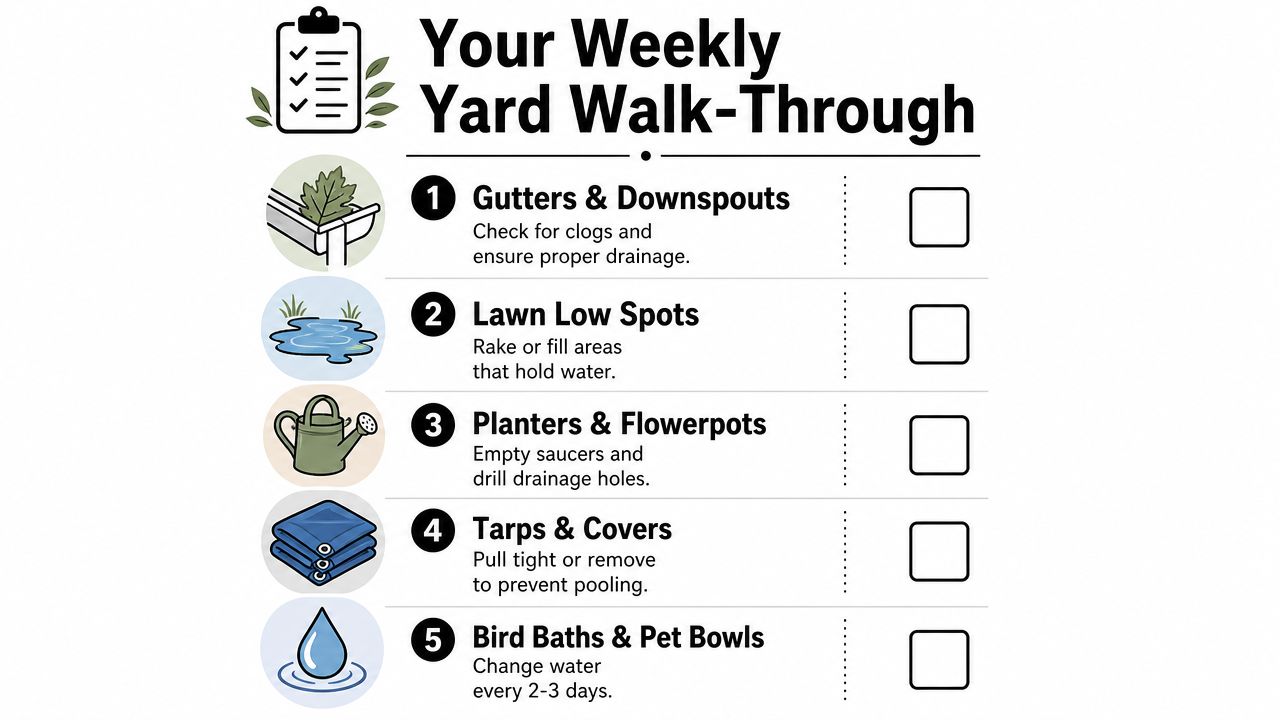
The best mosquito inspection is the one you repeat without skipping the easy-to-miss spots. Walk the yard the same way every week, and start where Northwest Indiana yards usually hold water, at the roofline, then the low ground, then the shaded corners that stay damp after snowmelt or a spring storm.
Start where water enters and exits
Check gutters first, then follow each downspout to where it drops water. Clogged gutters, roof drainage problems, tires, and other water-holding containers keep showing up as repeat breeding sites, and that includes the kinds of overflow problems homeowners usually notice only after the yard has already stayed wet for a while (Northeast IPM Center, University of Florida IFAS Extension, EPA mosquito control guidance). Sagging runs and weak drainage at the base of a downspout are the details a homeowner can miss, even when they are obvious from a technician's view.
Then work the yard edge. Toys, tarps, recycle bins, wheelbarrows, and decorative yard pieces can all trap rain in folds, corners, and low spots. Tires are a problem too, and wheelbarrows are one of the easiest items to overlook when they sit with the bowl facing up (University of Florida IFAS Extension).
Field habit that saves time: if something can collect rain, check it before you decide it is just storage.
Finish in the shade
Bird baths, fountains, pet dishes, and ornamental water features need their own look because they refill and sit undisturbed between checks. Empty and refresh those water sources every week, and make sure the container itself is not holding debris that keeps the water still (EPA mosquito control guidance). For rain barrels, use a screened setup and follow a tight maintenance routine, which is the part many homeowners miss when the barrel is tucked beside the house. See this guide on how to keep mosquitoes out of a rain barrel.
The shaded, tucked-away areas matter too. Under decks, behind AC units, and along fence lines, you will usually find small pockets that stay damp longer than the open lawn. A 15-minute weekly walk-through is enough for most homeowners if they stay consistent. The goal is not perfection, it is catching the one missed container before it sits long enough to matter.
Safe DIY Treatments for Standing Water You Cannot Remove
Some water just won't go away. Rain barrels, ornamental ponds, drainage depressions, livestock troughs, and certain low spots may refill too quickly for simple dumping to solve them. That's where treatment choices matter, because not every product fits every situation.
Compare the practical options
| Option | Best for | How it works | Watch out for |
|---|---|---|---|
| Bti dunks | Bird baths, rain barrels, tubs, small standing-water sites | Targets mosquito larvae in water | Doesn't affect adults, and it won't keep working if water gets refreshed without retreatment |
| Bti pellets or granules | Slightly larger water-holding spots or multiple small containers | Reaches larvae in shallow water | Use only where the label allows, and keep up with the weekly check |
| Mosquito bits | Small containers and nuisance water pockets | Delivers larval control in a practical homeowner format | Not a fix for clogged drainage or repeated refilling |
| Fountain or bubbler circulation | Ornamental ponds and decorative water features | Keeps water moving so mosquitoes have a harder time completing development | Pumps need maintenance, and shallow stagnant edges can still breed |
| Goldfish or native mosquito-eating fish | Larger ornamental ponds | Adds biological control in water features that support fish | Not suitable for every pond, and fish won't solve overflow or debris problems |
| Broad-spectrum insecticides in water | Poor fit for most home water features | Can kill a wide range of organisms | Risky around aquatic habitats, pets, and beneficial insects, so it's usually the wrong first choice |
The Green Advantage recommends Bti products in the form of dunks, pellets, or granules for standing water that can't be removed. That lines up with extension guidance that larviciding can reduce nearby adult mosquito pressure when source removal isn't possible (LSHTM summary of larval-source management). If you want a plain-language walkthrough for one common setup, the rain barrel mosquito guide is a good place to start.
What not to rely on
Bti only works on larvae, not pupae or adults, so it needs the right timing. Oil-based surface films can be short-lived and may interfere with fountain pumps, which makes them a poor fit for most residential water features. Broad-spectrum insecticides in water are usually too blunt for the job and can create avoidable side effects in places where kids, pets, and pollinators already spend time.
If the water is still there after every rain, the better move is often a combination of treatment and correction. That means treating the water safely, then fixing the reason it keeps coming back.
Landscaping and Drainage Fixes That Last
Mosquito pressure drops when water stops hanging around in the first place. In Northwest Indiana, that usually means dealing with downspouts, grading, compacted soil, and any feature that keeps creating a damp pocket after storms. The goal isn't a perfect yard design, it's a yard that dries fast enough to stop acting like a breeding site.
The fixes that usually pay off first
Extending downspouts away from the foundation is a practical first move, especially where splashback keeps the base of the wall wet. Regrading low spots can also make a big difference if the yard repeatedly holds water after rain. If the problem area never really improves, French drains or dry creek beds can redirect water before it settles.
Compacted clay soil is a common Northwest Indiana headache because it sheds water instead of absorbing it. Aeration helps, but in heavier problem areas, the drain path matters more than the grass. Plant choices matter too. Dense groundcover and cluttered borders can create small shaded, wet microhabitats that hold moisture longer than you'd expect.
For homeowners comparing DIY fixes with bigger drainage work, contact Modern Yard Landscapes for a drainage-focused overview of how problem areas are corrected.
If the same spot stays wet after normal weather, it's not a mosquito problem first. It's a drainage problem first.
Why this helps more than mosquitoes
Better drainage helps with more than bites. Damp foundations, overwatered borders, and sheltered wet edges also encourage ants, termite activity, and rodent movement around the home. That's why a drainage project often improves the overall pest picture, not just the mosquito count.
For Crown Point homeowners, the decision line is pretty clear. If one container or one gutter is the issue, DIY cleanup is enough. If the same low spot keeps filling, or the same corner keeps producing bites, the fix usually belongs with a professional who understands both pest pressure and the water path behind it.
Seasonal Timing for Northwest Indiana Mosquitoes
Mosquito pressure in Crown Point doesn't behave the same way all year. Early spring brings snowmelt and clogged gutters, late spring adds repeated rain into containers, summer heat speeds the breeding clock, and fall cleanup determines whether drainage problems carry into the next season. That pattern is why season-long mosquito reduction plans make sense for some properties, while a one-time treatment works better for others.
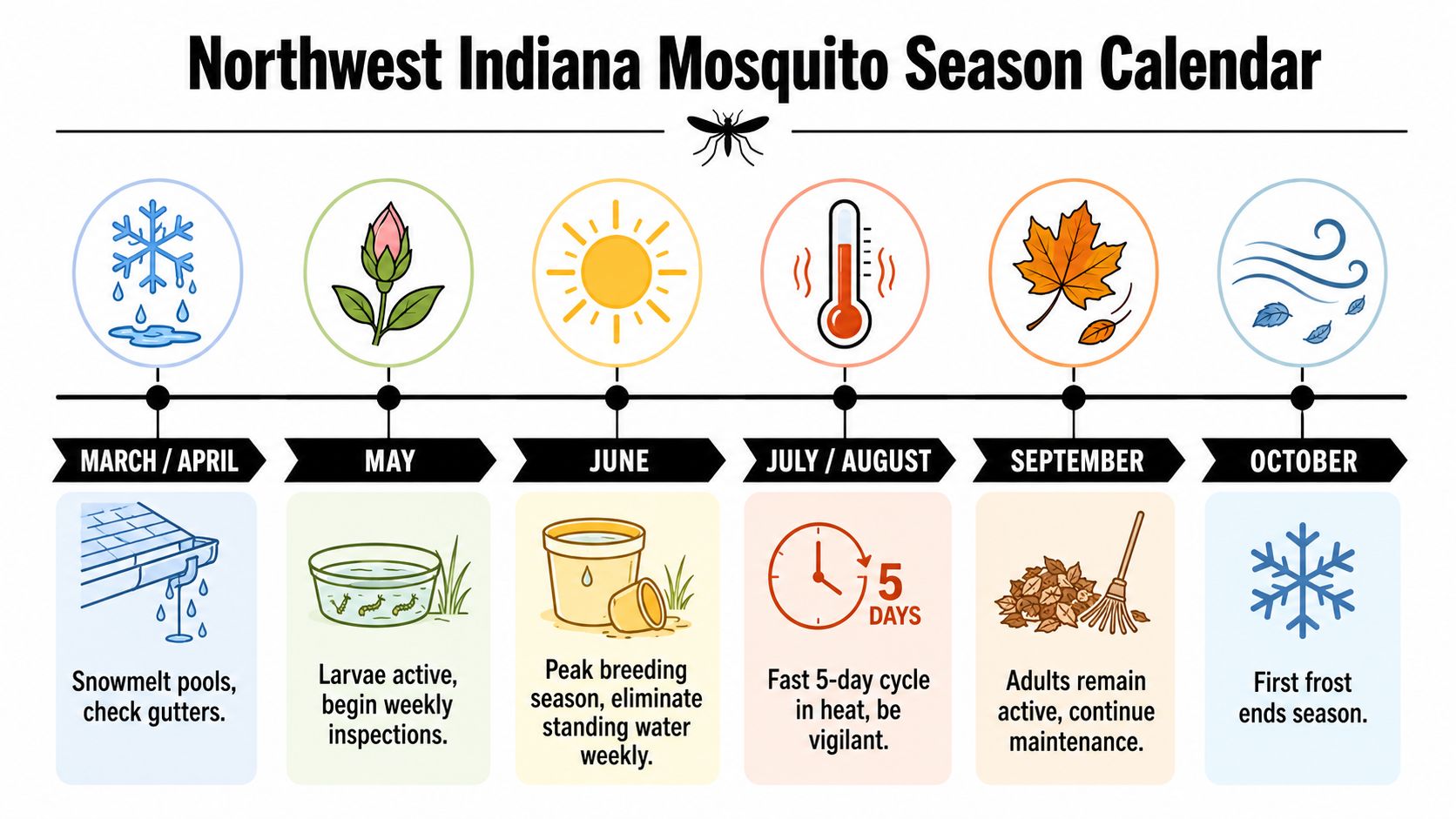
A simple local calendar
March and April usually start with meltwater that pools near downspouts, low spots, and hard edges where the sun hasn't dried things out yet. By May, the focus shifts to weekly inspection because container water starts building up after each rain. June is when standing water needs the most attention, because warm weather keeps the breeding cycle moving.
July and August are the months when homeowners feel the fast turnaround most sharply. If a container gets missed, the five-day clock becomes a real problem. September still needs maintenance because adults remain active while leaves and debris start clogging drains again. By October, the first frost ends the season, but only if the yard has been kept clean enough to drain properly.
When DIY is enough
DIY usually holds up when the property is tidy, the water source is temporary, and the bites stop after cleanup. It also works when there's one obvious container and the rest of the yard dries normally. If a shaded rest area still feels quiet and dry, you're probably on the right track.
Good threshold: if you can remove the water and the bites stop, keep doing that every week.
When mosquitoes keep coming back from the same corner, or when the property sits near retention ponds or wooded edges, the job gets bigger. That's where a seasonal service plan can help by keeping inspections, larval control, and perimeter treatment on schedule instead of waiting for the next spike.
When to Call The Green Advantage and What to Expect
If you've cleaned up the obvious water and the mosquitoes are still around, it's time to stop guessing. That's especially true when the same yard keeps producing bites after a careful inspection, when neighboring properties feed the problem across the fence line, or when drainage and water features are more than a homeowner wants to manage alone. If the mosquito issue is showing up alongside ants, rodents, or termites, the property probably needs a broader pest review too.
A good service visit should feel straightforward. You call the local office, set the appointment, and a technician comes out to walk the property with you. They look at gutters, downspouts, shaded containers, low spots, water features, and any hidden breeding sites that were easy to miss from the porch. Then they choose the right approach for the site, which may include larval treatment in breeding water and a broader mosquito reduction plan around the perimeter.
For homeowners building a practical maintenance routine, the annual home maintenance checklist is a useful companion because pest prevention works better when it's part of regular property care, not an afterthought.
The value here isn't complicated. You get a yard that's easier to use, fewer surprises after rain, and one less thing to check every time you step outside. For residential pest control or commercial pest control in Crown Point, IN and nearby Northwest Indiana communities, The Green Advantage can handle the inspection, the cleanup support, and the targeted mosquito work that helps keep your outdoor space usable.
If you're ready to stop fighting the same standing-water mosquito problem every week, contact The Green Advantage to schedule a pest inspection or request a quote for mosquito control in Crown Point, IN.
What Attracts Mosquitoes to Your Yard: Stop Them in 2026

A warm Crown Point evening can go from perfect to miserable fast. The kids are in the yard, the grill is going, and then the mosquitoes show up around the patio lights, the shrubs, and every place someone stops moving for a second. If that sounds familiar, you're not dealing with bad luck, you're dealing with a yard that's giving mosquitoes the conditions they want.
For homeowners in Crown Point, IN and nearby Northwest Indiana neighborhoods, the fix usually starts with understanding what attracts mosquitoes to your yard in the first place. The Green Advantage works with that reality every day, helping families and businesses reduce mosquito pressure with practical pest control that focuses on breeding sites, resting sites, and the small, easily overlooked details. The goal isn't just fewer bites for one night. It's a yard that feels usable again.
Reclaim Your Crown Point Yard from Mosquitoes
A lot of mosquito calls start the same way. A family finally gets a chance to eat outside, a dog wanders onto the lawn, and within minutes everyone is swatting and heading back inside. In Crown Point, that frustration usually comes from a yard that looks fine at a glance, but still gives mosquitoes water, shade, and shelter.
Why the problem feels bigger than it looks
Mosquitoes don't need a swamp to turn a property into a problem. They're drawn to the exact mix of moisture, still air, and hiding spots that show up in ordinary suburban yards, especially after rain and during warm stretches. That's why a property can look tidy and still feel overrun by biting insects.
The Green Advantage takes a local, homeowner-focused approach to mosquito control in Crown Point, IN. That means looking at the whole yard, not just the obvious puddles. It also means understanding how Northwest Indiana lawns, shrubs, downspouts, and shaded corners can create the kind of environment mosquitoes use all season long.
Practical rule: if a yard gives mosquitoes a place to breed, a place to rest, and a person to feed on, the problem keeps coming back.
Families usually want the same thing, a yard that's safe for kids, pets, cookouts, and evening time outside. That takes more than a quick spray. It takes a plan that addresses the habitat, the weather patterns, and the parts of the property that keep resetting the cycle.
The Number One Mosquito Magnet Standing Water
Standing water is the place to start because it's where the next generation begins. Mosquitoes don't need a pond to breed, they need still water that sits long enough for eggs and immature stages to develop. In many common container-breeding mosquitoes, that can happen in as little as 7 to 10 days antipesto.com, which is why a bucket, birdbath, clogged gutter, or saucer can become a fresh source of mosquitoes in about a week if nobody empties it.
What to check first
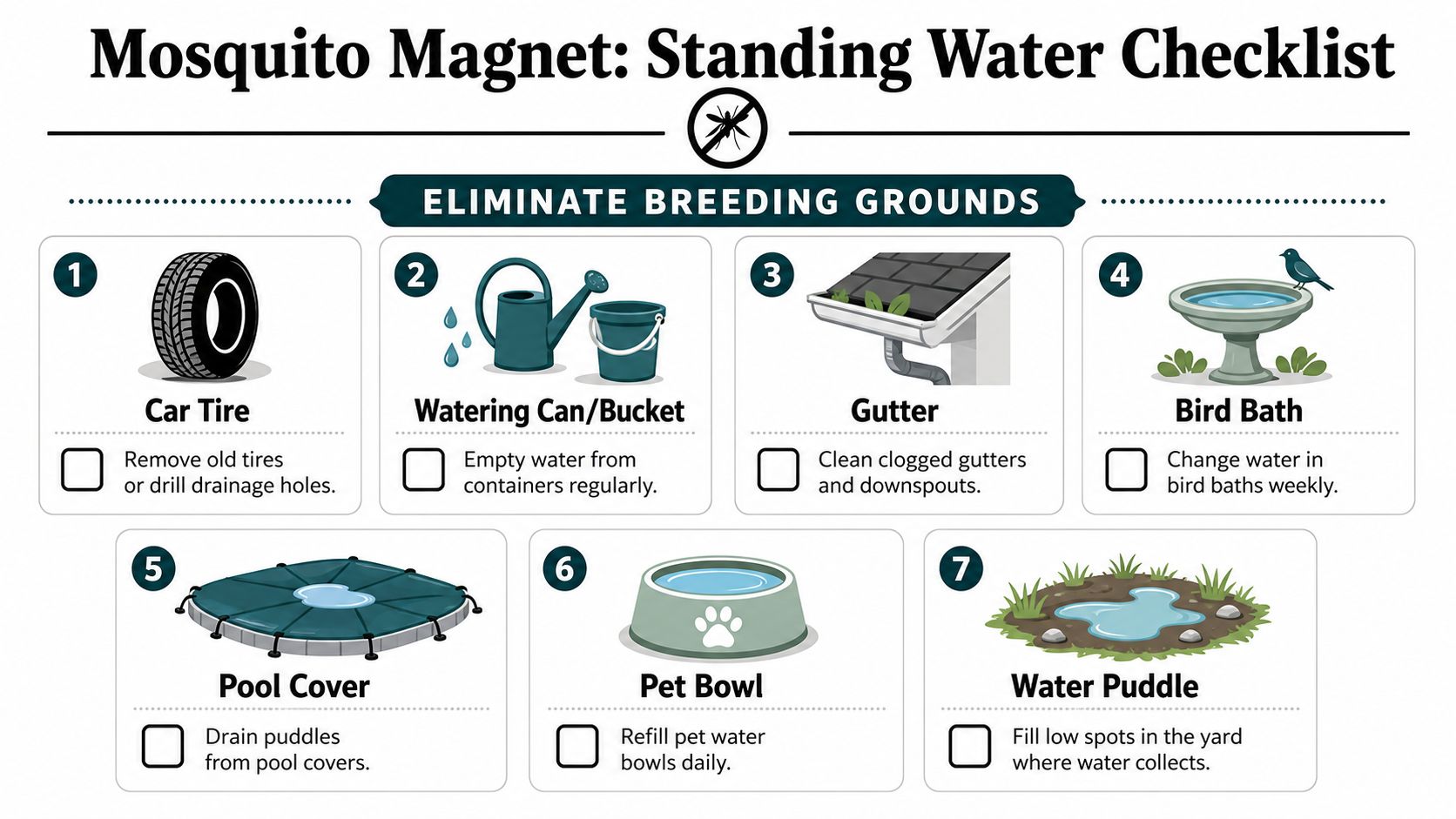
The obvious places matter, birdbaths, splashy low spots, old tires, and any decorative water feature that isn't moving. But the hidden ones are usually the primary problem. The Ohio State University Extension notes that mosquito control works best when you eliminate breeding water instead of chasing adults after they emerge Ohio State University Extension.
A good weekly habit is simple:
- Dump containers after rain. Buckets, toys, planters, and anything else that catches water need a close look.
- Clean gutters and downspouts. Debris traps water and gives mosquitoes a place to develop.
- Empty saucers and tarps. Flowerpot saucers, pool covers, and folded materials can hold enough moisture to matter.
- Check drainage blind spots. Low spots in the lawn and tucked-away depressions can stay wet longer than you think.
The reason this matters in Crown Point is that rain doesn't just wet the yard, it resets it. If you want a plain-language explanation of how rain affects mosquito populations, that resource walks through why populations often surge after wet weather.
For a deeper local breakdown of the breeding cycle, see the Green Advantage guide on mosquito breeding and mosquito control. Once water is removed, mosquito pressure drops, but only if the source stays gone long enough to break the cycle.
Why Mosquitoes Still Find You in a Dry Yard
A yard can look dry and still draw mosquitoes. Homeowners usually focus on water first, but mosquitoes also follow carbon dioxide, body heat, skin odors, shade, and still air to find people and resting spots Call Wayne's. That means a yard can be free of standing water and still give mosquitoes the right conditions to linger near your patio, deck, or seating area.
The cues mosquitoes follow
Human scent is part of the problem. Mosquitoes respond to cues tied to sweat and skin chemistry, and research notes that factors like genetics and pregnancy can affect how noticeable a person is to them PMC. Two people standing next to each other can get very different attention from biting mosquitoes.
Color matters too. Cleveland Clinic notes attraction to red, orange, black, and cyan, while lighter colors such as white, green, and blue may be less attractive. That is useful for evening wear and for planning what people wear at backyard gatherings.
Dense vegetation also helps mosquitoes. Tall grass, thick shrubs, and shaded corners create protected places where they can rest during the day and move in when people step outside. In Crown Point yards, mowing, trimming, and opening up airflow can matter almost as much as removing water.
The practical takeaway is straightforward. A yard becomes more mosquito-friendly when host signals, cover, and humid shelter overlap. Patio fans, less clutter around seating areas, and regular trimming can make outdoor space noticeably less inviting to biting insects.
Mosquito control gets harder when the yard becomes a resting zone, not just a breeding zone.
For homeowners who want a look at the hiding places adults use, the Green Advantage has a helpful resource on where mosquitoes hide. That is the part many DIY checklists miss.
A Homeowner's Guide to Finding Mosquito Hotspots
Start with the spots that look harmless. While the patio is often checked, the gutters, the toys near the fence, or the tarp folded behind the shed are easily forgotten. That's where mosquito issues keep going.

Walk the yard like a mosquito would use it
Look for anywhere water can sit without being disturbed. Independent homeowner guidance repeatedly points to clogged gutters, flower-pot saucers, bird baths, toys, tarps, buckets, and even tree hollows as overlooked breeding sites Tom's Guide. That's the part most routine yard checks miss.
A practical walkthrough helps:
- Start at the roofline. Check gutters, downspouts, and any extender that isn't draining cleanly.
- Move to containers. Pots, buckets, toys, and folded covers trap water after rain.
- Inspect shaded edges. Beds under shrubs, the north side of the house, and the fence line often stay damp longer.
- Look low. Bare soil dips, compacted lawn areas, and spots near patios can hold water after a storm.
After you've done the water check, turn to shelter. Dense plantings, piles of yard debris, and clutter around decks all give adult mosquitoes a place to rest. That matters because a yard can be dry and still produce bites if adults are already living in the cover.
A quick video can help you compare what you're seeing in your own yard with the kinds of hotspots technicians check during service.
If you're comparing your own property to a more detailed visual of mosquito hiding behavior, the Green Advantage page on where mosquitoes hide is a useful companion. It's especially helpful when the yard looks clean but bites keep happening.
When to Call for Professional Mosquito Control
DIY cleanup goes a long way, but it doesn't solve everything. If you've dumped water, cleaned the gutters, trimmed the overgrowth, and mosquitoes are still active, the problem may be coming from adults already resting on the property or moving in from nearby yards. That's a common reason homeowners keep fighting bites even after the obvious sources are gone.
What professional service adds
Professional mosquito control targets more than one stage of the problem. It looks at the shaded resting areas, the dense vegetation, and the places adults use during the day, not just the puddles people can see. That broader view matches how mosquitoes behave in a maintained yard, which is why a property can feel “done” from the homeowner's perspective and still support active mosquitoes Moshield.
If you're comparing service styles, Professional mosquito treatments in Miami gives a useful example of how residential mosquito work can be structured around recurring pressure, rather than one-time reaction.
Here's the trade-off. Store-bought repellents and one-off sprays can reduce bites for a while, but they don't keep pressure down around the whole yard. Professional service is more useful when:
- Bites keep coming back after rain.
- Shrubs, decks, and shade stay heavy with activity.
- You want a yard you can use without constant repellent.
- The property needs a broader habitat correction, not just a surface treatment.
That's where trained mosquito reduction makes sense for residential pest control and, on larger properties, commercial pest control too. It's a better fit when the issue is persistent instead of occasional.
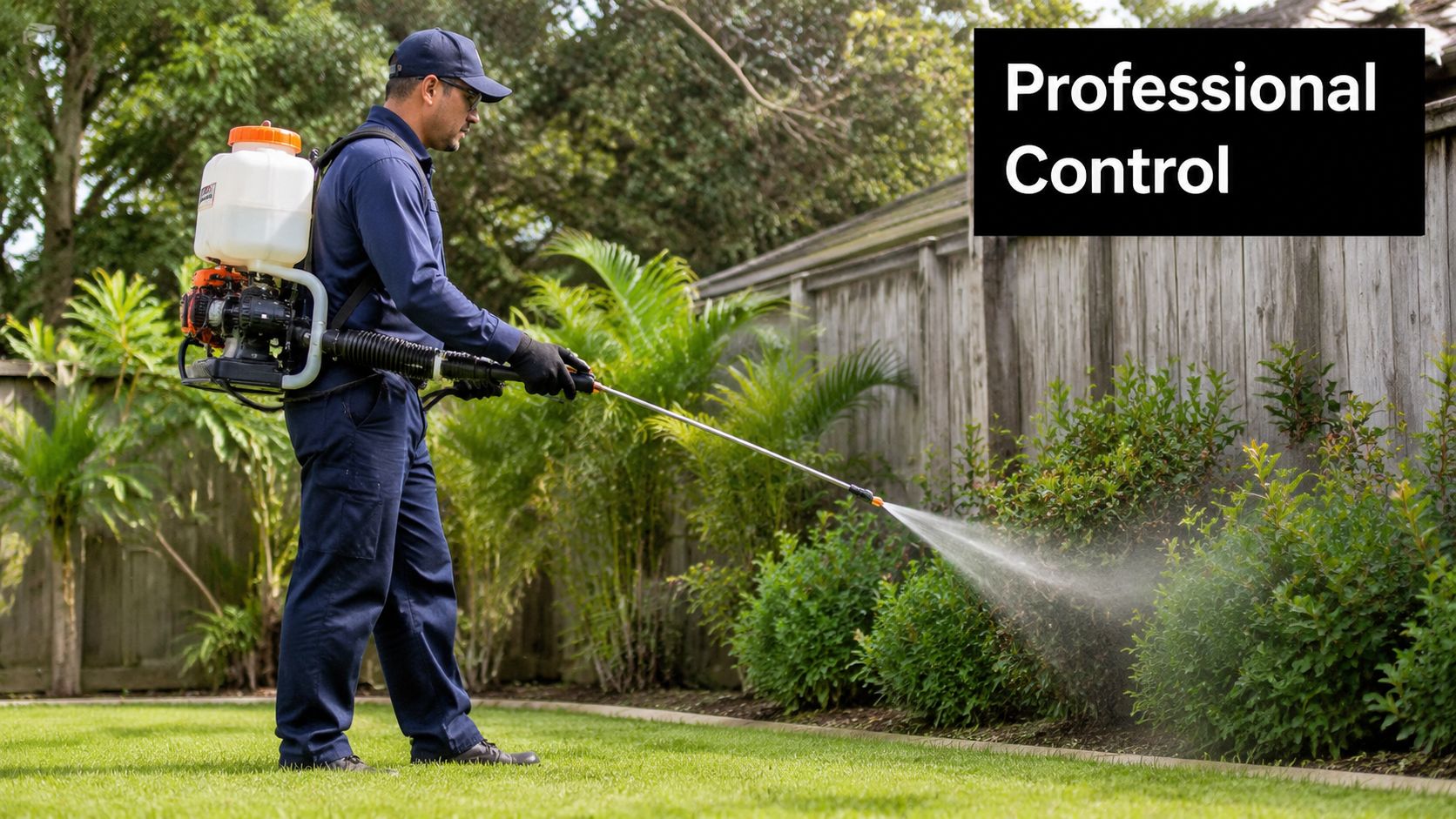
The Green Advantage Solution in Crown Point IN
The Green Advantage approaches mosquito reduction like a property problem, not a guess. For Crown Point, IN homeowners, that usually starts with a consultation and a careful inspection of the yard, the shade line, the drainage, and the spots where mosquitoes rest during the day. From there, the treatment plan can be matched to the property's layout, the season, and the level of pressure on site.
What matters most is that the process is practical. A local company that works in Northwest Indiana understands how weather swings, landscaping, and neighborhood drainage affect mosquito activity. That matters for families who want pest control near me, an exterminator near me, or reliable pest control in Crown Point, IN without a lot of back-and-forth.
The Green Advantage also brings a broader pest management mindset. Mosquito reduction fits alongside other service needs like ant control, termite control, rodent control, spider control, wasp removal, and preventative pest treatments for homes and businesses. If you need commercial pest control or ongoing residential pest control, the same local knowledge helps keep the plan realistic and easy to maintain.
A good mosquito service should leave you with two things. First, a clearer picture of what's attracting pests on the property. Second, a path forward that protects the yard without making it a science project for the homeowner.
If your evenings in Crown Point keep getting cut short, contact The Green Advantage for a property review and a service quote. The right inspection can turn a mosquito problem into a manageable one, and the sooner it's handled, the sooner you get your yard back.
A CTA for The Green Advantage.
Effective Tick Control Yard Solutions in Crown Point, IN

A lot of Crown Point homeowners reach the same point every summer. The grass looks good, the patio is ready, the dog is running the fence line, and the kids want to stay outside until dusk. But once you start finding ticks on pets, on pant legs, or near the wooded edge of the yard, relaxing gets harder.
That's especially true in Northwest Indiana, where humid weather, shaded lots, leaf litter, and tree lines give ticks exactly what they want. A generic once-over with a store-bought spray usually doesn't solve the full problem. Real tick control yard work takes a smarter plan, especially on properties near brush, drainage areas, fence rows, and woods.
For homeowners searching for pest control near me, exterminator near me, or pest control in Crown Point, IN, the goal usually isn't just to kill what's visible today. It's to make the yard feel usable again. That means lowering tick pressure, reducing hiding spots, and building a practical routine that fits how families in Crown Point use their property.
Protecting Your Family and Pets in Northwest Indiana
On a warm evening in Crown Point, the backyard should feel simple. Grill on. Kids outside. Dog circling the patio and cutting through the grass. Then somebody notices a tick crawling on a sock, or a pet comes in and needs a close check before anyone settles in for the night.
That worry is common here because many Northwest Indiana yards have the same setup. Lawn in the middle. Shrubs near the house. A fence line, wood line, or brushy border around the back. Add summer humidity and damp shade, and ticks don't have to travel far to move from edge habitat into spaces where families spend time.

Why local yards stay risky
Ticks don't need a neglected property to become a problem. A clean, well-kept yard can still have pressure if it backs up to woods, holds moisture, or gives rodents and deer easy travel routes. That's why broad online advice often falls short for homeowners in Crown Point and nearby Northwest Indiana communities.
A practical plan usually starts with the yard, but pets need attention too. If your dog is the first one bringing ticks inside, it also helps to review basics like choosing effective tick shampoo so your pet care routine matches what you're doing outdoors.
Ticks are a yard-edge problem first, but families feel the impact on patios, play areas, and pets.
What homeowners want from a real solution
Homeowners aren't looking for a complicated lecture. They want to know what works, what doesn't, and whether they can let their kids and pets use the yard without second-guessing every trip outside.
That's where local experience matters. In Crown Point, IN, a tick problem usually isn't just about one pest. The same moisture, brush, and rodent activity that support ticks can also overlap with broader residential pest control concerns like mosquito control, rodent control, spider activity, and seasonal pest issues that show up around garages, sheds, and foundations.
A good plan starts by treating the yard like a system. The wooded edge matters. Pet routes matter. Leaf litter matters. And in this area, the weather matters more than many homeowners realize.
First Steps to a Tick-Safer Yard
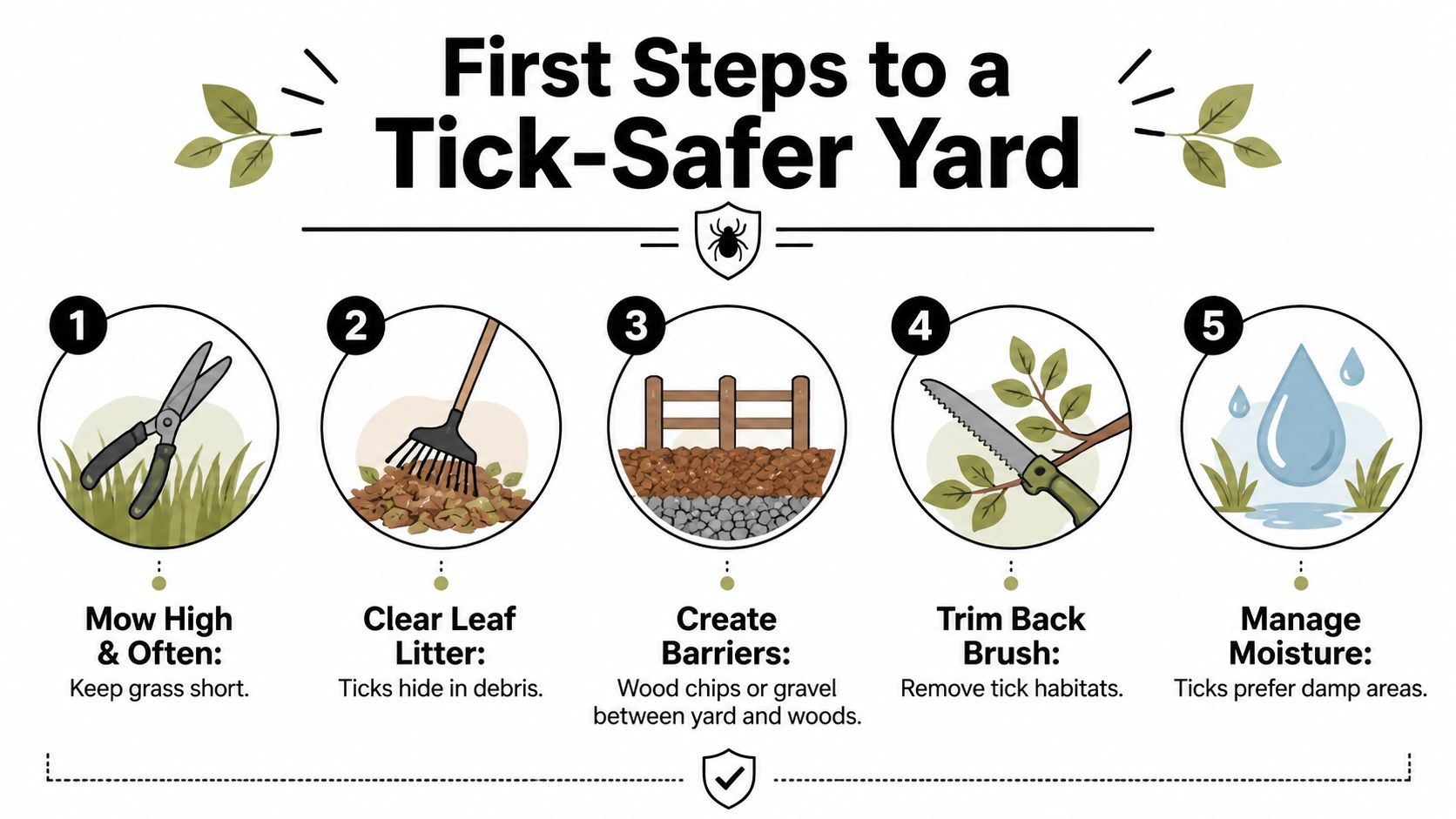
The fastest way to improve a tick control yard setup is to make the property less comfortable for ticks before you think about products. Habitat change doesn't replace treatment when tick pressure is already high, but it gives every other step a better chance to work.
Here's the yard checklist many homeowners in Crown Point can start over a weekend.
Start with mowing, borders, and cleanup
The clearest evidence-based yard method combines maintaining turf height at 2 to 2.5 inches, creating a continuous 3-foot-wide barrier of dry inorganic material between lawn and woods, and removing leaf litter and tall grasses in March to April before nymphs become active according to this yard management guidance.
That sounds straightforward, but the details matter.
- Keep turf in the right range: Grass that stays around 2 to 2.5 inches dries faster and holds less humidity at ground level. Ticks prefer the cooler, damp layer that builds up when turf gets shaggy.
- Build a real barrier: Use dry inorganic material such as crushed stone or decomposed granite. The target is a continuous 3-foot-wide barrier. Gaps defeat the point because ticks and host animals use those breaks as crossing points.
- Rake out leaf litter early: Leaf piles and matted debris hold moisture and give ticks cover. Clearing those zones before spring activity picks up helps reduce sheltered habitat.
What to avoid in the border zone
Many homeowners install a border and still wonder why activity continues. One common reason is using the wrong material.
Practical rule: Dry stone works better than moisture-holding landscape fill in tick transition zones.
Bark mulch, wood chips, and similar organic fills may look tidy, but they can hold moisture and fit right into the shaded edge habitat ticks prefer. If your yard backs to woods in Crown Point, the material choice around that line matters.
A simple maintenance routine helps keep those improvements from fading:
- Measure the edge barrier a few times through the season so it stays at least 36 inches wide and doesn't get overgrown.
- Check turf height weekly at several spots instead of just eyeballing it from the patio.
- Trim shrubs up from the soil so air and light can move underneath.
- Watch damp pockets near downspouts, play sets, fence corners, and wood storage.
Later in the season, many homeowners also look into natural tick repellent for yard options as part of a lower-impact prevention plan. Those products can play a role, but they work better when the habitat has already been corrected.
A short visual walkthrough can help you spot the weak points most yards miss.
Focus on the places people ignore
Most of the yard usually isn't the problem. The problem is the transition space.
Check these first:
- Fence lines: Tall grass and brush collect moisture and invite rodent traffic.
- Under shrubs: If you can't see bare air under the plant, it's probably holding too much shade and humidity.
- Behind sheds and wood piles: Low disturbance areas often become hiding zones.
- Pet shortcuts: Dogs create predictable routes, often straight through the coolest part of the yard.
This kind of cleanup also supports broader preventative pest treatments. A drier, more open yard is less attractive to mosquitoes, rodents, and some nuisance insects, which is why good outdoor pest management often overlaps from one service to another.
Understanding Your Treatment Options
Once the yard is cleaned up, homeowners usually compare three paths. Do it all yourself, try natural products first, or bring in professional treatment. Each can help, but they don't perform the same way and they don't ask the same amount of time from you.
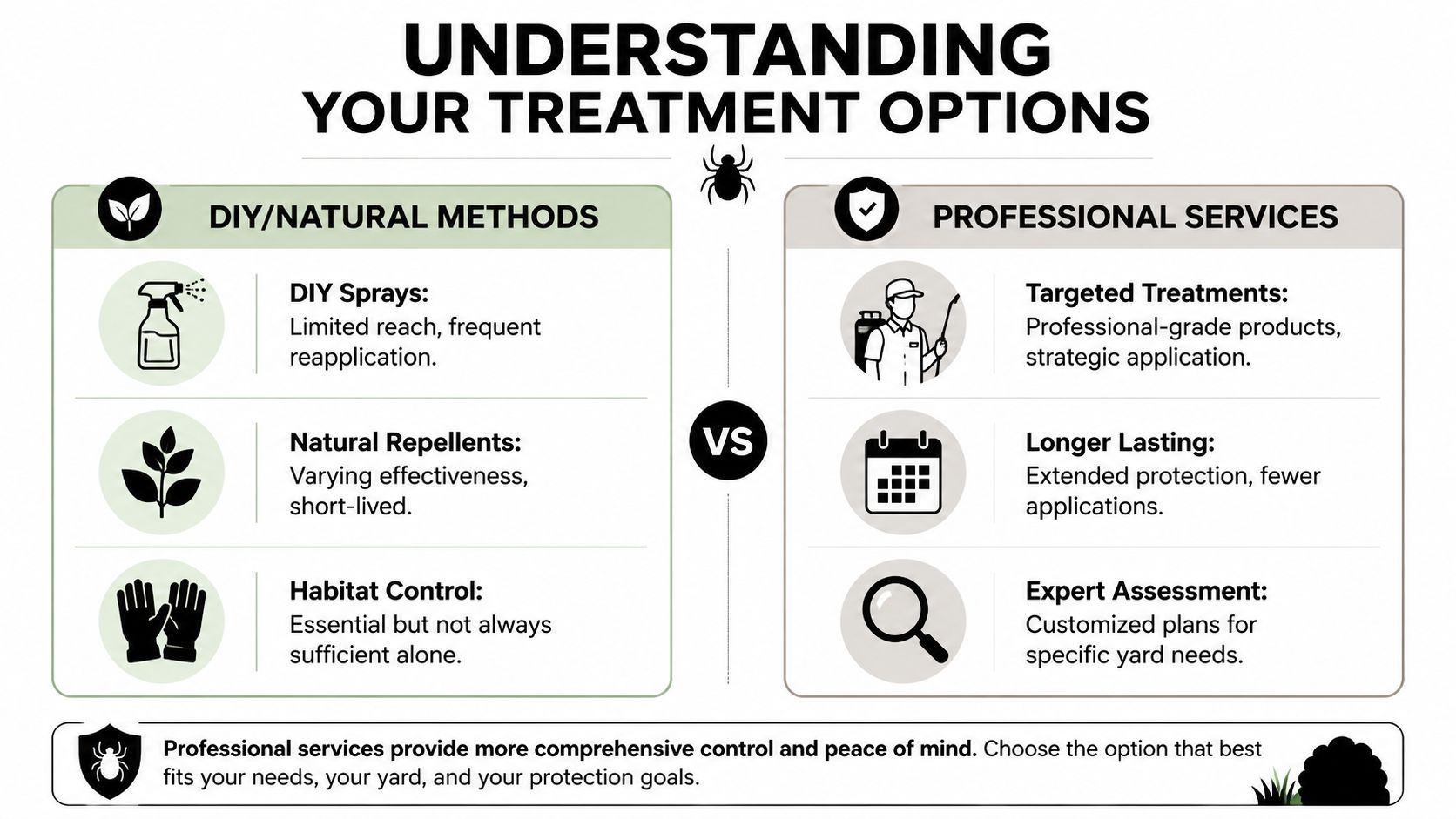
DIY and natural options
A lot of homeowners start with cedar-based sprays, botanical products, hose-end concentrates, or hand-pump applications around the perimeter. That's understandable. People want a lower-impact option, and they want to stay in control of what goes into the yard.
The trade-off is consistency. EPA-registered synthetic pesticide products labeled for ticks have consistently achieved greater than 80% suppression of blacklegged ticks in residential yards, while unregulated minimum risk 25(b) products often suppress ticks for only 1 to 3 weeks before reapplication is needed, based on this review of residential tick control studies.
That doesn't mean every natural approach is useless. It means homeowners should go in with realistic expectations. If you choose a minimum-risk product, you may need a much tighter reapplication schedule to hold the line during active periods.
Where professional service changes the outcome
Professional service isn't just “stronger spray.” A key difference is targeting. Ticks aren't spread evenly across the property, so treating the entire lawn the same way often wastes effort and misses the most important zones.
A thoughtful plan usually prioritizes:
| Area | Why it matters |
|---|---|
| Shaded bed edges | Moist ground and dense plant cover help ticks persist |
| Wooded transitions | Wildlife and rodents move ticks into the yard from here |
| Fence lines and brush | These corridors stay cooler and less disturbed |
| Pet routes and play-adjacent edges | Human and animal traffic turns tick presence into real exposure |
Some homeowners also ask about methods that reduce ticks without directly targeting the animal host. One option often discussed is the use of tick tubes with permethrin-treated cotton for mice. These are different from broad sprays and are meant to interrupt the mouse-tick cycle in a more targeted way.
For homeowners comparing local service paths, best flea and tick control for yard options can help frame the choices between one-time treatment, recurring service, and integrated plans.
The right treatment depends less on what sounds strongest and more on whether it matches the way ticks are entering and surviving on your property.
A balanced way to decide
Choose DIY-only if the yard has light pressure, limited wooded edge, and you're willing to keep up with repeated maintenance and reapplication.
Choose a professional plan when the property has recurring activity, a brushy perimeter, pet exposure, or a wooded lot line. That's often the case in Crown Point, where a clean lawn in the center can still sit next to a high-risk edge.
For many homes, habitat correction plus targeted treatment is the point where the yard starts feeling manageable again.
The Green Advantage ITM Approach for Crown Point
Generic perimeter spraying sounds convenient, but it often breaks down in Northwest Indiana. Crown Point yards deal with humid conditions, dense edge growth, and regular reinfestation pressure from nearby wooded areas. If the plan doesn't account for that, the yard may look treated on paper while ticks keep returning.
Why one-size-fits-all programs fall short here
Research highlighted in this Northwest Indiana tick yard guide notes that in humid, wooded-edge environments, tick re-infestation can occur within 4 to 6 weeks because of early summer nymph surges and heavy rain washout. That's the part many homeowners never hear when they're sold a simple “spray and forget” service.
A real integrated plan has to account for timing, weather, edge habitat, and how the property is used. A play area near a tree line needs different attention than an open front lawn. A dog run behind the garage needs different attention than ornamental beds by the porch.
What an integrated local program looks like
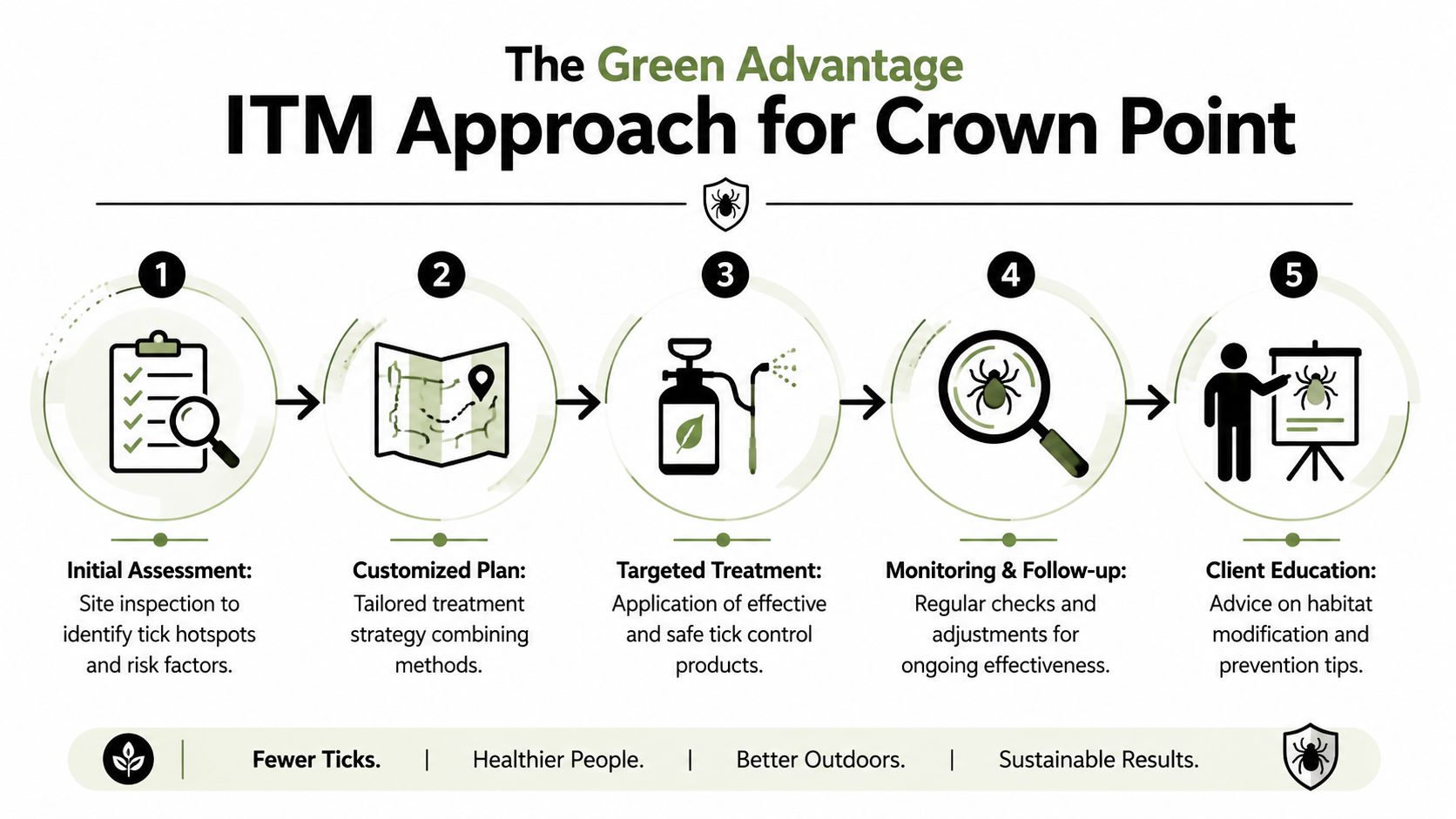
A strong ITM approach usually follows a sequence instead of relying on a single visit.
Property inspection
The first step is walking the whole site, especially the transition areas. Wood lines, leaf buildup, pet paths, low shrubs, damp corners, and rodent activity all affect where ticks hold.Habitat assessment
At this stage, the yard plan gets practical. The question isn't just where ticks are. It's why they're comfortable there.Targeted treatment
Product placement matters more than broad coverage for the sake of coverage. Shaded borders, perennial beds, and edge zones usually deserve the most attention.Follow-up and seasonal adjustment
In Crown Point, service timing has to match the season. Heavy summer rain, fresh growth, and wildlife movement can change pressure fast.Homeowner guidance
Mowing height, border upkeep, leaf cleanup, and pet traffic control all affect results between visits.
How this works on local properties
On many Northwest Indiana lots, the center lawn isn't the battlefield. The main pressure starts where the maintained yard touches brush, trees, or unmanaged neighboring ground. That's why a tick control yard program should behave more like ongoing management than a one-time application.
A season-long plan works better than a calendar reminder that says “spray once in spring.”
One local option homeowners use is The Green Advantage, which provides a thorough property inspection, identifies likely tick hotspots, and builds treatment around site conditions instead of treating every lawn the same way. That kind of approach also fits properties that may need broader commercial pest control or residential pest control support for mosquitoes, rodents, and other outdoor pest activity tied to moisture and site layout.
For Crown Point homeowners searching for an exterminator in Crown Point, IN, the key question isn't whether someone can apply a product. It's whether they can read the property and manage the problem through the season.
Comprehensive Pest Protection for Your Property
Ticks rarely show up alone as a property-management issue. The same conditions that support them often support other pests too. When a yard holds moisture, dense vegetation, debris, and rodent traffic, it becomes easier for multiple pest problems to develop at once.
Why yard conditions affect more than ticks
A shaded, overgrown perimeter can also support mosquito control needs, especially around damp ornamental beds and low-drainage areas. Rodent activity matters as well, because mice and similar animals move through the same edge habitat that supports ticks. If you're already seeing signs of gnawing, nesting, or movement around sheds and foundations, that's not a separate issue. It's part of the same outdoor pressure pattern.
A broader property plan may also include:
- Rodent control: Reducing harborage around wood piles, dense cover, and structures.
- Mosquito control: Targeting damp resting areas and breeding-prone parts of the yard.
- Spider control: Cutting back insect pressure around eaves, garages, and entry points.
- Wasp removal: Addressing nests around rooflines, play areas, and patios.
- Termite control: Protecting structures where moisture and wood contact create risk.
One property, connected pest problems
This is why many homeowners who start by searching for tick control yard services end up asking about full pest control in Crown Point, IN. They want the patio, lawn edge, garage, and foundation protected as one property, not handled as unrelated problems.
A well-managed yard does more than reduce ticks. It removes the conditions that let several pests settle in close to the home.
That's also useful for landlords, real estate professionals, and businesses that need dependable exterior conditions. Good outdoor management protects comfort, supports property value, and cuts down on the cycle of reacting to one pest at a time.
Partnering with The Green Advantage
Homeowners usually feel better once they know what the process looks like. Pest control shouldn't feel vague. You should know who's coming, what they're looking for, what they'll recommend, and what you can do between visits to keep pressure down.
What the experience looks like
The process usually starts with a phone call or quote request. That first conversation should be simple. You explain what you've seen, where you've seen it, whether pets use the yard, and whether the property backs up to trees, brush, or unmanaged ground.
From there, a technician visits the property and inspects the areas where tick pressure usually starts. That includes edges, beds, leaf litter zones, pet routes, shaded corners, and any spots where moisture lingers. If broader outdoor issues are present, this is also when related needs like rodent control, mosquito control, or other preventative pest treatments can be identified.
Why the strategy matters
This part matters because yard treatment alone has limits. A large-scale study found that springtime barrier acaricide applications reduced tick abundance on treated properties by 63%, yet did not produce a statistically significant difference in human-tick encounters or tick-borne disease incidence, according to the Journal of Infectious Diseases study. That's why a professional should treat spraying as one part of a larger plan, not the whole answer.
In practice, that means you should expect advice on yard conditions, not just product application. You should also expect clear communication about timing, follow-up, and what changes on the property may improve results.
What homeowners should expect after service
A reliable service relationship includes more than the visit itself.
- Clear findings: You should understand where the risk is highest on the property.
- Specific recommendations: Not generic cleanup advice, but practical steps tied to your layout.
- Seasonal follow-up: Tick pressure changes with weather and growth.
- Honest expectations: The goal is reduction and smarter management, not a false promise that one treatment solves every exposure risk.
For homeowners looking for pest control near me, exterminator near me, or residential pest control in Crown Point, peace of mind comes from that combination of field experience, transparency, and ongoing support.
If your yard backs up to woods, stays damp through summer, or keeps producing ticks even after DIY treatment, it may be time for a closer look. The Green Advantage works with homeowners and properties across Crown Point, IN and nearby Northwest Indiana communities to inspect risk areas, build practical treatment plans, and help families reclaim their outdoor space with more confidence.
Expert Pest Control for Flying Insects in Crown Point

A calm evening in Crown Point can turn annoying fast. You set out food on the patio, open the back door a few times, and before long you're swatting at flies, watching mosquitoes hover near the kids, or hearing that sharp buzz that makes everyone look up for a wasp nest.
That frustration is common across Northwest Indiana because our pest pressure shifts with the seasons. Wet stretches create mosquito breeding pockets. Warm afternoons push fly activity around trash areas, pet waste, and garage entries. Late summer often brings wasps closer to decks, soffits, and outdoor gathering spots. What feels like a random nuisance usually has a clear cause.
Homeowners searching for pest control near me, exterminator near me, or pest control in Crown Point, IN usually want the same thing. A straightforward answer, a practical plan, and a home that feels comfortable again. That applies to families, landlords, and commercial property managers alike.
Your Guide to Flying Insect Control in Crown Point IN
If you're dealing with flying pests around your home, the first step is to stop guessing. Mosquitoes, flies, gnats, moths, and wasps don't all respond to the same treatment. What works for one problem can do almost nothing for another, especially during a Northwest Indiana season when moisture, heat, and yard conditions keep changing.
Most flying insect issues start in one of three places. Breeding sites, food sources, or easy entry points. A low spot in the yard that holds water, a torn screen, a trash can lid that doesn't seal, or a gap around a side door can keep the problem going even after you've sprayed.
What local homeowners need most
Residents in Crown Point usually aren't looking for a lecture on insect biology. They want to know why pests showed up, whether the problem will get worse, and what fixes it.
That means looking at:
- Where insects are coming from, not just where you notice them
- What attracts them, including moisture, food waste, lights, and harborage
- When activity spikes, because Northwest Indiana weather changes treatment timing
- Which control method fits the pest, instead of using a generic spray for everything
Practical rule: Good pest control for flying insects starts with exclusion and source reduction. Treatment matters, but removing the reason insects are there matters more.
For local service businesses, that same principle applies online too. The companies that clearly explain real problems and real solutions tend to turn anonymous visitors into pest control leads because worried homeowners respond to useful, specific guidance.
Why local experience matters in Crown Point
A Crown Point property doesn't behave like a property in a drier or warmer region. Here, spring moisture, summer humidity, shaded yards, wooded edges, and nearby water features all change flying insect pressure. Residential pest control has to account for that. Commercial pest control does too, especially around loading areas, dumpsters, service doors, kitchens, and warehouse entries.
If you've been searching for an exterminator in Crown Point, IN, value isn't just someone showing up with a sprayer. It's having someone diagnose the pattern, reduce the pressure, and help keep the issue from returning.
Identifying Common Flying Pests in Northwest Indiana
Not every buzzing insect around your home needs the same response. In Crown Point, the most common calls involve mosquitoes, house flies, wasps, gnats, and fabric moths. Some are mostly outdoor pests that drift inside. Others start indoors and stay there until someone finds the source.
A quick identification check saves time and avoids the usual mistake of treating symptoms instead of causes. If the issue is wasps under the eaves, that's different from fungus gnats around overwatered houseplants or house flies tied to sanitation and entry points.
Northwest Indiana Flying Insect Identification Guide
| Insect | Key Identifiers | Primary Risk | Peak Season (NWI) |
|---|---|---|---|
| Mosquitoes | Thin body, long legs, high-pitched buzz, active around dusk and shaded areas | Bites and outdoor discomfort | Warm season, especially after rainy periods |
| House flies | Gray body, quick erratic flight, often found near kitchens, trash, or pet areas | Food contamination | Warm months, often persistent around entry doors |
| Wasps | Slender body, narrow waist, visible nest activity around soffits, decks, and overhangs | Stings and nest aggression | Late spring through summer into early fall |
| Gnats | Very small flying insects, often hovering in clusters near drains, plants, or damp areas | Indoor nuisance and recurring annoyance | Any time conditions stay damp |
| Fabric moths | Small pale or buff moths, weak fliers, often noticed near closets or stored textiles | Damage to natural fiber items | Often noticed indoors year-round |
What each pest is telling you
Mosquitoes usually mean there's standing water somewhere nearby or dense vegetation holding moisture and shade. That doesn't always mean a big pond. It can be a clogged gutter, a forgotten container, or a low spot in the yard.
House flies are often a sanitation and exclusion problem at the same time. If they keep showing up around windows or kitchen lights, check waste handling, food residue, pet waste, and door gaps.
Wasps don't need much space to get started. A small protected void under a rail, soffit, light fixture, or porch ceiling can become a regular traffic route.
When identification changes the treatment plan
A frequent pitfall for many DIY attempts arises. Homeowners see "flying bugs" and buy a general aerosol. But if the underlying issue is a nest, a breeding site, or repeated entry through damaged screens, the spray becomes a short-term interruption, not a solution.
If you need help telling one stinging insect from another, this local stinging insect identification guide is a useful reference, especially when you're trying to decide whether that insect near the roofline is likely to sting or hover.
Small differences matter. A wasp treatment focuses on nest location and safe removal. A fly treatment focuses on sanitation, exclusion, and where adults are resting or entering.
Common local patterns around homes and businesses
In residential pest control, mosquito calls often rise after rain followed by heat. Fly issues increase around patios, garages, and trash storage. In commercial pest control, doors that stay open, food handling areas, and dumpster proximity all raise the stakes.
The main point is simple. Accurate identification drives better results. That applies whether you're dealing with a porch problem at home or searching for pest control in Crown Point, IN for a storefront, warehouse, or rental property.
The Real Risks of an Uncontrolled Flying Insect Problem
An uncontrolled flying insect problem does more than annoy you. In Crown Point, I see this shift happen fast in late spring and summer. A backyard that felt fine in May can become a place the family avoids by July after standing water, humidity, and longer evenings start driving mosquito and fly activity.

Health and household concerns
Mosquitoes usually create the first complaint because bites change behavior right away. People stop using the patio, kids come back inside covered in welts, and evening yard time gets cut short. In Northwest Indiana, that pressure often spikes after periods of rain followed by heat, which is why breeding-site control matters as much as adult knockdown. Homeowners dealing with recurring mosquito activity should understand how breeding sites drive mosquito pressure around the home.
Wasps and hornets bring a different risk. One nest under an eave or near a front entry can turn a normal trip to the mailbox into a safety concern, especially for anyone with a sting sensitivity.
House flies raise another issue altogether. When they move from trash, drains, or animal waste to kitchen counters, fruit bowls, and food prep areas, the problem becomes sanitation, not simple nuisance.
Property use and daily disruption
Some flying insects affect the way a home functions even when they are not biting. Gnats around sinks or houseplants make kitchens and living areas feel damp and hard to keep under control. Fabric moths can damage stored clothing, rugs, and other natural-fiber items before the problem is noticed.
The quality-of-life piece is what many homeowners underestimate.
You start changing routines. Doors stay closed. Guests spend less time outside. Trash gets taken out early because flies build up by afternoon. For Crown Point properties near ponds, drainage areas, open fields, or wooded edges, those pressures can last through the warm season if nothing interrupts the cycle. That is one reason property owners benefit from understanding preventive maintenance, especially when recurring pest pressure is tied to moisture, entry points, and seasonal upkeep. See understanding preventive maintenance.
For business owners, the tolerance is even lower. Repeated fly activity near doors, dining areas, stock rooms, or workstations affects customer confidence and day-to-day operations fast.
Why targeted action matters
Treatment works better when it follows the insect's life cycle and the conditions on the property. According to the Minnesota Pollution Control Agency, effective Integrated Pest Management calls for identifying the pest, checking whether larval and adult activity has reached action thresholds, and treating breeding sites as well as active adults when needed. Their guidance on Integrated Pest Management thresholds for mosquito control explains why repeated spraying of visible adults alone often wastes time and money.
That trade-off shows up on real properties all over Crown Point. If mosquitoes are hatching in clogged gutters, yard items holding water, or low spots that stay wet after storms, adult sprays may reduce activity for a short window but will not stop the next wave. If flies are tied to garbage storage, drains, or animal areas, the same pattern applies.
Homeowners usually call for help when they realize the issue has become routine instead of occasional. At that point, the job is not to chase every insect you can see. The job is to find what is feeding the problem and shut that down.
Essential Prevention and Habitat Reduction Strategies
Prevention does more work than commonly believed. If you make your property harder for flying insects to enter, feed, and breed, you reduce pressure before treatment even starts. In Crown Point, that matters because spring moisture and summer humidity can keep reinfestation going unless the environment changes too.
Protect your home against flying insects with these practical steps:
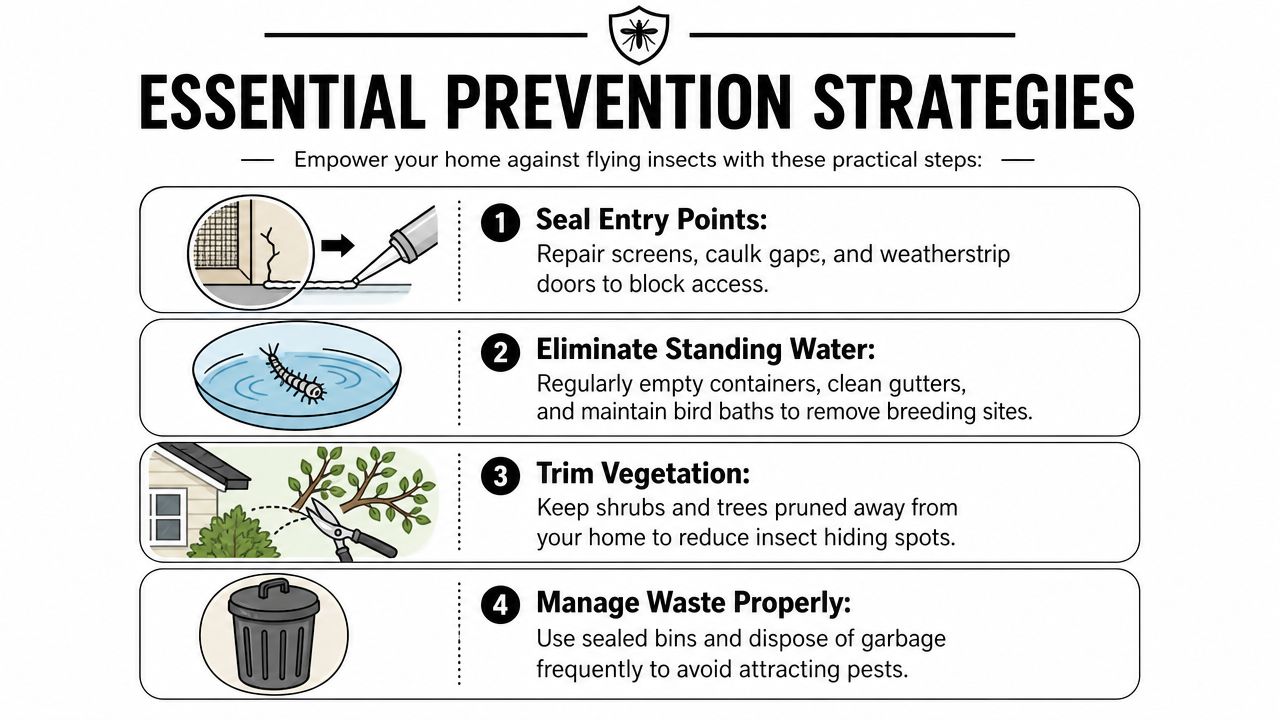
Seal up the structure
Physical exclusion is one of the most dependable parts of pest control for flying insects. The Indiana Department of Environmental Management recommends sealing openings with 16-gauge mesh as a specific physical barrier threshold to block entry points for mosquitoes and other flying pests (Indiana guidance referenced here).
That standard is worth paying attention to around:
- Window screens: Repair tears and loose corners before insect pressure peaks
- Door sweeps: Close the gap at garage and side doors where flies often enter
- Vent openings: Screen them properly instead of assuming the cap is enough
- Soffit and utility penetrations: Small openings can support repeated entry
Remove water and damp harborage
Mosquitoes don't need much water to keep a breeding cycle going. Crown Point yards with clogged gutters, decorative containers, uneven drainage, or neglected bird baths can stay productive for mosquitoes longer than homeowners expect.
A practical local checklist looks like this:
- Clean gutters: Spring and fall debris holds water longer than it should
- Empty containers: Buckets, toys, planters, and covers collect enough water to matter
- Manage bird baths: Refresh and maintain them instead of letting water sit
- Correct drainage issues: Low pockets near patios and foundations hold moisture
If mosquito activity is building around your yard, this page on mosquito breeding and mosquito control gives a clear look at what to check first around the property.
Treat prevention like routine maintenance
A lot of homeowners only react once insects are everywhere. That's understandable, but it usually means the property has been inviting pests for a while. Thinking in terms of understanding preventive maintenance helps because the same logic applies here. Small recurring checks prevent larger recurring problems.
Local reminder: In Northwest Indiana, gutters, screens, and standing water need seasonal attention. Waiting until the insects are active is later than ideal.
This short video gives a useful visual overview of prevention habits around the home.
Cut down food and shelter
Flies and gnats follow food, residue, and moisture. Wasps favor protected building features and nearby foraging areas. A cleaner exterior and tighter routine around waste handling can reduce activity noticeably.
Focus on these habits:
- Use sealed trash containers: Lids should close fully, especially in warm weather
- Pick up pet waste: Leaving it out gives flies a steady attraction point
- Trim vegetation: Branches touching siding and dense shrubs create sheltered zones
- Clean outdoor eating areas: Grease, drink spills, and food scraps keep drawing insects back
These steps matter for homes, restaurants, offices, and multi-unit properties. They also support other services people often ask about, including mosquito control, wasp removal, rodent control, and seasonal preventative pest treatments. Prevention won't always solve an established infestation by itself, but it makes every professional treatment work better.
Why DIY Flying Insect Control Often Fails
Most DIY products promise fast relief, and sometimes they do give it. The problem is that relief isn't the same thing as control. Homeowners often knock down a few visible insects, then watch the same problem return because the nest, breeding source, or entry route is still active.
Understand why store-bought solutions often miss the mark:
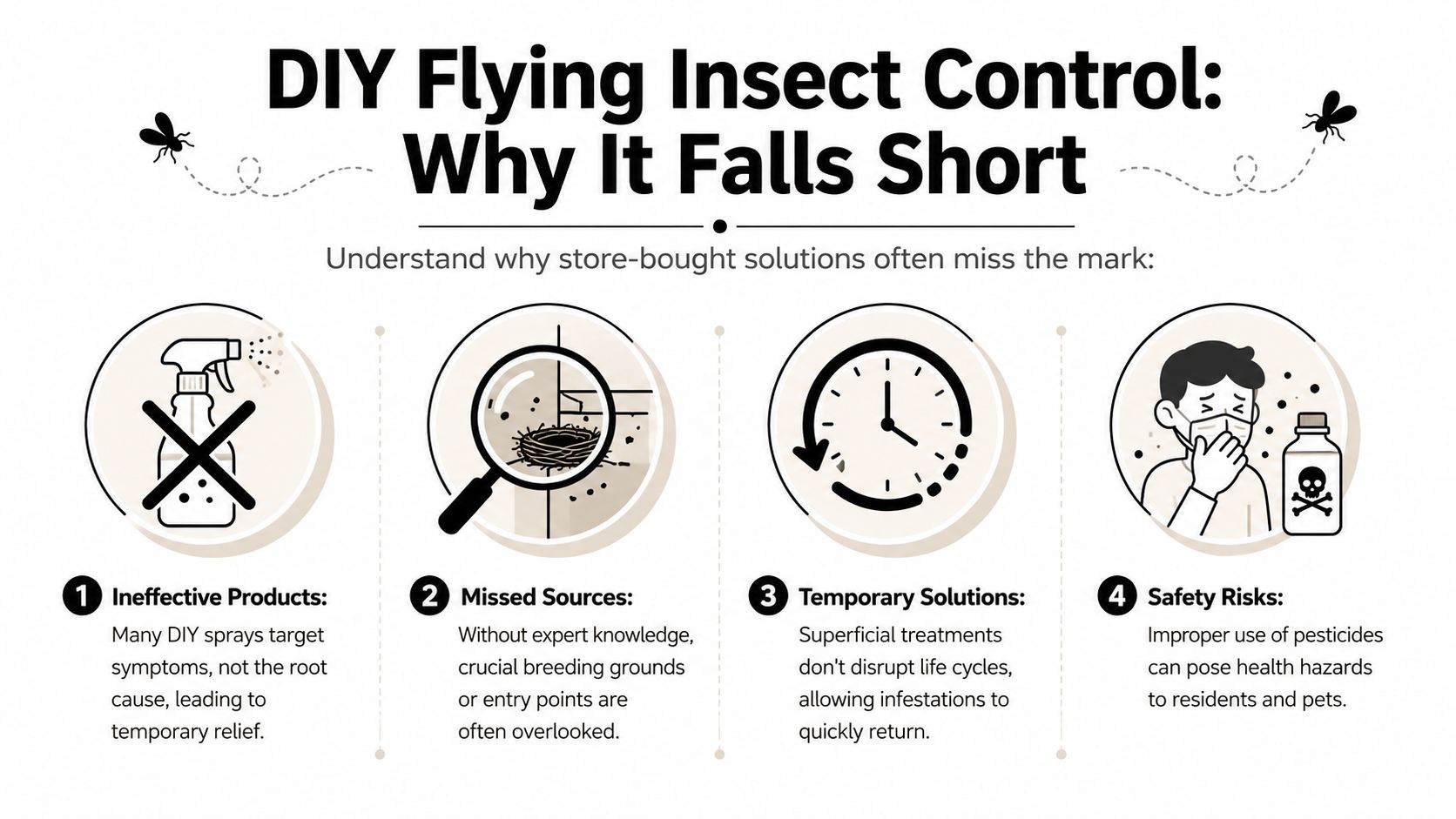
Traps and zappers get misused
One of the most common mistakes is trap placement. Industry guidelines explicitly state insect light traps should be positioned 20 feet away from outdoor living spaces. Placing traps visible from the exterior draws additional insects into the facility, whereas internal placement close to entry points intercepts them after entry (industry guidance discussed here).
That runs against the usual homeowner instinct to hang a light trap near the back door or patio. In practice, that can pull more insects toward the very space you're trying to protect.
Sprays have real limits
Many people assume a fogger or aerosol works the same in any weather. It doesn't. Area spray insecticides for flying insects are only effective within a 65°F to 90°F thermal window, and even then their contact kill duration is only 1 to 2 hours (Iowa State fly control guidance). Below that range, the chemical doesn't disperse adequately. Above it, evaporation and degradation work against you.
That matters in Northwest Indiana because evenings can cool off quickly in spring and heat can build hard in summer. A homeowner can apply a product exactly as planned and still get weak results because the conditions weren't right.
DIY usually targets the wrong stage
Adult insects get attention because they're visible. Larvae, nests, and breeding pockets don't. That's why so many treatments feel expensive without feeling effective.
A few examples:
- Mosquitoes: Spraying adults around the deck won't fix standing water nearby
- House flies: Killing visible flies won't address sanitation or resting surfaces
- Gnats: Aerosols won't solve damp drains or overwatered plant soil
- Wasps: Surface spraying random traffic routes won't remove the nest
Store-bought products often attack what you can see. Persistent infestations come from what you can't see yet.
Safety and overapplication are real concerns
Homeowners also tend to overuse products when results disappoint them. More spray, more often, in more places. That raises exposure concerns without solving the root cause.
This is why people searching for exterminator in Crown Point, IN or pest control near me often call after trying several rounds of DIY first. The issue isn't effort. It's that flying insect problems require correct identification, timing, placement, and source control. Without those, the cycle keeps resetting.
The Green Advantage Professional Treatment Process
You notice the problem at the same time many Crown Point homeowners do. A warm evening opens up after a wet stretch, the patio is finally usable, and then the flies, mosquitoes, or wasps start pushing you back inside. In Northwest Indiana, timing matters. Spring moisture, summer heat, nearby retention ponds, shaded yards, and older door and window seals all change how flying insect pressure builds from one block to the next.
Inspection comes first
A treatment plan starts with a real inspection. For homes in Crown Point, that means checking where insects are getting in, where they are resting, and what on the property is helping them stay active. The Green Advantage follows the same integrated pest management principles used in commercial work, where Green Advantage pest control articles for Crown Point and Northwest Indiana emphasize inspection, identification, and correction of the conditions behind the activity.
A good inspection checks more than the obvious hot spots. It usually includes:
- Entry routes around doors, windows, utility penetrations, soffits, garage edges, and vents
- Moisture and breeding sources such as clogged gutters, bird baths, low yard areas, drains, damp mulch, and trash zones
- Resting and nesting areas in shrubs, eaves, attic edges, storage areas, and fence lines
- Pressure patterns so service matches where insects gather at dusk, collect near lights, or build around traffic areas
In this part of Indiana, I pay close attention to season and recent weather. A property that is quiet in April can change fast after a few humid weeks in June. A yard near drainage, woods, or standing water often needs a different approach than a newer subdivision lot with mostly sun and wind exposure.
Treatment should match the pest and the structure
Good service is specific. Mosquito work around a backyard has different goals than cluster fly activity near a garage door, and neither should be handled like a yellowjacket nest in a soffit void.
The Green Advantage provides a licensed, site-specific process for homeowners and businesses in Crown Point and nearby Northwest Indiana. That process can include inspection findings, habitat correction guidance, exclusion recommendations, and targeted treatment based on the insect and the property layout.
Application details matter indoors and in enclosed areas. The EPA pesticide label for CB-80 aerosol explains that space treatments depend on correct dilution, accurate cubic footage, and keeping the area closed for the required period before ventilation. That is one reason professional handling matters. The product choice, placement, and method all have to fit the site.
What gets addressed beyond the spray
A useful service plan usually includes several parts working together:
- Exclusion recommendations: door sweeps, screen repair, vent screening, gap sealing
- Source reduction: water management, sanitation fixes, vegetation trimming, waste control
- Targeted treatments: placed where insects rest, enter, feed, or nest
- Follow-up review: checking what improved, what pressure remains, and what correction still needs to happen
That follow-up piece matters more than people think. If flies dropped inside the house but keep collecting around one exterior door, the next step may be light management, exclusion, or sanitation near that entry, not just another broad application.
Residential and commercial work have different pressure points
Residential service usually centers on family comfort, protecting kids and pets, reducing bites and stings, and making the yard usable again. Commercial properties have another layer of concern. Entry doors, trash areas, loading zones, customer visibility, and day-to-day operations all affect the plan.
Some businesses also care about how quickly missed calls and service requests are captured after closing hours. Tools like automatic lead capture after hours solve that communication problem. Pest control still comes down to inspection, response time, and correcting the conditions on site.
Long-term control comes from matching timing to local pressure
The best results usually come from a mix of methods, applied at the right time for Crown Point conditions. Early-season mosquito work has a different purpose than mid-summer fly control around waste areas or late-season wasp treatment around eaves and play spaces. The schedule matters because Northwest Indiana pest pressure shifts with rainfall, humidity, crop activity, and temperature swings.
Lasting control comes from choosing the right method for the insect, the season, and the structure, then adjusting as conditions change.
Schedule Your Crown Point Pest Inspection Today
It is late July in Crown Point. You step onto the patio to enjoy the evening, and within minutes you are swatting mosquitoes near the grass line while flies keep collecting by the back door every time it opens. That is usually the point where a quick spray from the hardware store stops helping. The problem has a source, and the source needs to be found.
In Northwest Indiana, timing matters. Wet spring conditions can set up mosquito pressure early. Mid-summer heat pushes fly activity around trash, pet waste, and damp organic buildup. Late summer and early fall often bring wasp complaints around soffits, playsets, and deck frames. If you wait too long, you usually end up treating a larger population and a wider part of the property than you would have a few weeks earlier.
Homeowners want straight answers. What insect is active. Why here. What needs to change first. A proper inspection should give you those answers without turning a simple service call into a guessing game.
What a good inspection should cover
A useful visit is practical, not complicated.
- Initial contact: explain what you are seeing, where activity is strongest, and when it ramps up
- On-site inspection: identify the insect, check entry points, look for breeding moisture, and inspect the areas that keep drawing them back
- Property-specific plan: match the solution to the structure, yard layout, current season, and pressure level
- Follow-through: treat the active issue and correct the conditions that are helping it continue
For business owners, speed matters for a different reason. Missed calls after hours can delay service while flies, gnats, or wasps keep disrupting staff and customers. Some companies use tools like automatic lead capture after hours to keep requests from slipping through while the office is closed.
Why now is the right time to call
The best time to inspect a flying insect problem is while activity is still clear and the pressure points are easy to trace. That is especially true in Crown Point neighborhoods with standing water after rain, wooded edges, retention ponds, or heavy backyard use during summer.
Good control often includes more than product application. On one property, the answer may be trimming harborage and reducing moisture near the foundation. On another, it may be sealing a gap at an entry door, adjusting exterior lighting, or changing how trash is stored between pickups. Commercial sites sometimes need exclusion measures at doors and service areas, as noted earlier in the article. The right fix depends on the insect and the conditions keeping it active.
If you have been searching for pest control in Crown Point, IN, residential pest control, commercial pest control, or an exterminator in Crown Point, IN, the next step is simple. Get the property inspected, identify the insect correctly, and use a treatment plan that fits your home, your business, and the part of the season we are in.
If you're ready for a clearer answer and a practical plan, contact The Green Advantage to schedule a pest inspection or request a quote for your Crown Point property.
How to Keep Mosquitoes Out of Rain Barrel: 2026 Guide
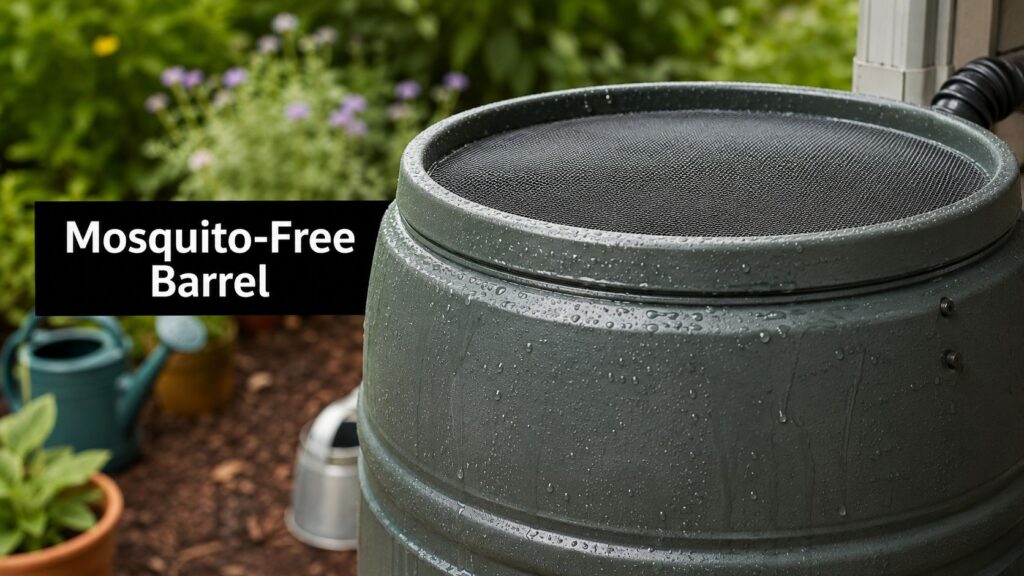
A lot of Crown Point homeowners set up a rain barrel for the right reasons. You want to save water, keep a garden healthy, and make better use of every heavy Northwest Indiana rain. Then a few warm evenings pass, and the same setup that felt smart starts drawing buzzing, biting mosquitoes right where your family wants to relax.
That's the frustrating part about mosquito problems. A rain barrel can look clean, useful, and harmless while still acting like a reliable breeding spot. If you've been searching for how to keep mosquitoes out of rain barrel systems without giving up your garden routine, the answer starts with solid DIY habits. It ends with a bigger view of your whole property.
Your Crown Point Backyard Oasis or a Mosquito Magnet?
A homeowner in Crown Point might spend a Saturday doing everything right. The flower beds are mulched, the vegetable garden is thriving, and the rain barrel is hooked up neatly to the downspout behind the shed. By early evening, the patio should be the best spot in the yard.
Instead, people start swatting.
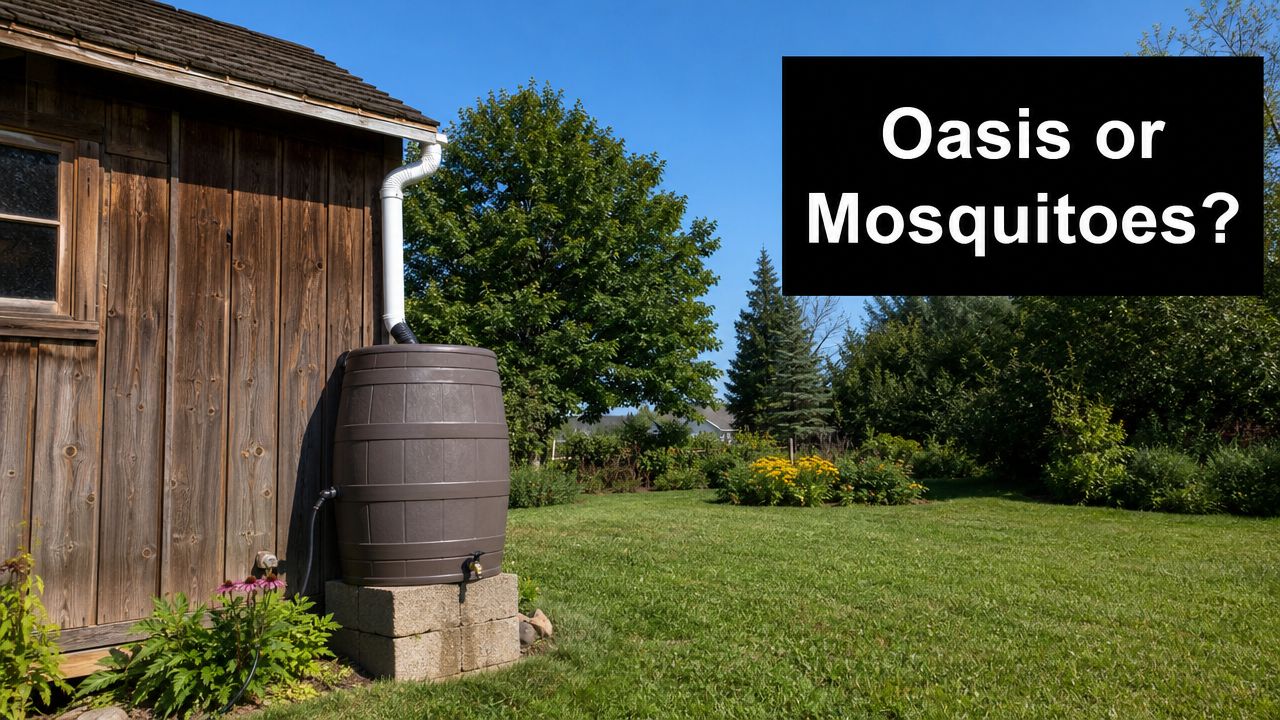
That's a common pattern in Northwest Indiana. Rain barrels support eco-conscious landscaping, but they also create exactly what mosquitoes look for if the system isn't managed carefully. The problem usually isn't the idea of rainwater collection itself. The problem is that mosquitoes only need access to still water and a small opening.
Why good intentions still lead to bites
Most homeowners don't ignore mosquito prevention. They install a lid, maybe add a screen, and assume they've handled it. Then the bites continue, often because the actual access point isn't obvious. It may be an overflow opening, a loose connection, or a bit of water that never fully drains.
Local reality: In Crown Point, warm weather, summer storms, shaded yards, and dense landscaping give mosquitoes plenty of backup habitat even when the barrel seems like the only issue.
That's why a rain barrel problem rarely stays isolated. The mosquitoes coming from one water source don't stay politely near the spigot. They move into seating areas, around entry doors, and across the whole yard.
Why local help matters
Homeowners searching for pest control near me, exterminator near me, or pest control in Crown Point, IN usually aren't looking for theories. They want a practical fix that protects their home life. Families want to grill, kids want to play outside, and property owners want outdoor spaces to feel usable again.
For mosquito issues, local experience matters because Northwest Indiana yards have recurring patterns. Heavy rainfall, clogged gutters, low spots in turf, ornamental containers, and rain barrels all work together. A company serving this area needs to understand the full picture, not just the single container holding water.
Understanding Why Mosquitoes Love Your Rain Barrel
A rain barrel gives mosquitoes what they need most. It holds water in one place, often in a shaded or partially shaded area, and many setups stay undisturbed for days at a time. That combination is enough to turn a useful gardening tool into a dependable mosquito nursery.
The key timing issue is simple. Rain barrels must be completely drained within five days of filling to prevent standing water from becoming a high-risk breeding habitat, because the mosquito life cycle from egg to adult typically takes 7 to 10 days depending on temperature, as explained in Blue Water Baltimore's rain barrel mosquito guidance.
What happens inside the barrel
Female mosquitoes look for still water where they can lay eggs. Once eggs hatch, larvae stay in the water and continue developing. If the water sits long enough, the cycle keeps moving.
That's why a barrel can become a problem quickly after rain, especially during warm spells in Crown Point. Homeowners often think, “It's just one barrel.” Mosquitoes don't see it that way. They see protected water with very little disturbance.
If you want a broader look at how standing water drives yard infestations, The Green Advantage's mosquito breeding and mosquito control guide is a useful companion resource.
Why this gets worse in Northwest Indiana
A rain barrel doesn't sit in isolation. In many Crown Point yards, it sits near shrubs, fences, mulch beds, and shaded corners that give adult mosquitoes places to rest during the day. After they emerge, they already have shelter nearby.
Here's where homeowners often underestimate the problem:
- Warm weather speeds activity. Mosquito development and feeding pressure increase during the season when families spend the most time outdoors.
- Storm cycles refill the problem. A barrel that was safe one week can become risky again after the next heavy rain.
- Backyards add support habitat. Gutters, toys, planters, tarps, and low spots can keep the local mosquito population going even if one source is addressed.
Mosquito control works better when you treat the barrel as one part of a yard-wide system, not the whole system.
That shift in thinking matters. If your goal is learning how to keep mosquitoes out of rain barrel setups, the first step is understanding that the water itself is only part of the issue. The second step is making sure every opening, every maintenance habit, and every surrounding condition supports prevention.
First-Line Defense A Homeowner's Guide to Rain Barrel Safety
The most effective DIY prevention starts with blocking access, treating water when needed, and keeping the barrel from holding old water. Homeowners can make real progress with a few disciplined habits, especially when they focus on details instead of assumptions.
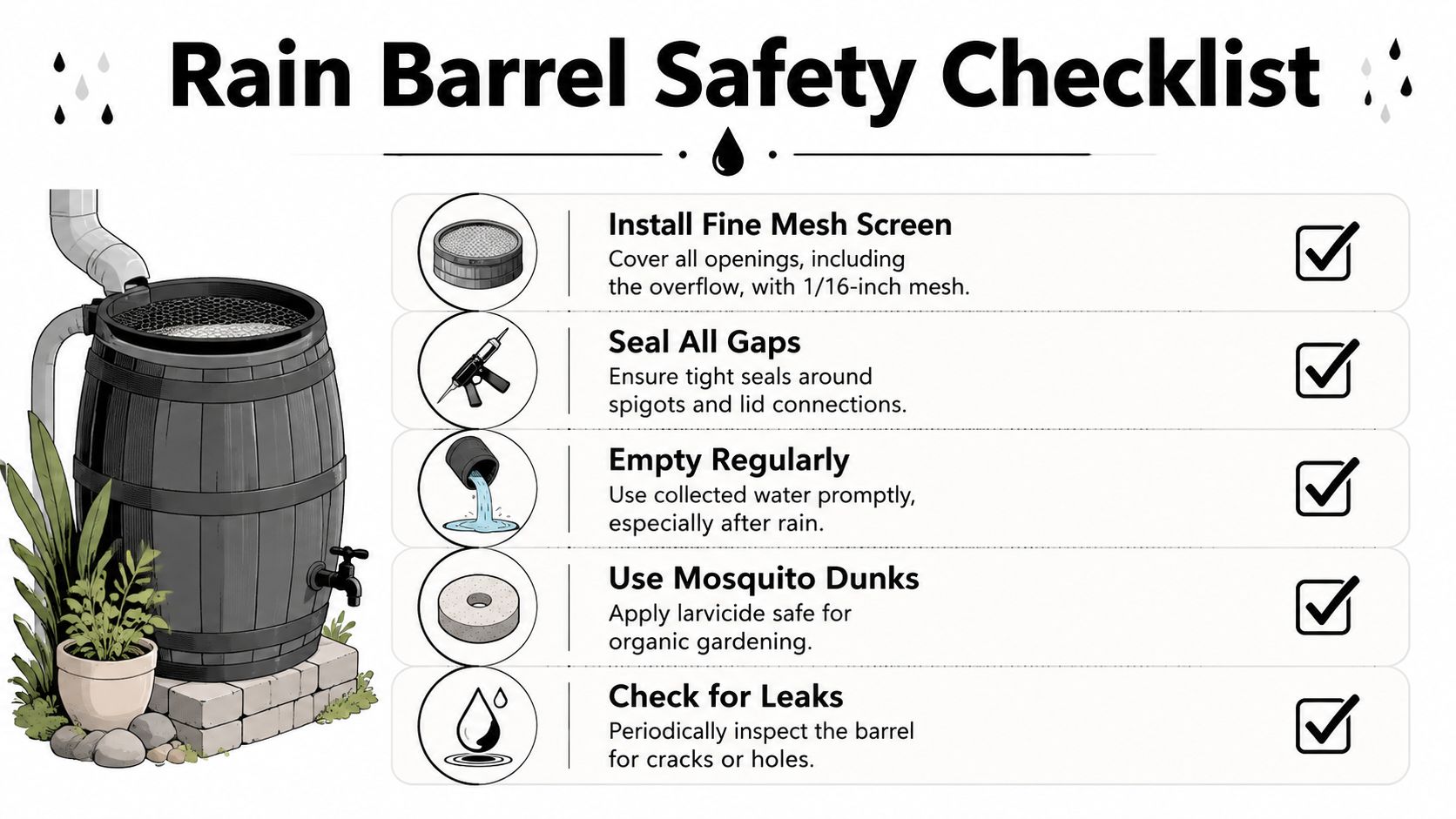
Start with the screen, not guesswork
A lid alone isn't enough if mosquitoes can get through the mesh or around it. Mosquito presence in rain barrels is reduced by over 90% when a mesh covering with a 1/16-inch (about 1.6 mm) aperture is installed over the lid, according to the University of Illinois rain barrel guidance. That size matters because smaller mosquito species can pass through standard window screen mesh.
Use that fact as your baseline standard, not as an upgrade.
What to check on the barrier side
- Use the right mesh size. Install 1/16-inch mesh over the lid opening, not standard window screen.
- Cover every opening. The overflow port, intake points, and any access holes need the same level of protection.
- Tighten the fit. A high-quality screen won't help if edges lift or gaps form around the frame.
Practical rule: If a mosquito can reach the water from any opening, the barrel is still vulnerable.
A lot of DIY setups fail because the homeowner screens the obvious opening and misses the smaller one.
Here's a visual walkthrough to reinforce the basics before you inspect your own setup:
Use BTI correctly
If your barrel regularly holds water, Bacillus thuringiensis israelensis, or Bti, is one of the most practical larval control tools available. Vector control guidance says Bti products such as mosquito dunks or bits eliminate 95 to 100% of mosquito larvae in rain barrels when applied at one dunk, about 4 grams, per 50 to 100 gallons of water monthly, according to San Diego County rain barrel mosquito prevention guidance.
Bti works on mosquito larvae in the water and is described there as non-toxic to humans, pets, plants, and wildlife. That makes it a solid fit for homeowners using collected rainwater in garden beds.
If you want product-specific guidance before you buy, this mosquito dunks overview from The Green Advantage helps explain what to look for.
Keep water moving out, not sitting in
Drain and use the water promptly after rain. The most effective barrel is the one that doesn't sit full for long periods. If your gardening routine doesn't use the stored water often enough, the system may be oversized for how your household operates.
A simple maintenance routine usually looks like this:
- Inspect after every rainfall. Check the lid, screen, overflow area, and spigot connections.
- Use the stored water quickly. Don't let the barrel become a long-term holding tank unless it's managed consistently.
- Reapply Bti on schedule. Follow the label and your barrel volume carefully.
DIY rain barrel safety can work. It just works best when homeowners stay exact about the details.
When DIY Isn't Enough The Hidden Risks You Might Miss
Many online guides make rain barrel mosquito control sound simple. Screen the lid, drop in a dunk, and move on. In practice, that's where a lot of homeowners get tripped up.
The missed issue is often residual water. The BlueBarrel rain barrel mosquito article points out that water trapped below outflow valves or in decorative top depressions can create hidden breeding zones, even when the lid is screened. In other words, a barrel can look protected from the top while still holding mosquito-friendly water elsewhere in the design.
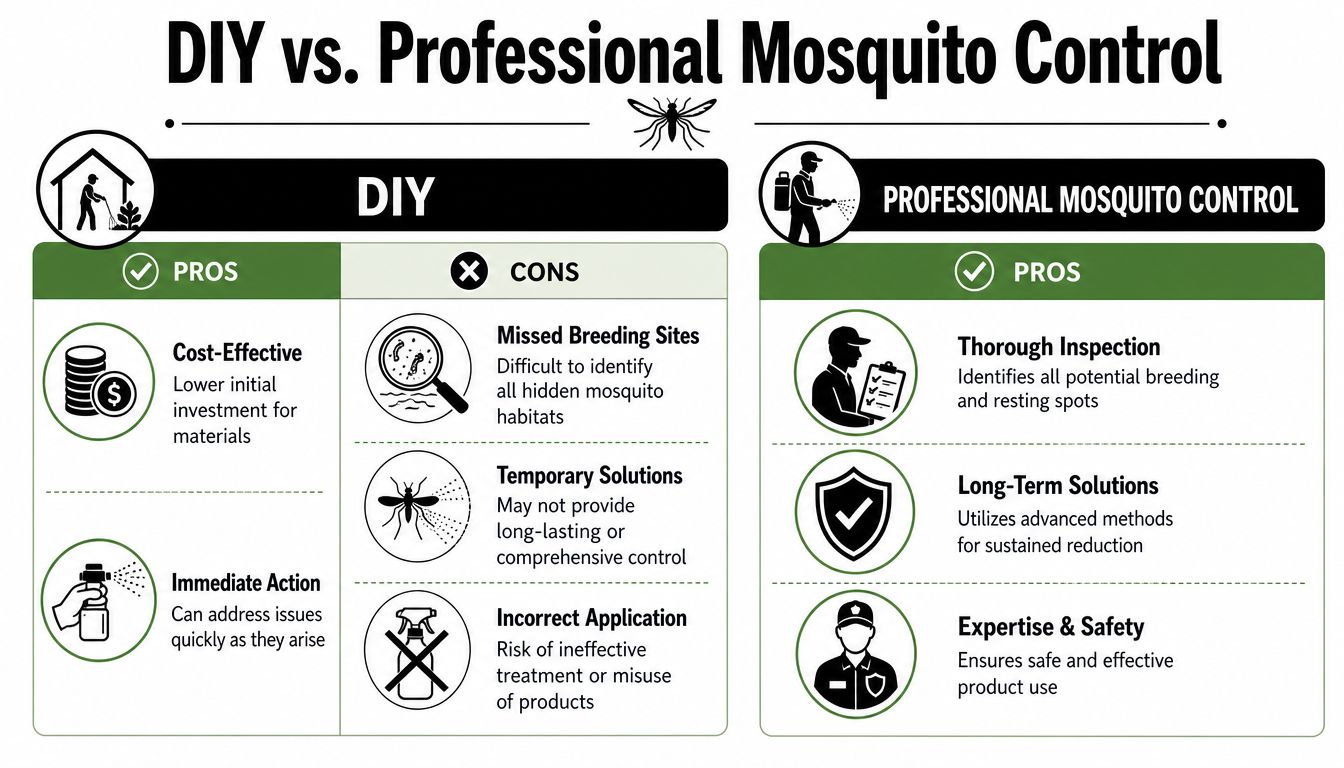
The failure points homeowners overlook
A barrel doesn't have to be obviously open to become a problem. Small mechanical details matter.
| Hidden issue | Why it causes trouble |
|---|---|
| Overflow ports | Mosquitoes may access water if these openings aren't screened securely |
| Water below the spigot | The barrel may appear drained while a small pocket of water remains |
| Top depressions | Certain designs hold water above the main chamber |
| Loose fittings | Tiny gaps around connections can defeat otherwise careful screening |
That's why some homeowners feel like they're doing everything right and still getting bitten.
BTI has a limit
Bti targets larvae. It does not solve every water-quality issue inside a barrel. Homeowners sometimes notice stagnant water starts smelling unpleasant, especially when organic debris builds up and oxygen levels drop. That rotten-egg type odor pushes people to look for aeration or other maintenance changes, because larval control alone doesn't make stored water fresher.
A rain barrel can be mosquito-managed and still be poorly maintained.
That distinction matters. DIY steps are useful, but they're narrow. They address one part of one breeding site. They don't inspect nearby gutters, shaded puddling, clogged drains, or dense foliage where adult mosquitoes rest during the day.
For many homeowners in Crown Point, that's the turning point. The issue isn't whether DIY advice is wrong. It's that mosquitoes exploit the small things that are often overlooked during routine checks.
A Comprehensive Mosquito Control Plan for Your Indiana Home
A well-maintained rain barrel is a smart start. It isn't a full mosquito control program.
If mosquitoes are active across your yard, the barrel may be one contributor among many. Northwest Indiana properties often have several repeat problem areas at the same time. Gutters hold water after storms, low spots stay damp, kids' items collect rain, and thick shrubs give adult mosquitoes daytime shelter. Sealing one container won't remove pressure from the rest of the property.
What a property-wide approach looks like
Professional mosquito control works better when it combines inspection, habitat reduction, and targeted treatment. For homeowners seeking residential pest control, that means looking beyond visible water and asking where mosquitoes are breeding, where they're resting, and why the property keeps supporting them.
A complete plan typically includes:
- Yard inspection. Identify standing water sources, drainage trouble spots, and shaded resting areas.
- Prevention guidance. Correct barrel issues, gutter problems, and routine moisture traps around the home.
- Targeted mosquito reduction. Address active mosquito pressure where people use the yard.
- Seasonal follow-up. Recheck conditions as weather patterns change.
This is also where broader pest management matters. Homes that need mosquito help often benefit from other preventative pest treatments at the same time, especially when dense landscaping, moisture, and exterior clutter also support spiders, wasps, ants, or rodents. For businesses and shared properties, the same logic extends to commercial pest control programs that protect entrances, outdoor common areas, and customer-facing spaces.
Why local service beats one-size-fits-all advice
In Crown Point, IN, mosquitoes respond to local weather, yard layout, and how each property drains after rain. A generic checklist won't tell you which low corner of the fence line stays wet longest or which shrub mass is holding the most adult activity.
That's where The Green Advantage fits. Their mosquito control service can be used alongside homeowner maintenance steps such as proper screening and Bti use, while also addressing the broader outdoor conditions that a rain barrel guide alone won't solve.
Peace of mind usually comes from layered control, not a single product or a single fix.
That's the difference between searching for exterminator in Crown Point, IN and buying one more DIY item. One path gives you tools. The other gives you a plan.
Enjoy Your Yard Again with The Green Advantage
Individuals don't contact a pest company because they enjoy talking about insects. They call because mosquitoes are changing how they live at home. The patio goes unused. Kids come inside covered in bites. Even basic yard work becomes miserable.
That's why professional mosquito control has value beyond convenience. It helps protect comfort, routine, and confidence in your own outdoor space. Homeowners looking for pest control near me or exterminator near me usually want a clear answer to one question. Can someone help me get this under control without turning it into a full-time job?
What working with a local pest professional should feel like
The process should be simple and direct.
First, the property needs a careful review. That includes the rain barrel, but it shouldn't stop there. A serious inspection also looks at drainage patterns, vegetation, recurring moisture points, and other breeding or resting sites around the home.
Second, you should get practical recommendations that match how you use your yard. Some families need a stronger focus on patio and play areas. Some properties need more prevention work near landscaping and structures. For landlords and local businesses, the priority may be keeping shared outdoor areas more usable and reducing complaints.
Thorough service matters when the barrel is already active
When larvae are already present or the water smells foul, the proper mechanical response is immediate. The San Gabriel Valley Mosquito and Vector Control District rain barrel guidance says to remove 100% of the water and scrub the interior walls with a scrub pad and warm, soapy water to detach mosquito eggs that stick to the barrel sides.
That kind of detail matters because mosquitoes don't only rely on what's floating in the water today. They take advantage of what remains stuck to surfaces and what gets overlooked during cleanup.
Homeowners get better results when they stop treating mosquito activity as a one-time annoyance and start treating it like an outdoor pest issue that needs structure.
For families in Crown Point and nearby Northwest Indiana communities, the right solution is usually a blend of good homeowner habits and consistent local expertise. That applies whether you're dealing mainly with mosquitoes or also need support with spider control, wasp removal, ant control, rodent control, or other seasonal pest issues around the property.
If you want your yard back, the next step isn't complicated. Get the problem inspected, get a realistic plan, and stop letting one overlooked water source dictate how your family uses the outdoors.
If mosquitoes are taking over your yard in Crown Point, IN or nearby Northwest Indiana communities, contact The Green Advantage to schedule a pest inspection or request a quote. Whether you need help with a rain barrel issue, ongoing mosquito control, residential pest control, or commercial pest control, you'll get clear guidance, practical solutions, and a service plan built for your property.
How Long Do Mosquitoes Live Without Food?
Most mosquitoes die within 2 to 4 days if they have no food at all, meaning no sugar and no blood. That sounds simple, but it's misleading for homeowners because mosquitoes almost always find a sugar source outdoors, and female mosquitoes can still survive up to 14 days without feeding when conditions are favorable.
If you're in Crown Point, IN, you've probably dealt with this firsthand. You step outside on a warm evening to sit on the patio, let the kids play, or grill dinner, and within minutes everyone's swatting, itching, and heading back inside. A lot of people then ask the same practical question: if mosquitoes can't live long without food, can you just wait them out or remove what attracts them?
That usually doesn't work in a real Northwest Indiana yard. Mosquitoes don't need much to keep going, and backyards give them plenty of places to rest, hide, breed, and refuel. That's why homeowners searching for pest control near me, exterminator near me, or pest control in Crown Point, IN are often looking for more than a quick spray. They want a solution that effectively holds up.
Your Trusted Local Exterminator in Crown Point IN
In Crown Point, mosquito problems rarely feel small. One family can do the right things, dump standing water, trim back growth, and still get driven indoors because the pressure isn't coming from just one flower pot or one puddle. It's coming from the whole environment around the property.
That's the reality across Northwest Indiana. Summer moisture, shaded landscaping, backyard features, and neighboring conditions all give mosquitoes enough support to hang around longer than most homeowners expect. By the time homeowners search for exterminator in Crown Point, IN or residential pest control, they're usually already tired of trying piecemeal fixes.
Local reality: A mosquito problem in your yard usually isn't one isolated source. It's a combination of resting areas, moisture, nearby breeding spots, and steady access to plant sugars.
The biggest misunderstanding is thinking mosquitoes only depend on blood. They don't. Blood matters for egg production, but sugar keeps them going day to day. That means removing a few attractive plants or assuming they'll disappear if no one is outside for a while won't solve the issue.
What homeowners are really up against
A backyard mosquito issue often builds from several conditions working together:
- Shaded harborage: Dense shrubs, low branches, and overgrown edges give mosquitoes cool places to rest during the day.
- Moisture pockets: Gutters, toys, planters, tarps, and low spots hold water longer than people realize.
- Easy sugar access: Nectar, fruit residue, and natural plant juices are enough to keep mosquitoes alive.
- Constant reinfestation: Even if you reduce activity in one area, mosquitoes can move in from nearby properties.
That's why mosquito work belongs in the same conversation as preventative pest treatments, spider control, rodent control, and other exterior pest management. A home's outdoor environment affects what ends up around doors, patios, garages, and entry points.
How Long Mosquitoes Actually Live Without Food
You walk out to the patio after two quiet days and expect the mosquitoes to be gone. Then the first one lands on your arm before the grill is even hot. That happens because mosquitoes do not need much to stay alive, and in a Crown Point yard, they usually find it.
The short answer to how long do mosquitoes live without food depends on what kind of food is missing. Sugar is their day-to-day fuel. Male mosquitoes live on plant sugars. Female mosquitoes use sugar too, and blood helps them produce eggs.
According to Oh Deer's mosquito lifespan reference, mosquitoes that are completely cut off from food survive only a few days. Female mosquitoes can last longer when they still have access to sugar, even without a blood meal. For a homeowner, that is the part that matters. A mosquito does not need to feed on people every day to remain a problem in the yard.
Sugar keeps the problem going
In real backyards, total starvation almost never happens. Mosquitoes can use nectar, plant fluids, and other natural sugars from landscaping around your home or a neighboring property. Even a clean yard can still support adult mosquitoes long enough for them to rest, bite, and keep the cycle going.
That is why DIY logic often breaks down. People assume less standing water or fewer evenings outside will make the problem fade on its own. What happens is adult mosquitoes keep finding enough sugar to survive while new mosquitoes continue developing in overlooked water sources.
What “without food” means in practice
| Condition | What it means for survival | What it means for your yard |
|---|---|---|
| No food at all | Survival is brief, only a few days, based on the source above | This is rare outdoors |
| Sugar available, no blood meal yet | Females can stay alive and keep searching for a host | Biting pressure can continue even if people are not outside much |
| Favorable shelter and moisture | Adults last longer and remain active around resting areas | Shrubs, low branches, and shaded corners stay productive for mosquitoes |
The trade-off is simple. You can spend time trying to remove every possible sugar source, every damp hiding place, and every breeding pocket, or you can treat the property in a way that reduces adult activity and interrupts the life cycle. In the field, I can tell you the first option is not realistic for most homeowners.
This also explains why mosquito pressure can continue late into the season. If you want the local timing behind that, our guide on when mosquito season ends in Northwest Indiana breaks down what changes and what does not.
A mosquito problem does not disappear just because food seems limited. In Northwest Indiana, the practical answer is that mosquitoes usually survive long enough to keep biting unless the property is treated correctly.
Local Factors in Northwest Indiana That Help Mosquitoes Survive
Northwest Indiana gives mosquitoes more help than most homeowners realize. In Crown Point, warm weather, humidity, environmental shade, and regular access to water all support mosquito activity. Even a well-kept property can stay attractive if there are damp resting zones and nearby breeding pockets.

Why our local environment matters
Mosquitoes don't need a swamp to become a problem. They use low spots in lawns, clogged gutters, birdbaths, patio containers, and drainage trouble around homes and commercial properties. In neighborhoods across Crown Point and nearby Northwest Indiana communities, that adds up fast.
A few local pressure points show up again and again:
- Backyard water sources: Decorative features, pet dishes, planters, and rain collection points can support mosquito development.
- Dense vegetation: Foundation plantings, fence lines, and shaded corners create daytime shelter.
- Regional moisture: Seasonal rain and humid stretches make it harder for breeding areas to dry out quickly.
Overwintering changes the picture
Some mosquito problems don't reset as neatly as people think when summer ends. According to this entomology discussion on overwintering mosquitoes, standard mosquitoes may survive 2 to 4 days without food, but overwintering adult females such as some Culex can survive up to 100 days in a hibernation state without feeding if they remain in cool, leaf-littered environments that limit dehydration.
That matters in Northwest Indiana because it shows why seasonal assumptions can lead homeowners astray. Fall doesn't always mean the issue is finished. Some mosquito populations persist through protected conditions and come back into play later.
For a closer look at seasonal timing in our area, see when mosquito season ends in Northwest Indiana.
A yard can look quiet and still support the next wave of mosquito activity if cool hiding spots and moisture stay in place.
Why Professional Mosquito Control Is Your Best Defense
You step outside after dinner in Crown Point, the yard looks dry, and within five minutes everyone is swatting. That usually means the mosquitoes are not coming from one obvious puddle or one corner of the property. They are cycling through shaded resting spots, small hidden water sources, and neighboring conditions that retail products rarely touch.

Homeowners do help their own situation when they dump water, clean gutters, and cut back heavy growth. I recommend that. The trade-off is that cleanup alone takes time, has to be repeated, and still misses the mosquito life stages you do not see. A bug zapper kills random flying insects. Citronella gives limited, short-range relief. Store-bought sprays may knock down some adults for a day or two, but they do not give consistent control across the whole yard.
Professional mosquito service works better because it is built around how mosquitoes use a property in real life:
- Breeding areas: containers, low spots, drainage edges, and other places that hold enough moisture for development
- Resting sites: shrubs, fence lines, under decks, and shaded foliage where adults wait out the heat
- Travel and bite zones: patios, play areas, entry points, and the humid edges where people notice pressure
As noted earlier, mosquitoes can survive longer than many homeowners assume when temperature, shade, and moisture line up. That is why waiting for them to die off on their own usually fails. In Northwest Indiana, one wet stretch or one overlooked harborage area can keep the cycle going.
A good local program is not just a spray visit. It is inspection, targeted application, timing, and follow-up based on how Crown Point properties hold water, shade, and humidity through the season. That local piece matters. A wide-open lot behaves differently than a fenced yard with dense landscaping and a low, damp rear property line.
Health is part of the decision too. Homeowners who want a clearer picture of that side of the problem should read our guide on mosquito-borne risks and how mosquito control services mitigate them.
Professional mosquito control reduces the source of the problem and the places mosquitoes hide between bites.
That same planned approach is why homeowners comparing commercial pest control, eco-friendly pest control, or residential pest control usually get better results from scheduled service than from shelf products used one weekend at a time.
Protect Your Health and Reclaim Your Crown Point Yard
The goal of mosquito control isn't just fewer bites. It's getting your yard back so your family can use it.

A treated property feels different in everyday life. You can sit on the patio longer, let the kids play outside without constant swatting, and enjoy evenings that don't end the second mosquitoes show up. For many homeowners in Crown Point, that quality-of-life change is what makes mosquito service worth it.
More than comfort
Mosquito reduction also supports a healthier outdoor environment around the home. Less mosquito pressure means fewer bites, less irritation, and less stress about what's hovering around family gathering spaces, play areas, and entry doors.
That peace of mind usually connects with other pest concerns, too. Homeowners who need mosquito control often also need help with ant control, wasp removal, spider control, or broader preventative pest treatments that keep seasonal pest issues from stacking up around the house.
Good pest control protects how you live in your home, not just the structure itself.
This short video gives a useful visual look at the kind of outdoor mosquito challenge many homeowners are dealing with:
For homeowners in Northwest Indiana, that broader protection matters. Mosquitoes may be the reason you start looking for pest control near me, but the right provider should also help you stay ahead of the other pests that show up with the seasons.
Our Pest Control Process for Your Home or Business
When homeowners or property managers call for help, they want to know what happens next. A clear process matters because good pest control isn't guesswork. It's inspection, targeting, treatment, and follow-through.

What to expect
Initial contact
You explain what you're seeing, where activity is worst, and whether the problem affects a home, rental, office, or outdoor common area.On-site evaluation
A technician checks the property for breeding conditions, resting areas, moisture issues, and the parts of the yard or building perimeter where mosquito pressure is strongest.Treatment plan built for the property
No two properties in Crown Point are identical. Shade, drainage, vegetation, use patterns, and nearby conditions all change the approach.
Why the process matters
A professional plan should do more than react to today's swarm. It should improve control over time by addressing the reasons mosquitoes keep returning.
That often includes:
- Targeted applications: Focused treatment in the zones where mosquitoes rest and reproduce
- Site recommendations: Practical guidance on standing water, trimming, storage, and yard conditions
- Ongoing support: Follow-up service when the property needs continued reduction and seasonal protection
For homeowners and businesses alike, that structure creates consistency. It also helps when mosquito control is part of a larger service need that may include termite control, rodent control, or routine exterior pest management.
The best service call is the one where you understand what was found, what was treated, and what you can do between visits to keep pressure down.
If mosquitoes are taking over your yard or outdoor business space, The Green Advantage can help with practical, locally informed pest control in Crown Point, IN and nearby Northwest Indiana communities. Reach out to schedule a pest inspection, request a quote, or talk through a mosquito control plan that fits your property.
Indoor Mosquito Repellent Spray: Crown Point Guide
You hear it first as a faint buzz near the lamp. Then one lands on your arm while you're watching TV, and another shows up in the bedroom right after you turn out the light. If you're dealing with mosquitoes inside your house in Crown Point, grabbing an indoor mosquito repellent spray feels like the obvious move.
Sometimes it is the right first move.
It just isn't the whole answer. Indoor sprays can knock down the mosquitoes you see. They usually don't fix why mosquitoes are getting inside in the first place, why they keep showing up, or why the problem returns after a few days. That's where homeowners lose time, money, and patience.
If you've been searching for pest control near me, exterminator near me, or pest control in Crown Point, IN, you're probably past the point of wanting another generic product roundup. You want a straight answer. Here it is. Use indoor mosquito spray for short-term relief, but don't mistake it for a complete mosquito control plan.
Battling Indoor Mosquitoes in Your Crown Point Home
A lot of indoor mosquito problems start the same way. A door opens after sunset. A torn screen goes unnoticed. Moisture builds up around the home, and mosquitoes stay active around entry points. Then they end up in the kitchen, the bathroom, or circling the living room window when you're trying to relax.
For Northwest Indiana homeowners, this gets frustrating fast because indoor mosquitoes feel personal. They're in your safe space. They're near your kids' rooms, your pets' bedding, your food prep area, and the places where you should be comfortable. So you spray the room, swat what you can, and hope that handles it.
Why the quick fix keeps disappointing
Indoor mosquito sprays can help, but they don't erase the conditions that let mosquitoes enter and linger. If entry points stay open, if resting spots remain untouched, or if mosquitoes are breeding outside and moving in, the problem keeps resetting.
Local reality: If you're spraying the same room over and over, the spray isn't your main problem. Your house is telling you mosquitoes still have access.
That matters in Crown Point because mosquito activity around homes often overlaps with broader pest issues. The same house that needs mosquito control may also benefit from residential pest control, screen inspection, moisture correction, and seasonal prevention around the exterior.
What homeowners should do next
Start by treating the indoor sightings seriously, especially if they keep happening. If mosquitoes are surviving long enough to bother you indoors, there is usually a reason.
A useful place to begin is learning how long mosquitoes can live inside a home. That helps you understand why one mosquito tonight can turn into several nights of frustration if the conditions are right.
If you're looking for an exterminator in Crown Point, IN, the smarter goal isn't just killing the mosquitoes you can see. It's stopping the cycle so your home feels normal again.
Understanding Indoor Mosquito Sprays and How They Work
Most homeowners use the phrase indoor mosquito repellent spray to describe any product they spray inside the house. That's too broad. Some products repel. Some kill. Some do both poorly if they're used for the wrong job.
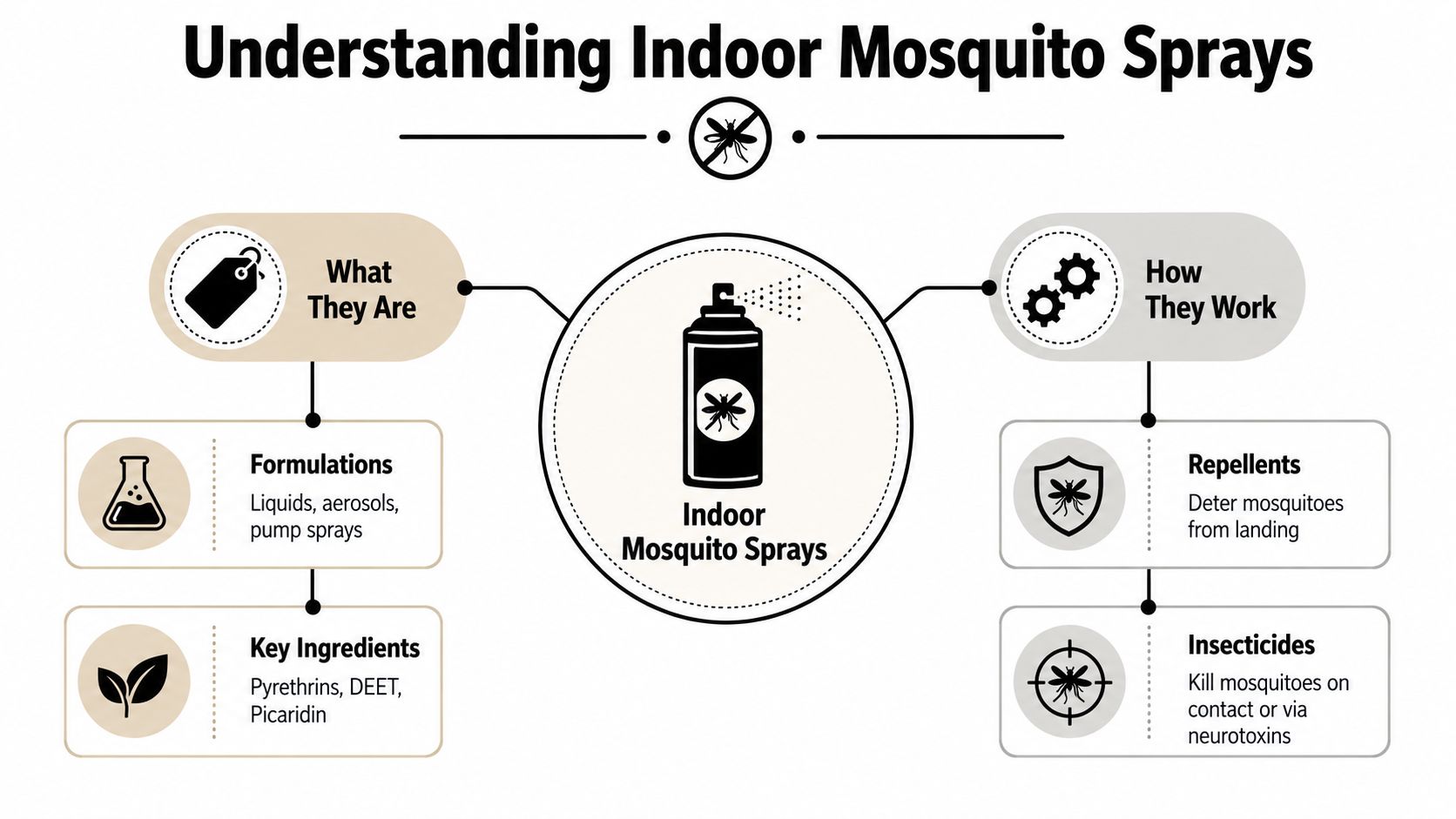
The two indoor spray categories that matter
The CDC separates indoor mosquito products into foggers or aerosols and surface sprays. Foggers and aerosols kill mosquitoes in the air. Surface sprays kill when mosquitoes land on treated indoor resting sites like under sinks, in closets, and behind furniture, according to CDC guidance on indoor spraying.
That distinction matters because mosquitoes indoors don't just fly around randomly. They rest. They hide in protected areas. If you only spray open air, you may knock down a few adults and miss the places where others settle.
Repellent versus insecticide
Homeowners also mix up repellents and insecticides, and that leads to bad expectations. Public health guidance treats those as different tools. A repellent is meant to keep mosquitoes away from you. An insecticide is meant to kill mosquitoes.
If you spray a personal repellent around a room and expect the product to eliminate the infestation, you're using the wrong tool for the job. If you use an indoor insect spray but ignore re-entry points, you're still leaving the door open to the next round.
Sprays work better when you match the product to the problem. Air knockdown for active flyers. Targeted treatment for indoor resting areas. Prevention at the entry points and around the home.
What this means in real homes
If you're standing in a store aisle comparing cans, keep this simple:
| Product type | Primary job | Typical use case |
|---|---|---|
| Fogger or aerosol | Kill mosquitoes in the air | Fast knockdown when mosquitoes are actively flying indoors |
| Surface spray | Kill on contact after landing | Treat indoor resting spots where mosquitoes settle |
| Personal repellent spray | Keep mosquitoes off skin | Bite prevention for people, not room-wide elimination |
The mistake I see most often is using one category and expecting results from another. That's why brand comparisons alone don't solve much. The issue isn't just what product you bought. It's whether the product matches the behavior of the mosquitoes in your house.
Safe and Effective Use of Mosquito Sprays Indoors
If you're going to use an indoor mosquito repellent spray, use it with discipline. A lot of DIY frustration comes from two bad assumptions. First, that more product means better protection. Second, that if a product is sold on a shelf, it must be safe to use however you want.
Neither is true.
Higher concentration doesn't automatically mean better results
For personal mosquito repellent sprays, the active ingredient concentration matters, but higher isn't always better. The Mississippi State Department of Health reports that DEET products are sold from about 5% to 100%, but 10% to 35% DEET provides adequate protection under most circumstances, and concentrations above about 50% don't provide significantly greater protection. It gives a practical example. 50% DEET provides about 4 hours of protection, while 100% DEET gives only about 1 extra hour according to the department's mosquito repellent guidance.
That should change how you shop. Stop chasing the strongest label just because it sounds tougher. For many homeowners, that's wasted exposure without a meaningful gain.
Indoor use needs a safety-first routine
The CDC's indoor spraying guidance says foggers or aerosols require occupants and pets to leave the home until the spray has dried. That's not a minor detail. It's the difference between proper use and careless use.
Use this checklist before you spray indoors:
- Read the label all the way through: Don't assume two products work the same way.
- Remove people and pets when required: If the label or product category requires vacancy, follow it.
- Keep sprays away from food areas: Kitchens, counters, utensils, and food storage need extra caution.
- Treat the right spots: Random spraying wastes product and increases exposure.
- Reapply only as directed: Overapplication doesn't create bonus protection.
If you're also trying to reduce residue concerns in a house with animals, this guide on what to use for pet-safe cleaning is a useful companion resource for handling the surfaces around your living space more carefully.
The label is not optional
Homeowners get into trouble when they improvise. They spray bedding, overuse products in closed rooms, treat the wrong surfaces, or mix products that were never meant to be combined.
Practical rule: Use mosquito products exactly where the label allows, exactly how the label allows, and no more often than the label allows.
If you need a broader primer on indoor application habits, this article on how to spray pest control in your home is worth reviewing before you start. Indoor spraying can be useful, but once you need to think this hard about location, drying time, people, pets, and surfaces, you can see the limit of DIY pretty quickly.
DIY Sprays vs Professional Mosquito Control Strategies
DIY indoor sprays have a role. They just have a narrow one. They help when you need immediate relief from mosquitoes already inside. They don't give most Crown Point homeowners what they want, which is fewer mosquitoes around the property and fewer mosquitoes getting indoors in the first place.
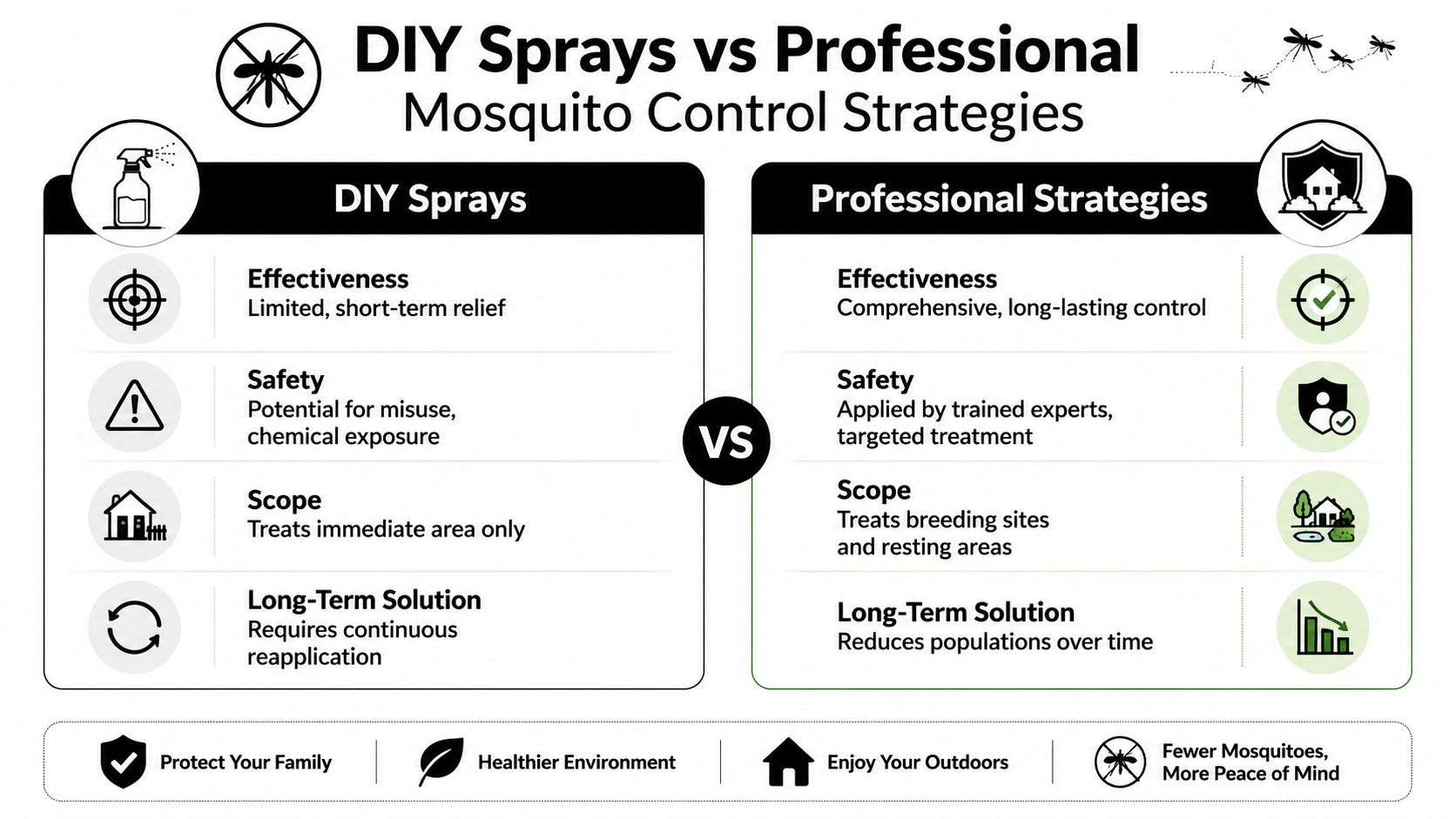
What DIY does well and where it stops
A can of spray is reactive. You see mosquitoes, so you spray mosquitoes. That can make the room better tonight.
Public-health guidance is clear that indoor spraying belongs inside a broader system. The American Mosquito Control Association says indoor use works best when combined with screened windows, air conditioning, and removal of standing water in its mosquito control guidance. That's the part too many homeowners skip.
Side-by-side comparison
| Issue | DIY indoor spray | Professional mosquito strategy |
|---|---|---|
| Immediate knockdown | Good for visible mosquitoes indoors | Good, plus evaluation of where mosquitoes are coming from |
| Root cause control | Weak | Stronger because the plan includes entry points, resting areas, and breeding pressure around the property |
| Consistency | Depends on homeowner timing and technique | Depends on inspection, targeted treatment, and follow-up |
| Safety burden | Falls on the homeowner | Managed through trained application and site-specific decisions |
| Long-term peace of mind | Limited | Better when the whole property is part of the plan |
A more complete strategy can include indoor assessment, exterior reduction, standing-water inspection, and recommendations on screens, doors, and moisture-prone areas. One available option in Crown Point is The Green Advantage, which provides mosquito reduction as part of broader pest management for local properties.
Here's a useful video if you want a quick visual overview before deciding how far to take DIY.
My recommendation
If you get the occasional mosquito indoors, use the right spray correctly and move on. If you're repeatedly buying products, reapplying, and still getting bit inside, stop treating this as a spray-shopping problem.
It's a control-plan problem.
When to Call a Pest Control Exterminator in Crown Point IN
A lot of homeowners wait too long to call. They keep testing one more aerosol, one more room spray, one more weekend cleanup. Meanwhile, the mosquitoes keep showing up.
The trigger point is straightforward. The CDC recommends hiring a pest control professional if mosquitoes persist after you've taken steps like using indoor sprays, fixing screens, and removing standing water, according to its guidance on mosquito control at home. That's the line between a manageable nuisance and a problem that needs diagnosis.
Clear signs it's time to stop experimenting
Call a professional if any of these sound familiar:
- Mosquitoes keep returning indoors: You knock them down, but new ones show up anyway.
- You already fixed the obvious issues: Screens, doors, and standing water have been addressed, but the activity continues.
- You're seeing them in multiple rooms: That usually points to a broader access or resting pattern.
- You want a whole-property solution: Indoor relief isn't enough if the source pressure outside remains high.
- You need confidence around family spaces: Bedrooms, bathrooms, kitchens, and pet areas require smarter treatment choices.
Why persistence matters
Persistent mosquitoes usually mean one of two things. Either they're continuing to enter the house, or they're surviving in overlooked areas connected to a larger property issue. Both problems call for inspection, not guesswork.
If you've already done the obvious work and mosquitoes are still winning, the next step isn't another can. It's a professional diagnosis.
For homeowners comparing service approaches, this overview of Effective mosquito management is a helpful example of what a broader mosquito-control mindset looks like. The key takeaway is simple. Serious mosquito problems don't respond well to isolated indoor spraying.
This is the moment that warrants a search for an exterminator in Crown Point, IN or pest control near me. Not at the first mosquito. At the point where repeated DIY effort isn't solving the problem.
Your Solution for a Mosquito-Free Home in Northwest Indiana
Indoor mosquito repellent spray has a place. It's useful for fast relief. It is not a complete defense for your home, and it shouldn't carry that burden by itself.
What protects your family better is a layered approach. Control the mosquitoes you find indoors. Reduce the reasons they get inside. Address conditions around the home that support them. Then keep pressure on the problem before it rebuilds. That's how homeowners move from constant swatting to real peace of mind.

If you're in Crown Point or nearby Northwest Indiana communities, don't treat mosquitoes as a one-room issue when they're clearly a property issue. The same home may also benefit from broader residential pest control, seasonal exterior treatments, spider control, rodent control, wasp removal, or prevention for other recurring pest pressures.
For homeowners budgeting and comparing service categories, Home Project Services' pest control guide can help you think through the bigger picture. Then take the next practical step and talk to a local team that can inspect the situation directly.
You don't need another summer of spraying the same corners and hoping for a different outcome. If mosquitoes are getting inside your home, fix the cause and take control of the whole problem.
If you're ready for a practical plan instead of another temporary fix, contact The Green Advantage to schedule a pest inspection or request a quote in Crown Point, IN and Northwest Indiana. Whether you need mosquito control, residential pest control, or help tracking down a recurring indoor pest issue, the goal is simple. Protect your home, reduce the stress, and make your space comfortable again.
Mosquito or Spider Bite? a Guide for Crown Point Homeowners
You finish up a summer evening in the yard in Crown Point, head inside, and spot a red bump on your arm while getting ready for bed. Now the guessing starts. Was it a mosquito from the backyard, or a spider hiding somewhere closer to the house?
That question worries a lot of homeowners, and for good reason. A bite usually happens fast, the pest is rarely caught in the act, and irritated skin can look similar at first. By the time the area turns red, itchy, or sore, you are left trying to read clues from a small patch of skin, a little like trying to identify muddy footprints after the person is already gone.
This uncertainty is common, and it is why many homeowners start looking for pest control in Crown Point, IN after one too many nights of guessing what is buzzing, crawling, or nesting around the home. Sometimes a bite is only a bite. Sometimes it is an early warning that standing water, overgrown landscaping, clutter, or entry points are making your property more inviting to pests than it should be.
The goal here is simple. Help you figure out what to do next.
You will get a practical path for Northwest Indiana homes, starting with how mosquito and spider bites often differ, then moving into symptom timing, basic first aid, signs that call for medical care, and the home and yard conditions that tend to keep these pests around. If the pattern points to a bigger pest issue, a professional treatment plan can help protect your family and make the outside of your home feel usable again.
A Homeowner's Guide to Pest Bites in Crown Point IN
You get through a normal evening in Crown Point, lock up the house, and notice a new red bump while washing up for bed. That is when the questions start. Was it a mosquito from the yard, or a spider you never saw indoors?
That kind of guessing is common around Northwest Indiana. Our mix of humid summer weather, shaded yards, standing water after rain, and tucked-away storage areas gives both mosquitoes and spiders plenty of places to stay close to people. One bite can be minor. A pattern of bites usually means the home or yard is giving pests what they need.
The first thing to know is simple. A bite mark is only one clue.
Early on, mosquito and spider bites can overlap enough to confuse anyone. Both may show up as a small red, irritated spot. The difference often becomes clearer the way a tool works after you turn it on, not the second you pick it up. Mosquito bites usually trend toward itching. Spider bites are more likely to feel painful, tender, or hot first, and some develop in a less predictable way.
Why homeowners misread bites
Skin reacts with a limited set of signals. Redness, swelling, itching, and soreness are your body's alarm bells. Different pests can trigger similar alarms, especially in the first several hours.
That is why trying to identify a bite too quickly can send you in the wrong direction. If you did not see what bit you, it helps to look at the full situation. Where were you earlier? Did the bite show up after yard time, garage cleanout, or pulling clothes from storage? Are other family members getting similar bumps, or is it a one-time spot?
Those details matter because the next step is not only "What bit me?" It is also "What should I do about the area on my skin, and what around my home may be causing this to keep happening?"
Why this matters in Crown Point homes
In this area, mosquitoes often build up around clogged gutters, birdbaths, low spots that hold water, and dense landscaping that stays damp and shaded. Spiders tend to show up where insects are already active, especially in garages, basements, sheds, wood piles, storage bins, and quiet corners around the foundation.
So the bite is sometimes the symptom, not the whole problem.
A single bump does not automatically point to a serious pest issue. Repeated bites on the patio, bites after time near one section of the yard, or bites that seem to happen indoors more than once deserve a closer look. That is the point where practical home care and pest control start to overlap.
For homeowners dealing with recurring pest pressure, residential pest control is often a sensible next step, not an overreaction. The goal is to reduce the conditions that keep pests close to your family, not just to treat one itchy spot and hope it does not happen again.
If you are also sorting through other possible causes of skin irritation, this comparison from Vanish Canada bed bug solutions can help you rule out look-alike problems before you decide what to address at home.
Visual Signs and Symptom Timelines
When people ask me about a mosquito or spider bite, I tell them to compare two things first. Look at the skin, then pay attention to the timeline. Those two clues usually tell you more than the initial panic does.
Here's the fastest side-by-side view.
Mosquito Bite vs. Spider Bite At a Glance
| Characteristic | Typical Mosquito Bite | Typical Spider Bite |
|---|---|---|
| Appearance | Small raised bump with redness around it | More variable, sometimes with two puncture marks |
| Main sensation | Usually itch first | Often pain or burning first |
| Timing | Appears quickly after the bite | May be noticed later, especially if symptoms build |
| Skin changes over time | Often becomes more itchy before fading | Can blister or look target-like in more serious cases |
| Common clue | Outdoor exposure in areas where skin is uncovered | Bite may happen when a spider is trapped in clothing, bedding, storage, or hidden areas |
| What to watch | Itching that peaks later | Worsening pain, unusual skin breakdown, or whole-body symptoms |
A visual can help if you're trying to compare what you're seeing at home.
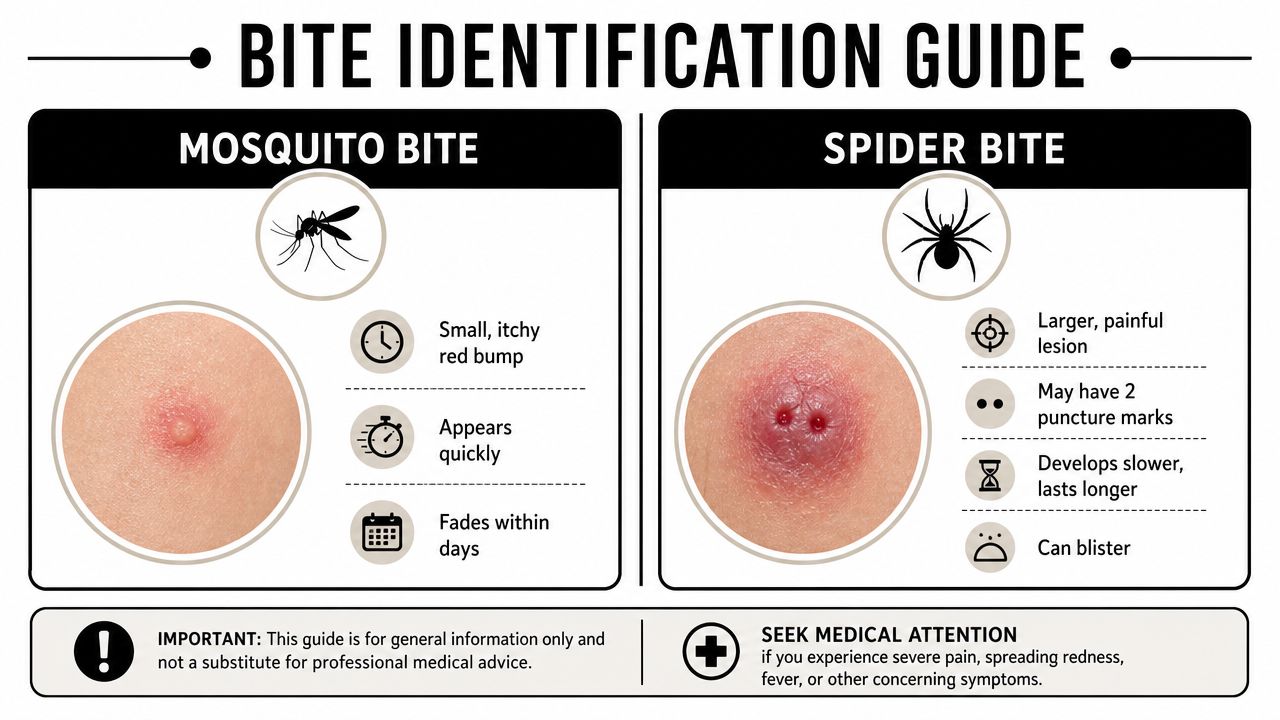
What a mosquito bite usually does
Mosquito bites often follow a pretty recognizable pattern. A review in PMC on mosquito bite reactions describes a two-phase immune response. First comes an immediate wheal with surrounding redness that peaks in about 20 to 30 minutes. After that, a delayed itchy papule tends to peak at 24 to 36 hours and usually settles down over several days.
That helps explain why a bite can seem tolerable at first, then become much itchier the next day. The itch is largely tied to histamine-related and IgE-related pathways, not direct tissue damage. In plain language, your body's reaction is doing most of the irritating.
What a spider bite may look and feel like
Spider bites don't follow one neat script. Some are mild. Some are painful. Some are mistaken for other skin issues entirely. What often throws people off is that they expect a spider bite to look dramatic right away, and that isn't always how it starts.
A more useful question is this: is the spot mainly itchy, or is it painful and getting stranger-looking?
For readers trying to sort out other look-alikes too, this guide on Vanish Canada bed bug solutions is a helpful companion, especially when the concern isn't just mosquito versus spider but whether the skin reaction may be from another source entirely.
A mosquito bite usually annoys you. A concerning spider bite tends to demand your attention.
A simple 48-hour way to think about it
If the bump appears fast, itches strongly, and doesn't do much beyond redness and swelling, mosquito is often the better fit.
If it becomes more painful, shows blistering, looks target-like, or seems out of proportion to a normal itchy bump, don't assume it's “just a bug bite.” That's the point where symptom severity matters more than guessing the exact pest.
Bite Severity Red Flags and When to See a Doctor
Most bites are minor. That's the reassuring part. The important part is knowing when a bite stops being a home-care issue and becomes a medical question.
Spider bites, in particular, are better judged by severity, not by whether you can spot two tiny marks. According to Poison Control's guidance on insect and spider bites, spider bites may involve pain or burning, blistering, a target-like lesion, and in venomous cases can progress to muscle cramps, fever, chills, nausea, or tissue necrosis. Poison Control advises urgent evaluation if symptoms worsen significantly or if black widow or brown recluse exposure is suspected.
Get medical help right away if you notice these symptoms
- Breathing trouble or throat symptoms. Any trouble breathing, swallowing, or signs of a severe allergic reaction need immediate care.
- Rapidly worsening pain. Itching is common with mosquito bites. Escalating pain is more concerning.
- Muscle cramps, fever, chills, or nausea. Those whole-body symptoms matter more than the bite's appearance.
- Blistering or tissue breakdown. If the skin starts to ulcerate, darken, or break down, don't wait it out.
- Strong suspicion of a black widow or brown recluse bite. If you know or strongly suspect that type of exposure, seek urgent evaluation.
When a mosquito bite deserves more attention
Most mosquito bites are itchy, annoying, and temporary. Still, use common sense if a reaction seems out of line with a normal bump, especially if you develop significant swelling, generalized hives, or feel unwell.
If mosquito-related illness is on your mind, this local resource on mosquito-borne illnesses in Indiana gives a useful overview for homeowners in our area.
Don't measure seriousness by size alone. A small spot with strong systemic symptoms is more urgent than a larger itchy bump that's otherwise stable.
A practical decision guide
Call your doctor or urgent care if the bite is getting worse instead of gradually calming down.
Go sooner rather than later if:
- Pain keeps increasing
- The skin looks unusual, not just red
- You have fever, chills, nausea, or cramps
- You suspect a venomous spider
- You're seeing signs that worry you beyond a routine itchy bite
That's not alarmist. It's just smart triage.
First Aid and Home Treatment for Mild Bites
If the bite is mild and there are no red flags, home care usually focuses on one job. Calm the skin down and avoid making it worse.
Start simple and keep it clean
Wash the area gently with soap and water. That helps remove surface irritants and gives you a clean starting point if you need to monitor the spot later. Pat it dry instead of rubbing it.
Then use a cold compress for short stretches. Cool temperature can take the edge off swelling and itching, and it often works faster than people expect.
Use familiar over-the-counter options
For many mild bites, homeowners do well with a short list of basics:
- Cold compress. Good for swelling, itch, and that hot irritated feeling.
- Hydrocortisone cream. Often helpful when the main problem is itch.
- Calamine lotion. Useful if the skin feels irritated and you want a soothing topical option.
- Oral antihistamine. Sometimes helpful if the itching is keeping you up or if you tend to react strongly.
If the bite seems more painful than itchy, the best first move is still gentle cleaning and cooling while you watch how it develops.
What not to do
Don't scratch it open. That's one of the easiest ways to turn a simple bite into a more complicated skin problem.
Don't squeeze a suspected spider bite. And don't keep layering random home remedies on irritated skin if one basic step isn't helping.
Mild bites usually improve with boring care, not aggressive care.
Watch the trend, not the minute-to-minute look
A mild bite can look a little angry before it improves. What you want is a general trend toward less itching, less swelling, and less irritation. If the opposite is happening, or the bite starts acting less like a nuisance and more like a medical issue, stop self-treating and get advice.
Preventing Bites with Smart Home and Yard Care
You come in from a summer evening in Crown Point, and by bedtime someone is scratching again. At that point, prevention stops feeling abstract. You want to know what to change tomorrow.
The good news is that bite prevention usually comes down to interrupting two simple pest needs. Mosquitoes need water to start the next round. Spiders need quiet hiding spots, a steady supply of insects, and small openings that let them slip inside. Once you look at your home through that lens, the job gets more manageable.
Mosquito prevention starts with small water sources
A lot of homeowners look for a big standing-water problem and miss the little ones. Around here, the usual trouble spots are flowerpot saucers, toys left in the yard, clogged gutters, low spots near downspouts, and anything covered with a sagging tarp. Small pockets of water can do more than people expect.

A simple yard check works well:
- Empty standing water from buckets, planters, toys, pet items, tarps, and birdbath edges.
- Clean gutters and downspouts so rainwater can move out instead of sitting.
- Trim back dense, damp growth where adult mosquitoes rest during the day.
- Keep grass and edges maintained so the yard dries out faster after rain.
If you only have ten minutes, walk the property the day after a storm. That one habit catches a surprising number of mosquito sources.
Spider prevention is really about cutting off shelter and entry
Spiders act more like quiet squatters than aggressive invaders. They settle where they are left alone and where other bugs are already available to eat. That is why garages, basements, storage corners, crawl spaces, and gaps around doors or utility lines matter so much.
Start with the house itself. Reduce clutter, pull stored items a little away from walls, seal obvious cracks, and check door sweeps. Screens matter too. If yours are bent, torn, or loose, this guide on how to install new window screens is a useful place to start.
Outdoor conditions count as well. Shrubs pressed against siding, stacked firewood near the foundation, and porch clutter all give spiders protected transition zones close to the house. If you want more local examples, this article on creating spider-free spaces in Crown Point matches what technicians commonly find on Northwest Indiana properties.
The best routine is one you can repeat every week
Perfection is not the goal. Consistency is.
Use a simple weekly reset:
- Check the yard after rain.
- Empty anything holding water.
- Look over screens, thresholds, and door sweeps.
- Cut back growth touching the house.
- Clear out undisturbed clutter in garages, sheds, and storage areas.
That routine lowers the odds of bites now and reduces the conditions that keep bringing pests back. For many Crown Point homes, that is the point where prevention starts to feel less like guesswork and more like a plan.
Professional Mosquito and Spider Control in Crown Point
You clean up the yard, dump the standing water, and still end up scratching bites after ten minutes on the patio. Or you clear out a basement corner and keep finding the same kind of spider activity near windows and storage. That is usually the point where home prevention has done what it can, and the property needs a closer look.
Professional mosquito control and spider control work like troubleshooting a house problem at the source. The job is to find where pests are resting, breeding, feeding, and slipping indoors, then reduce those conditions in a way that holds up longer than a one-time spray.

Why mosquito problems can ramp up fast
Analysts at StatPearls explain that mosquito-borne disease remains a major global health issue, and that adult mosquitoes have a short life cycle, which helps populations build quickly when water and weather line up, as noted in StatPearls on mosquito-borne disease.
For homeowners in Crown Point, the practical takeaway is simpler than the science. If you are seeing heavy mosquito activity around the yard, the cycle usually started earlier in places you may not notice right away, such as low spots, clogged drainage areas, shaded damp edges, or containers that keep refilling after rain.
What professional service changes
A technician is not just looking at the bite itself. They are reading the property the way a mechanic reads an engine sound. Where does water sit? Where do mosquitoes rest during the day? What corners of the structure are giving spiders shelter and access to insects?
That wider view often helps most with:
- Recurring bites outdoors in the same parts of the yard
- Deck, patio, or play areas people are starting to avoid
- Spider activity indoors around garages, basements, window areas, and storage spaces
- Business properties where outdoor comfort and appearance both matter
One local option for residential pest control and commercial mosquito spraying services in Northwest Indiana is The Green Advantage, which offers mosquito reduction programs, inspections, and broader pest management support.
When an exterminator makes sense
The right time to call an exterminator in Crown Point, IN is usually before the problem becomes part of your normal routine. Repeated bites, steady mosquito pressure near the house, or spiders returning to the same indoor areas are good signs that cleanup alone is not solving the full problem.
A professional visit can help answer the "what next?" question. First, reduce the immediate pest pressure around your family and the places you use every day. Then address the property conditions that keep restarting the issue, especially in Northwest Indiana yards where summer moisture, shade, and dense growth can keep pests close to the home.
The goal is to stop your home and yard from staying attractive to biting pests.
What to Expect When You Work With The Green Advantage
A lot of homeowners hesitate to call because they assume pest control will be complicated, pushy, or vague. It doesn't have to be.
The process should feel straightforward. You call, explain what's happening, and talk to someone who can help sort out whether you're dealing with a likely mosquito issue, spider activity, or a broader pest pattern around the property.
The first conversation
Usually, the first step is simple. You describe what you've noticed. Maybe it's bites after being in the backyard. Maybe it's webs in the basement and a painful bite that happened while moving storage. Maybe it's both.
A good office team helps schedule the right kind of visit and gets your questions moving quickly instead of bouncing you around.
The on-site inspection
Once a technician arrives, the focus is on conditions, not guesses. They'll look for the kind of details homeowners often miss because they see the property every day: standing water sources, clogged drainage points, overgrown edges, harborage around foundations, screen issues, cluttered storage, and likely pathways pests use to get close to people.
That inspection matters because a bite on your skin doesn't always tell the full story. The property usually does.
The treatment plan and follow-up
You should expect a clear explanation of what was found, what can be handled with homeowner maintenance, and what treatment makes sense if service is needed. No one benefits from mystery language.
For families in Crown Point and nearby Northwest Indiana communities, that clarity is what turns pest control from a stressful call into a manageable home maintenance decision. Whether the issue points to mosquito reduction, spider control, or a broader prevention plan, the process should leave you knowing what's happening and what comes next.
If you're comparing options for pest control in Crown Point, IN, look for that transparency. It matters just as much as the treatment itself.
If bites keep showing up around your home, yard, or business, it may be time to stop guessing and get a professional assessment. The Green Advantage serves Crown Point and nearby Northwest Indiana communities with practical pest inspections, mosquito reduction, and spider control that help protect your family, property, and peace of mind. Reach out to request a quote or schedule an inspection.