
Best Mosquito Control for Northwest Indiana Yards
You're standing beside the grill in your Crown Point backyard, trying to enjoy dinner while mosquitoes find every uncovered inch of skin. A candle burns on the patio table, a citronella plant sits by the door, and someone keeps asking whether the bugs seem worse this year. The short answer is that a single product rarely solves an outdoor mosquito problem.
The best mosquito control for Northwest Indiana yards is seasonal and layered. Start with standing-water removal, add personal protection and airflow, then use targeted professional treatments when the property, weather, or mosquito pressure calls for more. That approach works better than spraying once and hoping the next hatch never arrives.
Why Mosquitoes Take Over Northwest Indiana Yards
Crown Point yards offer mosquitoes what they need: water, shade, humidity, and places to rest close to people. A clogged gutter, an overturned toy, a flowerpot saucer, or a low spot that stays wet after rain can become part of the problem. Properties near wooded edges, retention areas, drainage swales, and dense landscaping often face more pressure because adult mosquitoes can move in from nearby breeding areas.
Homeowners often search for what attracts mosquitoes to your yard after noticing bites around the patio, deck, or playset. The practical question isn't whether one scented product can repel them. It's whether the yard keeps producing or sheltering mosquitoes faster than a one-time treatment can manage them.
Why one spray doesn't hold
A yard spray can reduce active adults in treated areas, but it doesn't remove every breeding site. New adults can emerge from water that was missed, arrive from nearby properties, or shelter in vegetation that wasn't treated. Rain, irrigation, and plant growth can also change conditions across the property.
That's why a candle, a citronella plant, or a single fogging visit shouldn't be sold as a complete solution. These tools may offer limited relief in a specific spot, but they don't address the full cycle from egg to larva to adult.
Local rule: If your yard has standing water, dense shade, or nearby wet ground, mosquito control needs a plan for the property, not just a product for the patio.
The local solution should match how you use the space. A family that wants to spend evenings outside needs a different plan from a landlord preparing a rental property or a restaurant protecting an outdoor dining area. Residential pest control and commercial pest control both benefit from the same basic discipline: inspect first, reduce breeding conditions, and treat only where treatment makes sense.
For Crown Point and nearby Northwest Indiana communities, that means planning around local weather and outdoor routines. Control should begin before biting adults dominate the yard, continue during peak activity, and include cleanup that reduces the next generation.
How Mosquito Biology Shapes Every Control Decision
Mosquito control becomes much easier to understand once you stop thinking of the adult biter as the whole problem. Mosquitoes move through aquatic stages in standing water before they emerge as flying adults. The early stages are easier to target because they're concentrated in containers, puddles, gutters, basins, and other wet areas.
The timeline that changes your priorities
A mosquito's development follows a simple sequence:
- Eggs are deposited in or near water.
- Larvae live in the water and feed near the surface.
- Pupae remain aquatic while the adult body develops.
- Adults emerge, fly, rest, feed, and reproduce.
Mosquitoes can complete development in calm, standing water in as little as 7 days, and EPA guidance says many species require 7 to 10 days of stagnant water to reach the aquatic stages that produce biting adults. The EPA guidance on mosquito breeding water explains why a weekly inspection isn't excessive. It's timed to interrupt the development window.
That matters after a summer storm. A child's toy, a tire swing, a wheelbarrow, or a clogged downspout can collect water, sit unnoticed, and produce new adults before the next weekend cleanup. In Crown Point, irrigation and heavy rain can create the same issue even when the rest of the yard looks dry.
Where adults hide
Adult mosquitoes don't spend the entire day flying over the lawn. They often rest in cool, shaded, humid areas such as low shrubs, ornamental grasses, weeds, and vegetation along fences or foundations. Those areas protect them from drying conditions and keep them close to the people and pets they seek later.
Only female mosquitoes bite. They need a blood meal to produce eggs, while both sexes can use plant nectar and other natural sugars. That's why a yard can seem quiet in the afternoon and become uncomfortable around dusk, especially where landscaping creates still air and shade.
The biology points to a clear order of operations. Remove or manage water first, reduce resting cover where practical, protect people with repellent and clothing, then use targeted adult control when pressure remains. Stronger spraying can't compensate for a missed breeding site.
Comparing DIY Repellents, Yard Treatments, and Professional Programs
Crown Point homeowners generally choose among three approaches. Personal repellents and simple prevention are useful for occasional outdoor activity. DIY yard treatments can help when the property is manageable and the homeowner can follow the label carefully. A recurring professional program makes more sense when mosquito pressure is persistent, the yard is complex, or outdoor comfort matters throughout the season.
| Option | Effectiveness | Season Cost | Safety & Environment |
|---|---|---|---|
| Personal repellents, fans, and traps | Protects people in a defined area, but doesn't reduce the breeding population | Usually limited to the occasions when you're outdoors | Can be a lower-impact choice when used as directed, with no broad yard application |
| DIY yard sprays and larvicides | Can reduce mosquitoes in treated areas when water sources and resting sites are correctly identified | Requires repeated purchases and homeowner labor during the season | Product labels, pollinator protection, pets, children, and water restrictions must be considered |
| Recurring professional mosquito program | Combines inspection, habitat work, larval control, and targeted adult treatment | Ongoing service rather than a single purchase | A site-specific plan can limit unnecessary applications and focus treatment where mosquitoes rest or breed |
The resistance problem
Chemical choice matters because mosquito populations don't all respond the same way. A 2023 operational study of Aedes aegypti found CDC bottle-assay mortality as low as 2 to 24% for permethrin and 48 to 94% for deltamethrin, even at 10 times the diagnostic dose, as reported in the operational resistance study. That doesn't mean every Crown Point mosquito population has the same response. It does mean “more spray” isn't a sound resistance strategy.
Essential-oil products may provide a pleasant scent and short-term deterrence, but they shouldn't be treated as a complete control program. Fogging can knock down active adults, yet it won't prevent the next hatch if water remains. Traps can help in selected situations, but placement and maintenance determine whether they contribute meaningfully.
The right decision depends on the property. If you're dealing with a few bites during occasional gatherings, start with source reduction and personal protection. If your children can't use the yard, your business depends on outdoor space, or weekly inspections aren't realistic, a mosquito reduction program with site-specific treatment and resistance-aware decisions is the more practical choice.
DIY Steps That Actually Reduce Mosquito Pressure
A single cleanup can change a yard quickly, but only if it becomes a routine. Start with a slow walk around the entire property, including areas away from the back door. Check gutters, shed roofs, furniture, toys, planters, tarps, and anything else that can collect rain. Look above eye level and along shaded edges where small containers are easy to miss.
Start with water
The CDC's mosquito control guidance for homes recommends removing standing water at least once a week. Empty, scrub, turn over, cover, or discard items that collect water, including tires, buckets, planters, toys, pools, birdbaths, flowerpot saucers, and trash containers.
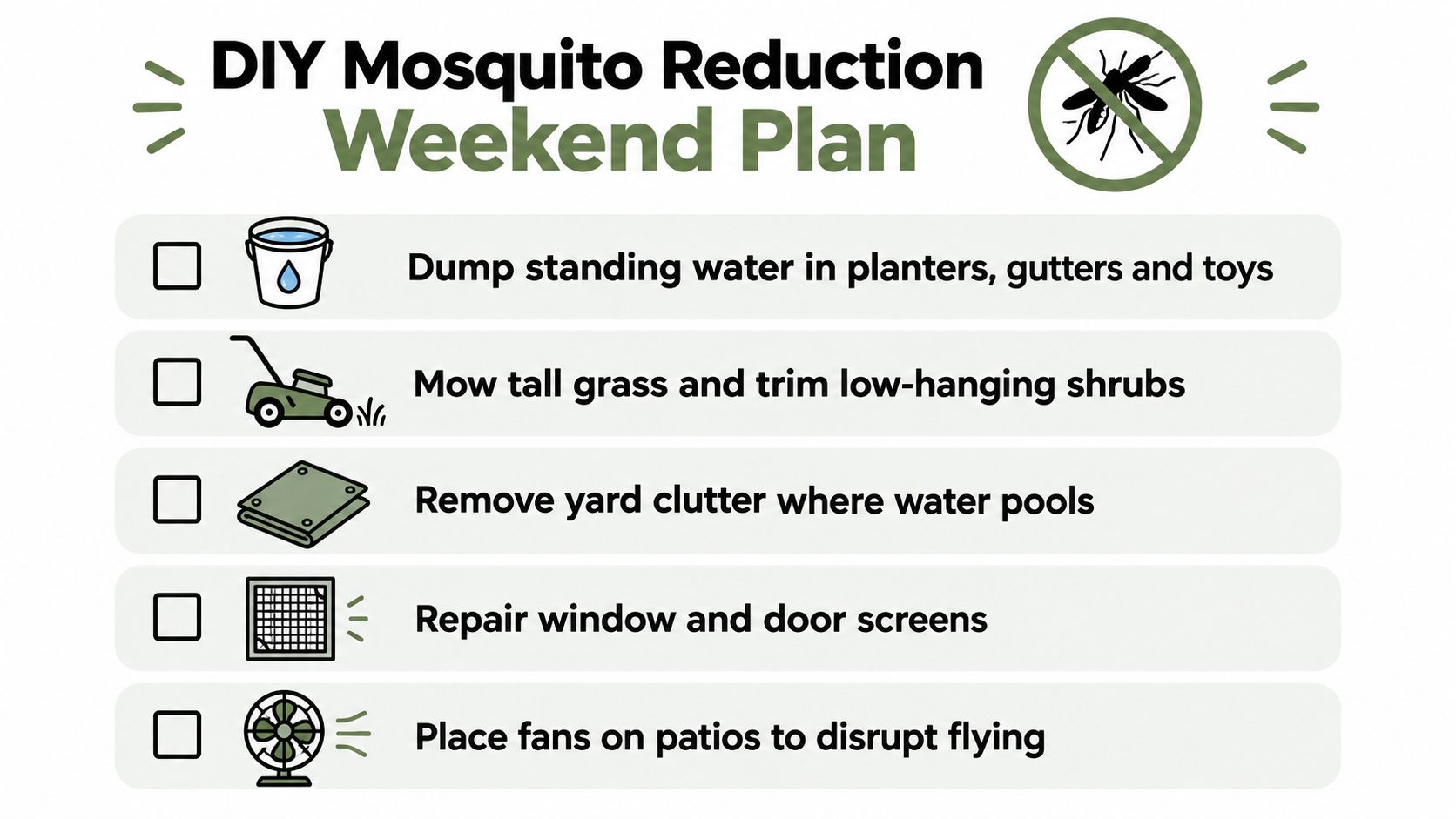
Use this weekend routine:
- Empty and scrub: Clean birdbaths, saucers, toys, and other containers instead of just tipping them over.
- Clear drainage: Remove gutter debris and confirm that downspouts drain away from the house.
- Flip or cover: Store wheelbarrows, bins, children's toys, and unused containers where rain cannot reach them.
- Manage permanent water: Apply a properly labeled larvicide only to larger water bodies that cannot be drained or covered. Review what kills mosquito larvae before selecting a product.
- Reduce shelter: Mow tall grass and trim low vegetation beside patios, walkways, and foundations.
Small amounts of water matter. The mosquito source-reduction guidance notes that mosquitoes can use as little as a tablespoon of water. As the biology timeline above explains, water left in place long enough to support larvae is a preventable breeding opportunity. Scrubbing matters because eggs can cling to container surfaces after the water is dumped.
Protect people while they're outside
For exposed skin, EPA and public-health guidance identifies repellents containing 20 to 30% DEET as effective options that typically protect for many hours. Products above 50% DEET do not provide better or longer protection, according to the EPA-registered repellent ingredient guidance.
Fans improve comfort on patios because mosquitoes are weak fliers. Repair window and door screens, keep doors closed, and bring pet bowls inside or empty them after use. DIY control is the right starting point when the property is manageable and the household can maintain weekly checks. If the yard borders dense vegetation, keeps producing mosquitoes after cleanup, or cannot be inspected consistently, move from weekend cleanup to a professional plan rather than relying on repeated spray applications.
When Professional Mosquito Service Makes the Difference
DIY control stops being the best use of your time when the property keeps generating mosquitoes faster than you can inspect it. Call a professional if your home borders wooded land or a retention area, if children need dependable outdoor playtime, if you're preparing for an event, or if weekly source reduction keeps falling off your schedule.
A credible service should begin with a property inspection, not an automatic spray. The technician should identify containers, drainage problems, shaded resting areas, vegetation, and conditions outside the lot that may affect pressure. That information determines whether the property needs source reduction, larvicide, targeted barrier treatment, personal-protection advice, or a combination.
What a layered program includes
The U.S. EPA states that egg-and-larva interventions are generally the most effective and least costly approach, because treating breeding habitats before emergence reduces the nearby adult mosquito population, as explained in this EPA-supported mosquito control review. Professional service should reflect that priority.
A site-specific program may include:
- Habitat mapping: Finding water-holding containers, drainage trouble, and adult resting areas.
- Larval control: Treating standing water that can't be drained, emptied, or covered.
- Targeted barrier treatment: Applying product to likely resting areas rather than indiscriminately treating every surface.
- Resistance-aware decisions: Reviewing local performance and changing tactics when a product isn't delivering adequate control.
- Follow-up timing: Returning according to mosquito pressure and the property's conditions, rather than treating one time and disappearing.
The residential mosquito reduction program available through the local team can be structured for recurring seasonal service or a single visit before an event. Technicians diagnose the site, explain what they're treating, and tailor the plan to the yard. That same approach is useful for landlords, property managers, and businesses that need commercial pest control around entrances, employee areas, or outdoor customer spaces.
For readers comparing regional approaches, this Miami mosquito treatment service provides another useful example of how professional mosquito programs can combine recurring treatment with property-focused control.
The following video offers additional visual context on mosquito management. It should supplement, not replace, an inspection of your own property.
Professional service doesn't create a mosquito-free bubble. It gives you a better system for reducing pressure, finding overlooked sources, and adjusting treatment when conditions change.
Seasonal Timing for Mosquito Control in Northwest Indiana
A wet spring followed by warm summer evenings can turn a Northwest Indiana yard into a mosquito problem before outdoor plans begin. Control should follow that pattern. Early cleanup removes breeding conditions, late-spring action limits population growth, summer service protects the areas you use, and fall work reduces problems that carry into the next season.
Early spring
Walk the property after snowmelt and spring rain. Clear leaves from gutters, check downspouts, remove discarded containers, and correct low spots that hold water. Look beneath decks, behind sheds, and around outdoor furniture, where winter debris can conceal breeding sites.
Schedule an inspection now if the yard had heavy mosquito pressure last year. Early findings give you more treatment choices than waiting until mosquitoes are biting at every gathering.
Late spring
As temperatures rise, start weekly water checks before mosquito numbers build. Review birdbaths, rain barrels, pool covers, toys, planters, and drainage areas. If water cannot be removed or covered, ask a licensed professional whether a larvicide fits that site and its conditions.
Begin professional service before outdoor activity peaks. Barrier treatments can reduce adult mosquitoes, but they work best alongside source reduction and follow-up decisions based on changing pressure.
Summer
Summer requires consistent timing, especially after storms, irrigation, or landscaping work. After late-June storms, inspect low spots and clogged gutters within 48 hours, before standing water remains unnoticed. Pay close attention to shaded areas near patios and seating, where people spend the most time.
Use repellent during active biting periods, repair damaged screens, and keep dense growth away from gathering areas. Small water sources still deserve attention, and the Crown Point seasonal mosquito prevention calendar supports checking temporary water before it becomes a recurring source.
A spray alone will not solve a yard that keeps collecting water. If pressure returns quickly after treatment, change the control plan instead of repeating the same application automatically.
Late summer and fall
Continue monitoring as weather shifts and mosquito activity changes. In early fall, empty and store containers, clean gutters again, remove yard clutter, and correct drainage before leaves hide problem areas.
Use the calendar as a guide, not a rigid schedule. A shaded lot with poor drainage may need earlier or more frequent service than an open yard with few water-holding features. Professional timing should follow the property's conditions and the areas where mosquitoes interfere with normal use.
Your Year-Round Mosquito Maintenance Checklist
Use this checklist to track pressure, locate overlooked breeding spots, and decide when DIY work has stopped paying off. Add one line for your lot, such as “check the retention-swale edge” or “walk the wooded fence line.”
Every week
- Run a five-minute route: Start at gutters, then check saucers, toys, tarps, and low spots. Scrub birdbaths instead of only tipping them out.
- Record changes: Note recent rain, irrigation, drainage problems, and the areas where bites remain common.
- Check usable space: Keep gathering areas accessible, and use labeled repellent or fans when people are outside.
Every month
- Inspect overlooked structures: Check downspout discharge, rain barrels, ornamental features, and equipment that can hold water.
- Check screens and access points: Repair tears before mosquitoes move indoors.
- Map resting habitat: Mark shaded vegetation, fence lines, and other places beside occupied areas that may need attention.
- Review treatment results: Record the date, product or service, treated zone, and remaining bite pressure. If the same approach keeps failing, ask for a different control plan rather than repeating it automatically.
At seasonal milestones
- Spring: Update the property map after winter debris and drainage changes appear.
- Summer: Compare pressure after storms, irrigation, and landscaping work. Request professional service if biting disrupts normal yard use.
- Fall: Store containers and confirm gutters and drainage before leaves conceal problem spots.
DIY fits a property you can inspect consistently with limited mosquito pressure. Choose professional help when difficult habitat borders the yard, source reduction does not hold, or dependable comfort matters for family, tenants, employees, or customers. Ask whether treatment will target the actual resting and breeding areas, include follow-up, and change when pressure persists.
Schedule a mosquito inspection and request a property-specific quote from The Green Advantage for Crown Point, IN and nearby Northwest Indiana service areas. The team can outline seasonal treatment, habitat guidance, and follow-up for your home or business.
Mosquito Control Program in Crown Point, in: What to Expect
A warm evening in Crown Point can change quickly. You step onto the patio, start dinner on the grill, and within minutes mosquitoes gather around your ankles and arms. Store-bought sprays may provide brief relief, but they rarely address the containers, gutters, low spots, and stormwater pockets producing the next wave.
A professional mosquito control program treats the problem as a repeating cycle. For homeowners searching for pest control near me, pest control in Crown Point, IN, or an exterminator near me, The Green Advantage offers a practical, inspection-first approach that combines property assessment, habitat management, monitoring, and targeted treatment for outdoor spaces in Crown Point and nearby Northwest Indiana communities.
Why Crown Point Backyards Need a Mosquito Control Program
Mosquitoes don't appear at random. A shaded yard with dense landscaping, a birdbath, clogged gutter, children's toys, or a low area that holds rain can provide everything mosquitoes need to reproduce. Clemson guidance explains that water standing for five days or more can become a mosquito-breeding site, while mosquito larvae commonly remain in water for about 4 to 14 days, depending on temperature, according to the American Mosquito Control Association's mosquito life-cycle guidance.
That timing makes a typical Crown Point backyard easy to overlook. A container may look harmless after a light rain, yet warm weather can let larvae develop before the next weekend cleanup. Stormwater features and neighboring properties can add pressure even when your own lawn looks tidy.
Practical rule: If a container can hold water, treat it as a possible breeding site until it has been emptied, covered, modified, or professionally addressed.
A homeowner might spray the porch before a family gathering and enjoy temporary comfort, only to find mosquitoes returning soon afterward. The spray may have affected flying adults in that immediate area, but it didn't remove the water source supporting future adults. A structured program looks beyond the visible swarm and asks what is keeping mosquito activity going.
The backyard cycle
Integrated mosquito management combines surveillance, source reduction, larval control, adult control, resistance testing, public education, and evaluation, rather than treating spraying as the entire solution. CDC integrated mosquito management guidance explains why these methods work together, source reduction lowers breeding habitat, while monitoring helps determine whether additional treatment is appropriate.
For a Crown Point homeowner, that can mean checking the areas used most often, identifying water that can't be removed easily, and timing treatments around actual mosquito activity. The purpose isn't to make every part of a property sterile. It's to make patios, play areas, entrances, and other high-use spaces more comfortable while addressing the conditions that create pressure.
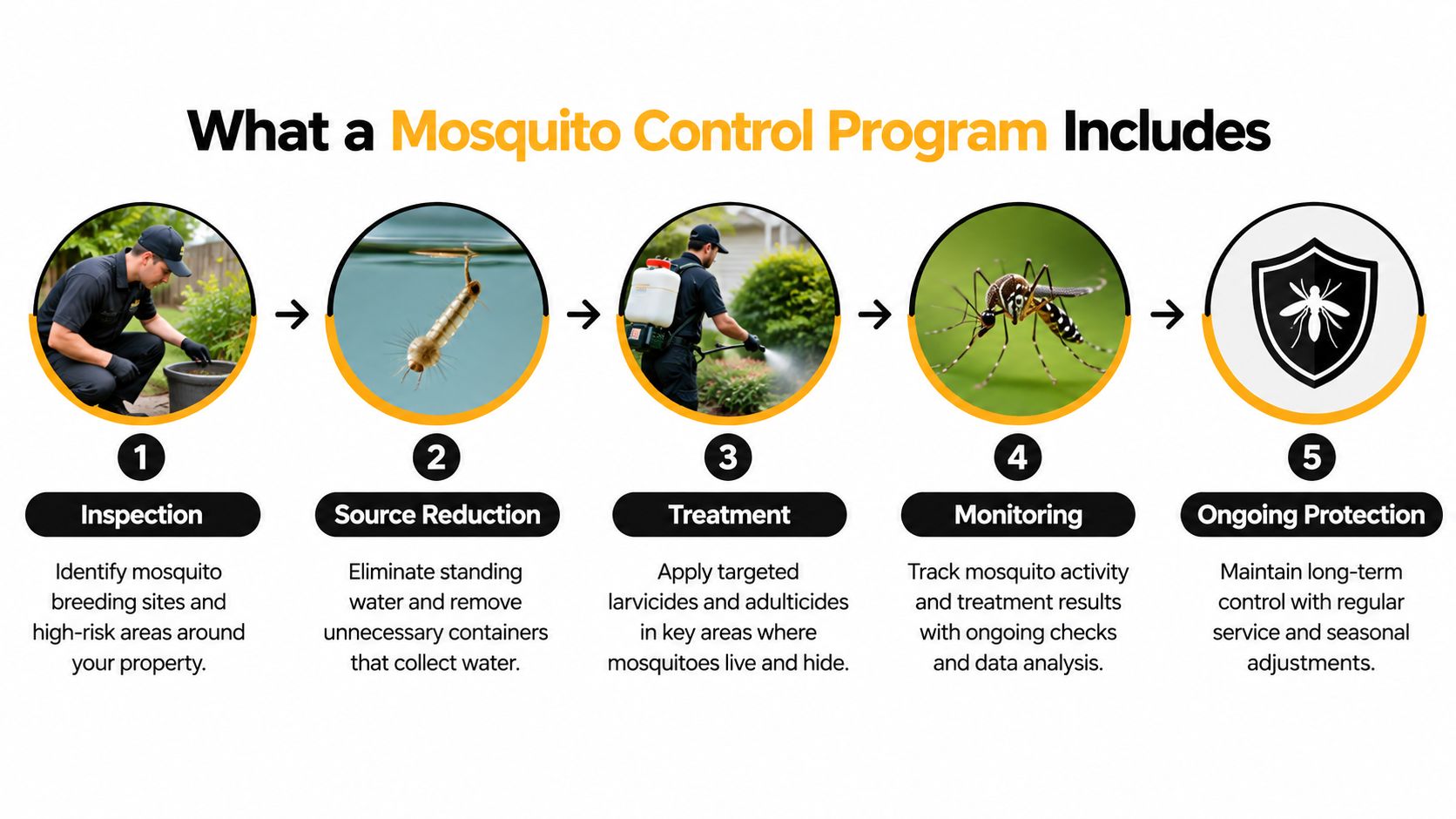
What a Mosquito Control Program Includes
A mosquito control program is a planned service, not an occasional spray applied without an inspection. Each part has a specific job, and the parts support one another.
Start with a property inspection
The technician examines outdoor areas where mosquitoes rest, feed, and reproduce. That includes shaded foliage, ornamental plantings, gutters, drains, birdbaths, buckets, toys, low yard areas, and places where runoff collects. The inspection also considers how people use the property, because the patio, pool area, doorway, and play space may need different attention from an unused corner.
Reduce breeding habitat
The next step is to remove or change water-holding conditions. Homeowners may be able to empty containers, refresh birdbaths, turn items upside down, clear debris, or improve drainage. A technician can identify less obvious sources and explain which areas need recurring attention.
Source reduction matters because it addresses mosquitoes before they become flying adults. It can also reduce the amount of later treatment needed, although inaccessible water may still require targeted larval control.
Treat suitable larval sites
Some breeding locations can't be drained or removed easily. Drains, hard-to-reach containers, and certain water features may need a larvicide selected for that purpose. The treatment is directed at developing mosquitoes in water instead of broadly treating every outdoor surface.
Apply targeted adult control when justified
Adult treatment may be appropriate when monitoring shows meaningful mosquito activity in an area people use. The technician considers location, timing, weather, vegetation, and the treatment target. A fixed calendar alone doesn't tell the full story.
Follow up and adjust
Mosquito pressure changes as rain, temperature, landscaping, and nearby water conditions change. Follow-up visits help determine whether the plan is working and whether the service needs adjustment. A seasonal plan can maintain protection during active periods, while a one-time service may suit a specific outdoor event.
This same inspection-based thinking supports other services, including residential pest control, commercial pest control, ant control, wasp removal, rodent control, spider control, and termite control. The treatment changes, but accurate diagnosis remains the starting point.
How Inspection and Monitoring Guide Treatment Decisions
Blanket spraying seems simple, but it can miss the actual source of the problem. A technician who starts with inspection can distinguish between a property producing mosquitoes and one receiving them from surrounding habitats. That difference affects where effort should go.
A monitoring process may focus on high-use outdoor areas, shaded foliage, standing water, drains, gutters, and low sections of the yard. It also considers species and activity patterns. Daytime-biting Aedes aegypti, for example, creates different concerns from mosquitoes that are most active around dusk. Programs that identify what is present can choose a more suitable response.
Data turns treatment into a decision
Surveillance isn't paperwork added after the work. It guides the choice between removing water, treating larvae, or addressing adult mosquitoes. CDC information on mosquito control programs reports that nearly all vector-control programs rated as needing improvement lack pesticide resistance testing, and more than half also lack routine surveillance or species identification, as described in the CDC overview of mosquito control programs.
That matters because an adulticide selected without local information may miss the target population or contribute to resistance. Monitoring also helps prevent unnecessary applications when mosquito activity doesn't justify them.
For homeowners comparing an exterminator in Crown Point, IN with a do-it-yourself product, the difference is the feedback loop. The technician observes conditions, applies an appropriate response, and checks whether the response changed activity. You can learn more about this broader approach through pest control monitoring services.
Thresholds support measured action
Local programs may use action thresholds rather than treating whenever someone reports a bite. Maryland's mosquito program, for example, uses a threshold of 10 female mosquitoes per trap night for ground spraying and 100 female mosquitoes for aerial spraying, along with separate landing-rate thresholds, as detailed by the Maryland Department of Agriculture mosquito control program.
Those figures belong to Maryland's program, not a Crown Point rule. They illustrate the principle, however. Good mosquito management connects treatment decisions to observed activity, site conditions, and the people using the property.
Larval Source Reduction and Adult Treatments Explained
The two approaches solve different parts of the mosquito problem. Larval source reduction aims to prevent mosquitoes from maturing, while adult treatment addresses flying mosquitoes already present in outdoor areas.
Larval source reduction
Source reduction is often the strongest long-term option for container-breeding mosquitoes because it removes the place where larvae develop. A homeowner may empty a bucket, clear a blocked gutter, refresh a birdbath, remove discarded containers, or correct a drainage issue. The work can be repetitive, but it reduces the supply of future adults.
A review summarized in the American Mosquito Control Association guidelines describes source reduction as the most effective long-term measure for container-breeding mosquitoes. The same review notes that habitat reduction can lower larval indicators without always producing an immediate change in adult mosquito measures when untreated habitats remain nearby.
That is why programs may add larviciding. When water can't be eliminated, a targeted larvicide can address developing mosquitoes in that site and is more specific than treating broad areas for adult insects.
Adult treatments
Adult treatments can provide faster relief in the outdoor areas where people spend time. A targeted application may focus on foliage and resting locations, with timing based on mosquito activity and site conditions. It shouldn't replace habitat work, because adult control doesn't remove the water that creates the next generation.
Resistance testing also matters. CDC guidance recommends using surveillance and resistance information when selecting adulticides, since repeated treatment without local data can fail to control the intended mosquitoes or encourage resistance.
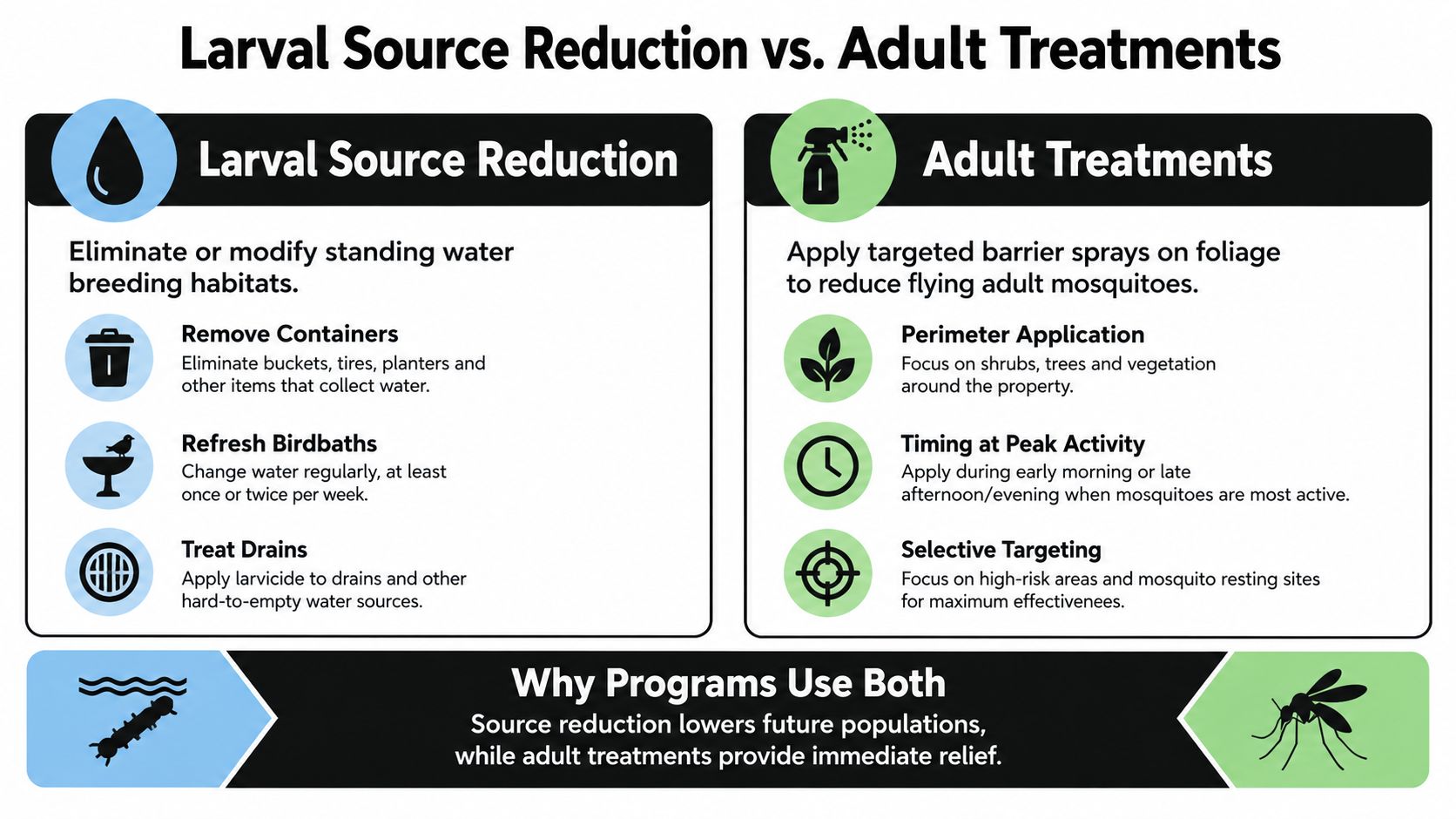
A balanced program uses each tool for the job it handles best. Source reduction lowers future pressure, larval treatment manages water that remains, and adult treatment can improve comfort when monitoring shows it is warranted. The mosquito breeding and mosquito control guide provides additional homeowner context.
Safety, Environmental Considerations, and Local Seasonality
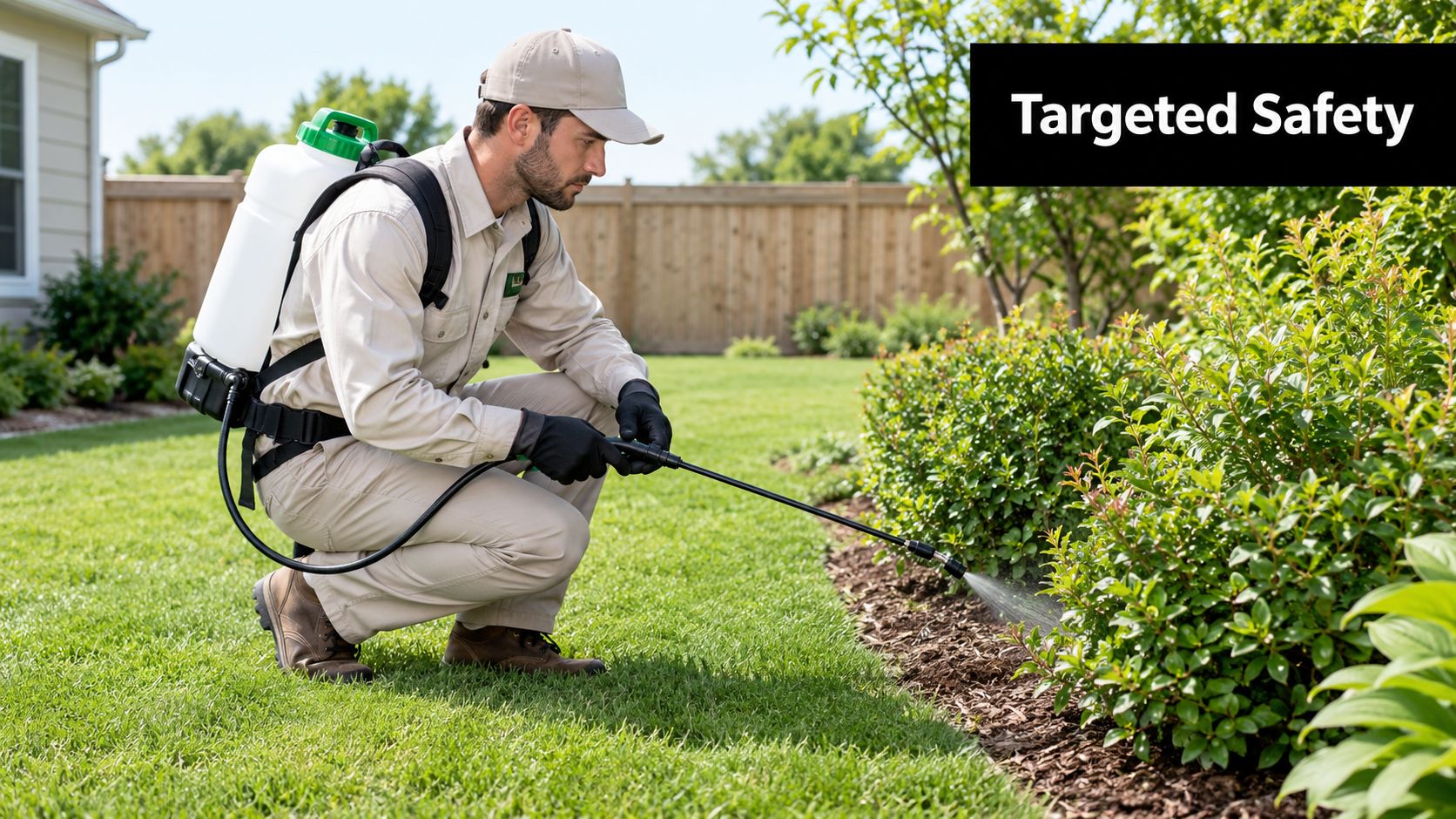
Homeowners often ask whether mosquito treatment can protect an outdoor space without creating unnecessary exposure for people, pets, plants, and beneficial insects. The answer depends on how the service is designed and performed. A responsible program uses targeted applications, follows product directions, considers weather, and limits treatment to appropriate areas.
Technicians also need to account for the property itself. Dense shrubs can provide mosquito resting sites, while open areas may have less persistent pressure. A stormwater feature, low drainage area, or shaded side yard can require a different response from a sunny lawn.
Seasonality changes the plan
Mosquito activity in Northwest Indiana shifts with temperature, rainfall, vegetation, and water conditions. Warm, wet periods can create more breeding opportunities, while changing temperatures alter how quickly larvae develop. A program that responds to these conditions is more practical than assuming every visit should look exactly the same.
That seasonal view also helps Crown Point homeowners plan service around how they use their property. A yard hosting regular outdoor meals may need attention focused on seating areas and pathways. A commercial facility may need a plan that considers employees, visitors, entrances, manicured grounds, and drainage features.
Thoughtful treatment protects more than comfort
Environmental responsibility doesn't mean ignoring mosquito pressure. It means using the least broad approach that can address the observed problem, removing habitats where possible, and avoiding treatment decisions based only on frustration. Public education is part of that process because a homeowner who empties water-holding containers helps reduce pressure beyond the treated area.
The same mindset applies to eco-friendly pest control and preventative pest treatments more broadly. Whether the concern is mosquitoes, ants, rodents, spiders, or wasps, a site-specific plan is more useful than applying products without understanding how pests are entering, feeding, or reproducing.
Expected Results and Why Professional Mosquito Control Works
A well-run mosquito control program should make treated outdoor areas more usable. Homeowners may notice fewer mosquitoes around patios, entrances, play spaces, and landscaping where people spend time. The purpose is practical relief, not a promise that every mosquito will disappear from the wider neighborhood.
Results develop through repeated attention because mosquito pressure can return from nearby properties, new rainwater, stormwater systems, and untreated habitats. A program that combines monitoring with habitat management and carefully selected treatment can respond to those changes more effectively than a single reactive application.
The larger public-health field shows how mosquito management has grown beyond spraying. Organized mosquito control in the United States dates to the early 1900s, including an early San Francisco Bay area program in 1903 and California's 1915 Mosquito Abatement Act. A 1997 national survey identified 345 mosquito control districts or programs serving more than 97 million people, at an estimated annual cost of US$231.7 million, or a little over US$2 per person per year, according to the CDC archive of the national mosquito control survey.
This history supports a straightforward conclusion for Crown Point homeowners. Mosquito control works best as an organized service with inspection, decisions based on evidence, habitat reduction, and follow-up. That same approach can support broader residential pest control, commercial pest control, termite treatments, rodent exclusion, and seasonal pest issues throughout Northwest Indiana.
The Green Advantage provides inspection-based mosquito reduction options for Crown Point homeowners and businesses, including seasonal service and one-time treatment for outdoor gatherings. If mosquitoes are limiting your yard, contact The Green Advantage to discuss your property, request a quote, and schedule a practical plan for your outdoor space.
How Long Does Mosquito Treatment Last in Crown Point

Most backyard mosquito barrier sprays last about 2 to 4 weeks, and the practical baseline for Crown Point homeowners is professional retreatment every 3 to 4 weeks through mosquito season. If you're hoping one spray in spring will carry you through summer, it won't. Mosquito control in Northwest Indiana is a calendar job, not a one-time fix.
You're probably reading this because the yard just turned on you. Late May hits, the kids want to be outside, the dog heads for the grass, you step onto the patio at dusk, and suddenly you're slapping your arms and ankles. That's usually when homeowners in Crown Point start asking the question. Not whether treatment works, but how long does mosquito treatment last when your yard backs up to trees, sits near retention water, or stays shady behind the fence line.
That's the part most generic mosquito articles miss. A small sunny lot behaves differently than a property with dense shrubs, damp corners, and standing water after every storm. Some treatments target adult mosquitoes resting on leaves and patio edges. Others target larvae in water. Some tools work on a service schedule. Others work continuously if they're maintained. In Crown Point, weather, vegetation, and water decide how long relief holds.
A Crown Point Homeowner's First Mosquito Treatment
Late spring in Crown Point usually starts the same way. The yard looks good, the patio furniture is out, and the first warm evenings feel like a green light to get outside again. Then the mosquitoes show up all at once.
A homeowner near a wooded lot or retention pond usually notices it first in the shaded corners. Under the deck. Around the downspout splash area. Along the back fence where the grass stays damp longer than the rest of the yard. The front lawn may feel fine, but the backyard turns into a place nobody wants to sit in after dinner.
The question homeowners actually mean
When people ask how long mosquito treatment lasts, they're usually asking something more specific.
- Will one treatment cover a party weekend?
- Will I need monthly service all summer?
- Why did the mosquitoes come back after rain?
- Is the problem my yard, or are they flying in from nearby water and brush?
Those are fair questions. They matter more in Northwest Indiana than broad national advice because local conditions swing hard. One stretch of dry weather can make a treatment feel solid. Then a wet, stormy run can make the same yard feel active again much sooner.
Practical rule: In Crown Point, don't judge a mosquito treatment by how many bugs drop the first night. Judge it by whether the yard stays comfortable through the next few weeks.
What usually drives the answer
A typical Crown Point yard has a few mosquito advantages working against it. Tree lines hold shade. Landscaping traps moisture. Birdbaths, clogged gutters, low spots, and toys left outside all create breeding pockets. Add kids, pets, and regular backyard use, and homeowners need a program that keeps pressure down consistently, not just briefly.
That's why most professional mosquito plans are built around repeat visits, not one dramatic treatment. Barrier sprays, larvicides, and traps each run on different timelines. The practical baseline stays the same. Most professional barrier sprays hold for roughly 2 to 4 weeks, so a 3 to 4 week retreatment cadence is the working schedule for most Crown Point properties through peak season.
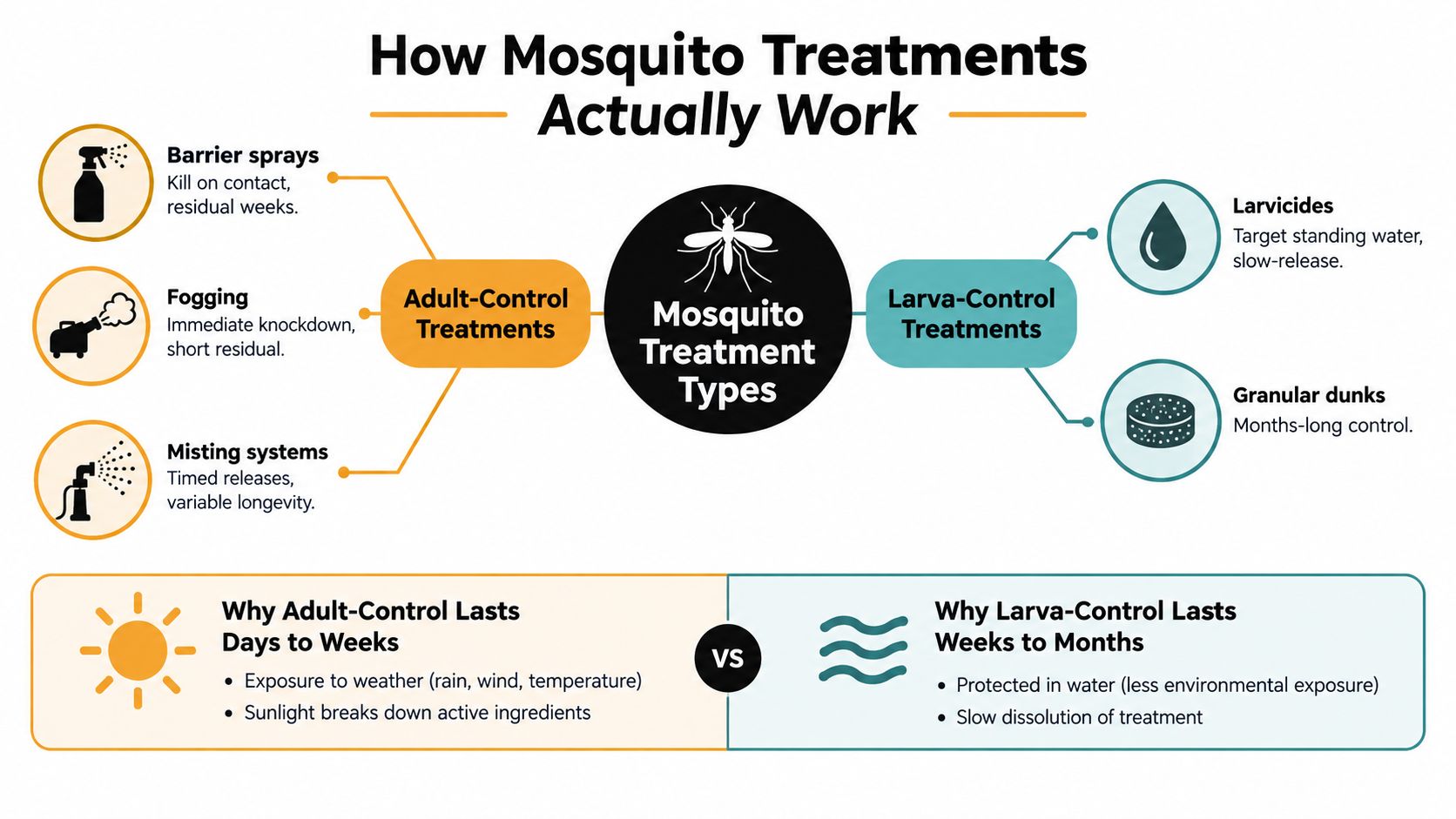
How Mosquito Treatments Actually Work
A Crown Point mosquito treatment has one job. Break the cycle in the places mosquitoes hide and breed around your yard.
Adult-control treatments
Adult-control is what homeowners feel first. Barrier sprays and event fogging target the shaded rest zones mosquitoes use during the day, including shrubs, lower tree canopies, fence lines, dense mulch beds, and the damp edges around patios and play sets.
For most Crown Point properties, barrier spray is the main tool because it leaves a usable residue on those surfaces. That residue is what keeps working after the technician leaves. Product guidance collected in this mosquito insecticide residual overview puts common outdoor pyrethroid residuals in the general 2 to 4 week range, which matches how these treatments are usually scheduled through our local season.
Fogging is different. It drops adult numbers fast, but it is the short-window option. If you want a yard to stay comfortable through June, July, and August, a one-time knockdown is not a real plan.
Larva-control treatments
Larva-control goes after the next wave before it starts. That means treating standing water in places like catch basins, drains, low spots that stay wet, ornamental features, and any container that keeps producing larvae after rain.
This part matters more in Northwest Indiana than many homeowners expect. Crown Point yards often have exactly the kind of hidden water sources that keep pressure up between spray visits. A clean-looking yard can still have mosquito production in a gutter elbow, sump discharge area, or a stack of kids' toys holding water behind the garage.
Larvicides usually last longer than adult sprays because they are placed in the breeding site instead of exposed across foliage and hardscape. The University of Kentucky Entomology department explains that products such as methoprene and Bti are used to stop mosquitoes from developing in water and are most effective where breeding sites can be identified and treated directly, as outlined in this mosquito larval control overview.
The practical takeaway is simple. Adult treatments protect the spaces where your family spends time. Larval treatments cut down the next hatch. On many Crown Point properties, you need both if you want treatment intervals to hold the way they should.
If you want a broader public-health refresher, this guide to protecting your health is worth reading.
Comparing Mosquito Treatment Methods and How Long They Last
In Crown Point, the right question is not "Which mosquito treatment lasts the longest?" The right question is "Which treatment fits the part of the season and the kind of yard you have?"
A shaded lot near trees and fence lines needs a different plan than an open yard with standing water by the sump discharge. That is why I compare methods by job first, not by marketing claims.
What each method is actually good at
Barrier spray is the main tool for backyard use because it treats the shrubs, lower tree limbs, fence lines, and damp shade where adult mosquitoes spend the day. It is the treatment that carries a weekly or every-few-weeks service plan through the Northwest Indiana season.
Fogging is different. It is a quick adult knockdown. Use it when you want fast relief before a graduation party, cookout, or holiday weekend. Do not expect it to carry the yard for long.
Larvicides handle the source. If your property has catch basins, low wet spots, clogged gutters, or containers that keep refilling after rain, larva control usually gives you more staying power than another round of adult spray alone.
Traps and habitat changes can help, especially on larger lots or properties with steady mosquito pressure from nearby water or heavy vegetation. They are support tools. They are not the main schedule item for a typical Crown Point homeowner.
| Method | What It Best Handles | How It Fits a Crown Point Season |
|---|---|---|
| Barrier spray | Adult mosquitoes resting in shaded yard areas | Main recurring treatment from late spring through early fall |
| Fogging | Fast knockdown before events or during sudden spikes | Short-term add-on, not a full-season plan |
| Larvicides in standing water | Mosquitoes developing in water before they become biting adults | Strong support after rainy stretches and on properties with repeat water issues |
| CO2 or lure traps | Ongoing pressure reduction in specific parts of a yard | Supplemental tool for larger lots or stubborn pressure |
| Biological controls and habitat changes | Lowering mosquito pressure over time by reducing breeding and hiding areas | Works best as season-long maintenance, not a one-time fix |
The practical call is simple. If you want dependable use of the patio and backyard, start with barrier spray. If your yard keeps producing mosquitoes after rain, add larva control. If you have a one-day event, fogging can help, but it should not be mistaken for a regular program.
A published review of barrier spray research supports that general pecking order in the field, showing that outdoor residual treatments can suppress mosquito activity for a limited window while results vary by product and conditions, as outlined in this residual barrier spray review.
That matches how we schedule in Crown Point. The Green Advantage does not build mosquito service around the single longest number on a label. We build it around the local season, weather swings, and whether the property has water sources that keep refilling the yard with new mosquitoes.
What Makes Mosquito Treatments Wear Off Faster or Last Longer
A mosquito treatment doesn't fade on a neat timer. In Crown Point, yard conditions decide a lot of the outcome.
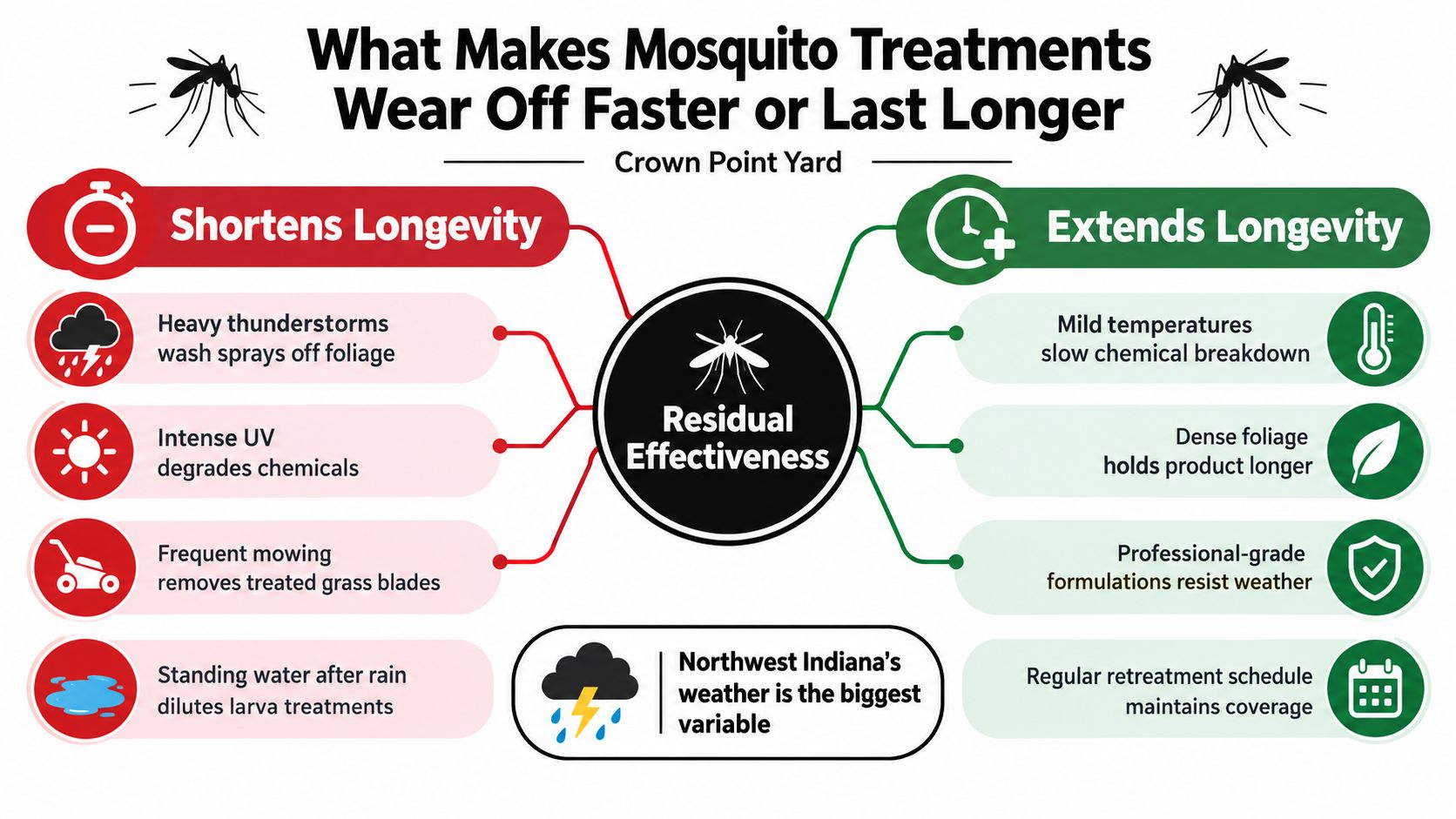
Weather changes everything
Heavy summer rain is the first thing I look at when a homeowner says a treatment seemed short-lived. The Cass County Vector Control guidance says residual mosquito barrier sprays generally last a couple of weeks, but rain or heavy watering can shorten that effectiveness, and it recommends repeating the treatment as directed or every couple of weeks in this property mosquito spraying guidance.
Sun matters too. Hot, exposed leaf surfaces break down residue faster than shaded foliage. A south-facing shrub line usually won't hold the same way a dense, protected planting bed does.
Surface and plant type matter
Not every treated area holds product equally. A peer-reviewed summary of residual persistence points out that durability varies sharply by surface, active ingredient, and weather. It notes residual effects such as permethrin lasting up to 1 week, resmethrin about 48 hours to 1 week, and some products remaining detectable up to 2 weeks. Another paper cited there reported different persistence by target surface, with 8 to 14 days on vegetation versus 15 to 20 days on walls, according to this residual persistence summary.
That matters in real yards. Concrete patio edges, vinyl fence lines, and hard surfaces can hold differently than soft leaf tissue. Dense shrubs can protect treatment from direct exposure, but they also shelter mosquitoes. Open lawn doesn't hold mosquitoes the same way because it isn't their main daytime resting site.
Why a fresh spray can still feel weak
Sometimes the treatment didn't fail. The yard got repopulated fast.
The U.S. EPA says the mosquito life cycle typically takes about two weeks, though it can range from 4 days to as long as a month depending on conditions, in this mosquito life cycle overview. CDC material gives a similarly fast timeline of approximately 8 to 10 days from egg to adult in this CDC life cycle fact sheet.
If clogged gutters, toys, planters, ditch edges, or birdbaths keep producing new adults, a good barrier treatment can feel like it wore off before it did.
- Stormy stretches: Fresh water creates fresh breeding.
- Fast summer growth: Thickening vegetation creates more resting shelter.
- Nearby water features: New mosquitoes can keep emerging close to the yard.
A Crown Point Mosquito Treatment Calendar for the Season
The right mosquito schedule in Crown Point follows the season, not a generic national template.
What the local season usually looks like
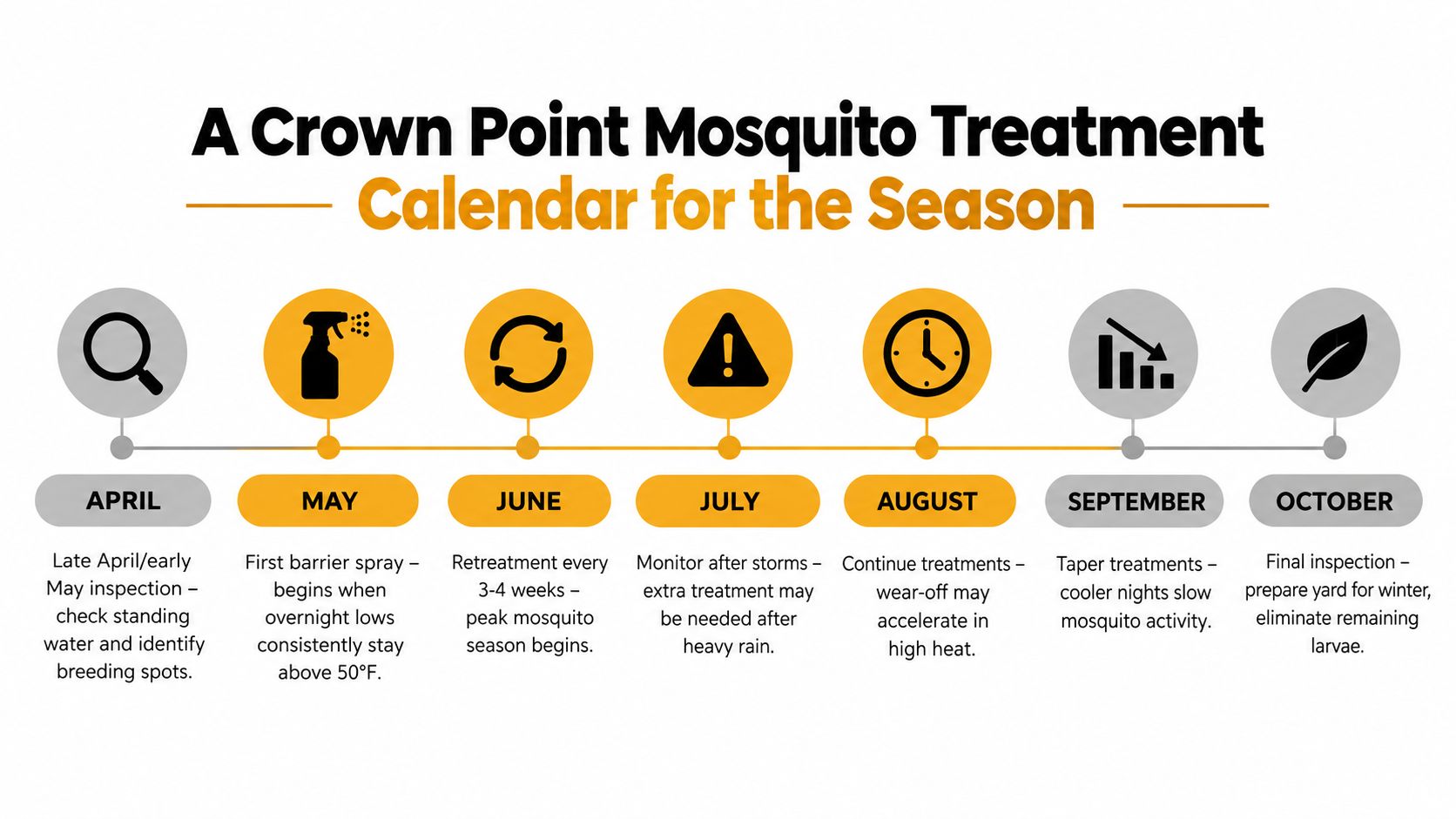
Start with an inspection in late April or early May, once overnight temperatures are staying mild and the yard starts holding moisture consistently. That's the time to check gutters, splash blocks, birdbaths, low spots, and shady edges before mosquito pressure ramps up.
The first barrier spray usually makes sense in mid-May for most Crown Point properties. From there, the practical rhythm is every 21 to 28 days through June, July, and August. That schedule tracks with the common residual window already covered above and lines up with the part of the season when backyard use peaks.
Texas A&M AgriLife Extension notes that residual sprays can suppress mosquito activity for up to a month, which is a fair upper-end benchmark when conditions cooperate, as noted in this backyard mosquito control publication.
How I'd time it in a Crown Point yard
- Late April to early May: Inspect the property and correct standing-water issues.
- Mid-May: First full-yard barrier treatment.
- June through August: Retreat every 3 to 4 weeks. Tighten the schedule after storm-heavy periods.
- September: Stay in rotation if evenings are still warm and activity remains noticeable.
- October: Consider a final visit after a wet year or on properties with lingering pressure near water and woods.
Homeowners who want a deeper local scheduling reference can review this best time to spray mosquitoes in Crown Point.
A quick visual helps if you're mapping the season around outdoor use and weather:
If you wait until the yard is miserable in July, you're already playing catch-up.
DIY Mosquito Products Versus Professional Service in Crown Point
DIY mosquito products can help around the edges. They usually don't hold up like a real service program on a Northwest Indiana property.
Where DIY usually falls short
Store-bought sprays, coils, torches, and plug-in repellents are mostly short-coverage tools. They may help for a brief stretch on a patio or during a single evening, but most homeowners don't get full-property reach. The underside of shrubs, the canopy edge, the back fence line, the area under decks, and foundation plantings are usually where coverage breaks down first.
That's the issue. Not just chemistry. Coverage.
What the side-by-side looks like
| Factor | DIY Store-Bought Products | Professional Barrier Spray Service |
|---|---|---|
| Coverage | Limited to what the homeowner can reach comfortably | Full-yard treatment of shrubs, shaded harborage, under decks, and perimeter vegetation |
| Longevity | Often feels short and inconsistent outdoors | More dependable residual window when applied thoroughly on target areas |
| Equipment | Basic sprayers, cans, foggers, or handheld products | Commercial application equipment designed for better reach and even coverage |
| Consistency | Depends on homeowner timing, weather judgment, and reapplication habits | Scheduled repeat service keeps the property on a steadier cycle |
| Water-site treatment | Usually overlooked | Can be paired with larva-control where standing water is part of the problem |
A lot of homeowners start with DIY because it seems simpler. Then they realize they're reapplying, missing hidden resting areas, and still getting bitten near the same damp corners of the lot.
For homeowners comparing options, The Green Advantage outlines its mosquito control service in Crown Point as a recurring seasonal approach rather than a one-and-done spray. That's the right framework for most local yards.
My blunt advice
Use DIY if you need a little short-term help before a cookout. Don't lean on it as your whole summer strategy if your yard has trees, shade, standing water issues, or bordering vegetation. That's when homeowners start typing pest control near me, exterminator near me, or pest control in Crown Point, IN because the store-bought approach stops being worth the time.
Practical Tips to Make Mosquito Treatment Last Longer
You can stretch the life of a mosquito treatment if you stop working against it.
What to do before and after service
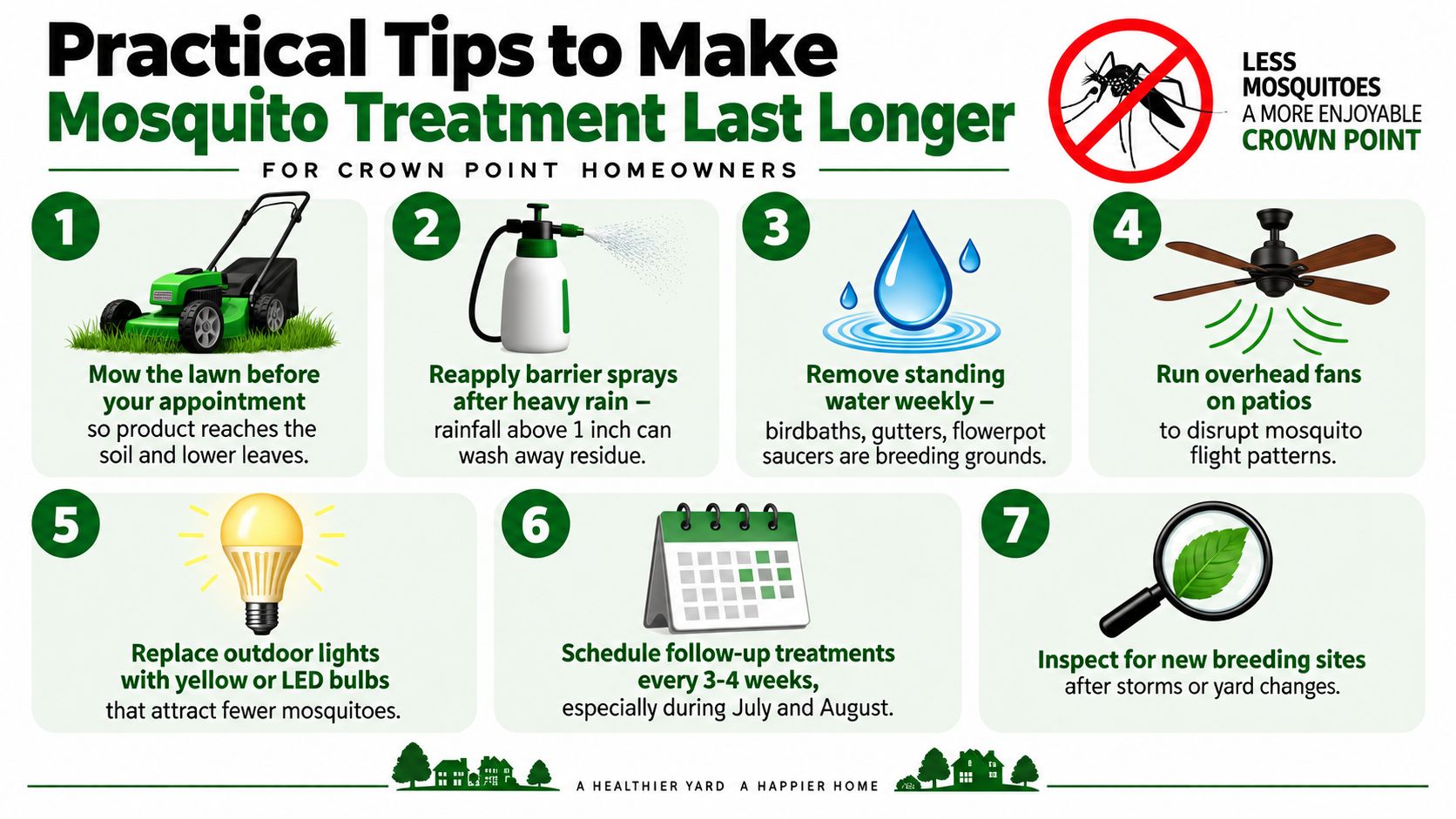
Mow before the appointment, not right after. If the grass and lower foliage are overgrown, product won't reach the zones where mosquitoes rest. Trim back thick edges around fences, decks, and landscaping beds so treatment can reach into those pockets.
Go easy on irrigation right after treatment. Heavy watering on fresh foliage shortens outdoor residual life. If you know a major rain is coming, timing matters. A treatment right before a washout won't perform the same way as one that gets a clean day to settle.
The weekly habits that matter
Here's the checklist I'd give any Crown Point homeowner trying to hold the line between visits:
- Dump standing water: Empty birdbaths, saucers, buckets, toys, and wheelbarrows every week.
- Clear the gutters: Debris-filled gutters become mosquito factories after summer storms.
- Refresh water features: Keep ornamental features moving and maintained so they don't turn stagnant.
- Use fans on porches: Air movement makes it harder for mosquitoes to work a sitting area.
- Watch the shady corners: If mosquitoes are coming back, they usually return to sheltered edges first.
Don't give mosquitoes a nursery and then blame the spray.
Skip the gimmicks
A lot of money gets wasted on gadgets that don't solve the actual problem. Ultrasonic devices, weak botanical-only fads, and random yard hacks usually don't fix a property with active breeding and heavy resting cover. Stick with methods that address vegetation, standing water, and repeat service timing.
This same practical thinking applies across other seasonal pest issues in Northwest Indiana too. Homeowners searching for residential pest control, eco-friendly pest control, rodent control, spider control, or wasp removal usually get better results when they combine treatment with cleanup and prevention instead of chasing quick fixes.
Setting Realistic Expectations and Scheduling Your Next Visit
Here's the honest version. Mosquito control works, but it doesn't create a magical mosquito-free bubble around your property.
What good service should feel like
After a solid yard treatment, most homeowners notice a drop in activity fairly quickly. The yard should feel more usable. The patio becomes tolerable again. The dog isn't getting swarmed near the fence line. The kids can play outside without constant slapping and scratching.
Then the pressure slowly rebuilds. That's normal outdoors. New adults emerge. Nearby activity shifts. Rain resets parts of the problem. By the time you're nearing the next service window, you may notice more activity in the shadiest zones first. That doesn't automatically mean the treatment failed. It usually means the schedule is doing exactly what it's supposed to do and the next visit is coming due.
Who usually needs tighter scheduling
Some properties need more attention than others.
- Larger lots with wooded edges: More resting sites and more incoming pressure.
- Homes near ponds, ditches, or retention areas: More breeding pressure nearby.
- Dense ornamental landscaping: More places for adult mosquitoes to hide.
- Commercial properties and multifamily sites: More square footage and more use patterns to protect.
That's why one homeowner searches for pest control in Crown Point, IN and needs a simple seasonal plan, while another needs a more layered program that may also touch related services like preventative pest treatments, commercial pest control, ant control, or termite control as part of broader property care.
My recommendation
If you're in Crown Point and you want the yard usable through mosquito season, plan on an early-season start and recurring visits through the peak months. Don't wait until July to think about it. Book before the season fills up, especially if your property backs to trees, holds water, or gets hammered after summer storms.
Professional mosquito service makes the most sense when you treat it like seasonal maintenance, not emergency cleanup.
If you want a practical mosquito plan built for Crown Point and nearby Northwest Indiana properties, The Green Advantage offers recurring mosquito treatments, property inspections, and broader pest support for homes and businesses dealing with seasonal pest pressure. To schedule service, request a quote, or line up a yard assessment before mosquito season peaks, visit The Green Advantage.
7 Plants That Repel Mosquitoes Safe for Dogs

A Crown Point summer evening can turn uncomfortable quickly. Mosquitoes gather around patios, dog beds, shaded play areas, and damp corners of the yard, even when the landscaping looks healthy and well maintained. Aromatic plants may help reduce mosquito activity close to where they grow, but they won't remove standing water, eliminate breeding sites, or control an established population.
The Green Advantage is a family-owned pest control provider serving Crown Point and the broader Northwest Indiana community. The seven choices below can add useful scent, color, and seasonal flexibility to a dog-friendly yard, but each has trade-offs involving placement, care, ingestion risk, and realistic coverage. Before planting, it's also smart to review broader resources on safe houseplants for pets, especially if your dog chews foliage.
1. Citronella Grass Cymbopogon nardus
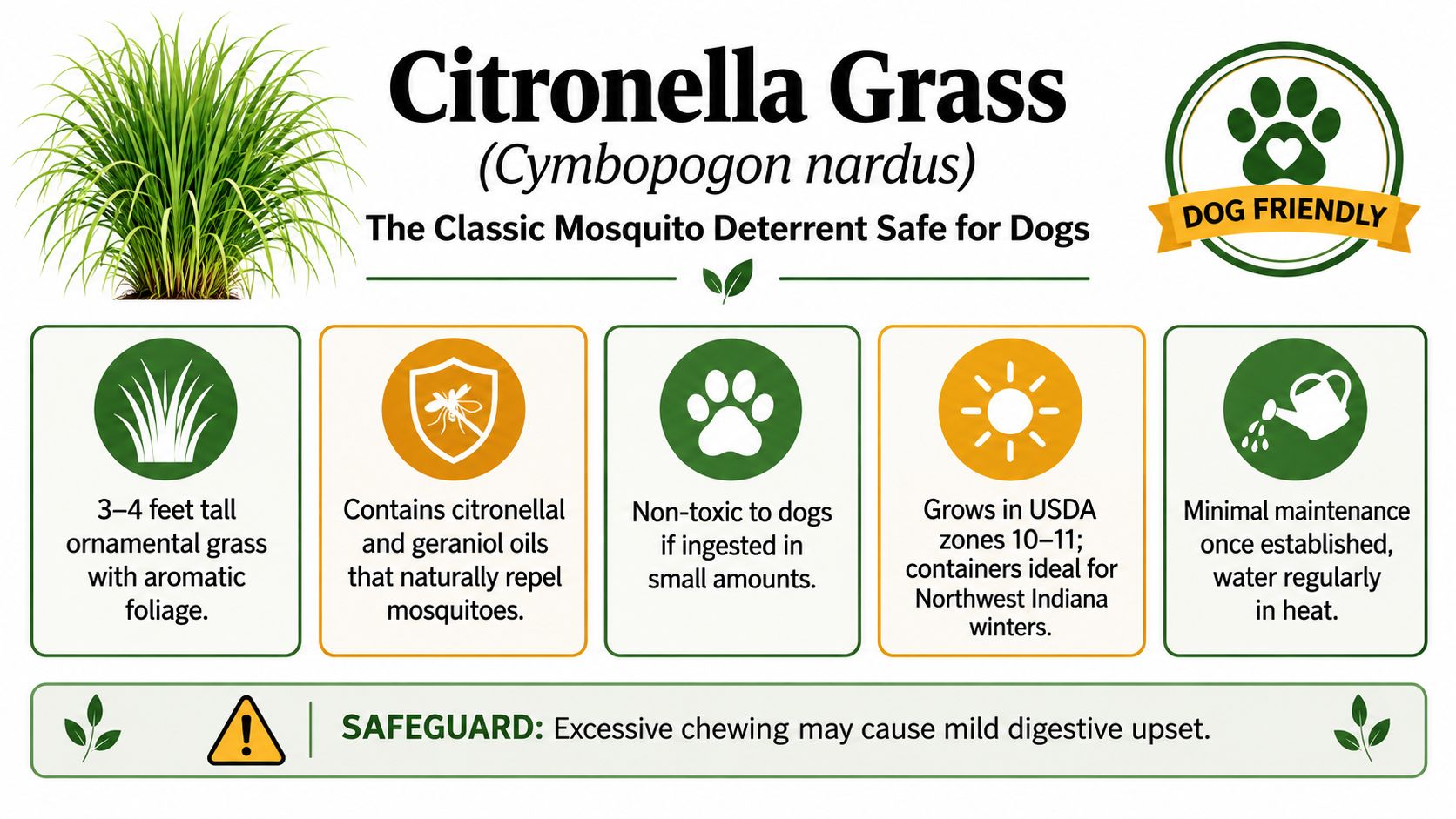
Citronella grass is often the first plant homeowners mention when searching for plants that repel mosquitoes safe for dogs. Its aromatic leaves can contribute useful fragrance near a patio, deck, or outdoor sitting area, particularly when the plant is placed close to the space people and pets use. In Crown Point, containers are usually more practical than permanent beds because they make seasonal movement and winter protection easier.
A large decorative pot near a dog bed or patio chair can keep the plant close to the area where its scent matters most. It won't create a mosquito-proof perimeter around an entire yard, and planting it at the property edge won't address mosquitoes emerging from wet soil, clogged gutters, or containers holding water.
Practical rule: Treat citronella grass as a close-range landscape helper, not as a substitute for mosquito reduction.
Growing citronella grass in Northwest Indiana
Keep the plant in a sunny, well-watered location during hot weather. Containers also let you move it indoors before frost, which is important for managing a warm-season plant in Crown Point. Regular trimming can encourage fuller growth and refresh the foliage, but don't crush leaves and rub them on your dog or apply concentrated citronella oil without veterinary guidance.
Pet owners should also distinguish citronella grass from the plant marketed as a “mosquito plant.” That product is often a scented geranium, and ASPCA poison-control guidance warns that citronella can cause gastrointestinal upset in dogs, with more serious signs possible after larger exposures. The safest approach is to prevent chewing and keep containers where dogs can't knock them over.
For a more complete overview of mosquito-repelling plants, combine plantings with standing-water management and professional mosquito control when activity remains high.
2. Lavender Lavandula angustifolia
Lavender earns its place in a dog-friendly garden because it provides more than aromatic foliage. Its purple blooms add structure along a sunny patio border, while the fragrance can make outdoor seating more pleasant and may discourage some flying insects near the planting. It's also a useful choice for homeowners who want a tidy perennial rather than a fast-growing herb.
Plant lavender where it receives full sun and where water drains quickly. Crown Point yards with heavy or compacted soil can create problems if lavender's roots stay wet. A raised bed, amended planting area, or container can help, particularly in locations that hold moisture after storms.
Placement and pruning matter
A lavender border around a patio or dog run may improve comfort right beside that border, but it won't protect a distant lawn or wooded edge. Leave space around each plant for air movement, prune after flowering to maintain a compact shape, and avoid frequent watering once the plant is established. Overwatering can weaken the plant and reduce the quality of its aromatic growth.
Lavender itself is often included among dog-friendly options, but concentrated lavender oil is a different product. The ASPCA dog plant list is a useful neutral reference for checking plant safety, and owners should contact a veterinarian or poison control if a dog eats an unfamiliar plant.
Research on plant-derived repellents also supports realistic expectations. A peer-reviewed review found that several extracted botanical repellents, including some aromatic oils, repelled mosquitoes for about 60 to 180 minutes in testing, not for an entire day (peer-reviewed review of plant-derived repellents). That evidence concerns extracted compounds, not a living lavender border. For more context on whether lavender oil repels mosquitoes, remember that formulation and exposure determine performance.
3. Rosemary Rosmarinus officinalis
Rosemary fits naturally beside an outdoor kitchen, grill, or patio table. Its tough, fragrant foliage gives homeowners a useful culinary herb and an attractive container plant, while the aroma may help reduce mosquito interest close to the plant. For dog owners, rosemary is commonly presented as a safer choice than several “mosquito plant” products that carry ingestion warnings.
Northwest Indiana soil can be challenging for rosemary when it drains slowly. Use a container with drainage holes if your yard has dense clay or regularly wet areas. Position the pot in full sun, keep foliage from staying damp, and water only when the plant needs it rather than following a fixed schedule.
A strong container candidate
A rosemary pot beside an outdoor dining table is easier to manage than a shrub planted in an exposed bed. You can shift it toward the seating area when guests arrive, shelter it during severe weather, and move it indoors before damaging cold. Harvesting sprigs for cooking also encourages a fuller shape when you pinch or cut cleanly.
Rosemary still provides limited, local coverage. A pot won't stop mosquitoes traveling in from neighboring properties, drainage areas, or shaded vegetation. It also shouldn't lead you to rub crushed leaves or oil onto a dog's coat. Plant safety and topical safety aren't the same thing.
The strongest plant-based repellency results have generally involved formulated oils rather than growing herbs outdoors. A review of plant-based repellents reported complete protection times from 9.1 to 11.5 hours for certain citronella, pine, peppermint, and related oil formulations in controlled testing (review of plant-based repellents). Outdoor wind, heat, and exposure can reduce performance, so rosemary works best as one layer alongside drainage improvements and professional mosquito control.
4. Marigold Tagetes spp.
Marigolds give Crown Point homeowners a practical way to add color around patios, raised beds, and dog-friendly outdoor areas. They're accessible, easy to replace, and suitable for containers or sunny borders. Their presence may contribute to a less inviting environment for some insects, but a row of flowers won't control mosquitoes developing in nearby water.
Start marigolds indoors before the local spring planting window or sow them outdoors after frost danger has passed. Choose a sunny location, avoid crowding, and remove spent blooms to keep the plants looking productive through the warm season. Containers near a dog bed or outdoor dining area make placement flexible and keep the flowers visible rather than scattered at the far edge of the property.
Use color as part of a layered plan
Clusters generally make more practical garden sense than isolated plants. A bright border can define the edge of a seating area, while containers can be moved when mosquito activity shifts. Keep the soil from staying saturated, and check saucers after watering because any container that holds stagnant water can undermine the goal by creating mosquito habitat.
Marigold safety advice is inconsistent across online gardening content, especially among different species and varieties. The responsible approach is to identify the plant, check the ASPCA list, and prevent dogs from chewing large amounts of any ornamental. “Natural” doesn't automatically mean harmless, and the same caution applies to plant extracts and homemade sprays.
If mosquitoes remain concentrated around the yard, professional treatment can address the places plants can't reach. The Green Advantage can evaluate common sources of mosquito pressure, including damp garden areas and areas near outdoor living spaces, then discuss a practical mosquito reduction plan for your property.
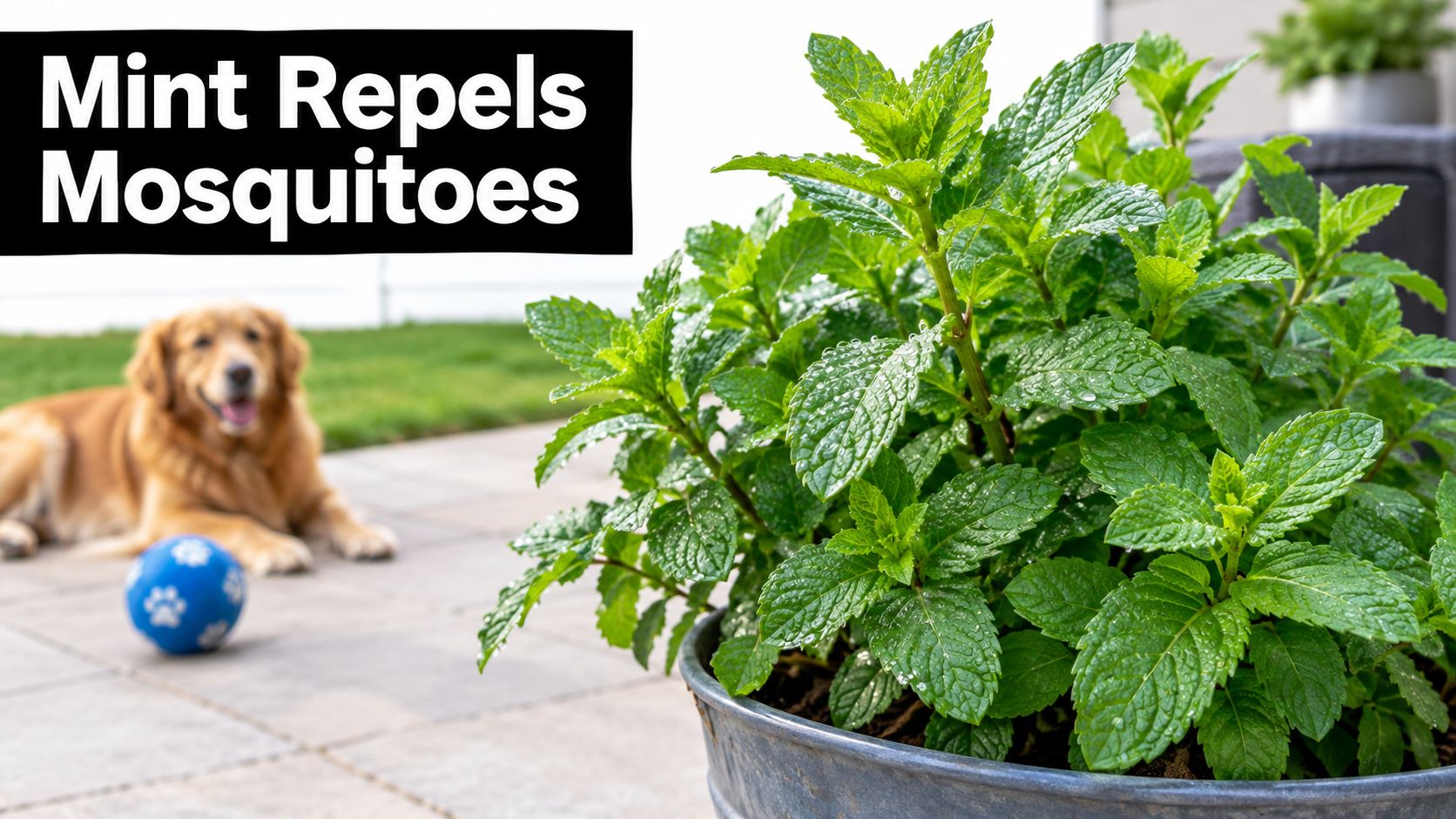
5. Mint Mentha spp.
Mint is flexible, fragrant, and useful in a patio garden, but it comes with one major landscaping warning. It spreads aggressively when planted directly in open soil. For that reason, dog owners should grow mint in containers, raised planters with defined barriers, or another controlled setup rather than placing it loose beside a fence or dog run.
A large pot near outdoor seating can provide fresh leaves for drinks and cooking while keeping the aromatic foliage close to the people and pets using the space. Mint tolerates sun and partial shade, but it needs consistent moisture, especially in containers that dry quickly during a Crown Point heat spell.
Containment is part of pet safety
Mint plants can become messy when neglected, and loose stems may invite chewing. Keep pots stable, inspect drainage holes, and place them where an active dog can't easily tip the container. Pinching stem tips encourages bushier growth and gives you a reason to remove old or damaged foliage.
Use mint as a localized helper rather than a barrier across the property. The scent fades with distance, and a dense planting won't eliminate mosquitoes around storm drains, wet grass, clogged gutters, or water-filled toys. Don't use concentrated peppermint oil in a diffuser or apply it directly to a dog without veterinary advice.
A layered approach works better. Combine contained mint with lavender or rosemary near the patio, remove water-holding objects after rain, and request professional mosquito control when bites continue despite reasonable yard maintenance.
6. Basil Ocimum basilicum
Basil is a strong fit for homeowners who want mosquito-conscious landscaping without giving up a productive kitchen garden. A few containers near an outdoor dining table can provide fresh leaves for meals and add aromatic foliage close to the areas where people gather. Basil is a warm-season annual in Crown Point, so it offers seasonal value rather than year-round protection.
Wait until frost danger has passed before setting basil outdoors. Give it full sun, regular watering, and enough room for air circulation. Containers are especially useful because you can move basil closer to a table or dog lounging spot, protect it from heavy weather, and bring it into a sheltered location when temperatures fall.
Keep basil leafy and vigorous
Pinch flower buds before they open if you want continued leaf production. Harvest the top stem sections regularly instead of stripping lower leaves, and water when the soil begins to dry. A wilted basil plant won't provide much attractive foliage, and standing water in a saucer can create an avoidable mosquito problem.
Basil's fragrance may help around the plant, but it won't replace mosquito control in a larger yard. Mosquitoes can approach from shaded vegetation and neighboring areas, and dogs can still receive bites while moving beyond the patio. Keep basil where your dog can't destroy the pot, but don't assume a chew-resistant plant makes essential-oil use safe.
For pet-focused protection, also maintain your dog's veterinary prevention plan. Plantings can improve the yard environment, while a veterinarian can advise on approved measures for mosquito-related risks. When outdoor activity remains uncomfortable, residential mosquito control from a local provider can address the broader exposure pattern.
7. Geranium Pelargonium spp.
A garden center may label a scented geranium as a “mosquito plant,” but that name does not identify one specific species or guarantee dog safety. Scented Pelargonium varieties can offer lemon, rose, apple, or peppermint fragrance in a patio container. Geranium-family plants still require caution: the ASPCA guidance on toxic and non-toxic plants lists geraniums as capable of causing gastrointestinal upset when dogs ingest them.
For a dog that chews leaves, skip a ground-level bed. Use a clearly labeled plant in a secured, raised container, and confirm the botanical name before buying. Keep the original label, especially if the retailer uses “citronella” as a marketing name.
Seasonal container care
In Crown Point and across Northwest Indiana, scented geraniums work best as warm-season container plants. Set them outdoors after frost danger has passed, then give them bright light, well-draining soil, and careful watering. Let the soil surface dry before watering again, pinch growing tips to maintain fuller growth, and move the container indoors before fall frost. A sunny window can preserve the plant for another season, but indoor placement still requires chew prevention.
Its fragrance may make a small patio more pleasant, yet a living geranium will not protect a yard or provide dependable all-day coverage. Results from a citronella formulation cannot be transferred to a geranium, and a formulated product should never be treated as proof that applying essential oil to a dog is safe. Keep oils off your pet unless a veterinarian specifically directs their use.
If your dog chews a geranium or another questionable plant, use what to do if your dog eats a potentially toxic plant as a starting point, then contact your veterinarian or an appropriate poison-control resource. For persistent mosquitoes around shaded areas, drains, or neighboring properties, professional mosquito reduction may be needed alongside contained plantings.
7-Plant Comparison: Dog-Safe Mosquito Repellents
| Plant | Implementation complexity | Resource requirements | Expected outcomes | Ideal use cases | Key advantages |
|---|---|---|---|---|---|
| Citronella Grass (Cymbopogon nardus) | Moderate, container/overwinter management | Warm-zone plant or indoor relocation; regular summer watering | Short-range deterrent (3–5 ft); reduces attraction, not eradication | Patio containers near dog beds and play areas | Strong repellent oils; ornamental; pet-safe |
| Lavender (Lavandula angustifolia) | Low, hardy, low-maintenance | Full sun, well-draining soil; drought tolerant | Moderate close-range repellency; seasonal blooms (summer–fall) | Borders, perennial beds, dog runs | Fragrant, pollinator-friendly, durable in IN climate |
| Rosemary (Rosmarinus officinalis) | Low–Moderate, may need winter protection for some varieties | Full sun, very well-draining soil; mulch in winter; drought tolerant | Year-round foliage deterrent within ~3–5 ft | Containers near outdoor kitchens, patios, dog areas | Culinary use, evergreen, low water needs |
| Marigold (Tagetes spp.) | Low, easy annuals from seed | Full sun, regular watering; replant each spring | Quick, short-range deterrent (1–3 ft); seasonal until frost | Cost-effective borders, containers, mass plantings near pet areas | Affordable, fast-growing, attractive blooms |
| Mint (Mentha spp.) | Moderate, vigorous grower requiring containment | Hardy, tolerates partial shade; prefers regular moisture; best in containers | Strong close-range deterrent (3–5 ft); fast coverage | Container herb gardens near seating and dog zones | Very hardy, culinary/medicinal uses, rapid establishment |
| Basil (Ocimum basilicum) | Low, seasonal annual, simple care | Warm-season plant; consistent moisture; containers recommended | Short-range deterrent (2–4 ft) during warm months | Patio containers by dining areas and dog lounging spots | Quick growth, culinary value, fragrant foliage |
| Geranium (Pelargonium spp.) | Low–Moderate, containerize for winter in cold climates | Well-draining soil, full sun–partial shade; indoor overwintering | Moderate close-range deterrent (2–4 ft); long bloom season | Decorative patio containers and barriers near pet areas | Ornamental blooms, scented foliage, pet-safe |
Plants Help, but a Complete Mosquito Plan Goes Further
Dog-safe plantings can improve the immediate area around a patio, container garden, dog bed, or outdoor kitchen. They're most useful when you match the plant to the location. Rosemary, basil, mint, and scented herbs work well in movable containers, while lavender and marigolds can add structure and color to sunny borders. Citronella grass offers seasonal flexibility in a pot, and geranium containers can provide fragrance when carefully identified, secured, and monitored.
The central limitation is coverage. Living plants release scent from their foliage, but they don't remove breeding water or reach mosquitoes throughout a property. Wind, heat, yard layout, dense vegetation, and nearby wet areas all affect how comfortable an outdoor space feels. Plant-derived repellents have a history of temporary and ingredient-specific performance, so homeowners shouldn't treat a garden bed as an all-day mosquito barrier.
Start with the basics around your Crown Point property. Empty water from plant saucers, toys, buckets, and other containers. Keep gutters flowing, trim dense vegetation near seating areas, and inspect shaded locations where water remains after rain. Don't use essential-oil diffusers around dogs without veterinary guidance, and don't crush leaves onto a pet's coat just because the plant itself appears safe to grow.
When mosquitoes remain active after these steps, The Green Advantage can help determine whether you need targeted mosquito reduction, broader residential pest control, or a seasonal prevention plan. Property managers and businesses may also need commercial pest control to protect employees, customers, tenants, and outdoor gathering spaces. The same local team can discuss related needs such as ant control, termite control, rodent control, spider control, wasp removal, preventative pest treatments, and pest inspections.
For homeowners searching for pest control near me, an exterminator near me, or pest control in Crown Point, IN, a property-specific evaluation is more useful than relying on a generic plant list. The Green Advantage serves Crown Point and nearby Northwest Indiana communities with licensed, certified services and environmentally mindful approaches designed around each site.
The Green Advantage provides mosquito reduction, residential pest control, commercial pest control, and property inspections for homes and businesses in Crown Point and surrounding Northwest Indiana. If your dog-friendly landscaping isn't keeping outdoor areas comfortable, visit The Green Advantage to request a quote or schedule service.
Professional Mosquito Yard Treatment in Crown Point, IN
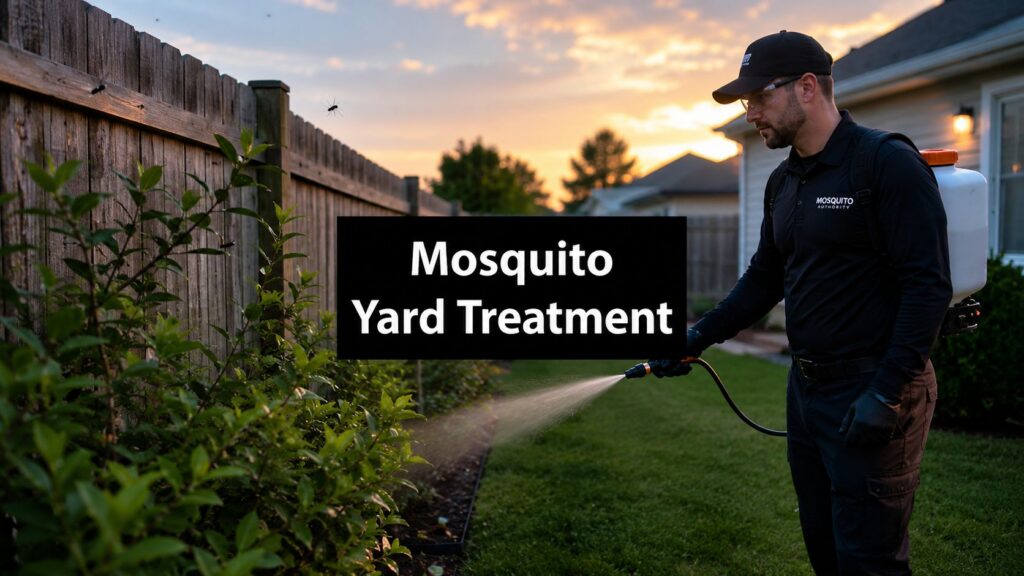
A midsummer dinner in Crown Point can go from relaxing to miserable in minutes. The grill is ready, the patio table is set, and then mosquitoes start working every exposed ankle and arm until everyone retreats indoors. If you're searching for pest control near me, an exterminator near me, or a dependable mosquito program in Northwest Indiana, the right answer isn't always another quick spray. It starts with understanding what's producing mosquitoes on and around your property.
The Green Advantage serves Crown Point, IN and nearby Northwest Indiana communities with practical pest management for homes, businesses, rental properties, and outdoor spaces. A thorough professional mosquito yard treatment combines inspection, habitat correction, larval control, and targeted adult mosquito treatment. That approach matters whether you also need residential pest control, commercial pest control, ant control, termite control, rodent control, spider control, or wasp removal.
Why Mosquito Yard Treatment Matters in Crown Point
A family in Crown Point may step onto the patio expecting a quiet evening and find the yard unusable before dinner is finished. Mosquitoes often gather around shaded landscaping, fence lines, decks, drainage areas, and nearby water. In Lake County, yards can sit beside retention ponds, wooded lots, drainage easements, or low areas that refill after storms, giving mosquitoes repeated opportunities to develop close to the home.
The local setting creates a difficult combination. Humid summer weather, thunderstorms, shaded vegetation, and water that lingers in containers or low spots all support mosquito activity. A property doesn't need a visible pond to have a problem. A clogged gutter, a tipped-over toy, or a folded tarp can hold enough water to keep the local population going.

The problem is bigger than outdoor discomfort
Mosquitoes are more than an interruption to patio meals. West Nile virus and other mosquito-borne illnesses remain public health concerns in Northwest Indiana, so reducing contact with biting mosquitoes is a reasonable part of responsible property care. Homeowners can also use practical pest control tips for dining to make outdoor meals less attractive to flying pests, but those measures won't correct breeding conditions across the yard.
The goal of a mosquito program is not to promise a completely insect-free property. Mosquitoes can arrive from surrounding areas, and weather can change pressure quickly. The goal is to reduce mosquito pressure enough to restore usable outdoor space, protect the investment in landscaping, and make time outside more comfortable.
A habitat-first program also gives homeowners a clearer explanation for recurring activity. If the same low spot, gutter, or decorative water feature keeps producing larvae, spraying adult mosquitoes without correcting that source only treats the visible symptom. For information about the health concerns involved, homeowners can review Indiana mosquito-borne illnesses and discuss property-specific concerns during an inspection.
Practical rule: If a treatment plan only discusses where to spray and never asks where mosquitoes are developing, it's incomplete.
How Professional Mosquito Yard Treatment Actually Works
Mosquitoes pass through four stages, egg, larva, pupa, and adult. The first three stages depend on water, while the adult mosquito rests in vegetation and moves through the yard looking for a host. A household bucket is a useful comparison. If a bucket collects rain and stays undisturbed, it can become a small mosquito nursery even though it looks harmless from a distance.
A bottle cap of standing water can produce dozens of mosquitoes in under two weeks. That's why many of the mosquitoes biting around a home are connected to conditions on the property or nearby, rather than appearing without a local source.

Four layers of a working program
Inspect and correct habitat. A technician checks gutters, downspout discharge areas, tarp folds, wheel ruts, plant saucers, birdbaths, dense ground cover, and other places where water can remain. The simplest fix is often to empty, cover, turn over, or remove the item.
Control larvae before they mature. Some water can't be drained or covered. EPA guidance distinguishes larvicides, which target mosquitoes in breeding water, from adulticides, which target flying adult mosquitoes. CDC guidance recommends using larvicides only for larger water bodies that can't be dumped or covered, and not in drinking water. Products may include biological or insect-growth-regulating materials selected for the site and applied according to the label.
Treat adult resting areas. Adult mosquitoes commonly rest in shaded foliage, under decks, along fence lines, and around structure perimeters. A residual barrier treatment places a labeled product on those surfaces so mosquitoes encounter it when they land.
Provide immediate knock-down. The service can also reduce the adult mosquitoes present during the visit. That creates faster relief, while habitat work and residual treatment address the next wave.
The CDC describes integrated mosquito management as a combination of surveillance, source reduction, larval control, adult control, resistance testing, public education, and evaluation. For a Crown Point property, the important point is simple: spraying is one tool in an adaptive program, not the entire program.
What Happens During a Professional Service Visit
A Crown Point yard can look dry at the patio and still produce mosquitoes near a downspout, deck, or drainage easement. A professional visit starts with finding those pressure points before any application begins. The technician walks the property, checks recent moisture patterns, and notes access, shade, vegetation, and areas where water remains after rain.
The inspection should produce a treatment plan, not just a route around the foundation. The technician records conditions such as dense ivy, low spots, birdbaths, ornamental water features, poor downspout discharge, and shaded areas beneath decks. Each finding affects whether the right response is removal, drainage correction, larval control, or targeted adult treatment.
A practical visit usually follows this sequence:
Inspect the property. The technician maps water-holding sites, adult resting areas, drainage patterns, gates, pets, play spaces, and pollinator activity.
Separate correctable sources from unavoidable ones. Water that can be emptied, covered, drained, or modified should be handled that way. Treating removable water leaves the underlying problem in place.
Set application boundaries. Adult treatment is directed toward labeled residential surfaces where mosquitoes rest, including shaded vegetation, fence lines, under-deck spaces, and suitable foundation areas. A calibrated backpack mist blower or low-volume sprayer generally allows more controlled placement than a broad fogging pass.
Explain the work before leaving. Service notes should identify treated areas, conditions that need homeowner attention, and the follow-up window.
Coverage quality depends on reaching the places mosquitoes use, not coating exposed turf for appearances. Dense foliage, shrub interiors, and shaded edges require careful technique, while unnecessary drift should be limited around people, pets, play areas, and pollinator activity.
The final conversation matters because mosquito pressure changes with rainfall, vegetation growth, and nearby breeding sources. A homeowner should know what was found, what was treated, and which source-reduction tasks will have the greatest effect before the next visit. That documentation distinguishes a habitat-first management visit from a quick perimeter pass.
Professional Treatment Compared to DIY Options
DIY products can help with a small gathering or a temporary problem, but they usually don't replace a property-specific program. Citronella candles and torches create a limited comfort zone near the flame. Bug zappers may attract and kill some flying insects, but they don't remove breeding water or create a residual barrier in shaded vegetation.
Residential foggers provide a short burst of adult knock-down. They don't reliably reach every leaf underside, dense shrub interior, or hidden water source. Natural sprays can be useful as a supplemental measure, but their performance depends heavily on coverage, weather, and how often the product must be reapplied.
The comparison below uses the figures supplied for this service discussion. The exact performance and cost for any product can vary, so homeowners should read the label and request an itemized quote rather than treating these figures as a guarantee.
| Method | Effective Duration | Coverage Area | Knockdown Rate | Avg. Cost per Week |
|---|---|---|---|---|
| Professional barrier treatment | 21 to 30 days, depending on conditions and product label | Broad, targeted coverage of foliage, shaded resting zones, fence lines, and structure perimeters | About 90% for a professional application | Varies by property size, service plan, and quote |
| Citronella candle or torch | Roughly 2 to 4 hours near the burn area | Small comfort zone around the device | Not a yard-wide knock-down method | Varies by fuel and replacement needs |
| Store-bought bug zapper | Variable and limited to insects reaching the device | Immediate area around the unit | Not a reliable mosquito population treatment | Varies by equipment and electricity |
| Residential fogger | Short-term, weather-sensitive relief | Areas reached during a single pass | About 30% to 50% reduction on one pass | Varies by canister use and yard size |
| Garden pump sprayer with natural spray | Often short-lived and dependent on conditions | Operator-dependent, with gaps common in dense plants | Variable | Varies by product and reapplication frequency |
The strongest professional advantage is not just stronger chemistry. It's calibrated application, label-driven dosing, equipment reach, and source inspection. A technician can direct material into the shaded foliage and undersides of leaves where mosquitoes rest, while a garden sprayer may leave untreated pockets.
Homeowners improving the rest of their outdoor space can also consult this DreamYard DIY landscaping guide, especially when planning drainage, plant placement, and maintenance access. DIY landscaping can support mosquito control, but it won't replace larval management when water remains on the property.
For a smaller yard with low pressure, DIY measures may be enough as a supplement. When pressure is high, the property is larger than a quarter acre, or dense landscaping blocks coverage, professional service is usually the more practical option.
Why Source Reduction Is the Hidden Key
Monthly spraying sounds like a complete mosquito plan because it's the most visible part of the service. It isn't. Adult mosquitoes can be reduced on treatment day, but new adults can continue emerging if the property still contains water where larvae develop.
Crown Point properties often hide those sources in ordinary places:
- Clogged gutters: Leaves and sediment hold water after rain.
- Container clutter: Tires, toys, buckets, plant saucers, and trash lids collect small pools.
- Lawn depressions: Low areas can stay wet after storms.
- Decorative water: Birdbaths and ornamental features need regular maintenance.
- Tarp folds: Covers over firewood, equipment, or furniture can trap rain.
- Poor discharge: Downspout extensions may empty into a low area that drains slowly.
The CDC recommends emptying, scrubbing, turning over, covering, or throwing away water-holding items once a week. It also notes that small amounts of standing water can support breeding when they persist. Stormwater guidance recommends keeping stored water for less than 72 hours whenever possible, because water held longer than 3 days can create mosquito habitat. These recommendations make weekly property checks a core part of the program, not a cosmetic cleanup task.
What a technician does with each source
A technician may remove the source, recommend a drainage or structural correction, or treat unavoidable water with a labeled larvicide such as BTI or methoprene. The choice depends on whether the water can be dumped, covered, drained, or safely managed.
This is why homeowners should ask about habitat findings before asking only how often the yard is sprayed. The practical details of standing water and mosquito control often determine whether a barrier treatment delivers useful suppression or gets overwhelmed by fresh emergence.
The higher-value question: Which conditions on this property are producing the next generation of mosquitoes?
A habitat-first approach can reduce the pressure that repeatedly feeds the adult population. Sprays still have a role, particularly on shaded resting sites, but chemistry works more efficiently when the property isn't continuously supplying new mosquitoes.
Seasonal Treatment Schedule for Northwest Indiana
In Crown Point, the first warm evenings can arrive before a yard looks ready for service. A useful schedule follows mosquito development and property conditions, so inspection and source reduction start before repeated barrier applications become necessary.
How the season typically unfolds
- Late March through April: Check gutters, containers, drainage, and low areas for winter water and debris. Correct conditions that hold water, and treat unavoidable water when appropriate.
- May through early June: Watch for adult emergence as temperatures and moisture support activity. Schedule the first barrier treatment when needed, then reassess shaded landscaping and water sources.
- July through August: Pressure is often highest near tree lines, dense plantings, decks, and evening-use areas. Reapply according to the property, weather, vegetation, and treatment conditions, often within the 21 to 30 day service window described in the supplied treatment guidance.
- September: Reduce service as activity changes, but continue checking containers, low spots, and gutters blocked by leaves.
- October through early November: Remove remaining water sources, prepare the yard for winter, and record corrections that can improve conditions next season.

A five-to-six-visit annual program can maintain steadier control than one application because each visit creates another opportunity to find new water, adjust coverage, and respond to rain or growing vegetation. The schedule still belongs to the property, not the calendar. A yard beside dense woods or a retention pond may need closer monitoring, while an open, well-drained lot may require less frequent attention. The application is only one part of the plan. Inspection, correction, and follow-up determine whether it keeps working.
Benefits of Working with The Green Advantage
In Crown Point, a mosquito service earns its value by finding what keeps pressure coming back. The Green Advantage serves Crown Point, IN and nearby Northwest Indiana communities, where heavy shade, clay-heavy soils, wooded lots, retention areas, and changing stormwater patterns can all affect a yard.
The technician's inspection should connect mosquito activity to the property's layout. Water near downspouts, damp ground cover, catch basins, drainage easements, and shaded vegetation can remain productive or attractive habitat after the lawn appears dry. That information gives the service a clear target instead of turning every visit into the same driveway-side spray.
A useful program may include:
- Habitat mapping: Recording water sources and shaded resting areas across the property.
- Larval control: Treating water that cannot be removed, according to the product label and site conditions.
- Barrier treatments: Applying adult mosquito control to suitable foliage and structural perimeter areas.
- Follow-up communication: Documenting findings, homeowner corrections, and the next service window.
- Residential and commercial planning: Adjusting the approach for a backyard, rental property, restaurant patio, office site, or other commercial facility.
The practical difference is coordination. If a blocked gutter, wet planting bed, or drainage problem remains, an application may reduce adult mosquitoes temporarily while the same source continues feeding new activity. Inspection and source correction give the treatment a better chance to hold.
Product choice and application technique also need to account for children, pets, pollinators, and outdoor use. The technician should explain treated areas, access restrictions during application, and when the space can be used again. Pollinator-conscious work avoids actively blooming plants where bees forage and focuses on mosquito resting habitat when the label permits.
Field research supports barrier treatment as one part of an integrated service. A residential study found pyrethroid barriers reduced mosquito abundance by 87% in the first week, with cumulative reductions of 72% at four weeks and 61% at six weeks. Other yard-scale and residential studies reported reductions of 77.1% and 74.6% over a 56-day post-treatment interval. These findings are summarized in PCT Online's mosquito spray research update, and they do not guarantee identical results in every yard.
For homeowners comparing an exterminator in Crown Point, IN, ask how the company inspects breeding habitat, explains treatment areas, records recommendations, and follows up. Those process details show whether the service is addressing mosquito habitat or repeating an application.
Frequently Asked Questions About Mosquito Yard Treatment
Is treatment safe for dogs, cats, and children?
Professional applications should follow the product label and site-specific safety instructions. People and pets need to remain away from treated areas during application and until the technician confirms the required reentry conditions. The Green Advantage should provide clear instructions for your property, including any drying or access window.
How long does a treatment last?
The residual period depends on rainfall, sunlight, vegetation growth, mosquito pressure, and the product label. Field research has documented meaningful reductions lasting through several weeks, including up to six weeks in one residential study, although performance varies by site and conditions. A recurring program helps address re-entry and new emergence rather than relying on one visit.
Will treatment kill bees and butterflies?
Pollinator protection depends on timing, placement, and product use. Technicians should avoid treating blooming plants where pollinators forage and focus adult mosquito treatment on shaded resting areas when permitted by the label. Tell the technician about gardens, hives, and flowering plants before service.
Do I need to be home?
Usually, you don't need to be home if the technician can access the property, gates are unlocked, pets are secured, and any treatment instructions are available. Confirm access requirements when scheduling.
What should I do about standing water?
CDC guidance recommends emptying, scrubbing, turning over, covering, or discarding water-holding items once a week. Cover stored water with a tight lid or mosquito-resistant mesh, and use larvicides only in larger water bodies that cannot be dumped or covered, never in drinking water.
When should treatment start?
Begin with a pre-season inspection in late March or April, then time adult mosquito treatment around observed emergence and outdoor activity. Starting before pressure becomes severe gives the technician an opportunity to correct habitat before repeated biting dominates the yard.
How much does service cost?
Pricing depends on yard size, landscaping density, access, water sources, and the complexity of the treatment plan. The right quote should be itemized after an inspection, so you can see what the service includes rather than comparing unexplained flat prices.
The Green Advantage provides habitat-focused mosquito inspections, larval management, targeted barrier treatments, and seasonal follow-up for homes and businesses in Crown Point, IN and nearby Northwest Indiana communities. Visit The Green Advantage to request a property assessment, receive a written quote, and start a professional mosquito yard treatment plan that helps you use your outdoor space again.
Why Are There Mosquitoes in My House?
You're getting ready for bed, the lights are low, and one mosquito is still buzzing around the bedroom like it owns the place. Then another shows up in the bathroom, and now you're wondering if the problem is outside, inside, or both. In Crown Point, that's the kind of call The Green Advantage hears all the time, and it usually comes down to more than a single open door or a stray bite.
Mosquitoes are a public-health issue, not just a nuisance. The World Health Organization identifies mosquitoes as vectors for several serious illnesses, including malaria and dengue, and it notes that indoor mosquito presence is shaped by factors such as housing type, mosquito control measures, nearby water, the number of people in the home, and how attractive a person is to mosquitoes (WHO vector-borne disease fact sheet). Indoors, mosquitoes are usually looking for blood meals, shelter, and resting sites, and houses with entry points or moisture can make that easier.
For Northwest Indiana homeowners, that means the question isn't only why are there mosquitoes in my house, it's where they're getting in, where they're resting, and whether there's a hidden water source keeping them around. Local weather and yard conditions matter too, especially in areas where standing water and humid pockets let mosquitoes build up around the home. If you're also worried about mosquito-borne illness, see this local overview of mosquito-borne illnesses in Indiana for a practical local perspective.
The Unwanted Houseguest in Your Crown Point Home
A homeowner calls because the mosquitoes “aren't that bad,” then mentions they've killed three in the kitchen, one in the hallway, and another near the baby's room. That is usually the point where the problem stops feeling like a small annoyance and starts affecting how the whole house feels. In Crown Point, that can happen fast when summer humidity, shaded yards, and easy entry points all work together.
Why mosquitoes keep showing up indoors
Mosquitoes do not drift inside by mistake and then stay because they are confused. They move toward heat, carbon dioxide, shelter, and moisture, and a house can give them all four when it stays warm, damp, or easy to enter. A few mosquitoes indoors often point to a bigger pattern, especially when the property outside gives them places to breed and rest.
Entry is often tied to the outdoor conditions around the home, not just one bad screen. The same mosquito problem that starts in a yard can keep feeding itself indoors if water collects in planters, gutters, low spots, or other hidden places around the property. In Northwest Indiana, that connection matters because local weather, shade, and damp areas can keep mosquito pressure high around the house, then push the insects inside.
For a local perspective on the health side of the issue, see this Crown Point guide to mosquito-borne illnesses in Indiana.
Practical rule: if mosquitoes keep showing up in more than one room, treat it like a source problem until proven otherwise.
The concern is comfort, but the reason people call for pest control in Crown Point, IN is usually peace of mind. A house with mosquitoes rarely feels clean or restful, and families do not want to guess whether the problem is coming from outside, inside, or both. A local pest inspection helps sort out where the pressure is coming from and whether the house itself is part of the cycle.
How Mosquitoes Are Getting Into Your House
The most common mistake is assuming mosquitoes only come in through a wide-open door. In reality, they use small, boring-looking openings that homeowners walk past every day. Damaged screens, loose weather stripping, utility gaps, and unsealed vents can all become routes inside.
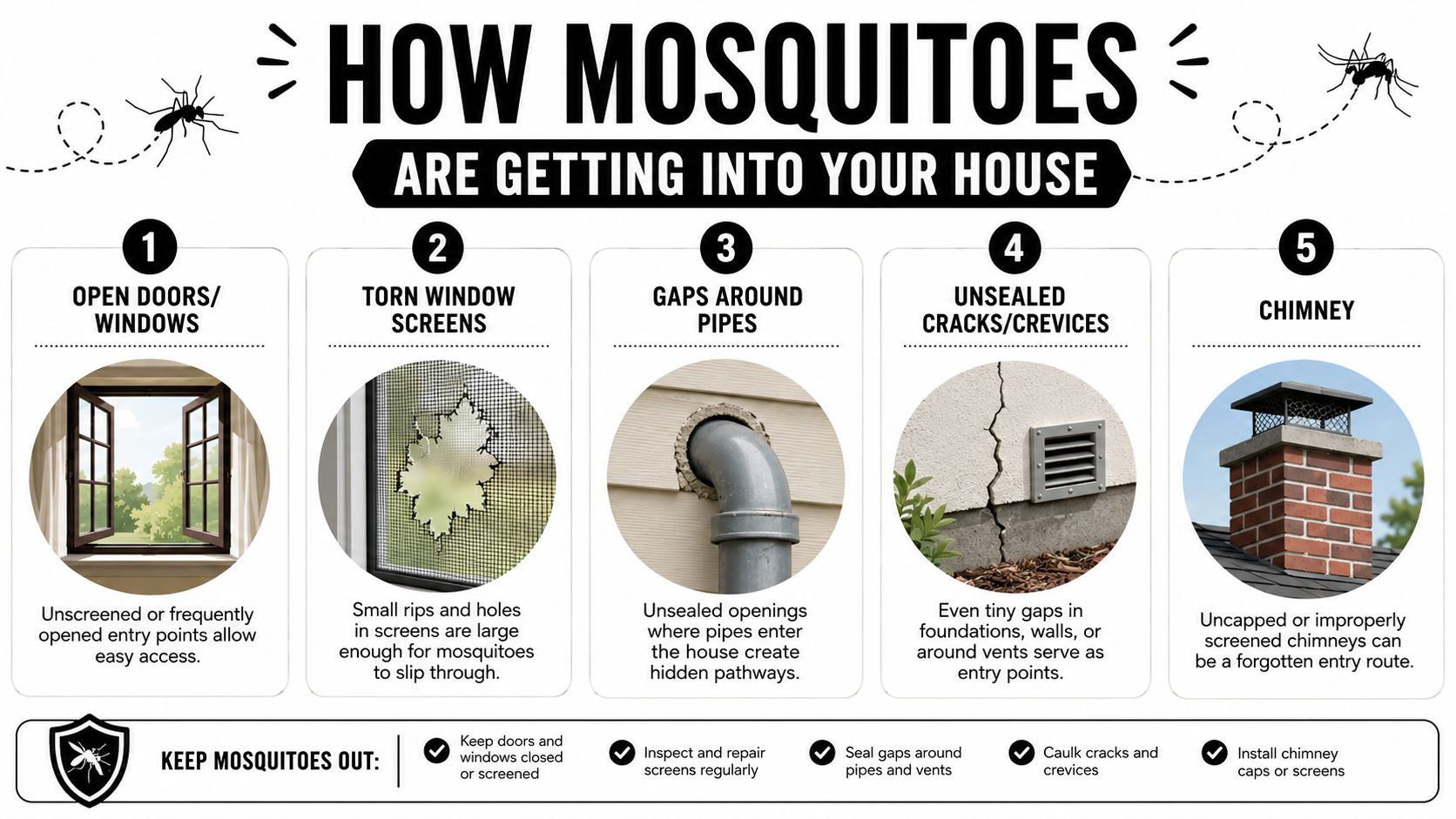
The entry points people miss
A quick walk-around often reveals the same trouble spots. Mosquitoes can slip through small gaps around doors and windows, damaged screens, vents, garages, chimneys, and utility openings, and they can even hitchhike indoors on clothing, pets, or people returning from outside (Agile Pests). That's why a home can seem sealed up and still have a steady mosquito problem.
Here's the homeowner checklist I'd use first:
- Door and window edges: Look for daylight, loose sweeps, or gaps where the frame doesn't seal tightly.
- Screen condition: Check for tears, bent frames, or screens that pull away when touched.
- Utility openings: Inspect where cables, pipes, or lines enter the house, especially near basements and garages.
- Vent and chimney screens: These get forgotten because they're higher up or out of sight.
- Garage and mudroom traffic: Mosquitoes can ride in when doors stay open during loading, unloading, or yard work.
Why entry control alone sometimes falls short
A homeowner can repair a screen and still see mosquitoes the next night. That usually means the house has more than one access route, or the insects are already inside and resting in a cool, shaded spot. A single fix helps, but it doesn't always solve a pattern that's coming from multiple weak points.
A sealed house matters, but a sealed house with moisture still gives mosquitoes somewhere to survive.
For readers comparing exterminator near me options, an experienced inspection pays off. If you want a deeper look at how indoor mosquito service works, The Green Advantage's interior mosquito control page gives a useful local reference.
The Hidden Breeding Sites Inside Your Home
Not every mosquito in a house flew in from outside. Some are born right there, in water you may barely notice. That's the part many homeowners miss, and it's why a few bites can become a recurring indoor problem.
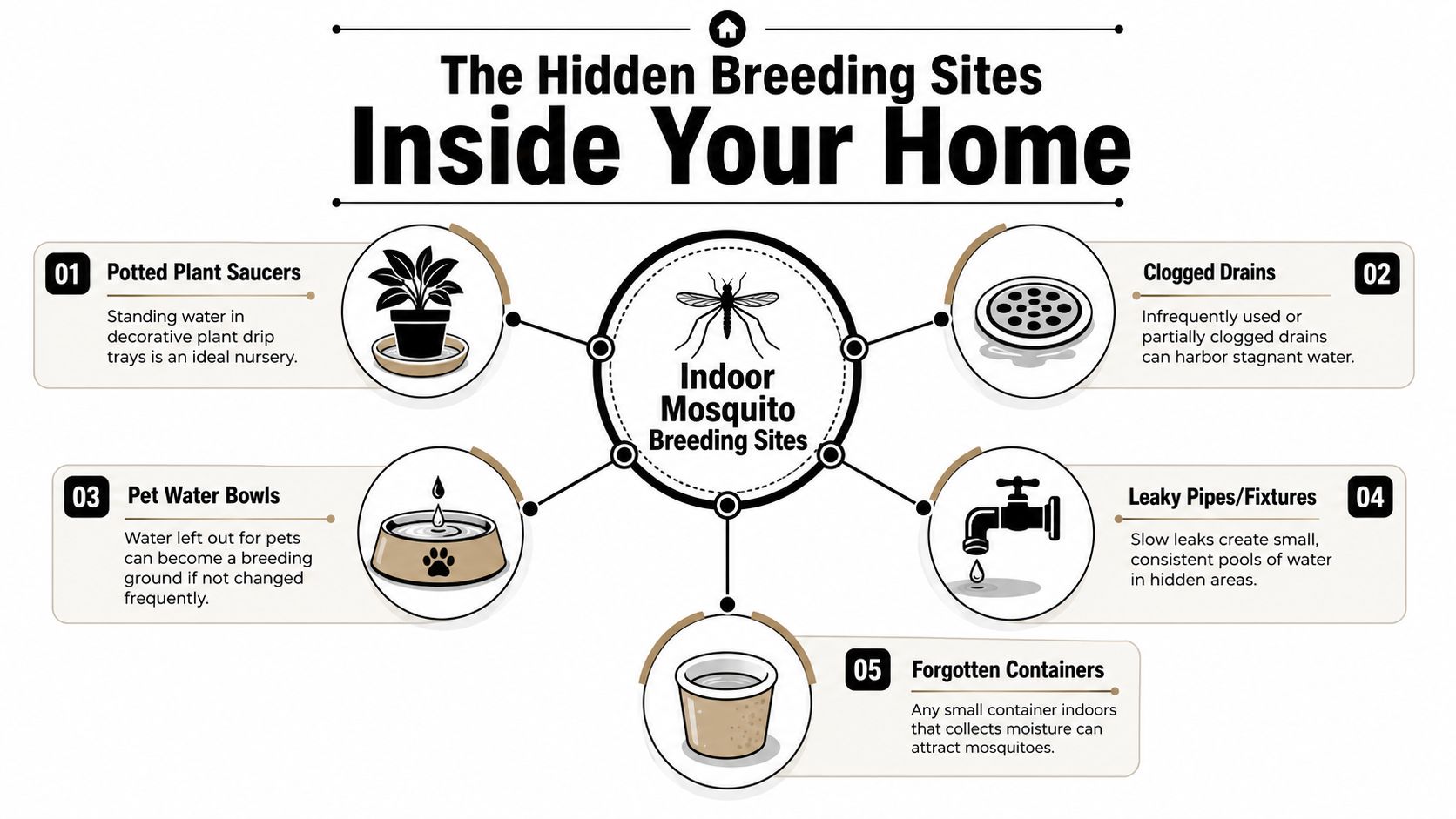
Small water, big problem
Mosquitoes do not need much water to breed. Female mosquitoes can lay eggs in very small standing-water sources, and one source notes that even a tablespoon of water can be enough for a breeding site (Engineer Fix). That means the usual suspects, plant saucers, drip trays, and small forgotten containers, can turn into indoor nurseries if the water sits long enough.
The older assumption is that breeding only happens in big puddles or swampy yard water. In practice, indoor sources are often tiny and persistent. A plant tray near a window, a pet bowl left unchanged, a slow leak under a sink, or a drain that doesn't get much use can all hold enough moisture for mosquitoes to cycle through again and again.
The rooms that deserve a closer look
Bathrooms, laundry rooms, basements, kitchens, and utility spaces are the places I'd inspect first. Those rooms often combine humidity, shade, and hidden water, which makes them attractive resting spots even when the source is small. A good home humidity guide, like this one from Sunset Shine Home Cleaning, can also help homeowners understand why damp indoor air keeps pests comfortable.
Rule of thumb: if a space stays damp, shaded, or underused, don't assume it's harmless just because it looks clean.
The bigger takeaway is simple. If mosquitoes remain after you've looked at doors, screens, and obvious entry points, the house may already be supporting an indoor cycle. That's the point where mosquito control becomes less about chasing adults and more about finding the water source they're using to keep coming back.
Your First Line of Defense Against Mosquitoes
The best homeowner defense is still the basic one. Clean out water, keep screens intact, and make the house less inviting. Those steps matter because they cut off the easiest survival conditions, and they're worth doing even if you plan to call for help.
What to do every week
The CDC says to once a week empty and scrub items that hold water, and it also notes that if mosquitoes remain after screen repair and container cleanup, professional treatment inside the home may be needed (CDC mosquito control at home). That advice is plain, practical, and hard to beat.
A homeowner can start with a short routine:
- Empty standing water: Check saucers, buckets, pet dishes, and anything that catches rain or condensation.
- Scrub water-holding items: Eggs can cling to surfaces, so dumping water alone isn't always enough.
- Repair screens quickly: Small tears are easier to ignore than they are to live with.
- Improve airflow: Stagnant, damp rooms tend to be more attractive resting spots.
- Watch the basement and garage: These areas often stay cooler and moister than the rest of the home.
Where DIY ends
DIY prevention works best when the issue is minor and the source is obvious. It's less effective when mosquitoes are coming from multiple access points, or when one hidden water source keeps replenishing the problem. That's why persistent indoor activity often needs a more complete inspection.
If you're comparing residential pest control providers, it helps to look at the whole home, not just the obvious window problem. A resource like identify household health risks can also help homeowners think more broadly about the conditions that make indoor spaces uncomfortable or unhealthy.
The practical line is this. If you've cleaned, repaired, and still see mosquitoes indoors, you're past the point where a spray can solve everything. At that stage, source identification matters more than guesswork.
The Green Advantage Solution for Mosquito Control

The strongest mosquito treatment starts with a full inspection, not a single product. A trained technician looks for entry points, moisture sources, and resting areas inside and around the structure, then matches the response to what's driving the problem. That matters because a house with mosquitoes needs source control, not just a quick knockdown.
What a professional service looks for
A proper visit usually focuses on the places homeowners miss. That includes utility openings, crawl spaces, basement moisture, shaded corners, and any indoor or outdoor source that can keep water in place long enough for mosquitoes to breed. The point is to find the chain, not just the symptom.
In the field, that can also include mosquito control around the property to reduce pressure from outside. For many homes in Crown Point and nearby Northwest Indiana neighborhoods, the issue is a mix of indoor access and outdoor activity. A complete plan may include targeted treatment, source reduction, and follow-up guidance for the season.
The Green Advantage also handles related commercial pest control and residential pest control needs, which helps when a home, rental property, or business all need consistent service standards. For homeowners who want a practical local option, The Green Advantage can provide a focused mosquito inspection and treatment plan suited to the structure and surrounding property.
Why timing matters
Mosquito breeding moves fast. New York State health guidance says many mosquitoes lay eggs in even small amounts of standing water, and eggs can develop in water that remains for more than four days (New York State health guidance). That short timeline is why a delay gives mosquitoes room to rebuild.
A professional approach breaks that cycle by treating the problem at the source, not just the adult mosquitoes you happen to see flying by. For families in Crown Point, that usually means less guessing, less repeat cleanup, and a clearer plan for keeping mosquitoes out of living spaces.
Working With Your Local Crown Point Exterminator
When a mosquito problem keeps coming back, homeowners usually want three things. They want the house to feel comfortable again, they want to know the problem was handled correctly, and they want a plan that doesn't turn into another seasonal headache. That's a fair expectation.
What you can expect from service
A good inspection should feel straightforward. The technician should look at the structure, identify likely sources, explain what's making the house attractive to mosquitoes, and recommend the next step in plain language. You shouldn't have to guess what was found or why the treatment matters.
That's especially important for pest control in Crown Point, IN, where moisture, season changes, and property layouts can vary a lot from one home to the next. A local team understands that mosquito pressure doesn't come from one cause every time. Sometimes it's a screen issue. Sometimes it's indoor moisture. Sometimes it's both.
Here's what usually helps most:
- Clear diagnosis: You know whether the issue is entry, breeding, or both.
- Targeted treatment: You're not paying for blanket work that doesn't match the problem.
- Prevention guidance: You get practical steps to reduce the chance of a return visit.
- Local follow-through: You can work with a company that understands Northwest Indiana homes and seasons.
The right service makes the house easier to live in, not just quieter for one night.
That's the reason people call an exterminator in Crown Point, IN instead of trying to chase mosquitoes room by room. Professional mosquito control protects comfort, supports better indoor conditions, and gives you a plan that fits the property instead of a generic answer.
If mosquitoes keep turning up in your home, schedule a pest inspection with The Green Advantage and get a local plan built for Crown Point and Northwest Indiana. Visit The Green Advantage to request a quote, ask about mosquito control, and take the next step toward a more comfortable home.
Outdoor Ultrasonic Pest Control: Facts vs. Fiction for 2026
You can stand on a Crown Point patio with a drink in one hand and still watch mosquitoes work your ankles like nothing is plugged in at all. That's why outdoor ultrasonic pest control keeps selling. It promises an easy fix, no sprays, no mess, no poison, just a little box and a quieter backyard.
I understand why homeowners keep trying it. A low-chemical option feels safer, especially when the garage has a mouse problem, the deck has mosquitoes, or the fence line keeps attracting ticks and other pests. But the honest question is simple, does the device pull its weight, or is the money better spent on pest control in Crown Point, IN that holds up in the real world?
The Green Advantage has seen these gadgets come and go around Northwest Indiana yards. The pattern doesn't change much. People buy them, hope for a clean perimeter, then call when the insects, rodents, or wildlife never got the memo.
The Patio Problem Every Crown Point Homeowner Knows
A summer evening in Crown Point usually starts the same way. The grill's hot, the kids are outside, the citronella candle is smoking away, and there's a little ultrasonic box glowing near the deck railing. Then the mosquitoes show up anyway, and somebody is back inside swatting at ankles and asking why the “fix” didn't fix anything.
That's the part most shoppers recognize right away. They are not buying a gadget because they love gadgets. They're buying it because they want to keep pests off the patio without turning the yard into a chemical zone. That instinct makes sense, especially for families looking for residential pest control options that feel practical and simple.
Outdoor ultrasonic pest control sits in that exact emotional lane. It sounds modern, discreet, and easy. Plug it in, stake it in the ground, and let the sound do the work. For homeowners searching for pest control near me or an exterminator near me, it looks like a cheap first step before calling a pro.
The problem is that outdoor pests don't care about marketing copy. They respond to food, water, shelter, and access. If a device can't change those conditions, it usually can't deliver dependable control. That's why this topic matters for anyone comparing a patio gadget with real mosquito control, rodent control, or preventative pest treatments.
Practical rule: if a product promises perimeter control outdoors, but it doesn't change the habitat, the result is usually disappointment.
For a yard in Crown Point, the better question isn't whether the box lights up. It's whether it keeps pests from getting comfortable where you live, relax, and entertain.
What Outdoor Ultrasonic Pest Control Actually Does
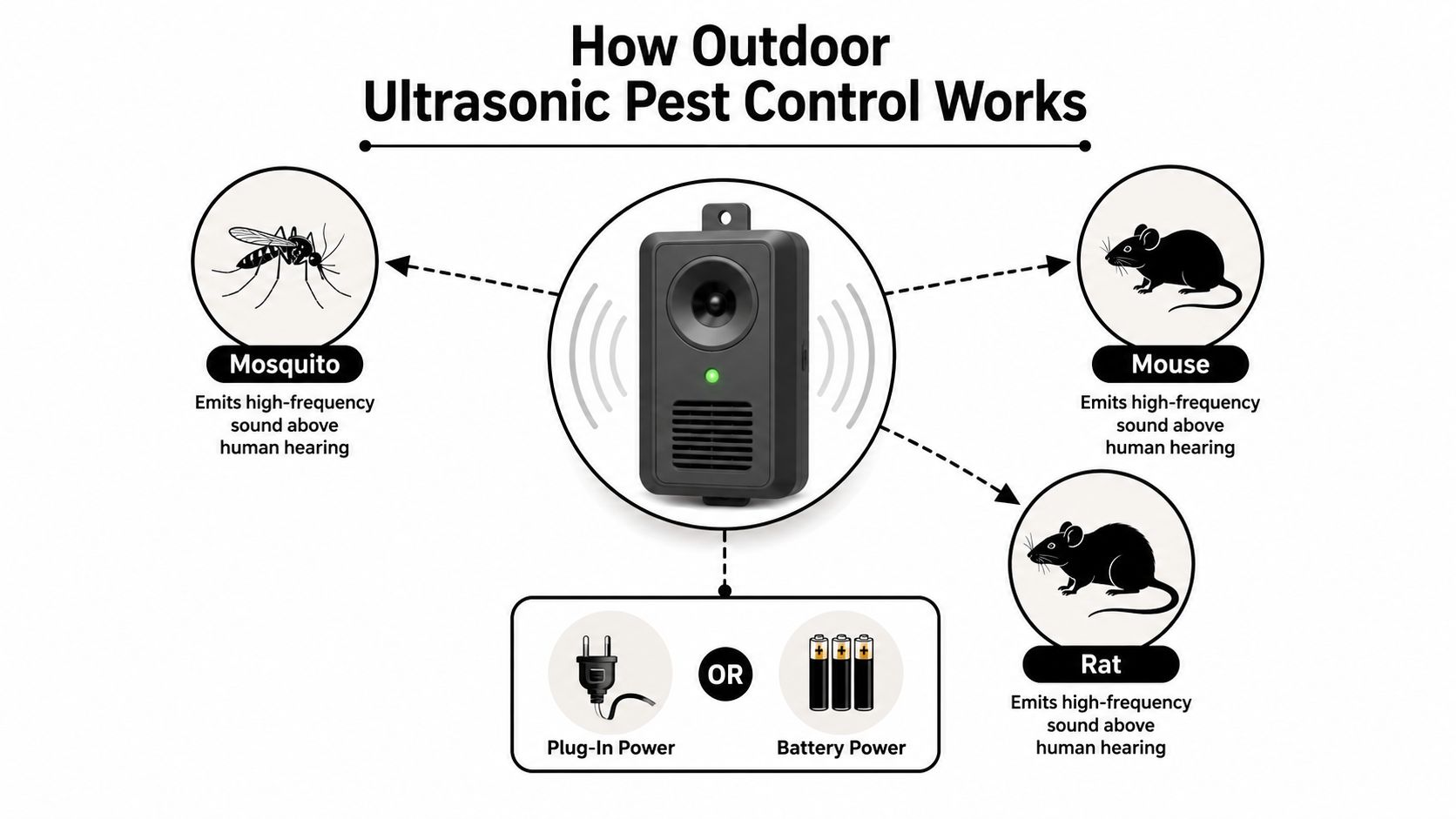
Outdoor ultrasonic pest control refers to plug-in or battery-powered devices that emit high-frequency sound above human hearing. Manufacturers sell them as a way to repel mosquitoes, rodents, raccoons, deer, ticks, and other pests around yards, patios, garages, sheds, and gardens. Newer models often include solar charging, motion activation, wider emission angles, and weatherproof housings.
The sales pitch is simple. The sound is supposed to be irritating enough that pests leave the area. That is why these products are usually marketed as a perimeter solution rather than a trap or bait system. The label sounds straightforward, but the category is broad, and the claimed effects vary from one unit to the next.
Core promise, core limit: the device emits sound pests may dislike, but the question is whether that sound changes pest behavior enough to matter outdoors.
What buyers are really comparing
| Pest | Finding | Evidence Strength |
|---|---|---|
| Rodents | Some short-term movement reduction, but effects fade fast | Weak for dependable outdoor control |
| Mosquitoes | No demonstrated field efficacy | Weak |
| Ticks | Too little repellency to prevent bites | Weak |
| Other pests | Claims vary widely, with inconsistent real-world results | Weak |
That table says it plainly. Some products may create a brief nuisance, but that is not the same as reliable control. For readers who care about tick pressure in the yard, the practical option is a proven yard strategy, not another hope-and-pray device, and that is why yard tick control guidance from The Green Advantage belongs in the conversation.
The key difference is species and setting. A device that looks impressive on a package can still perform poorly against mosquitoes in open air, rodents along a fence line, or ticks in leaf litter. Ultrasonic is a category, not a guarantee.
What the Science Actually Shows for Rodents, Mosquitoes, and Ticks
Rodents don't stay bothered for long
The clearest takeaway from the extension literature is that ultrasonic rodent devices can look decent for a moment and then fall apart. A Nebraska Cooperative Extension review reported only marginal repellency in controlled tests, with 30% to 50% reductions in movement activity in some cases, but also rapid habituation after just 3 to 7 days of exposure. That means the animals get used to it fast.
A later synthesis cited 27 peer-reviewed studies and found no statistically significant reduction across 19 controlled experiments, with reported significance values of p > 0.42 versus placebo devices, which is a long way of saying the devices did not outperform a fake unit in a dependable way. The University of Arizona Cooperative Extension also says commercially available sonic pest devices have not been shown effective in scientific studies.
Rodents are a serious issue in Northwest Indiana because garages, sheds, decks, and storage areas create easy shelter. That's why a blinking box is not a plan. Sealing access, removing food sources, and using actual exclusion methods are the tools that hold up.
Mosquitoes and ticks need better tools
For mosquitoes, the technical consensus is blunt. Commercial ultrasonic devices have no demonstrated field efficacy, and recent review work says the field evidence remains consistently low across categories. In plain terms, if your yard has biting mosquitoes, the sound from a repeller is not the lever that changes the outcome.
Ticks are no better. A peer-reviewed PLOS ONE study tested nine commercial devices against the paralysis tick Ixodes holocyclus and found less than 19.5% repellency, which the authors said was too low to recommend for preventing bites. That is not a yard solution. It is a weak signal at best.
A Cornell University IPM blog also reported “no effect” in scientific evaluations on pests including German cockroaches, bed bugs, and rodents, and it noted that some manufacturers' claimed frequency and intensity don't match actual output. The species matters, and the evidence keeps pointing in the same direction.
Why Yards Are Harder Than Living Rooms
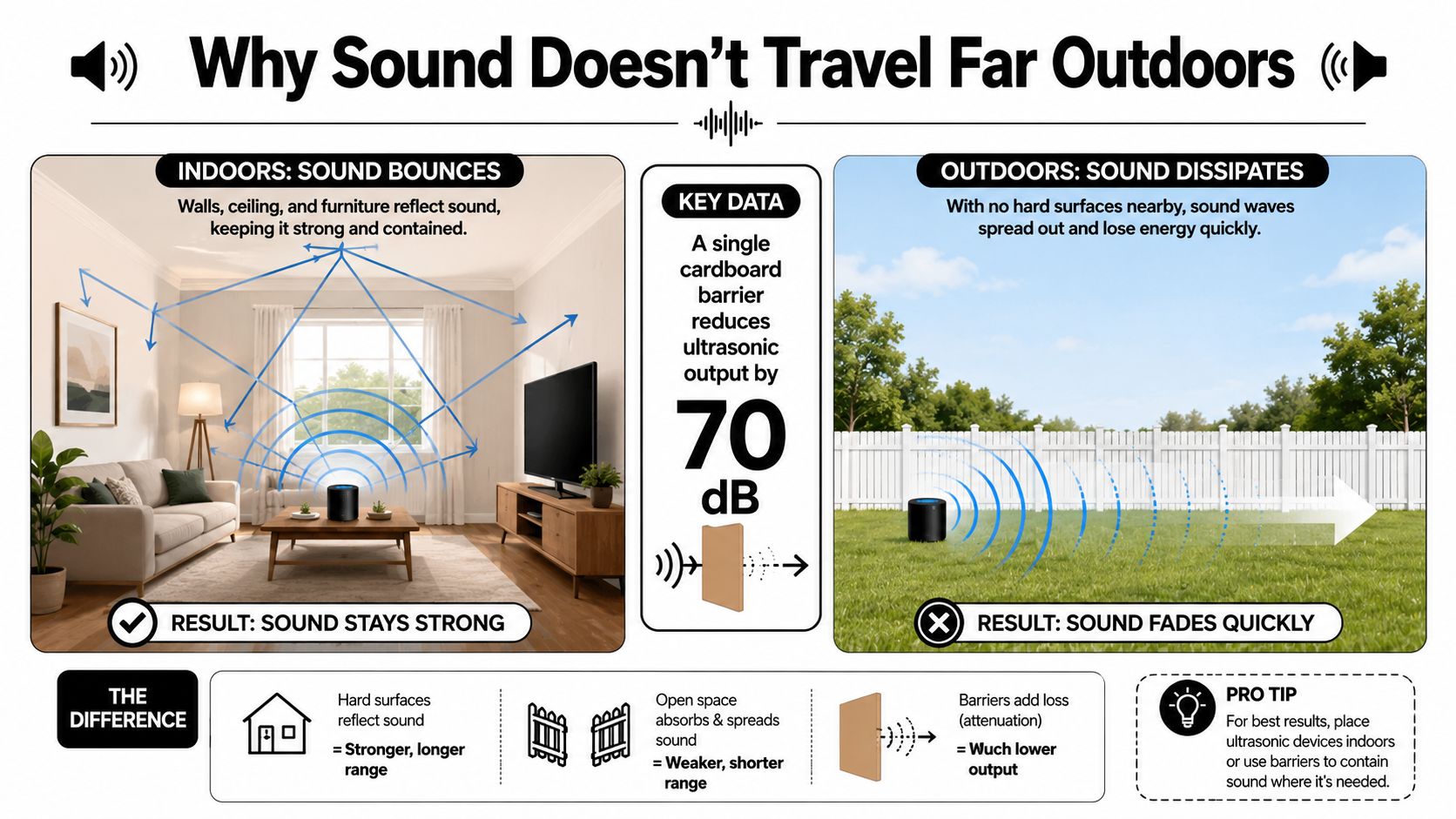
A yard in Crown Point is not a sealed room. That's the first thing product pages leave out. Sound outdoors gets interrupted, scattered, and weakened by whatever is in the way, and the published acoustical testing backs that up. In a classic evaluation of commercial ultrasonic pest devices, a single 0.30 cm cardboard barrier reduced output by about 70 dB, and the devices underperformed manufacturer claims in both intensity and peak frequency regions.
That matters because real yards are full of barriers. Siding, fences, patio furniture, shrubs, garden sheds, and even simple changes in layout can break the line of sight. Add wind and humidity, and the actual coverage gets smaller and more uneven than the box suggests. The result is dead zones, which is exactly where pests keep moving.
What “coverage” really means outdoors
A lot of shoppers read a square-foot claim and assume it means a hard perimeter. It doesn't. It usually assumes open air, clean sightlines, and ideal placement that most Northwest Indiana properties don't have. The practical range is far more variable than the packaging implies.
Newer models with solar charging, motion activation, and multi-directional emitters can improve convenience. They can also make installation easier. But convenience is not the same as outcome data, and independent proof that those features cut pest activity outdoors is still thin.
Homeowner rule: if the environment can block, absorb, or scatter the sound, the device's real-world coverage is already compromised.
That's why “how far does it reach?” is the wrong question by itself. The better question is whether the yard has enough open, unobstructed space for the device to matter at all. In most Crown Point yards, the answer is no.
The Honest Pros and Cons for Homeowners
Here's the fair version, not the sales version. These devices do have some appeal, but the tradeoffs are real, and every Crown Point homeowner should weigh them before buying.
What makes people keep trying them
- Low chemical footprint: Some families want to avoid sprays first, and a plug-in unit feels cleaner than a yard treatment.
- Low maintenance: Once installed, there's little day-to-day effort.
- No bait or poison handling: That matters for homes with children, pets, or frequent guests.
- Simple setup: Many units are easy to stake in the ground or plug into a weatherproof outlet.
Those are real conveniences. They explain why ultrasonic devices still show up on patios, porches, and garden edges even after the science let them down.
Where they fall short
- Weak evidence base: University extension sources keep saying the products have not been shown effective, and the broader study record is not encouraging.
- Fast habituation: Rodents can get used to the sound quickly, so any early reaction may not last.
- Inconsistent outdoor coverage: The yard environment works against the device.
- Questionable marketing history: The University of Arizona Cooperative Extension notes the FTC charged several companies with false advertising in the 1980s and required refunds.
- Possible sound exposure concerns: Cornell's IPM note says some devices exceed OSHA limits for human tolerance of sound exposure.
- Cost versus payoff: A device can cost enough to feel like a wasted service call if it doesn't change the pest pressure.
That is the comparison hardware stores rarely walk through with customers. If your main goal is peace on the patio, a little less hassle, and fewer bugs at dusk, a gadget with shaky performance is a poor bet.
If You Still Want to Use One, Do It This Way
A homeowner who already owns one should at least use it intelligently. Put it where the manufacturer can't pretend the environment is perfect. That means a weatherproof outlet, clear line of sight to the area where pests travel, and placement away from dense vegetation whenever practical.
Stake-mounted units make more sense when a cord would otherwise stretch across a walkway. Solar units can work for convenience, but the panel needs to stay clean, and batteries still need seasonal checks. Do not bury the device under snow, leaves, mulch, or patio clutter and expect it to perform.
Use it as a supplement, not a shield
The better setup is still the boring one that works:
- Remove standing water so mosquitoes have fewer breeding spots.
- Trim vegetation away from the home so pests lose cover near entry points.
- Seal gaps and cracks where rodents and insects get inside.
- Clear leaves and clutter where ticks and other pests hide.
- Use the device only as a secondary layer if you insist on keeping it.
That is the smartest way to think about it. A repeller might sit in the mix, but it does not replace exclusion, sanitation, or targeted treatment. For homeowners comparing device promises with a structured prevention plan, The Green Advantage's integrated pest management approach fits the way real yards work.
If the goal is a patio that stays usable, the device is a maybe. The habitat work is the part that matters.
What Actually Works in Northwest Indiana Yards
Start with the stuff pests are already using
Source reduction comes first because pests need something to live on, drink, or hide in. For mosquitoes, standing water is the obvious target. For raccoons and other nuisance wildlife, unsecured trash and pet food are invitations. For ticks, leaf litter and thick ground cover create the kind of edge habitat they love.
Block the easy entry points
Exclusion is the next layer. Seal gaps around the foundation, repair torn screens, install door sweeps, and close up vents that don't need to stay open. That works because it attacks access instead of hoping pests will get uncomfortable and leave on their own. If rodents are finding their way into a garage or crawl space, the problem gets real.
Use direct control where it fits
Mechanical traps and other targeted methods are still the right call for many rodent problems. They are not flashy, but they're direct. For mosquitoes, professional reduction programs can reduce pressure around outdoor living areas, especially when paired with habitat cleanup and smart placement around the property.
The Green Advantage offers mosquito control, rodent control, commercial pest control, and residential pest control for Crown Point and surrounding Northwest Indiana properties. It also handles pest inspections and preventive service plans, which matters when the issue is seasonal and keeps coming back.
Bottom line: the winning plan is layered. One gadget cannot do the job of source reduction, exclusion, and targeted treatment.
If you want fewer ants in spring, fewer spiders in corners, fewer wasps around eaves, and fewer rodent headaches going into fall, the fix is a consistent service plan, not a box that hopes pests hate sound enough to move out.
Talk to a Crown Point Pest Pro Before You Buy Another Gadget
If you've read this far, you probably aren't just curious. You're tired of mosquitoes chewing up the yard, worried about rodents in the garage, or trying to protect a property before a sale or inspection. That's exactly when a local pro makes more sense than another device on the patio.
The Green Advantage works the way busy homeowners need. You call once, reach knowledgeable office staff, and get scheduled without a lot of back-and-forth, which is more practical than waiting on generic pest control receptionist solutions that don't know your property. Then a technician comes out, checks the site, and builds a treatment plan around what's happening there, not around a one-size-fits-all package.
That matters for pest control in Crown Point, IN because every property is different. Some yards need mosquito reduction. Some homes need rodent exclusion. Some businesses need commercial service plans. And some people just need a pest inspection before a closing so they know what they're walking into.
If you want a real answer instead of a gadget gamble, call The Green Advantage and ask for a pest inspection or quote. You'll get a clear plan for the problem in front of you, not another promise that sound alone will solve it.
If you're ready to stop guessing, visit The Green Advantage and ask for a pest inspection, a quote, or a service plan built for your Crown Point property. The right fix starts with a real look at your yard, your home, and the pests that are present.
Standing Water Mosquitoes: A Crown Point Homeowner Guide

A wet yard in Crown Point can turn into a mosquito problem fast. One storm leaves water in the low spot by the patio, the bird bath sits untouched, and the downspout keeps spilling onto clay that doesn't dry out the way you want it to. By the time you notice the bites, the breeding spot has already done its work.
That's why standing water mosquitoes aren't a random nuisance, they're usually a sign that a few small yard habits and drainage issues have lined up at the same time. For homeowners looking for pest control near me or pest control in Crown Point, IN, The Green Advantage works the way a good field technician should, by finding the overlooked water sources, fixing what can be fixed, and treating what can't. The same damp conditions that favor mosquitoes can also make ants, termites, and rodents more likely to show up around a house, especially in Northwest Indiana's wet seasons.
Why Crown Point Yards Keep Attracting Mosquitoes
A lot of Crown Point yards look fine from the driveway and still hold water where mosquitoes breed. Spring snowmelt settles into low spots, gutters load up with leaves, and a downspout keeps feeding a patch of lawn that stays soft long after the rain stops. Add a bird bath, a pet bowl, a folded tarp, or a decorative pond that is not moving enough, and the yard gives mosquitoes the quiet water they want.
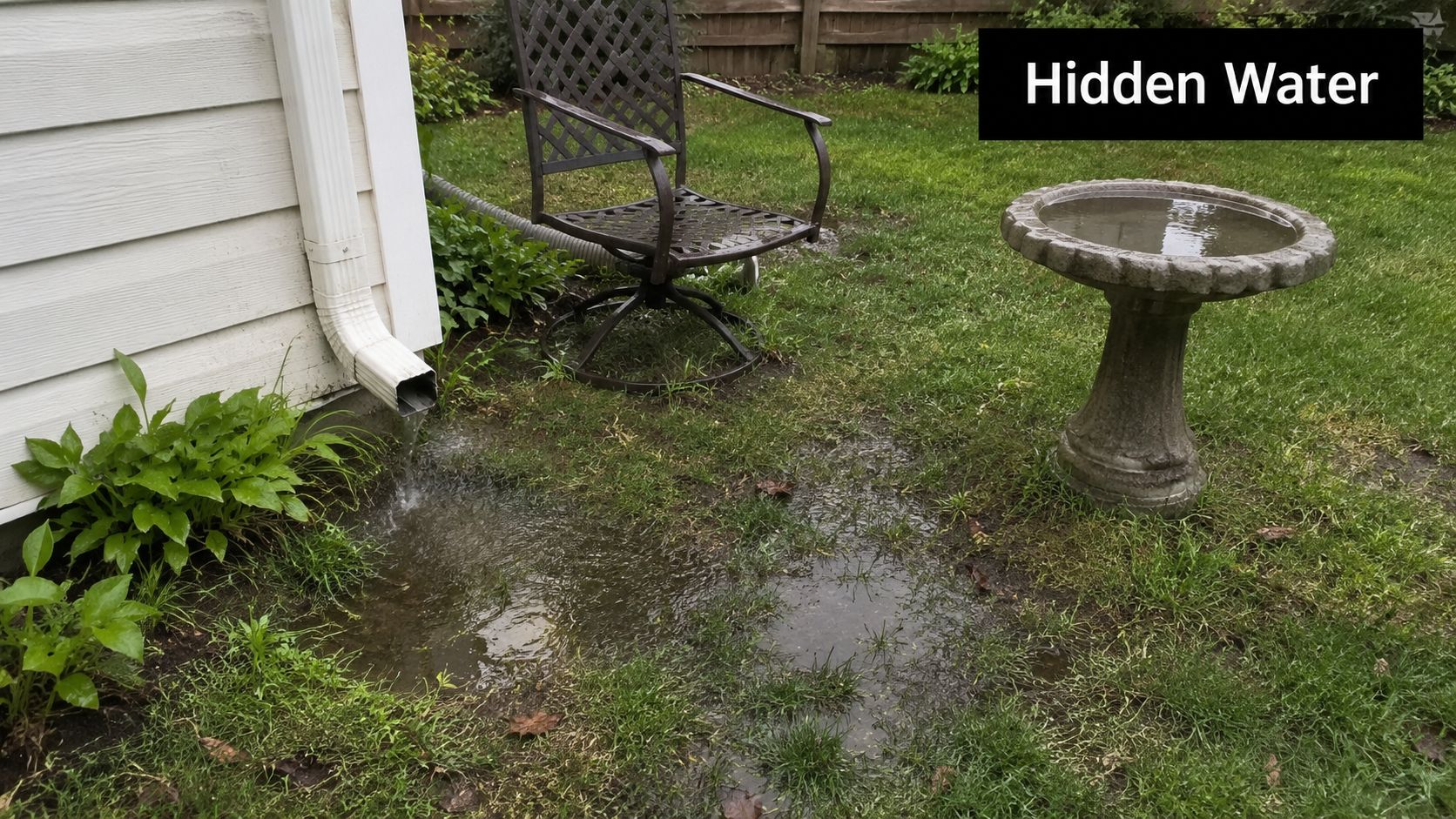
The pattern homeowners miss
Mosquitoes do not need a swamp. They use small, still water sources just as readily as a soggy corner of lawn or a clogged container by the garage. That is why a yard can look clean from the street and still turn into a mosquito problem after one wet stretch, especially when shade keeps the water from drying out.
Crown Point yards also deal with the way local ground holds water. Clay-heavy soil, snowmelt, and spring gutter overload can leave moisture sitting in the same places again and again. Once that happens, the issue is no longer just a puddle. It becomes a repeat breeding site, and the practical answer is source control, cleanup, and drainage work done on time. The Green Advantage explains that approach in its guide to mosquito breeding and control.
Practical rule: if water sits long enough for you to stop thinking about it, mosquitoes have already had time to use it.
Why this also points to bigger pest pressure
The same damp areas that support mosquito breeding also create the kind of moisture conditions that draw in other pests around a house. That is why a mosquito complaint often shows up alongside questions about residential pest control, commercial pest control, or even termite control and rodent control. A yard that drains poorly does more than feel buggy. It stays attractive to pests that like shelter, moisture, and easy access to a structure.
For homeowners who keep searching exterminator near me or exterminator in Crown Point, IN, the problem is usually repeated water management, not bad luck. A local inspection from The Green Advantage starts by tracing where the water is collecting, then deciding what needs cleanup, what needs treatment, and what needs a drainage fix so the problem does not keep coming back.
How Standing Water Mosquitoes Actually Work
A yard can look dry enough at a glance and still keep feeding mosquitoes. In Crown Point, that usually means water sitting in the places people stop checking, a bird bath that never fully empties, a gutter that holds a thin line of water, or a low spot that stays wet after snowmelt and spring rain. Mosquito control starts to make sense once you follow the water, because that is where the cycle keeps restarting.
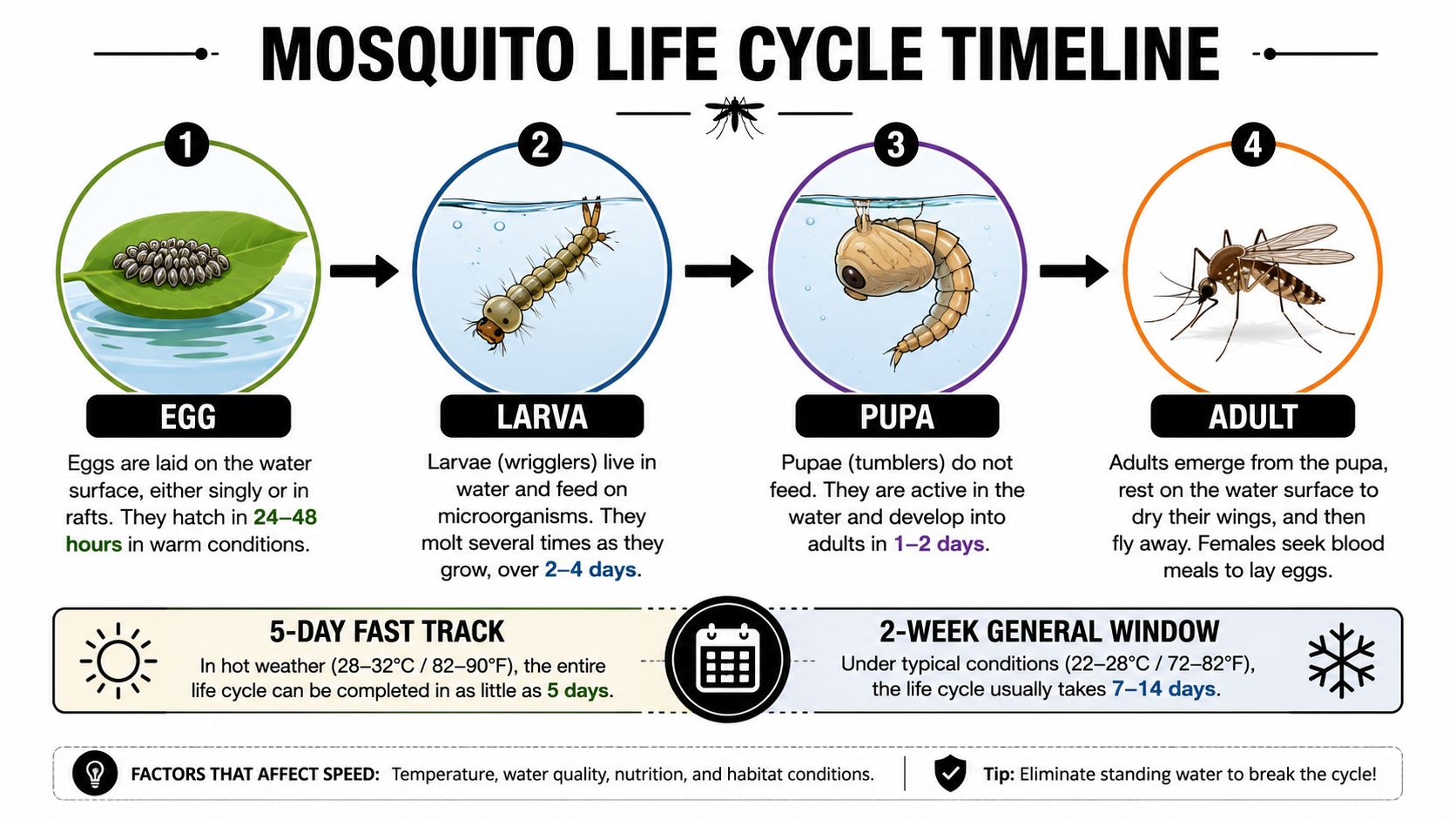
Mosquitoes use still water for two life stages before they become biting adults. Eggs hatch into larvae, larvae change into pupae, and pupae turn into adults once conditions are right. In practical terms, that means a small container of warm, stagnant water can keep the cycle going faster than many homeowners expect, especially if it sits in shade or gets ignored for a few days.
That speed is the reason source control matters so much. San Diego County says the full shift to adult can happen in as little as 5 days (San Diego County). North Carolina State Extension also warns that mosquitoes can develop in water that remains undisturbed long enough to support a life cycle, while the University of Florida IFAS Extension notes that even temporary water can become a breeding site if it is left in place instead of drained or dumped (North Carolina State Extension, University of Florida IFAS Extension).
Once that source stays in place, spraying adults only treats the visible part of the problem. The yard keeps producing more mosquitoes from the same spot. The practical fix is to break the cycle where it starts, then keep checking the places that refill after every rain or melt.
A bird bath that sits untouched through the week can turn into a nursery before the homeowner realizes the water never moved.
Why timing matters more than volume
It does not take much water for mosquitoes to get started. The Northeast IPM Center notes that they can breed in containers as small as a bottle cap (Northeast IPM Center). That is why a saucer under a planter, a toy left upside down, or the bowl of a wheelbarrow can matter just as much as a puddle in the grass.
The Green Advantage covers that same source-first approach in its mosquito breeding and mosquito control guide. For a homeowner, the takeaway is straightforward. Source reduction beats chasing adults, because it removes the water mosquitoes need to complete the cycle. That is also why the best time to check is after rain, after mowing, and after any stretch of humid weather that slows evaporation.
Your Weekly Yard Walk-Through
The best mosquito inspection is the one you repeat without skipping the easy-to-miss spots. Walk the yard the same way every week, and start where Northwest Indiana yards usually hold water, at the roofline, then the low ground, then the shaded corners that stay damp after snowmelt or a spring storm.
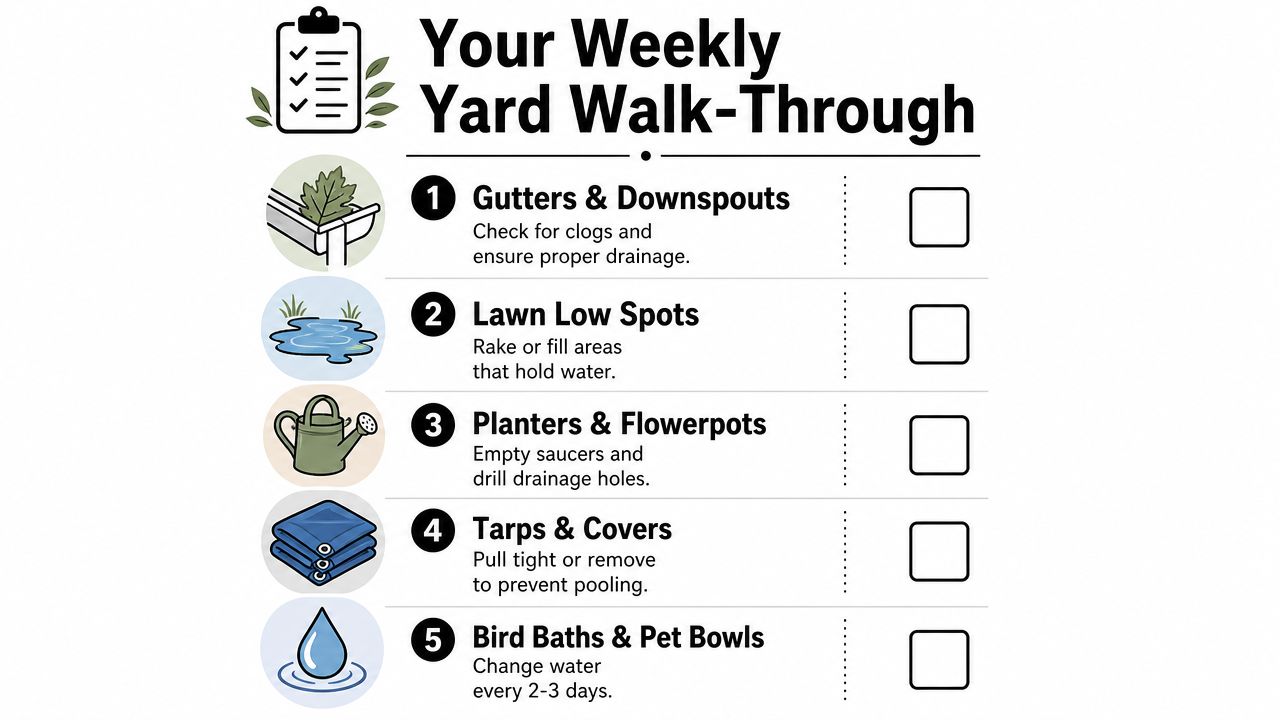
Start where water enters and exits
Check gutters first, then follow each downspout to where it drops water. Clogged gutters, roof drainage problems, tires, and other water-holding containers keep showing up as repeat breeding sites, and that includes the kinds of overflow problems homeowners usually notice only after the yard has already stayed wet for a while (Northeast IPM Center, University of Florida IFAS Extension, EPA mosquito control guidance). Sagging runs and weak drainage at the base of a downspout are the details a homeowner can miss, even when they are obvious from a technician's view.
Then work the yard edge. Toys, tarps, recycle bins, wheelbarrows, and decorative yard pieces can all trap rain in folds, corners, and low spots. Tires are a problem too, and wheelbarrows are one of the easiest items to overlook when they sit with the bowl facing up (University of Florida IFAS Extension).
Field habit that saves time: if something can collect rain, check it before you decide it is just storage.
Finish in the shade
Bird baths, fountains, pet dishes, and ornamental water features need their own look because they refill and sit undisturbed between checks. Empty and refresh those water sources every week, and make sure the container itself is not holding debris that keeps the water still (EPA mosquito control guidance). For rain barrels, use a screened setup and follow a tight maintenance routine, which is the part many homeowners miss when the barrel is tucked beside the house. See this guide on how to keep mosquitoes out of a rain barrel.
The shaded, tucked-away areas matter too. Under decks, behind AC units, and along fence lines, you will usually find small pockets that stay damp longer than the open lawn. A 15-minute weekly walk-through is enough for most homeowners if they stay consistent. The goal is not perfection, it is catching the one missed container before it sits long enough to matter.
Safe DIY Treatments for Standing Water You Cannot Remove
Some water just won't go away. Rain barrels, ornamental ponds, drainage depressions, livestock troughs, and certain low spots may refill too quickly for simple dumping to solve them. That's where treatment choices matter, because not every product fits every situation.
Compare the practical options
| Option | Best for | How it works | Watch out for |
|---|---|---|---|
| Bti dunks | Bird baths, rain barrels, tubs, small standing-water sites | Targets mosquito larvae in water | Doesn't affect adults, and it won't keep working if water gets refreshed without retreatment |
| Bti pellets or granules | Slightly larger water-holding spots or multiple small containers | Reaches larvae in shallow water | Use only where the label allows, and keep up with the weekly check |
| Mosquito bits | Small containers and nuisance water pockets | Delivers larval control in a practical homeowner format | Not a fix for clogged drainage or repeated refilling |
| Fountain or bubbler circulation | Ornamental ponds and decorative water features | Keeps water moving so mosquitoes have a harder time completing development | Pumps need maintenance, and shallow stagnant edges can still breed |
| Goldfish or native mosquito-eating fish | Larger ornamental ponds | Adds biological control in water features that support fish | Not suitable for every pond, and fish won't solve overflow or debris problems |
| Broad-spectrum insecticides in water | Poor fit for most home water features | Can kill a wide range of organisms | Risky around aquatic habitats, pets, and beneficial insects, so it's usually the wrong first choice |
The Green Advantage recommends Bti products in the form of dunks, pellets, or granules for standing water that can't be removed. That lines up with extension guidance that larviciding can reduce nearby adult mosquito pressure when source removal isn't possible (LSHTM summary of larval-source management). If you want a plain-language walkthrough for one common setup, the rain barrel mosquito guide is a good place to start.
What not to rely on
Bti only works on larvae, not pupae or adults, so it needs the right timing. Oil-based surface films can be short-lived and may interfere with fountain pumps, which makes them a poor fit for most residential water features. Broad-spectrum insecticides in water are usually too blunt for the job and can create avoidable side effects in places where kids, pets, and pollinators already spend time.
If the water is still there after every rain, the better move is often a combination of treatment and correction. That means treating the water safely, then fixing the reason it keeps coming back.
Landscaping and Drainage Fixes That Last
Mosquito pressure drops when water stops hanging around in the first place. In Northwest Indiana, that usually means dealing with downspouts, grading, compacted soil, and any feature that keeps creating a damp pocket after storms. The goal isn't a perfect yard design, it's a yard that dries fast enough to stop acting like a breeding site.
The fixes that usually pay off first
Extending downspouts away from the foundation is a practical first move, especially where splashback keeps the base of the wall wet. Regrading low spots can also make a big difference if the yard repeatedly holds water after rain. If the problem area never really improves, French drains or dry creek beds can redirect water before it settles.
Compacted clay soil is a common Northwest Indiana headache because it sheds water instead of absorbing it. Aeration helps, but in heavier problem areas, the drain path matters more than the grass. Plant choices matter too. Dense groundcover and cluttered borders can create small shaded, wet microhabitats that hold moisture longer than you'd expect.
For homeowners comparing DIY fixes with bigger drainage work, contact Modern Yard Landscapes for a drainage-focused overview of how problem areas are corrected.
If the same spot stays wet after normal weather, it's not a mosquito problem first. It's a drainage problem first.
Why this helps more than mosquitoes
Better drainage helps with more than bites. Damp foundations, overwatered borders, and sheltered wet edges also encourage ants, termite activity, and rodent movement around the home. That's why a drainage project often improves the overall pest picture, not just the mosquito count.
For Crown Point homeowners, the decision line is pretty clear. If one container or one gutter is the issue, DIY cleanup is enough. If the same low spot keeps filling, or the same corner keeps producing bites, the fix usually belongs with a professional who understands both pest pressure and the water path behind it.
Seasonal Timing for Northwest Indiana Mosquitoes
Mosquito pressure in Crown Point doesn't behave the same way all year. Early spring brings snowmelt and clogged gutters, late spring adds repeated rain into containers, summer heat speeds the breeding clock, and fall cleanup determines whether drainage problems carry into the next season. That pattern is why season-long mosquito reduction plans make sense for some properties, while a one-time treatment works better for others.
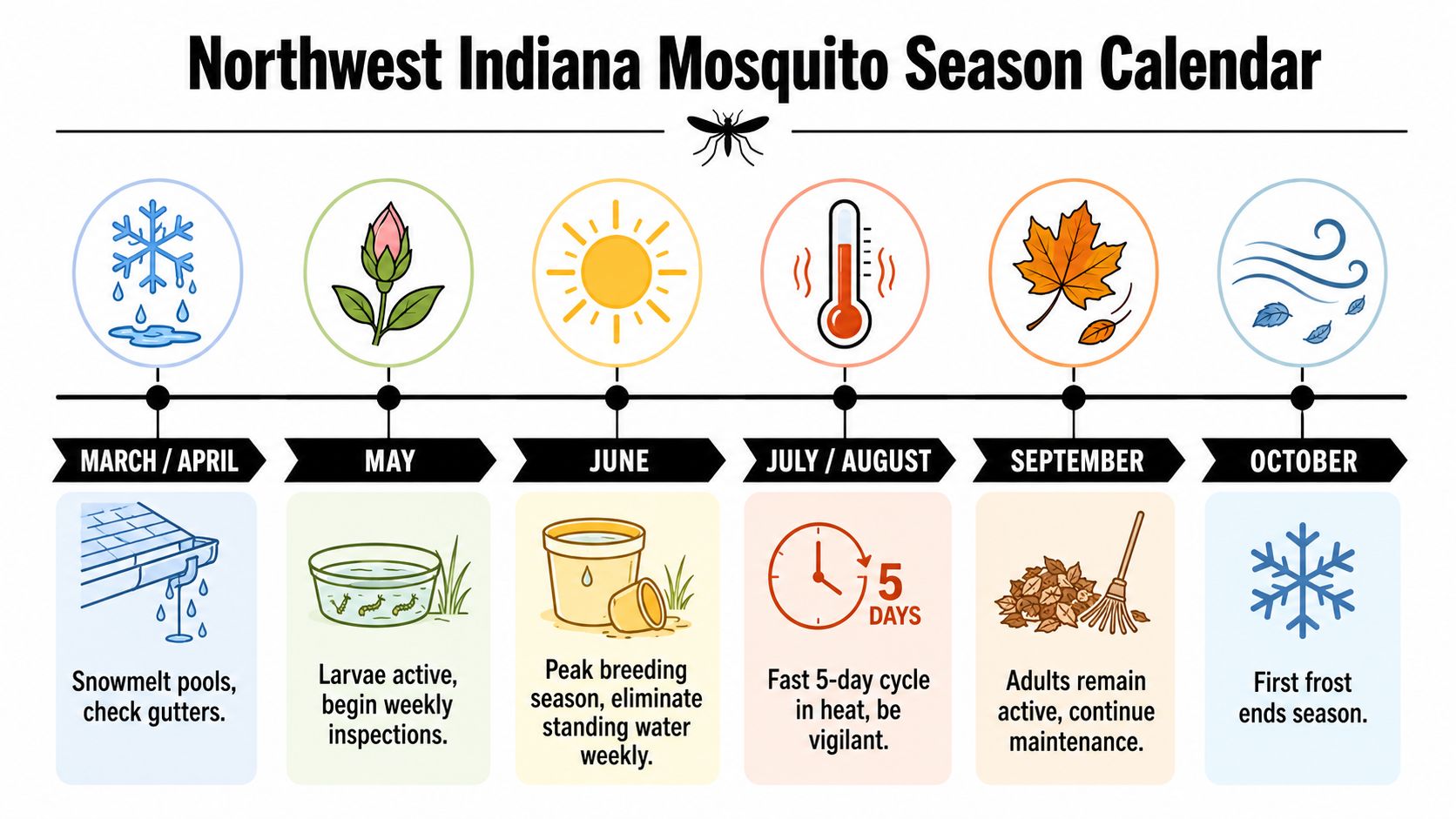
A simple local calendar
March and April usually start with meltwater that pools near downspouts, low spots, and hard edges where the sun hasn't dried things out yet. By May, the focus shifts to weekly inspection because container water starts building up after each rain. June is when standing water needs the most attention, because warm weather keeps the breeding cycle moving.
July and August are the months when homeowners feel the fast turnaround most sharply. If a container gets missed, the five-day clock becomes a real problem. September still needs maintenance because adults remain active while leaves and debris start clogging drains again. By October, the first frost ends the season, but only if the yard has been kept clean enough to drain properly.
When DIY is enough
DIY usually holds up when the property is tidy, the water source is temporary, and the bites stop after cleanup. It also works when there's one obvious container and the rest of the yard dries normally. If a shaded rest area still feels quiet and dry, you're probably on the right track.
Good threshold: if you can remove the water and the bites stop, keep doing that every week.
When mosquitoes keep coming back from the same corner, or when the property sits near retention ponds or wooded edges, the job gets bigger. That's where a seasonal service plan can help by keeping inspections, larval control, and perimeter treatment on schedule instead of waiting for the next spike.
When to Call The Green Advantage and What to Expect
If you've cleaned up the obvious water and the mosquitoes are still around, it's time to stop guessing. That's especially true when the same yard keeps producing bites after a careful inspection, when neighboring properties feed the problem across the fence line, or when drainage and water features are more than a homeowner wants to manage alone. If the mosquito issue is showing up alongside ants, rodents, or termites, the property probably needs a broader pest review too.
A good service visit should feel straightforward. You call the local office, set the appointment, and a technician comes out to walk the property with you. They look at gutters, downspouts, shaded containers, low spots, water features, and any hidden breeding sites that were easy to miss from the porch. Then they choose the right approach for the site, which may include larval treatment in breeding water and a broader mosquito reduction plan around the perimeter.
For homeowners building a practical maintenance routine, the annual home maintenance checklist is a useful companion because pest prevention works better when it's part of regular property care, not an afterthought.
The value here isn't complicated. You get a yard that's easier to use, fewer surprises after rain, and one less thing to check every time you step outside. For residential pest control or commercial pest control in Crown Point, IN and nearby Northwest Indiana communities, The Green Advantage can handle the inspection, the cleanup support, and the targeted mosquito work that helps keep your outdoor space usable.
If you're ready to stop fighting the same standing-water mosquito problem every week, contact The Green Advantage to schedule a pest inspection or request a quote for mosquito control in Crown Point, IN.
What Attracts Mosquitoes to Your Yard: Stop Them in 2026

A warm Crown Point evening can go from perfect to miserable fast. The kids are in the yard, the grill is going, and then the mosquitoes show up around the patio lights, the shrubs, and every place someone stops moving for a second. If that sounds familiar, you're not dealing with bad luck, you're dealing with a yard that's giving mosquitoes the conditions they want.
For homeowners in Crown Point, IN and nearby Northwest Indiana neighborhoods, the fix usually starts with understanding what attracts mosquitoes to your yard in the first place. The Green Advantage works with that reality every day, helping families and businesses reduce mosquito pressure with practical pest control that focuses on breeding sites, resting sites, and the small, easily overlooked details. The goal isn't just fewer bites for one night. It's a yard that feels usable again.
Reclaim Your Crown Point Yard from Mosquitoes
A lot of mosquito calls start the same way. A family finally gets a chance to eat outside, a dog wanders onto the lawn, and within minutes everyone is swatting and heading back inside. In Crown Point, that frustration usually comes from a yard that looks fine at a glance, but still gives mosquitoes water, shade, and shelter.
Why the problem feels bigger than it looks
Mosquitoes don't need a swamp to turn a property into a problem. They're drawn to the exact mix of moisture, still air, and hiding spots that show up in ordinary suburban yards, especially after rain and during warm stretches. That's why a property can look tidy and still feel overrun by biting insects.
The Green Advantage takes a local, homeowner-focused approach to mosquito control in Crown Point, IN. That means looking at the whole yard, not just the obvious puddles. It also means understanding how Northwest Indiana lawns, shrubs, downspouts, and shaded corners can create the kind of environment mosquitoes use all season long.
Practical rule: if a yard gives mosquitoes a place to breed, a place to rest, and a person to feed on, the problem keeps coming back.
Families usually want the same thing, a yard that's safe for kids, pets, cookouts, and evening time outside. That takes more than a quick spray. It takes a plan that addresses the habitat, the weather patterns, and the parts of the property that keep resetting the cycle.
The Number One Mosquito Magnet Standing Water
Standing water is the place to start because it's where the next generation begins. Mosquitoes don't need a pond to breed, they need still water that sits long enough for eggs and immature stages to develop. In many common container-breeding mosquitoes, that can happen in as little as 7 to 10 days antipesto.com, which is why a bucket, birdbath, clogged gutter, or saucer can become a fresh source of mosquitoes in about a week if nobody empties it.
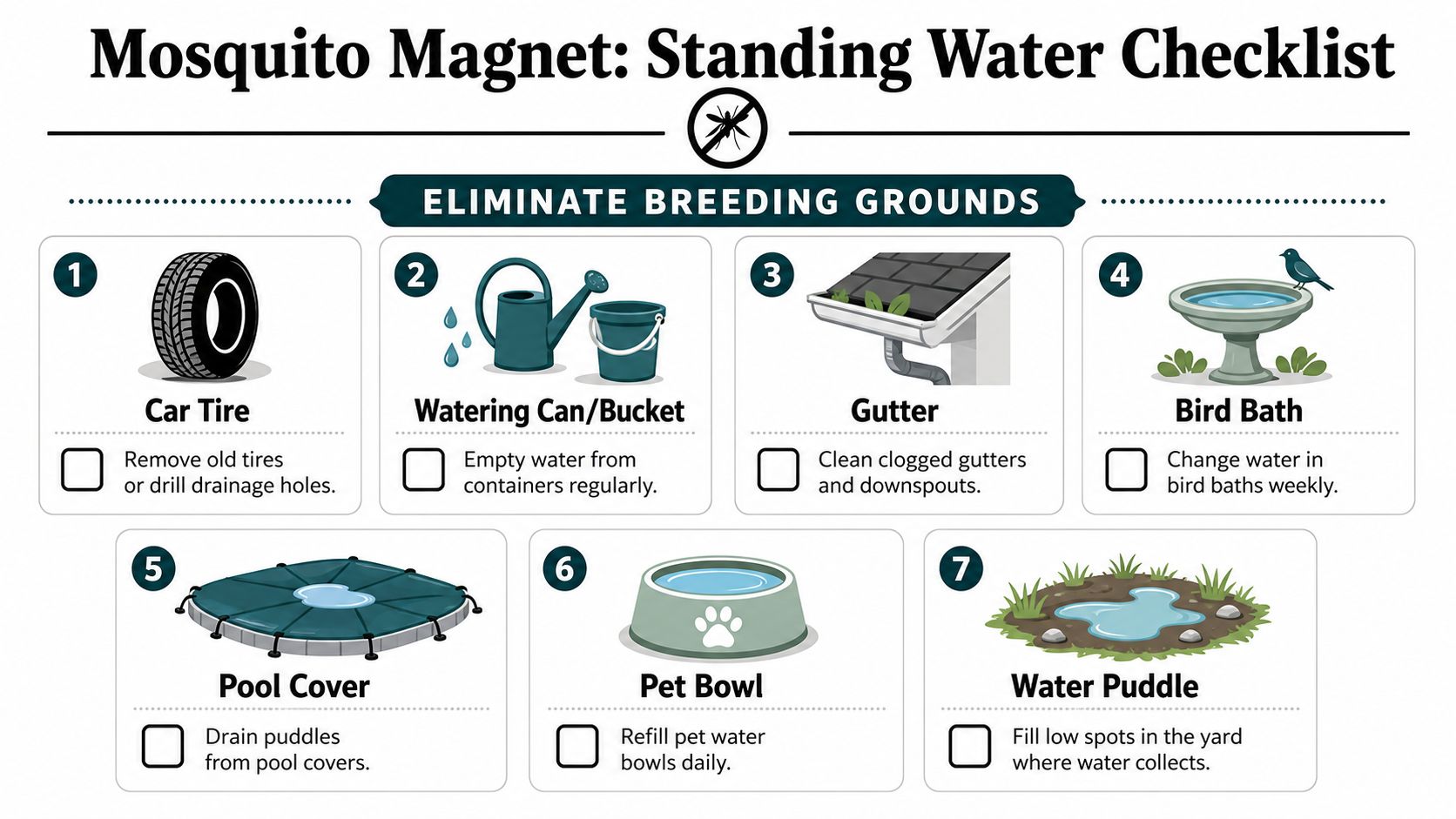
What to check first
The obvious places matter, birdbaths, splashy low spots, old tires, and any decorative water feature that isn't moving. But the hidden ones are usually the primary problem. The Ohio State University Extension notes that mosquito control works best when you eliminate breeding water instead of chasing adults after they emerge Ohio State University Extension.
A good weekly habit is simple:
- Dump containers after rain. Buckets, toys, planters, and anything else that catches water need a close look.
- Clean gutters and downspouts. Debris traps water and gives mosquitoes a place to develop.
- Empty saucers and tarps. Flowerpot saucers, pool covers, and folded materials can hold enough moisture to matter.
- Check drainage blind spots. Low spots in the lawn and tucked-away depressions can stay wet longer than you think.
The reason this matters in Crown Point is that rain doesn't just wet the yard, it resets it. If you want a plain-language explanation of how rain affects mosquito populations, that resource walks through why populations often surge after wet weather.
For a deeper local breakdown of the breeding cycle, see the Green Advantage guide on mosquito breeding and mosquito control. Once water is removed, mosquito pressure drops, but only if the source stays gone long enough to break the cycle.
Why Mosquitoes Still Find You in a Dry Yard
A yard can look dry and still draw mosquitoes. Homeowners usually focus on water first, but mosquitoes also follow carbon dioxide, body heat, skin odors, shade, and still air to find people and resting spots Call Wayne's. That means a yard can be free of standing water and still give mosquitoes the right conditions to linger near your patio, deck, or seating area.
The cues mosquitoes follow
Human scent is part of the problem. Mosquitoes respond to cues tied to sweat and skin chemistry, and research notes that factors like genetics and pregnancy can affect how noticeable a person is to them PMC. Two people standing next to each other can get very different attention from biting mosquitoes.
Color matters too. Cleveland Clinic notes attraction to red, orange, black, and cyan, while lighter colors such as white, green, and blue may be less attractive. That is useful for evening wear and for planning what people wear at backyard gatherings.
Dense vegetation also helps mosquitoes. Tall grass, thick shrubs, and shaded corners create protected places where they can rest during the day and move in when people step outside. In Crown Point yards, mowing, trimming, and opening up airflow can matter almost as much as removing water.
The practical takeaway is straightforward. A yard becomes more mosquito-friendly when host signals, cover, and humid shelter overlap. Patio fans, less clutter around seating areas, and regular trimming can make outdoor space noticeably less inviting to biting insects.
Mosquito control gets harder when the yard becomes a resting zone, not just a breeding zone.
For homeowners who want a look at the hiding places adults use, the Green Advantage has a helpful resource on where mosquitoes hide. That is the part many DIY checklists miss.
A Homeowner's Guide to Finding Mosquito Hotspots
Start with the spots that look harmless. While the patio is often checked, the gutters, the toys near the fence, or the tarp folded behind the shed are easily forgotten. That's where mosquito issues keep going.
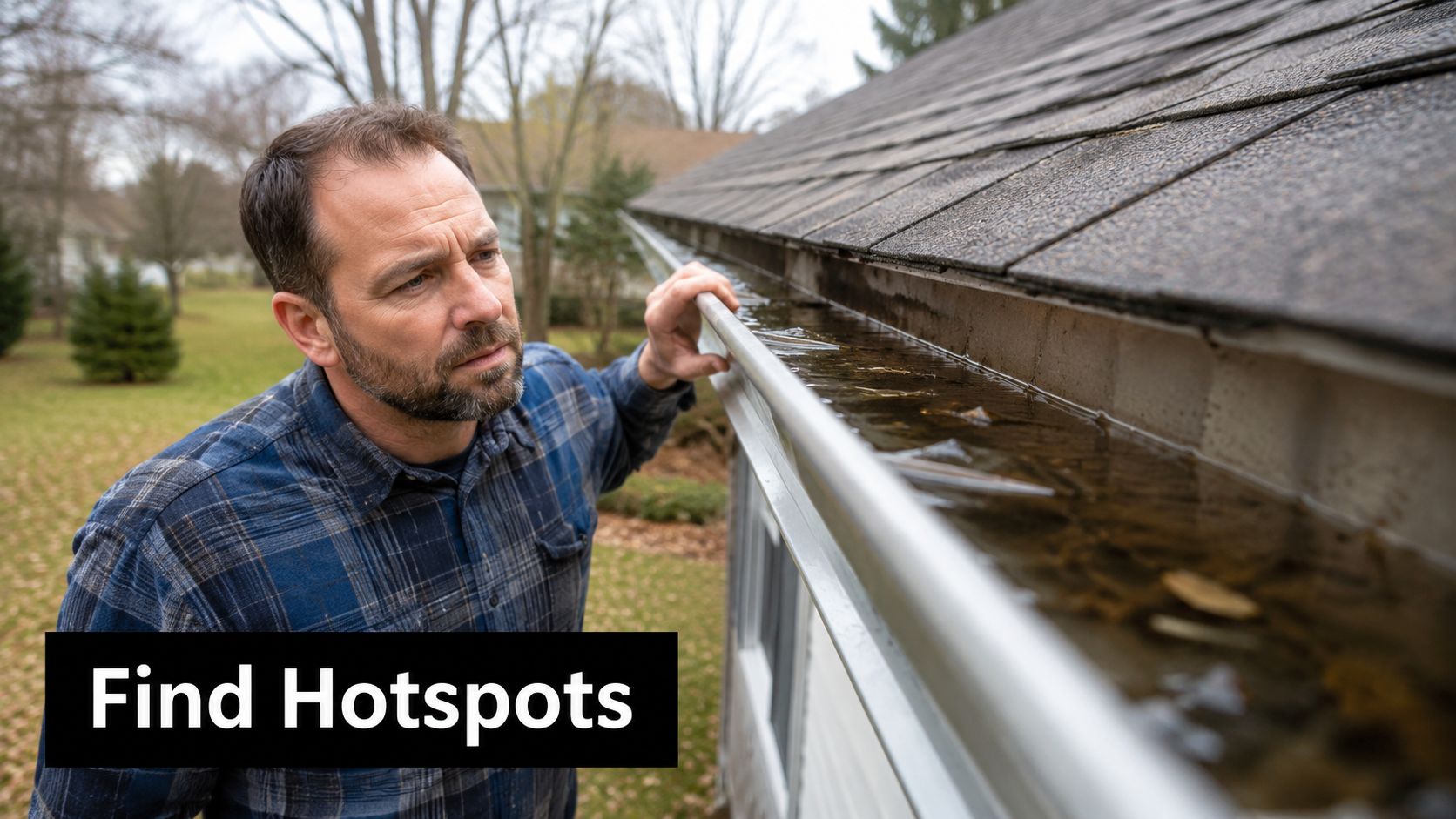
Walk the yard like a mosquito would use it
Look for anywhere water can sit without being disturbed. Independent homeowner guidance repeatedly points to clogged gutters, flower-pot saucers, bird baths, toys, tarps, buckets, and even tree hollows as overlooked breeding sites Tom's Guide. That's the part most routine yard checks miss.
A practical walkthrough helps:
- Start at the roofline. Check gutters, downspouts, and any extender that isn't draining cleanly.
- Move to containers. Pots, buckets, toys, and folded covers trap water after rain.
- Inspect shaded edges. Beds under shrubs, the north side of the house, and the fence line often stay damp longer.
- Look low. Bare soil dips, compacted lawn areas, and spots near patios can hold water after a storm.
After you've done the water check, turn to shelter. Dense plantings, piles of yard debris, and clutter around decks all give adult mosquitoes a place to rest. That matters because a yard can be dry and still produce bites if adults are already living in the cover.
A quick video can help you compare what you're seeing in your own yard with the kinds of hotspots technicians check during service.
If you're comparing your own property to a more detailed visual of mosquito hiding behavior, the Green Advantage page on where mosquitoes hide is a useful companion. It's especially helpful when the yard looks clean but bites keep happening.
When to Call for Professional Mosquito Control
DIY cleanup goes a long way, but it doesn't solve everything. If you've dumped water, cleaned the gutters, trimmed the overgrowth, and mosquitoes are still active, the problem may be coming from adults already resting on the property or moving in from nearby yards. That's a common reason homeowners keep fighting bites even after the obvious sources are gone.
What professional service adds
Professional mosquito control targets more than one stage of the problem. It looks at the shaded resting areas, the dense vegetation, and the places adults use during the day, not just the puddles people can see. That broader view matches how mosquitoes behave in a maintained yard, which is why a property can feel “done” from the homeowner's perspective and still support active mosquitoes Moshield.
If you're comparing service styles, Professional mosquito treatments in Miami gives a useful example of how residential mosquito work can be structured around recurring pressure, rather than one-time reaction.
Here's the trade-off. Store-bought repellents and one-off sprays can reduce bites for a while, but they don't keep pressure down around the whole yard. Professional service is more useful when:
- Bites keep coming back after rain.
- Shrubs, decks, and shade stay heavy with activity.
- You want a yard you can use without constant repellent.
- The property needs a broader habitat correction, not just a surface treatment.
That's where trained mosquito reduction makes sense for residential pest control and, on larger properties, commercial pest control too. It's a better fit when the issue is persistent instead of occasional.
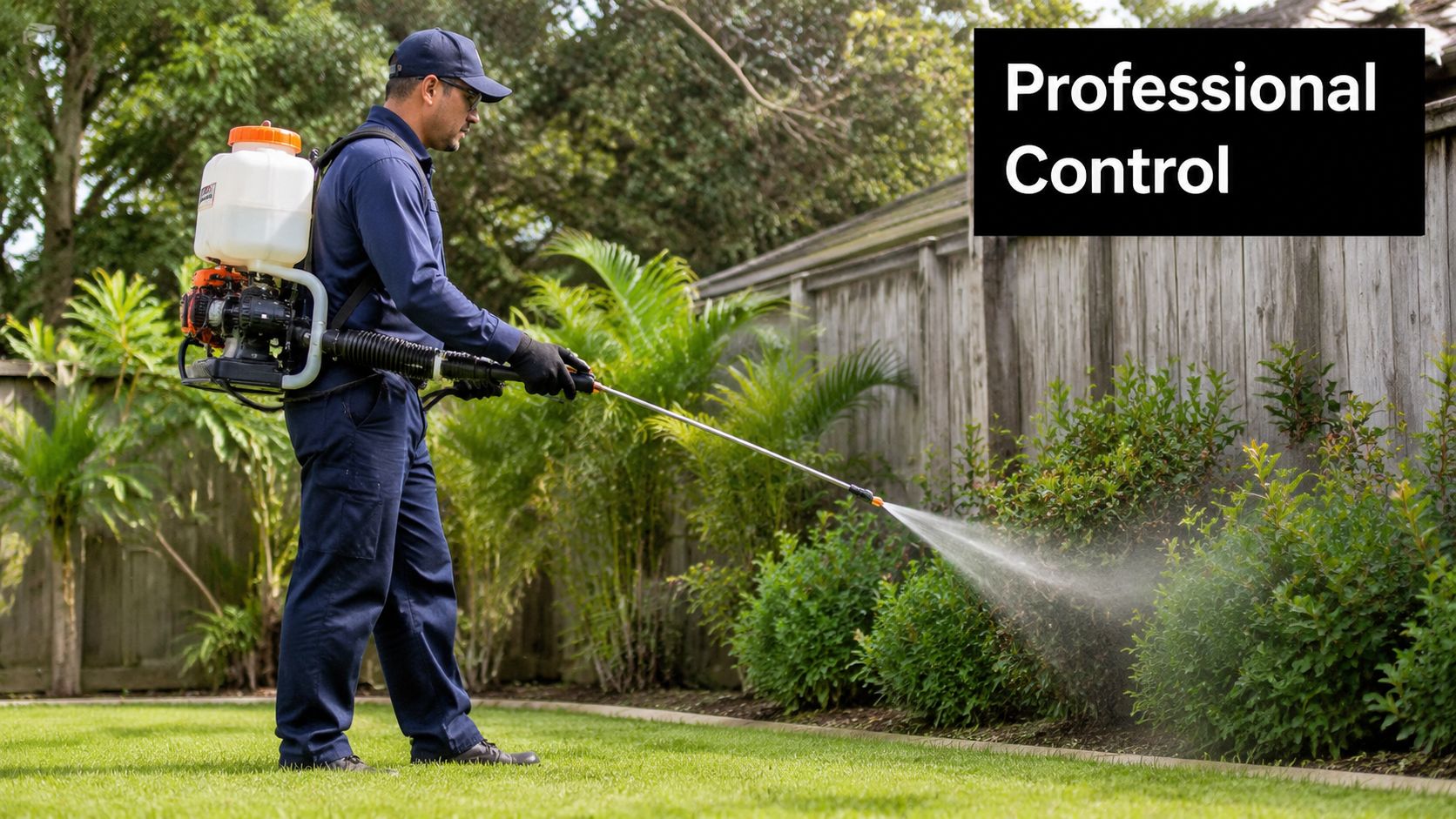
The Green Advantage Solution in Crown Point IN
The Green Advantage approaches mosquito reduction like a property problem, not a guess. For Crown Point, IN homeowners, that usually starts with a consultation and a careful inspection of the yard, the shade line, the drainage, and the spots where mosquitoes rest during the day. From there, the treatment plan can be matched to the property's layout, the season, and the level of pressure on site.
What matters most is that the process is practical. A local company that works in Northwest Indiana understands how weather swings, landscaping, and neighborhood drainage affect mosquito activity. That matters for families who want pest control near me, an exterminator near me, or reliable pest control in Crown Point, IN without a lot of back-and-forth.
The Green Advantage also brings a broader pest management mindset. Mosquito reduction fits alongside other service needs like ant control, termite control, rodent control, spider control, wasp removal, and preventative pest treatments for homes and businesses. If you need commercial pest control or ongoing residential pest control, the same local knowledge helps keep the plan realistic and easy to maintain.
A good mosquito service should leave you with two things. First, a clearer picture of what's attracting pests on the property. Second, a path forward that protects the yard without making it a science project for the homeowner.
If your evenings in Crown Point keep getting cut short, contact The Green Advantage for a property review and a service quote. The right inspection can turn a mosquito problem into a manageable one, and the sooner it's handled, the sooner you get your yard back.
A CTA for The Green Advantage.
Effective Tick Control Yard Solutions in Crown Point, IN

A lot of Crown Point homeowners reach the same point every summer. The grass looks good, the patio is ready, the dog is running the fence line, and the kids want to stay outside until dusk. But once you start finding ticks on pets, on pant legs, or near the wooded edge of the yard, relaxing gets harder.
That's especially true in Northwest Indiana, where humid weather, shaded lots, leaf litter, and tree lines give ticks exactly what they want. A generic once-over with a store-bought spray usually doesn't solve the full problem. Real tick control yard work takes a smarter plan, especially on properties near brush, drainage areas, fence rows, and woods.
For homeowners searching for pest control near me, exterminator near me, or pest control in Crown Point, IN, the goal usually isn't just to kill what's visible today. It's to make the yard feel usable again. That means lowering tick pressure, reducing hiding spots, and building a practical routine that fits how families in Crown Point use their property.
Protecting Your Family and Pets in Northwest Indiana
On a warm evening in Crown Point, the backyard should feel simple. Grill on. Kids outside. Dog circling the patio and cutting through the grass. Then somebody notices a tick crawling on a sock, or a pet comes in and needs a close check before anyone settles in for the night.
That worry is common here because many Northwest Indiana yards have the same setup. Lawn in the middle. Shrubs near the house. A fence line, wood line, or brushy border around the back. Add summer humidity and damp shade, and ticks don't have to travel far to move from edge habitat into spaces where families spend time.

Why local yards stay risky
Ticks don't need a neglected property to become a problem. A clean, well-kept yard can still have pressure if it backs up to woods, holds moisture, or gives rodents and deer easy travel routes. That's why broad online advice often falls short for homeowners in Crown Point and nearby Northwest Indiana communities.
A practical plan usually starts with the yard, but pets need attention too. If your dog is the first one bringing ticks inside, it also helps to review basics like choosing effective tick shampoo so your pet care routine matches what you're doing outdoors.
Ticks are a yard-edge problem first, but families feel the impact on patios, play areas, and pets.
What homeowners want from a real solution
Homeowners aren't looking for a complicated lecture. They want to know what works, what doesn't, and whether they can let their kids and pets use the yard without second-guessing every trip outside.
That's where local experience matters. In Crown Point, IN, a tick problem usually isn't just about one pest. The same moisture, brush, and rodent activity that support ticks can also overlap with broader residential pest control concerns like mosquito control, rodent control, spider activity, and seasonal pest issues that show up around garages, sheds, and foundations.
A good plan starts by treating the yard like a system. The wooded edge matters. Pet routes matter. Leaf litter matters. And in this area, the weather matters more than many homeowners realize.
First Steps to a Tick-Safer Yard
The fastest way to improve a tick control yard setup is to make the property less comfortable for ticks before you think about products. Habitat change doesn't replace treatment when tick pressure is already high, but it gives every other step a better chance to work.
Here's the yard checklist many homeowners in Crown Point can start over a weekend.
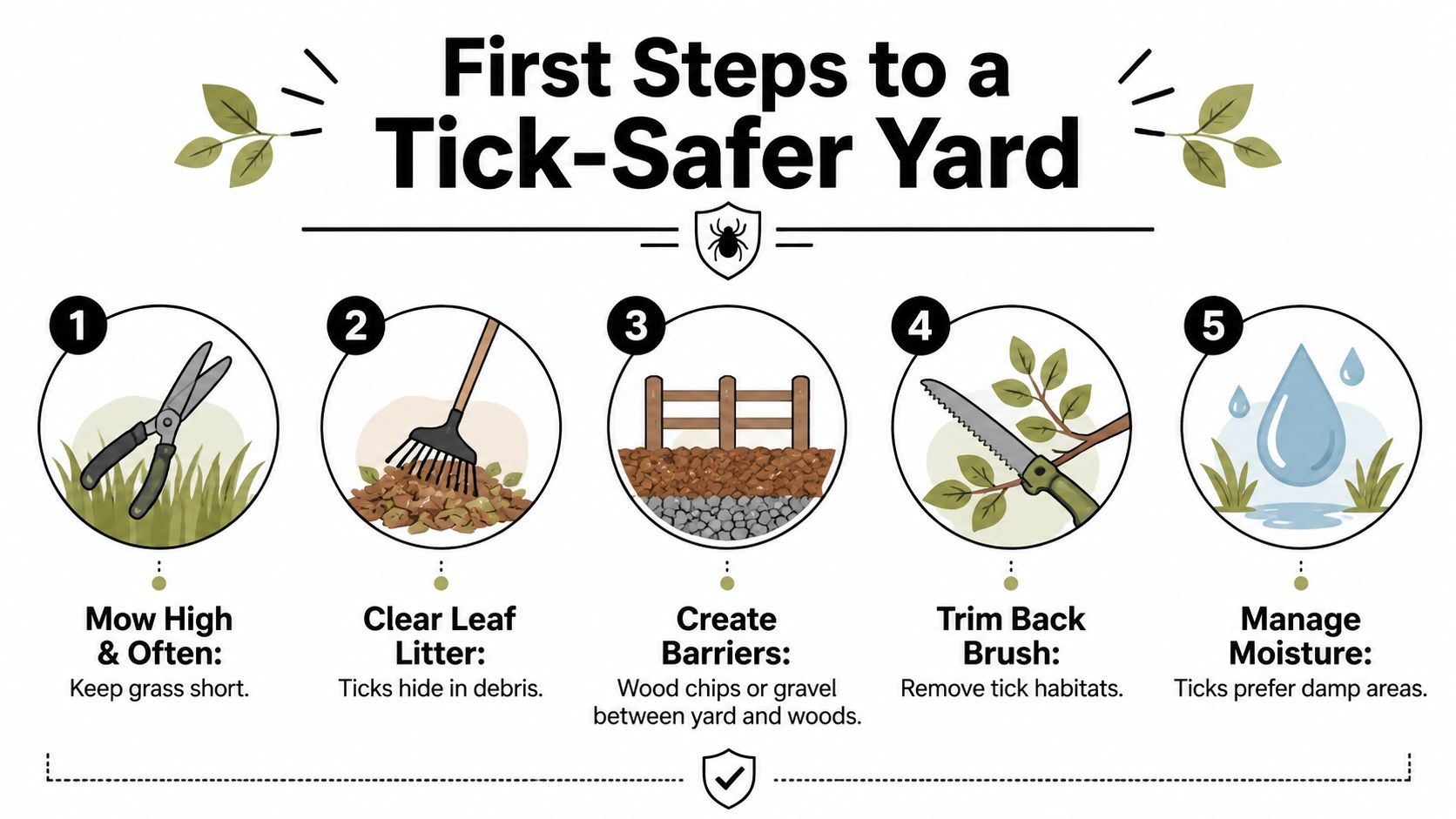
Start with mowing, borders, and cleanup
The clearest evidence-based yard method combines maintaining turf height at 2 to 2.5 inches, creating a continuous 3-foot-wide barrier of dry inorganic material between lawn and woods, and removing leaf litter and tall grasses in March to April before nymphs become active according to this yard management guidance.
That sounds straightforward, but the details matter.
- Keep turf in the right range: Grass that stays around 2 to 2.5 inches dries faster and holds less humidity at ground level. Ticks prefer the cooler, damp layer that builds up when turf gets shaggy.
- Build a real barrier: Use dry inorganic material such as crushed stone or decomposed granite. The target is a continuous 3-foot-wide barrier. Gaps defeat the point because ticks and host animals use those breaks as crossing points.
- Rake out leaf litter early: Leaf piles and matted debris hold moisture and give ticks cover. Clearing those zones before spring activity picks up helps reduce sheltered habitat.
What to avoid in the border zone
Many homeowners install a border and still wonder why activity continues. One common reason is using the wrong material.
Practical rule: Dry stone works better than moisture-holding landscape fill in tick transition zones.
Bark mulch, wood chips, and similar organic fills may look tidy, but they can hold moisture and fit right into the shaded edge habitat ticks prefer. If your yard backs to woods in Crown Point, the material choice around that line matters.
A simple maintenance routine helps keep those improvements from fading:
- Measure the edge barrier a few times through the season so it stays at least 36 inches wide and doesn't get overgrown.
- Check turf height weekly at several spots instead of just eyeballing it from the patio.
- Trim shrubs up from the soil so air and light can move underneath.
- Watch damp pockets near downspouts, play sets, fence corners, and wood storage.
Later in the season, many homeowners also look into natural tick repellent for yard options as part of a lower-impact prevention plan. Those products can play a role, but they work better when the habitat has already been corrected.
A short visual walkthrough can help you spot the weak points most yards miss.
Focus on the places people ignore
Most of the yard usually isn't the problem. The problem is the transition space.
Check these first:
- Fence lines: Tall grass and brush collect moisture and invite rodent traffic.
- Under shrubs: If you can't see bare air under the plant, it's probably holding too much shade and humidity.
- Behind sheds and wood piles: Low disturbance areas often become hiding zones.
- Pet shortcuts: Dogs create predictable routes, often straight through the coolest part of the yard.
This kind of cleanup also supports broader preventative pest treatments. A drier, more open yard is less attractive to mosquitoes, rodents, and some nuisance insects, which is why good outdoor pest management often overlaps from one service to another.
Understanding Your Treatment Options
Once the yard is cleaned up, homeowners usually compare three paths. Do it all yourself, try natural products first, or bring in professional treatment. Each can help, but they don't perform the same way and they don't ask the same amount of time from you.
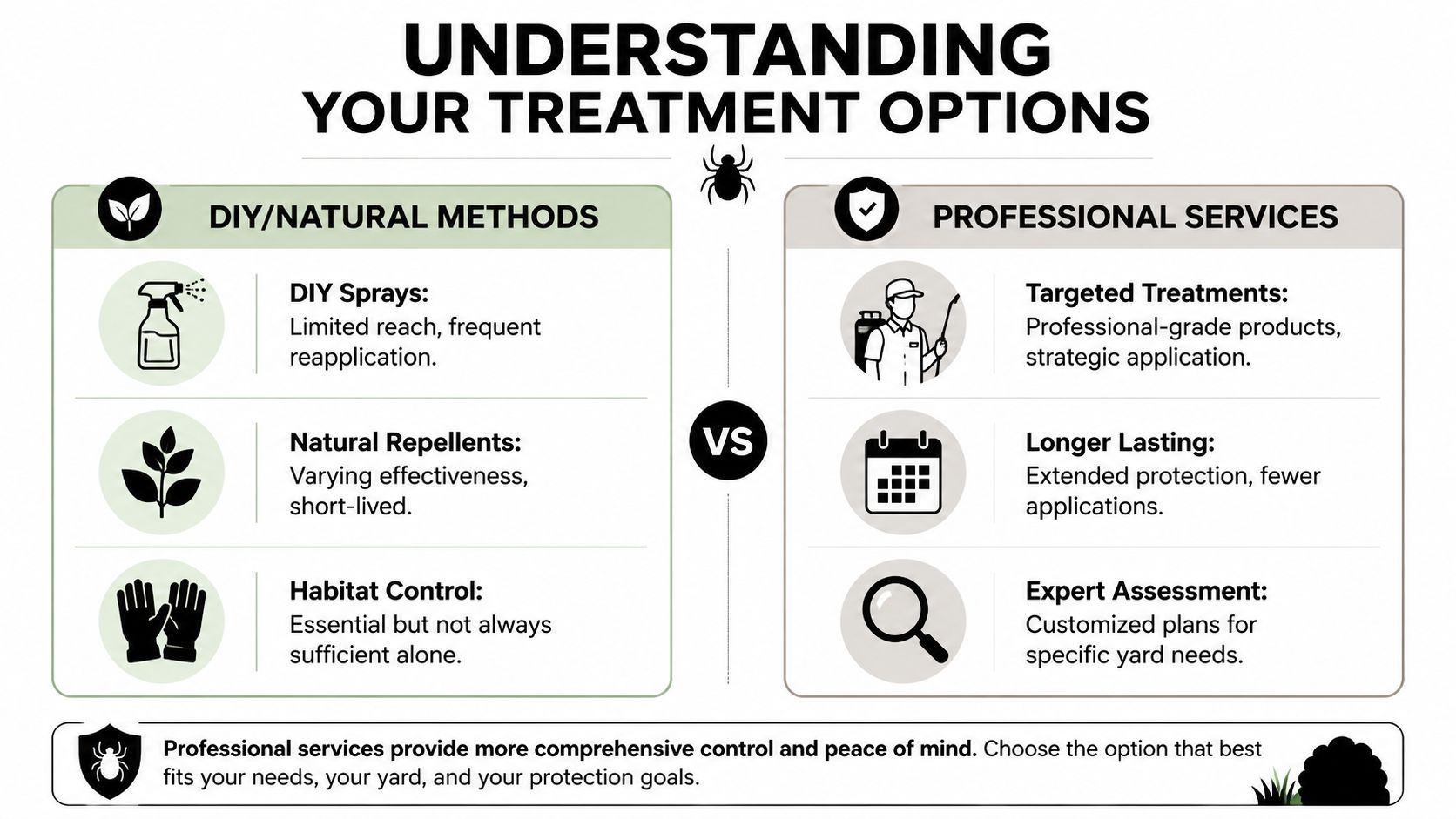
DIY and natural options
A lot of homeowners start with cedar-based sprays, botanical products, hose-end concentrates, or hand-pump applications around the perimeter. That's understandable. People want a lower-impact option, and they want to stay in control of what goes into the yard.
The trade-off is consistency. EPA-registered synthetic pesticide products labeled for ticks have consistently achieved greater than 80% suppression of blacklegged ticks in residential yards, while unregulated minimum risk 25(b) products often suppress ticks for only 1 to 3 weeks before reapplication is needed, based on this review of residential tick control studies.
That doesn't mean every natural approach is useless. It means homeowners should go in with realistic expectations. If you choose a minimum-risk product, you may need a much tighter reapplication schedule to hold the line during active periods.
Where professional service changes the outcome
Professional service isn't just “stronger spray.” A key difference is targeting. Ticks aren't spread evenly across the property, so treating the entire lawn the same way often wastes effort and misses the most important zones.
A thoughtful plan usually prioritizes:
| Area | Why it matters |
|---|---|
| Shaded bed edges | Moist ground and dense plant cover help ticks persist |
| Wooded transitions | Wildlife and rodents move ticks into the yard from here |
| Fence lines and brush | These corridors stay cooler and less disturbed |
| Pet routes and play-adjacent edges | Human and animal traffic turns tick presence into real exposure |
Some homeowners also ask about methods that reduce ticks without directly targeting the animal host. One option often discussed is the use of tick tubes with permethrin-treated cotton for mice. These are different from broad sprays and are meant to interrupt the mouse-tick cycle in a more targeted way.
For homeowners comparing local service paths, best flea and tick control for yard options can help frame the choices between one-time treatment, recurring service, and integrated plans.
The right treatment depends less on what sounds strongest and more on whether it matches the way ticks are entering and surviving on your property.
A balanced way to decide
Choose DIY-only if the yard has light pressure, limited wooded edge, and you're willing to keep up with repeated maintenance and reapplication.
Choose a professional plan when the property has recurring activity, a brushy perimeter, pet exposure, or a wooded lot line. That's often the case in Crown Point, where a clean lawn in the center can still sit next to a high-risk edge.
For many homes, habitat correction plus targeted treatment is the point where the yard starts feeling manageable again.
The Green Advantage ITM Approach for Crown Point
Generic perimeter spraying sounds convenient, but it often breaks down in Northwest Indiana. Crown Point yards deal with humid conditions, dense edge growth, and regular reinfestation pressure from nearby wooded areas. If the plan doesn't account for that, the yard may look treated on paper while ticks keep returning.
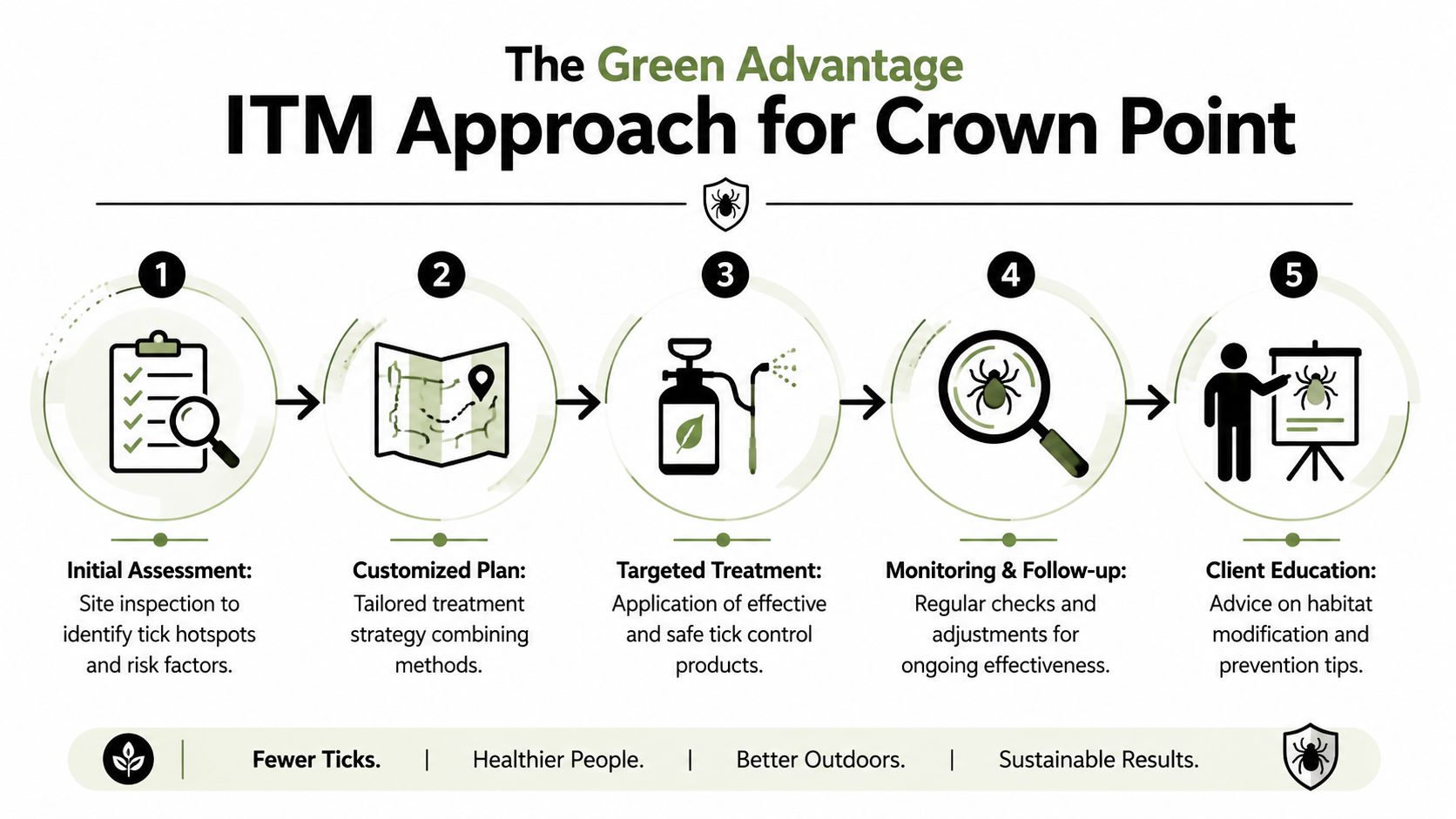
Why one-size-fits-all programs fall short here
Research highlighted in this Northwest Indiana tick yard guide notes that in humid, wooded-edge environments, tick re-infestation can occur within 4 to 6 weeks because of early summer nymph surges and heavy rain washout. That's the part many homeowners never hear when they're sold a simple “spray and forget” service.
A real integrated plan has to account for timing, weather, edge habitat, and how the property is used. A play area near a tree line needs different attention than an open front lawn. A dog run behind the garage needs different attention than ornamental beds by the porch.
What an integrated local program looks like
A strong ITM approach usually follows a sequence instead of relying on a single visit.
Property inspection
The first step is walking the whole site, especially the transition areas. Wood lines, leaf buildup, pet paths, low shrubs, damp corners, and rodent activity all affect where ticks hold.Habitat assessment
At this stage, the yard plan gets practical. The question isn't just where ticks are. It's why they're comfortable there.Targeted treatment
Product placement matters more than broad coverage for the sake of coverage. Shaded borders, perennial beds, and edge zones usually deserve the most attention.Follow-up and seasonal adjustment
In Crown Point, service timing has to match the season. Heavy summer rain, fresh growth, and wildlife movement can change pressure fast.Homeowner guidance
Mowing height, border upkeep, leaf cleanup, and pet traffic control all affect results between visits.
How this works on local properties
On many Northwest Indiana lots, the center lawn isn't the battlefield. The main pressure starts where the maintained yard touches brush, trees, or unmanaged neighboring ground. That's why a tick control yard program should behave more like ongoing management than a one-time application.
A season-long plan works better than a calendar reminder that says “spray once in spring.”
One local option homeowners use is The Green Advantage, which provides a thorough property inspection, identifies likely tick hotspots, and builds treatment around site conditions instead of treating every lawn the same way. That kind of approach also fits properties that may need broader commercial pest control or residential pest control support for mosquitoes, rodents, and other outdoor pest activity tied to moisture and site layout.
For Crown Point homeowners searching for an exterminator in Crown Point, IN, the key question isn't whether someone can apply a product. It's whether they can read the property and manage the problem through the season.
Comprehensive Pest Protection for Your Property
Ticks rarely show up alone as a property-management issue. The same conditions that support them often support other pests too. When a yard holds moisture, dense vegetation, debris, and rodent traffic, it becomes easier for multiple pest problems to develop at once.
Why yard conditions affect more than ticks
A shaded, overgrown perimeter can also support mosquito control needs, especially around damp ornamental beds and low-drainage areas. Rodent activity matters as well, because mice and similar animals move through the same edge habitat that supports ticks. If you're already seeing signs of gnawing, nesting, or movement around sheds and foundations, that's not a separate issue. It's part of the same outdoor pressure pattern.
A broader property plan may also include:
- Rodent control: Reducing harborage around wood piles, dense cover, and structures.
- Mosquito control: Targeting damp resting areas and breeding-prone parts of the yard.
- Spider control: Cutting back insect pressure around eaves, garages, and entry points.
- Wasp removal: Addressing nests around rooflines, play areas, and patios.
- Termite control: Protecting structures where moisture and wood contact create risk.
One property, connected pest problems
This is why many homeowners who start by searching for tick control yard services end up asking about full pest control in Crown Point, IN. They want the patio, lawn edge, garage, and foundation protected as one property, not handled as unrelated problems.
A well-managed yard does more than reduce ticks. It removes the conditions that let several pests settle in close to the home.
That's also useful for landlords, real estate professionals, and businesses that need dependable exterior conditions. Good outdoor management protects comfort, supports property value, and cuts down on the cycle of reacting to one pest at a time.
Partnering with The Green Advantage
Homeowners usually feel better once they know what the process looks like. Pest control shouldn't feel vague. You should know who's coming, what they're looking for, what they'll recommend, and what you can do between visits to keep pressure down.
What the experience looks like
The process usually starts with a phone call or quote request. That first conversation should be simple. You explain what you've seen, where you've seen it, whether pets use the yard, and whether the property backs up to trees, brush, or unmanaged ground.
From there, a technician visits the property and inspects the areas where tick pressure usually starts. That includes edges, beds, leaf litter zones, pet routes, shaded corners, and any spots where moisture lingers. If broader outdoor issues are present, this is also when related needs like rodent control, mosquito control, or other preventative pest treatments can be identified.
Why the strategy matters
This part matters because yard treatment alone has limits. A large-scale study found that springtime barrier acaricide applications reduced tick abundance on treated properties by 63%, yet did not produce a statistically significant difference in human-tick encounters or tick-borne disease incidence, according to the Journal of Infectious Diseases study. That's why a professional should treat spraying as one part of a larger plan, not the whole answer.
In practice, that means you should expect advice on yard conditions, not just product application. You should also expect clear communication about timing, follow-up, and what changes on the property may improve results.
What homeowners should expect after service
A reliable service relationship includes more than the visit itself.
- Clear findings: You should understand where the risk is highest on the property.
- Specific recommendations: Not generic cleanup advice, but practical steps tied to your layout.
- Seasonal follow-up: Tick pressure changes with weather and growth.
- Honest expectations: The goal is reduction and smarter management, not a false promise that one treatment solves every exposure risk.
For homeowners looking for pest control near me, exterminator near me, or residential pest control in Crown Point, peace of mind comes from that combination of field experience, transparency, and ongoing support.
If your yard backs up to woods, stays damp through summer, or keeps producing ticks even after DIY treatment, it may be time for a closer look. The Green Advantage works with homeowners and properties across Crown Point, IN and nearby Northwest Indiana communities to inspect risk areas, build practical treatment plans, and help families reclaim their outdoor space with more confidence.