
Expert Certified Pest Control Operators in Crown Point
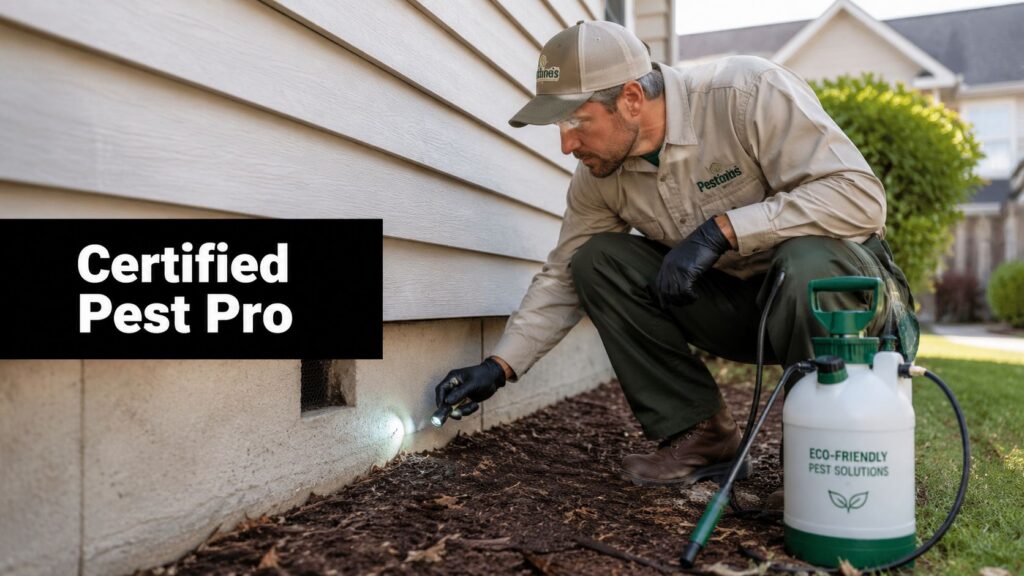
You find the issue when your house is supposed to feel calm. Ants show up on the kitchen counter before school. A wasp nest appears over the patio the day you plan to have people over. At night, you hear scratching in the wall and start wondering what is in there.
The search usually starts fast with pest control near me or exterminator near me. The hard part comes a few minutes later. Now you have to decide who should inspect your home, apply products safely around food areas, kids, and pets, and fix the problem instead of stirring it up for a week and letting it return.
Certification is part of that decision.
A certified pest control operator has training, state oversight, and a legal responsibility to handle pest problems the right way. For a homeowner in Crown Point, that shows up in practical ways. The inspection is more thorough. The pest is identified before treatment starts. The products, placement, and timing are chosen for the site instead of pulled from a one-size-fits-all routine.
That difference protects more than the house. It reduces the risk of misapplied pesticides around baseboards, kitchens, pet areas, and entry points. It also improves the odds of getting control the first time, because the work is based on pest biology, entry conditions, moisture issues, nesting habits, and seasonal pressure in Northwest Indiana.
Local experience matters too.
Ants, mosquitoes, rodents, wasps, spiders, and termites do not behave the same way in Crown Point from spring through fall, and they definitely do not respond to the same treatment plan. A certified operator knows when a line of ants points to a moisture issue, when mosquito activity calls for source reduction as well as treatment, and when scratching in a wall needs a proper inspection before anyone reaches for a product.
Homeowners are not just paying for someone to spray. They are paying for judgment, safe handling, and a treatment plan that fits the pest and the property. That is the true value behind certification.
Pests in Crown Point and Finding a Pro You Can Trust
A lot of service calls start with a homeowner who's already tried something from the store.
They've sprayed the baseboards for ants, hung a wasp trap near the deck, or put a few bait stations in the garage for mice. Sometimes that slows activity down for a few days. Sometimes it makes the problem look gone when it really isn't. Then the pests come back, often in a different part of the house.
That's the moment when people start searching for exterminator in Crown Point, IN and trying to figure out who's legitimate.
What homeowners are really asking
Clients aren't just asking, “Who can kill this pest?”
They're asking different questions underneath that one:
- Is this safe around my family and pets
- Will the treatment work
- Am I paying for a real solution or a temporary patch
- Does this company understand the kinds of pest issues we get in Crown Point and the rest of Northwest Indiana
Those are fair questions. Pest problems are stressful because they affect comfort quickly. A line of ants in the pantry feels invasive. A yellowjacket nest near the front walk changes how you use your own yard. Rodent activity in an attic or crawlspace can keep people awake at night.
Homeowners don't need someone who sounds convincing. They need someone who can identify the pest, explain the cause, and choose a treatment that fits the site.
The difference between help and qualified help
A handyman might seal a gap. A general maintenance person might knock down a visible nest. Those actions can help in a narrow sense.
But certified pest control operators are trained to look at the full problem. They inspect entry points, moisture conditions, harborage areas, product selection, label compliance, and follow-up needs. They also understand when a pest issue is part of a larger pattern, such as recurring ant pressure from grading and mulch contact, or mosquito activity tied to standing water and dense vegetation.
That's why choosing a professional matters so much more than choosing the lowest price. The wrong treatment wastes time, delays control, and can create unnecessary exposure without solving the infestation.
For residential pest control and commercial pest control in Crown Point, trust should be built on credentials, inspection quality, and clear communication. If a company can't explain what they found, why it's happening, and what the plan is, keep looking.
What a Certified Pest Control Operator Actually Does
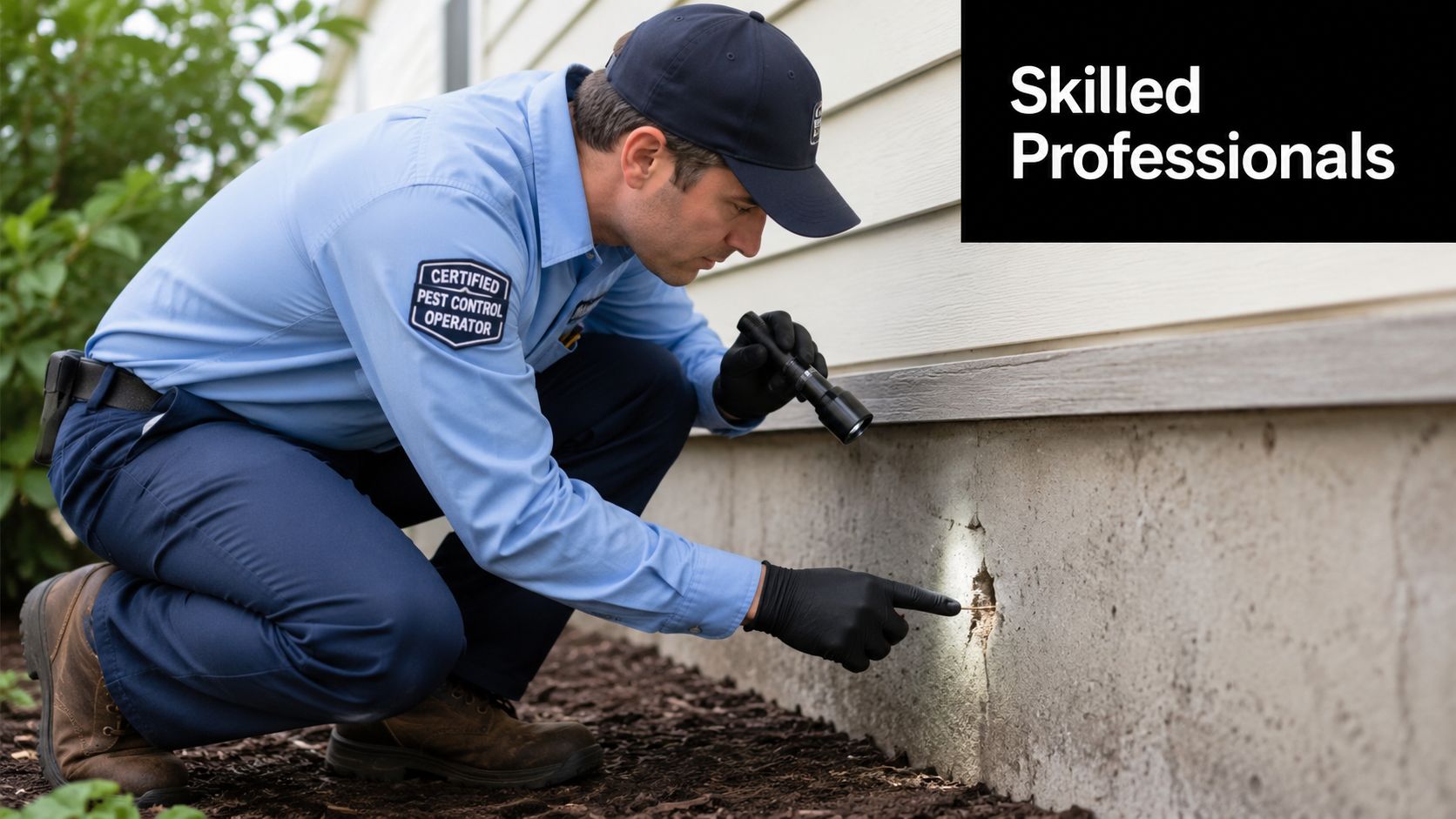
A certified operator starts by slowing the problem down.
Homeowners in Crown Point often call after trying the obvious fix. They sprayed the ant trail under the sink. They knocked down the wasp nest by the garage. They put out a few mosquito treatments from the hardware store. The pressure comes back because the visible pest was only part of the problem.
A certified operator is trained to identify the pest, inspect the site, choose a legal and appropriate treatment, and explain how to keep the issue from returning. That work protects more than comfort. It affects where products can be used, how exposure is limited around children and pets, and whether the service solves the source instead of chasing symptoms.
Inspection first, treatment second
A strong visit usually includes checking:
- Foundation lines and entry points where insects and rodents can get inside
- Moisture-prone areas such as basements, crawlspaces, sump areas, and plumbing penetrations
- Exterior conditions like stacked firewood, mulch against siding, clogged gutters, and vegetation touching the home
- Signs of activity such as droppings, trails, nesting, rub marks, frass, or insect debris
That inspection stage is where certification shows up in real life. The operator has to know whether the small ants in the kitchen are odorous house ants, pavement ants, or carpenter ants, because the treatment plan changes with the species. The same is true for mosquitoes. Some yards need targeted reduction around harborage and standing water. Others need a broader plan that starts with drainage, gutter correction, or trimming heavy vegetation.
For homeowners who want a closer look at the service process, this guide on what pest control companies do gives a useful overview.
The job involves judgment, safety, and accountability
Certified operators do more than apply products. They read labels, measure application rates, watch for sensitive areas, and document what was used and where it was applied. In a family home, those details matter.
A treatment around a play area, a dog run, a vegetable garden, or a kitchen cannot be approached carelessly. Product choice, placement, timing, and follow-up all have to fit the site. In Northwest Indiana, that often means balancing quick relief with long-term correction for recurring ants in spring, stinging insects in summer, rodents in colder months, and mosquito pressure during humid stretches.
A good operator also knows when chemical treatment should be limited or supported by other steps. Sealing a mouse entry point, correcting a moisture issue behind a bathroom wall, or removing leaf clutter from a shaded foundation can do more than another round of spray.
Here's a short look at the field in action:
What works and what usually doesn't
The strongest pest control programs use inspection, exclusion, habitat correction, monitoring, and targeted treatment together.
A few examples:
| Situation | What usually works | What usually fails |
|---|---|---|
| Ants in kitchen | Identify the species, trace entry routes, use targeted materials, reduce food and moisture sources | Repeated over-the-counter surface spraying |
| Rodents in garage or attic | Seal gaps, place traps and devices correctly, monitor activity, address food sources | Setting random traps without exclusion |
| Mosquito pressure in yard | Reduce breeding sites, trim dense harborage, use targeted service where needed | Treating blindly without addressing standing water |
| Wasp activity near entry doors | Treat the active nest safely, inspect nearby voids and repeat sites | Knocking nests down without dealing with live insects |
Practical rule: If the plan is just to spray every surface and leave, keep looking.
Understanding Pest Control Certifications and Licensing
Certification sounds abstract until you break it down into the parts that protect a homeowner.
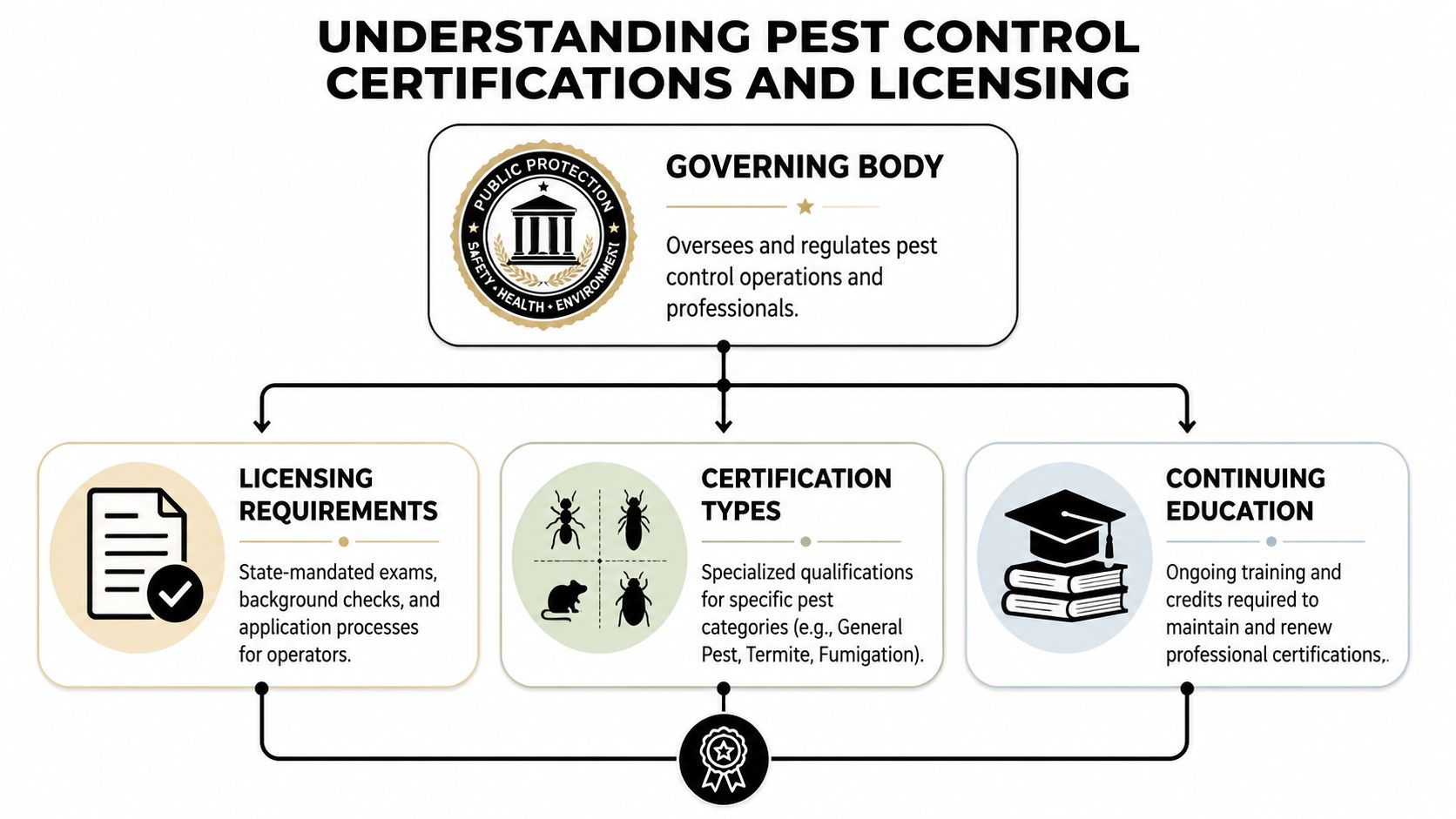
Certification means the person responsible for pest control work has met formal standards for experience, testing, and ongoing renewal. That's important because pest control involves product handling, legal restrictions, recordkeeping, and treatment decisions that affect health and property.
What certification typically requires
A good benchmark comes from Georgia's certified operator model. Applicants need at least two years of verifiable structural pest control experience within the last five years, or a related degree plus one year of actual service experience in that same period. They must pass the core exam plus a category exam. Each exam category costs $45, the credential fee is $100, and certification lasts for a five-year period. Renewal requires continuing education or reexamination, including 25 credits for Household Pest Control and 12 credits for Fumigation, according to Georgia's certified operator license requirements.
That's a useful example because it shows how the trade is built. It isn't one quick test and done. It's field work, exams, category knowledge, and renewal over time.
Exams are about judgment, not memorization alone
In many places, applicants must pass both a core pesticide safety exam and a category-specific exam. Some jurisdictions require a 75%+ passing mark on each module. In Ontario, the certification course also has to be completed within the last 12 months before applying, as described in the Ontario exterminator certification guide.
That matters because current knowledge counts. Labels change. best practices change. Pest pressure changes. A person who hasn't stayed current may still sound experienced while missing newer safety or treatment standards.
Certification should be viewed the way homeowners view electrical or plumbing credentials. It's proof that someone is allowed to do regulated work and expected to stay competent.
Why there are layers of responsibility
Homeowners sometimes assume the person at the door and the person legally responsible for the work are always the same person. Sometimes they are. Sometimes the technician performs service under the supervision of a certified operator who oversees the program, approves methods, and ensures compliance.
That layered accountability is a strength, not a flaw. It means there's a structure behind the visit.
Here's the simple version:
- Technician or applicator handles field service, inspection details, and treatment execution.
- Certified operator holds responsibility for category knowledge, supervision, and compliant service decisions.
- The company maintains licensing, records, and operational standards.
When you hire a firm for pest control in Crown Point, IN, you want all three parts to be in place. That's what separates a real professional operation from someone doing side work with store-bought materials and no oversight.
Key Benefits of Hiring a Certified Pro for Your NWI Home
Certification matters most when it changes the outcome for your household. For a homeowner in Northwest Indiana, that usually comes down to three things. Safety, effectiveness, and peace of mind.
Safer handling around people, pets, and property
Some products and use categories carry tighter rules for a reason. Government guidance in several markets requires certified applicators for restricted-class pesticides and limits assistant applicators to supporting certified applicators in application, transport, storage, and security, according to British Columbia pesticide certification and training guidance.
That tells homeowners something practical. Certification is not just personal knowledge. It's a workflow control. It affects who can handle what, who supervises whom, and how materials are stored and applied.
In everyday terms, a certified professional is more likely to make disciplined choices such as:
- Using targeted placement instead of broad, unnecessary application
- Reading site conditions carefully before treating near pet areas, food zones, or play spaces
- Choosing the right formulation for the location rather than using the same approach everywhere
Better diagnosis means better control
A lot of failed pest work comes from treating the visible symptom and missing the reason the pests are there.
That's common with ant control, rodent control, and spider control. A homeowner sees activity in one room, treats that room, and wonders why the problem returns. The certified pro is trained to work backwards from the evidence. Where are they getting in. What are they feeding on. What conditions are helping them stay. What treatment reaches the source instead of only the traffic path.
That's also why termite control, wasp removal, and mosquito control should never be approached casually. Each one has its own safety concerns and service logic.
Less guesswork, less stress
Good pest control should make your life simpler.
You should get a clear explanation of what was found, what the plan is, what preparation is needed, and what kind of follow-up makes sense. You shouldn't feel pushed into a one-size-fits-all package or a vague promise that “everything will be sprayed.”
The best service call often feels calm, not dramatic. The operator identifies the issue, explains the plan in plain language, and leaves you knowing what happens next.
For homes in Crown Point, that kind of clarity matters because many pest issues are seasonal, recurring, or tied to exterior conditions. A trained professional helps you solve the current problem and reduce the chance of the next one.
Your Checklist for Hiring a Pest Control Operator in Crown Point
When you're comparing residential pest control or commercial pest control options, don't judge by price alone. Ask better questions.
A strong company should be comfortable answering them.
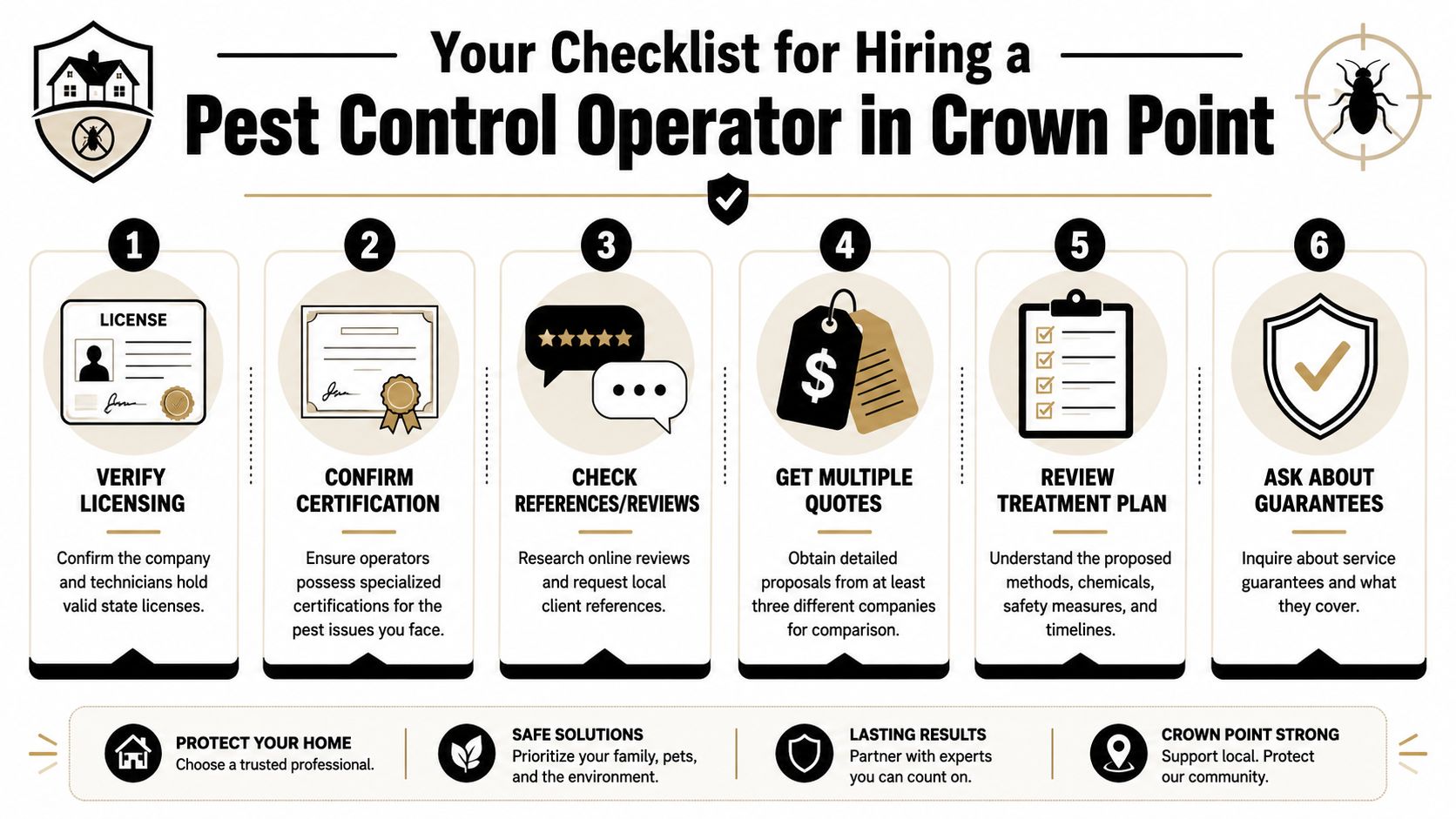
What to verify before you hire
Use this checklist when speaking with any exterminator in Crown Point, IN.
- Ask for licensing information. A legitimate company should be able to provide its state licensing details without hesitation. If someone gets evasive, that's a warning sign.
- Confirm certification for the type of work you need. General pest service, termite work, mosquito programs, and specialty treatments may involve different responsibilities and qualifications.
- Ask who supervises the service work. If a technician is coming out, find out who the certified operator or responsible manager is.
- Request proof of insurance. Pest control is regulated work performed on your property. Insurance is part of basic professionalism.
- Read local reviews carefully. Look for comments about communication, follow-through, punctuality, and whether the company solved the issue instead of repeating the same treatment.
What a professional consultation should look like
A quality inspection usually leads to a better result than a fast quote over the phone.
Watch for these signs:
| Good sign | Why it matters |
|---|---|
| The inspector asks where activity started | Helps establish pattern, severity, and likely source |
| They check inside and outside | Most pest issues connect to exterior conditions |
| They explain the pest clearly | Good service starts with correct identification |
| They describe prep and follow-up | Professional work includes expectations and next steps |
| They put the plan in writing | Clear scope protects both homeowner and company |
A weak consultation often skips inspection details and jumps straight to pricing. That may feel convenient, but it usually means the plan is generic.
Smart questions that protect you
Ask direct questions and listen to how specific the answers are.
- What exactly are you treating for
- Where will treatment be applied
- What do I need to do before or after service
- How do you handle children, pets, and sensitive areas
- What happens if activity continues after the first visit
For owners of rental property or commercial sites, it's also worth understanding the insurance side of operations. This resource on protecting your Tennessee pest control operations is focused on another state, but it gives a useful picture of why insurance and operational safeguards matter in the pest control industry.
Cheap service can be expensive if it leads to repeat infestations, unclear liability, or treatments that don't match the pest.
The best company to hire is usually the one that inspects carefully, documents clearly, and doesn't rush you past the questions.
The Green Advantage Experience Your Local Certified Solution
Homeowners in Crown Point don't need more jargon. They need a company that shows up, knows the difference between a surface issue and a structural one, and treats the property with care.
That's where a local, licensed team stands out. A company rooted in Northwest Indiana understands the seasonal rhythm here. Spring ant activity, summer mosquito complaints, fall rodent pressure, overwintering insects, and the outdoor conditions that drive pests toward homes and businesses. Local knowledge changes how inspections are done and how prevention plans are built.
Prevention-first service matters more now
Public health organizations have warned that mosquito-borne disease risk is expanding as warmer conditions and invasive mosquitoes affect more places. That's why modern pest management has shifted toward inspection, habitat modification, and targeted prevention-first programs instead of simple blanket chemical use.
For homeowners, that means better service should include looking for standing water, dense resting sites, drainage trouble, clogged areas, and yard conditions that support mosquito activity. The same prevention-first mindset helps with ants, rodents, and many recurring perimeter pests.

What good local service should feel like
The experience should be straightforward from the first phone call.
You should be able to talk with knowledgeable staff, get answers without runaround, and schedule an inspection that looks at the actual site conditions. The technician should explain what's happening in plain English, whether that's ant control, spider control, rodent control, mosquito control, termite control, or wasp removal. From there, the treatment plan should match the property instead of forcing the property into a canned plan.
For homeowners comparing providers, this page on why you should choose The Green Advantage for your pest control needs gives a clear picture of what that local service model looks like in practice.
When you hire certified professionals, you're not just paying for a treatment. You're paying for judgment, compliance, safer handling, and a better chance of fixing the problem correctly the first time.
If you're looking for pest control in Crown Point, IN, or searching for a dependable exterminator near me, contact The Green Advantage. Their licensed, certified team serves Crown Point and nearby Northwest Indiana communities with thoughtful inspections, effective treatment plans, and homeowner-focused service that puts safety and long-term prevention first.
How to Identify Termite Damage in Your Crown Point Home

Finding pests in your home is always unsettling, and for homeowners in Crown Point, IN, the mere thought of termites can be a nightmare. Catching an infestation early is your best bet to avoid costly, large-scale repairs. The first clues are often subtle—you might notice wood that sounds hollow when you tap it, spot thin mud tubes snaking across your foundation, or find tiny, discarded wings on your windowsills. As your local pest control experts, The Green Advantage is here to help you protect your home.

Your Guide to Protecting Your Crown Point Home from Termites
If you live in Northwest Indiana, you know that termites are a real and persistent threat. These insects are infamous for the silent destruction they cause, tunneling through your home's structure long before you see any outward signs of a problem. It’s a serious concern—nationally, termites cause over $5 billion in property damage every single year. That staggering number underscores why being proactive with professional pest control is so important for homeowners in the Crown Point area.
This guide is designed to give you confidence and peace of mind. We'll show you exactly what to look for, from the dead giveaways to the less obvious signs that an exterminator would spot, so you can protect your family and your property.
What You Will Learn in This Guide
With this information, you can walk your own property and perform a solid preliminary inspection. We’re going to cover everything you need to know to get started.
- Visible Clues: What to look for on your home’s exterior and inside common living areas.
- Hidden Damage: How to uncover evidence of termites that isn't in plain sight.
- A Systematic Approach: A room-by-room walkthrough so you don’t miss a thing.
- When to Call a Pro: Knowing the limitations of a DIY check and when it's time for professional help from an exterminator near you.
At The Green Advantage, we believe an informed homeowner is the best first line of defense. This guide is your starting point for a proactive home protection strategy, brought to you by local experts committed to keeping Crown Point homes safe. Our mission is to give you the knowledge to spot trouble early. If you do find something suspicious, our team is ready with professional termite control solutions to restore your peace of mind.
Spotting the First Visible Clues of Termites
Think of yourself as a detective. The best way to start your termite inspection is by learning to spot the obvious clues they leave behind. Termites are incredibly secretive, but a full-blown infestation rarely stays completely hidden. Catching these early signs can save you a world of headaches—and protect your Crown Point home from serious structural damage down the road.

The two biggest red flags we tell homeowners to look for are mud tubes and discarded wings. If you find either of these, you have a strong reason to suspect an active termite colony is operating nearby and it's time to call for professional pest control.
Mud Tubes: The Termite Superhighway
Finding a mud tube is one of the clearest signs of a subterranean termite problem. Picture these as tiny, protected highways for termites. They’re about the width of a pencil and are built from a mix of soil, wood bits, and termite saliva.
These tubes give termites a safe passage from their underground nest directly to the wood in your house, protecting them from the open air and predators like ants.
Grab a flashlight and check these hotspots:
- The exterior and interior of your foundation walls.
- Support piers and floor joists in the basement or crawl space.
- Cracks in the concrete slab.
- Anywhere pipes or utilities enter your home.
If you find a tube, resist the urge to break it open right away. Doing so can cause the termites to simply abandon that route and build a new, more hidden one, making it much harder for a professional exterminator to track and eliminate the colony.
Discarded Wings: A Clue Left Behind
Ever noticed a small pile of delicate, see-through wings on a windowsill or caught in a spiderweb? Don’t just sweep them up. This is a classic calling card of a termite swarm.
These wings belong to reproductive termites, known as "swarmers," who fly out from a mature colony to mate and start new ones. After their brief flight, they land and shed their wings. Finding a pile of them, big or small, means a termite colony is well-established somewhere close—maybe even inside your walls. It's an urgent sign that you need pest control in Crown Point, IN.
It’s easy to mistake them for flying ants, but it’s a warning you can't afford to ignore. If you're not sure what you're seeing, our guide on the differences between carpenter ants and termites can help you tell them apart.
Homeowner Tip: A common mistake is dismissing a small pile of wings. But even a handful of wings means a termite swarm has happened, and swarms only come from colonies that are big enough to expand.
Here in Northwest Indiana, our main adversary is the subterranean termite. These pests are responsible for roughly 80% of all termite-related property damage in the United States. They thrive in damp soil and use those telltale mud tubes to get into homes, often causing immense damage before a homeowner even knows they're there.
Spotting the Unseen: How to Find Hidden Termite Damage
It’s one thing to spot an obvious mud tube snaking up your foundation, but the real trouble with termites is the damage you can't see. Their most destructive work happens silently, deep within the bones of your home. As a homeowner in Crown Point, learning how to play detective and uncover this hidden activity is your best defense. This goes beyond a quick look-around; it requires using some of the same techniques our professionals use every day.
One of the most trusted methods we rely on here at The Green Advantage is a simple but effective technique called "sounding." You can do it yourself. Grab a screwdriver with a solid, heavy handle and start tapping firmly along your home's wooden elements like baseboards, doorframes, window sills, and exposed beams.
Listen carefully. A solid, dense thud is what you want to hear. But if you get a hollow, papery sound in return, that's a serious red flag. It’s a classic sign that termites have hollowed out the wood from the inside, leaving just a thin, fragile veneer on the outside.
Pay Attention to Subtle Surface Clues
Termites are incredibly sneaky, but their destructive habits often leave behind subtle clues on the surfaces of your home. As they tunnel through wood, they bring moisture with them, which can warp, bubble, or stain the materials covering it.
Be on the lookout for these telltale signs:
- Bubbling or Peeling Paint: Have you noticed paint blistering or flaking off a wooden surface for no clear reason? Before you blame a bad paint job, consider that termite-induced moisture from below could be the culprit. It can look a lot like water damage.
- Tiny Pinholes in Drywall: Termites sometimes create small exit holes in drywall or wallpaper. These holes are no bigger than a pinhead and are often sealed with a tiny speck of dirt, making them incredibly easy to overlook.
- Warped or Sagging Floors: If you walk across a section of your floor and it feels strangely spongy or bouncy, pay attention. This could indicate that termites have weakened the subfloor or the floor joists underneath, a common problem our residential pest control team sees.
Of course, termites aren't the only threat to your floors. It's helpful to understand the full range of issues, including what damages hardwood floors, to make an accurate diagnosis.
It's not always easy to tell what you're dealing with, as the signs of termites can mimic other common household problems like water damage or even other pests like carpenter ants.
Distinguishing Termite Damage from Other Issues
Knowing what to look for is half the battle. This table breaks down the key differences between the signs left by termites, water, and carpenter ants—another common pest in Northwest Indiana.
| Sign | Termite Damage | Water Damage | Carpenter Ant Damage |
|---|---|---|---|
| Damaged Wood Appearance | Eaten along the grain, creating hollow "galleries" that feel papery. Often contains soil or mud. | Wood is swollen, discolored (often dark stains), and feels soft or spongy when wet. Can be crumbly when dry. | Smooth, clean, and "sandpapered" galleries with no mud. There may be small piles of "frass" (sawdust-like shavings) nearby. |
| Presence of "Mud" | Mud tubes are a classic sign. Damaged wood is often filled with soil and mud. | No mud. You may see mineral deposits (efflorescence) on concrete or mold/mildew growth. | No mud. The tunnels and galleries are kept very clean. |
| Bubbling or Peeling Paint | Paint may blister or peel due to moisture introduced by termites tunneling underneath. | Paint blisters or peels over a wider, often stained area. The underlying wood is visibly wet or water-stained. | Not a typical sign. Damage is usually confined to the wood itself. |
| Flooring Issues | Floors may sag or feel spongy due to hollowed-out joists or subflooring. Laminate may blister. | Hardwood floors may cup or buckle. The area will show signs of staining and potential mold. | Damage is less likely to cause widespread sagging unless the infestation is extreme and has been going on for years. |
Spotting these differences can save you guesswork and help you take the right next steps, whether it's fixing a leaky pipe or calling a local pest control expert in Crown Point.
A hollow sound is your most reliable clue to an advanced infestation. Termites eat the soft wood from the inside out, leaving the hard outer grain—and your home's structural integrity—dangerously compromised.
This hollowing-out process is precisely what makes termites so destructive. The numbers are sobering: termites are estimated to cause damage to 600,000 homes in the U.S. each year, racking up an incredible $5 billion in repair costs and control treatments.
A Practical Room-By-Room Inspection Guide
Tackling a full-home termite inspection can feel overwhelming, but a systematic, room-by-room process makes it manageable. For homeowners in Crown Point, this methodical approach is the best way to ensure you don't miss the subtle signs termites leave behind before calling an exterminator.
Grab a good flashlight and a screwdriver with a solid handle. We're going to start where termites often do: at the very bottom of your home.
The Foundation and Crawl Space
Your search begins in the basement or crawl space. In Northwest Indiana, this is the most common entry point for subterranean termites, giving them the direct soil-to-wood contact they need to thrive.
Shine your flashlight along the sill plates—the wooden beams sitting right on top of your foundation. Carefully check support posts, floor joists, and any wood near foundation walls. This is where you're most likely to spot mud tubes. Pay extra close attention to areas around plumbing and utility lines, as termites love using these as hidden highways into your home.
Main Living Areas and Kitchen
Once you move up to the main floor, your focus should shift to baseboards, window frames, and door frames. Take your screwdriver and tap along these wooden elements every few inches. You're listening for that change in sound—a solid tap is good, but a hollow, papery thud suggests the wood has been eaten from the inside.
In rooms with hardwood, look for any blistering, sagging spots, or floors that feel spongy when you walk on them. Scan the walls for tiny pinholes in the drywall or wallpaper, which can be exit holes from a termite swarm. This simple tap-and-listen technique is a surprisingly effective way to find damage that’s otherwise invisible.

Engaging your senses of touch (tapping), hearing (listening for hollowness), and sight (spotting visible signs) gives you the best odds of catching an infestation before it turns into a structural nightmare.
The Attic and Upper Levels
It's less common, but don't neglect the attic. We've seen cases where termites travel all the way up through wall voids to get to the rafters and trusses supporting the roof.
Aim your flashlight at these main structural beams and look for any surface tunnels or sections that appear hollowed out. Be especially wary of any wood that looks like it has old water damage from a past roof leak. Damp wood is an open invitation for termites and other wood-destroying insects like carpenter ants and powderpost beetles.
Your Home's Exterior
Finally, head outside for a lap around your property. Walk the entire perimeter, keeping your eyes glued to the foundation line. You’re hunting for those tell-tale mud tubes climbing up the concrete or brick.
Make sure to inspect any wood that’s close to or touching the ground. This includes:
- Wooden decks and porches: Probe the support posts, ledger boards (where the deck attaches to the house), and stair stringers.
- Siding and trim: Look for wood that’s damaged or discolored, particularly near the ground.
- Garages and sheds: Don't forget these detached structures. They're just as vulnerable and need a thorough check as part of your overall pest control strategy.
If termites have been active for a while, the damage can compromise your home’s structural integrity. For certain homes, this could mean needing professional pier and beam foundation repair to restore safety and stability.
A thorough room-by-room check like this gives you a fantastic snapshot of your home's health. If you spot anything suspicious during your inspection, don’t panic. Just take a few clear photos and give The Green Advantage a call. Our exterminators in Crown Point, IN, can provide a professional assessment to confirm what's going on and map out the right solution.
When to Call for a Professional Inspection
Doing your own inspection is a fantastic first step and puts you in control of your home's health. But even the most careful homeowner's check has its limitations. Finding a mud tube or hearing a hollow knock on a floorboard is a huge red flag, but it doesn't tell you the whole story. At this moment, it's critical to call a professional exterminator near you for your home’s safety and your own peace of mind.
A visual check, no matter how thorough, can't see through walls. Termites are incredibly stealthy, and their real damage often happens deep inside support beams, under floors, and within wall cavities. A colony could be causing serious structural harm just inches away from where you looked, operating in complete silence.
When in doubt, call it out. If you find a single sign that points to termites, it's always smarter to get a professional opinion than to wait and see. The cost of an inspection is a tiny fraction of what you might pay for extensive structural repairs down the line.
The Professional Advantage in Crown Point
When you need pest control in Crown Point, IN, calling The Green Advantage means you’re bringing in more than just another set of eyes. Our certified technicians who serve Crown Point and the greater Northwest Indiana area don't just look around; they come equipped with specialized diagnostic tools that a homeowner can't access. We use technology like moisture meters and thermal imaging cameras to get a picture of what’s happening behind your walls.
- Moisture Meters are crucial for finding pockets of elevated moisture in wood—a primary attractant for subterranean termites and a strong indicator of their activity.
- Thermal Imaging helps us identify subtle temperature changes inside a wall. A large, active termite colony actually generates heat, and these cameras can spot those hotspots.
This kind of technology allows us to map out the precise location and size of termite activity with remarkable accuracy. We’re not just confirming that you have termites; we're figuring out exactly where they are and how bad the problem is. This detailed understanding is absolutely essential for creating a treatment plan that actually works.
What to Expect from Our Team
We believe in a no-pressure, totally transparent process. When you contact our Crown Point office for residential or commercial pest control, we'll have a straightforward conversation about what you've found and what you're concerned about. Our only job is to give you clear answers and a solid plan.
From that first comprehensive inspection to designing a customized, eco-friendly treatment plan, we're your local partners in this. We know the unique pest pressures that homeowners in Northwest Indiana deal with because we live and work here, too. To see exactly how we protect local homes, you can learn more about our professional termite treatments. We're here to give you the clarity and confidence to tackle any termite problem, big or small.
Got Questions About Termites? We've Got Answers.
Even after a thorough inspection, it's natural to have a few nagging questions. We talk to homeowners in Crown Point every day, and we hear the same worries about property damage and treatment costs. Let's clear up some of the most common questions we get.
Can I just handle a termite problem myself?
We understand the DIY route is tempting. While you might find some spot treatments at the hardware store, they almost never solve the real problem. The issue with subterranean termites is that the colony—the source of all your trouble—is hidden deep underground, sometimes a good distance from where you're seeing the damage.
To truly eliminate the threat, you need professional-grade products and a strategy that targets the entire colony. That's where a residential pest control expert from The Green Advantage comes in. It’s the only way to be sure your home is protected.
I found termites. Does that mean my house is going to fall down?
Take a deep breath. Finding termites is serious, but it doesn't mean your house is about to collapse. The rate of damage really depends on the colony's size, its age, and what kind of wood it's eating.
The absolute key is to act fast. Getting a professional inspection and treatment plan in motion right away stops the damage in its tracks, long before your home's structure is at risk.
One of the biggest mistakes we see is homeowners ignoring what they think is a "small" sign. An active colony of just 60,000 termites can eat through more than two feet of a 2x4 in a single year. Quick action is your best defense.
Will termites just leave on their own?
Unfortunately, no. A termite colony won't pack up and move on. Your home is a perfect, never-ending food source. An established colony will keep eating, growing, and causing more damage until it's professionally and completely eliminated. Waiting just makes the problem worse and the future repair bills bigger.
Is it true that wood rot attracts termites?
Absolutely. Rotting wood is like a dinner bell for termites. The fungus that causes wood to decay softens the wood, making it much easier for them to chew through.
This is why fixing leaky pipes, improving drainage, and dealing with any moisture problem is a huge part of good termite prevention. If you've got wood rot, you've essentially put out a welcome mat for termites. Addressing these moisture issues early is a core part of effective preventative pest treatments, something we can help with.
Don't let unanswered questions keep you from protecting your home. If you've spotted any of the signs we've talked about, or if you just want the peace of mind that comes from a professional set of eyes, give The Green Advantage a call. Our team is here to give you straight answers and effective, eco-friendly pest control you can trust. We proudly serve homeowners and businesses throughout Crown Point, IN, and all the surrounding communities in Northwest Indiana.
Local Pest Control in Crown Point, IN: A Guide to The Green Advantage

Finding pests like ants, spiders, or rodents in your Crown Point home is more than just an annoyance—it's a threat to your property and your family's peace of mind. As a homeowner, you need a solution that is both effective and safe. You might be searching for "pest control near me" or an "exterminator in Crown Point, IN," hoping to find a company that understands your concerns about harsh chemicals and prioritizes the well-being of your household.
This guide is designed to address those concerns. Pests in Northwest Indiana require a specific, localized approach. At The Green Advantage, we believe in a smarter, safer way to handle residential and commercial pest control. Our methods are built on a deep understanding of our local environment, focusing on solving pest problems at their source to prevent them from coming back. We don't just spray and leave; we diagnose, treat, and protect your home with targeted solutions that are tough on pests but considerate of your family and pets.
Let us introduce you to The Green Advantage—your trusted, local partner in Crown Point, IN, dedicated to providing effective, environmentally mindful pest management. Discover how our professional approach protects your property and restores your peace of mind.
Common Pest Issues in Crown Point, IN
Every season in Northwest Indiana brings its own set of pest challenges. From ants marching across your kitchen counter in the spring to rodents seeking warmth in your walls during the winter, these infestations are common but require professional attention to solve effectively. Spiders build webs in corners, wasps construct nests under eaves, and mosquitoes can make your backyard unusable. These aren't just nuisances; they can cause property damage, trigger allergies, and even transmit diseases. Ignoring a small problem often leads to a much larger, more difficult infestation down the road.
How The Green Advantage Solves Your Pest Problems
At The Green Advantage, we take a different approach to pest control. Instead of relying on broad, indiscriminate spraying, we use an Integrated Pest Management (IPM) strategy. This means our licensed and certified technicians start by identifying the root cause of your pest issue. We inspect your property to find entry points, food sources, and nesting sites. From there, we create a customized treatment plan that uses targeted, low-impact products and preventative measures to solve the problem for good. This method is not only more effective but also safer for your family, pets, and the local Crown Point ecosystem.

A Full Range of Pest Control Services
Whether you're dealing with a current infestation or want to prevent future ones, we offer a complete suite of services tailored to homes and businesses in Crown Point, IN, and the surrounding areas.
- Residential Pest Control: Comprehensive plans to protect your home from common pests like ants, spiders, and rodents.
- Commercial Pest Control: Customized solutions to keep your business pest-free and compliant with health standards.
- Termite Control: Advanced treatments, including the industry-leading Sentricon® system, to eliminate termite colonies and protect your property's structure.
- Mosquito Control: Targeted mosquito reduction services to reclaim your yard and make your outdoor spaces enjoyable again.
- Rodent Control: Effective strategies for rodent exclusion and removal to prevent property damage and health risks.
- Wasp Removal: Safe and professional removal of wasp and hornet nests to protect your family from painful stings.
Our team is an expert in a variety of environmentally friendly pest control methods, ensuring we use the right solution for every situation.
Benefits of Choosing a Professional Local Exterminator
Trying to handle a pest problem on your own can be frustrating, ineffective, and even risky. Choosing a professional pest control company like The Green Advantage offers significant benefits:
- Protect Your Property: Pests like termites and rodents can cause thousands of dollars in structural damage. Our preventative pest treatments stop them before they have a chance.
- Safeguard Your Health: Many pests carry bacteria and pathogens that can be harmful to your family. Professional pest control eliminates these health risks.
- Gain Peace of Mind: Knowing your home is protected by certified experts provides invaluable peace of mind. You can relax without worrying about what’s crawling in the walls or under the floor.
- Save Time and Money: DIY treatments often fail, leading to wasted time and money. Our professional services get the job done right the first time.
What to Expect When You Work With Us
At The Green Advantage, we pride ourselves on providing a seamless, professional, and reassuring customer experience. Here’s what you can expect when you choose us as your pest control partner in Crown Point, IN:
- A Clear Conversation: When you call us, you'll speak with our dedicated office staff who will listen to your concerns, answer your questions, and schedule an inspection at your convenience.
- A Thorough Inspection: A licensed and certified technician will visit your property to conduct a detailed assessment, identify the specific pest, and determine the extent of the problem.
- A Customized Plan: We’ll explain our findings and propose a targeted treatment plan tailored to your home’s unique needs, ensuring you are comfortable with our approach.
- Effective Treatment: Our technician will implement the treatment using precise, effective methods that are safe for your family and pets.
- Ongoing Protection: We offer preventative plans to keep your home protected year-round, addressing seasonal pest issues before they start.
We separate our office and field operations so our technicians can focus entirely on what they do best—solving your pest problems—while our office team ensures your experience is smooth and stress-free.
Schedule Your Pest Inspection in Crown Point, IN Today
Don't let pests take over your home and peace of mind. If you’re looking for a reliable, professional, and eco-friendly "exterminator near me" in Crown Point, IN, your search is over. The Green Advantage is here to provide the expert service you need with the local, community-focused care you deserve.
Ready to protect your Crown Point home with a team that puts your family and the environment first? Choose The Green Advantage for responsible, effective, and locally-focused pest control. Visit us online at The Green Advantage to schedule your inspection and get a personalized plan for a pest-free home.