
What Is Eco Friendly Pest Control in Crown Point, IN

Five years after FAO-supported rice IPM was widely introduced in Indonesia, rice yields increased 13% while pesticide use fell 60%, showing that eco-friendly pest control can protect outcomes without relying on routine spraying. In Crown Point, Indiana, the practical answer is integrated pest management, or IPM, a science-based system that prevents pests first and uses the least-disruptive effective treatment when monitoring justifies it.
The popular advice that “natural” automatically means safe misses the important part. Eco-friendly pest control isn't defined by a green bottle, a botanical ingredient, or a promise of zero chemicals. It's defined by how a technician identifies the pest, finds the conditions supporting it, chooses a proportional response, and checks whether that response worked.
That distinction matters in a Crown Point home with children, pets, a basement, or a pollinator-friendly yard. It also matters to landlords, property managers, and businesses that need residential pest control or commercial pest control without ignoring health, property, and environmental concerns. The Green Advantage serves Crown Point and surrounding Northwest Indiana with inspections, treatment plans, and follow-ups designed to keep clients informed from the first call through the final check (The Green Advantage).
What Eco Friendly Pest Control Really Means
Eco-friendly pest control means integrated pest management, not chemical-free pest control. IPM combines prevention, monitoring, sanitation, exclusion, habitat modification, mechanical controls, biological controls, and carefully selected chemical treatments when necessary. Its purpose is to manage pests at acceptable levels while reducing risks to people, non-target organisms, and the environment.
The modern concept was formally defined in 1965 at a Food and Agriculture Organization symposium in Rome attended by 87 delegates from 34 countries and seven international agencies (the history of IPM). That history helps explain why the term is broader than “organic spray.” IPM is a decision process based on inspection, pest identification, evidence, and proportional treatment.

Why the process matters more than the label
An EPA-described IPM program starts by addressing what pests need to survive: food, water, shelter, and access. A technician might recommend sealing a crack near a utility line, repairing a door sweep, correcting moisture near a sump pump, improving food storage, or moving waste containers away from the foundation before discussing treatment.
That approach is especially useful around children, pets, gardens, and beneficial insects. A targeted application in an identified harborage can create less unnecessary exposure than repeated, broad applications that don't address why ants, mice, or spiders keep returning. The right question isn't just, "Is this product natural?" It's, "Why is this treatment needed, where will it go, and how will you know it worked?"
A practical definition: A genuinely eco-friendly program prevents first, monitors consistently, treats only verified problems, and documents the result.
This guide applies that definition to pest control in Crown Point, IN, including ant control, termite prevention, rodent control, mosquito control, spider control, and wasp removal. If you're comparing environmental approaches beyond pest management, you can also compare green power washing options to see how prevention and product selection affect another type of property service.
The Core Principles of Integrated Pest Management
A technician using IPM doesn't begin by reaching for a sprayer. The work follows a sequence that turns a vague complaint, such as “bugs in the basement,” into a documented response.
Start with inspection and identification
The first visit should look beyond the visible pest. In a Crown Point basement, that may mean checking the sump pump area, plumbing penetrations, stored cardboard, foundation joints, and humidity-related conditions. Silverfish near a damp corner require a different response from ants entering through a window frame or mice moving beneath a garage door.
Correct identification prevents wasted treatment. It also helps a technician understand the pest's habits, likely harborage, entry routes, and the conditions that may keep the problem active.
Monitor before deciding how much action is needed
Monitoring can include visual evidence, traps, inspection of droppings or damage, and follow-up observations. EPA defines an action threshold as the pest population or environmental condition at which action is required because the pest creates a nuisance, health, or economic threat. EPA also emphasizes that monitoring results should determine whether an IPM plan continues or changes (EPA guidance on action thresholds).
That is why a calendar-based spray isn't automatically an environmentally responsible service. A recurring visit should still account for current activity, changing conditions, and whether prevention has reduced the original risk.
Prevent the conditions that invite pests
Exclusion closes the routes pests use. Sanitation removes food and waste opportunities. Moisture correction reduces the damp shelter that supports some insects. Yard maintenance can reduce harborage near the foundation.
The final step is evaluation. A written plan should record the pest identified, inspection locations, conducive conditions, threshold rationale, treatment sites, and follow-up findings. Homeowners seeking an integrated pest management service can use that record to ask whether the program is solving the cause or just repeating an application.

Before hiring an exterminator near me, look for these service signals:
- Identified pest: The technician names the pest or explains what evidence is still needed.
- Documented cause: The report notes entry points, moisture, food, shelter, or other conducive conditions.
- Defined threshold: The provider explains why treatment is warranted now.
- Targeted control: Applications, baits, traps, or repairs are tied to identified locations.
- Follow-up evaluation: The provider checks results and adjusts the plan when conditions change.
Common Eco Friendly Techniques and the Pests They Target
IPM uses a toolbox rather than one universal product. EPA describes the sequence as setting goals, monitoring, identifying the pest, removing food, water, and shelter, and then prioritizing methods and products that present the least risk to people and the environment (EPA IPM toolkit).
On a Northwest Indiana property, exclusion may include sealing foundation cracks, closing gaps around utility penetrations, repairing screens, and improving door sweeps. Those changes can help with mice, ants, spiders, and occasional invaders. Moisture management focuses on leaks, damp basement corners, clogged drainage, and shaded areas that support insect activity.
Sanitation and waste handling reduce food sources for ants and rodents. Mechanical controls, including traps and monitoring stations, can provide information or reduce activity without distributing product throughout a room. Biological controls may fit certain outdoor or agricultural situations, but they still depend on accurate identification, timing, and monitoring.
| Technique | Pests Most Affected in Northwest Indiana | Primary Result |
|---|---|---|
| Exclusion and sealing | Ants, mice, spiders, wasps | Reduces entry and nesting opportunities |
| Moisture correction | Silverfish, ants, mosquitoes | Removes damp conditions and breeding habitat |
| Sanitation and waste management | Ants, mice, cockroaches | Limits food and shelter |
| Traps and monitoring stations | Mice, some crawling pests | Detects or reduces activity without broad treatment |
| Targeted baits | Ants, selected rodents | Places control at verified activity points |
| Habitat modification | Mosquitoes, spiders, rodents, wasps | Makes the property less supportive of pest activity |
| Carefully selected treatment | Termites, ants, wasps, mosquitoes, other verified pests | Addresses a defined problem at a specific location |
Matching technique to pest
Mosquito control illustrates the difference between a product-first and habitat-first approach. Removing water from containers, improving drainage, and managing shaded breeding areas can reduce pressure before a technician considers a justified treatment. For personal outdoor protection, readers may also explore information about daily hydration with bite shield, while property-level mosquito reduction requires inspection of the environment itself.
Termite control also demonstrates why “green” can't mean “one-size-fits-all.” Termites require accurate inspection, attention to structural conditions, and a plan matched to the property. The same principle applies to rodent control, ant control, and wasp removal. Product choice matters, but placement, timing, prevention, and follow-up matter just as much.
For homeowners reviewing eco-friendly pest control products, the useful question is how the product fits into the complete plan. A targeted product used after inspection may be more responsible than repeated DIY applications that spread across the wrong areas or fail to address an entry point.
A Realistic Look at How Eco Friendly Service Works in a Crown Point Home
Eco friendly service usually does not start with a spray. In a Crown Point home, it starts with proof. If ants are moving along a kitchen baseboard, the visible trail is only the symptom. The useful questions are where they are getting in, what is feeding them, and whether the activity points to a nearby colony.

A technician works the problem the way a homeowner might trace a roof leak. You do not just wipe up the water and call it fixed. You follow the path back to the source. That is what the inspection does here. The technician checks the baseboard, nearby window frames, pipe openings, crumbs near appliances, pet food areas, moisture under the sink, and exterior foundation conditions. If possible, the ant is identified, evidence is recorded, and the homeowner is asked whether the activity shows up at a certain time of day or in one part of the house.
What happens next often looks smaller, not bigger.
The homeowner may be asked to clean a narrow food source, seal dry goods, correct a small gap, or address dampness under plumbing. Then the treatment, if one is needed, is matched to the finding. A targeted bait placed where ants are actively traveling can make more sense than coating the whole kitchen with product. That is the practical side of eco friendly service. The goal is not to use a product that sounds natural. The goal is to choose the least disruptive action that fits the documented problem.
The paperwork matters too. A good service record should show what was found, which prevention steps were recommended, where treatment was placed, and what to watch for over the next several days. If ants keep showing up, the next visit should adjust the plan based on what changed, not repeat the same application out of habit.
That is how integrated pest management feels in real life. The homeowner sees a sequence of decisions. inspect, identify, correct, target, evaluate.
The same logic applies to a mouse slipping through a garage gap, mosquitoes building around standing water, or a wasp nest near a doorway. The pest changes. The decision process stays the same. In Northwest Indiana, that matters because pressure shifts with the season, the property, and the conditions around the home. Homeowners can judge whether a service is truly eco friendly when the provider can show the findings, the recommendations, the treatment locations, and the follow-up results.
Limits and Misconceptions Worth Knowing
Eco-friendly pest control doesn't promise that every pest will disappear immediately or that every treatment will be chemical-free. It promises a more disciplined way to decide what action is justified and how to limit unnecessary exposure.
Natural isn't the same as harmless. A botanical or mineral-based ingredient can still affect people, pets, pollinators, or non-target organisms if it is misapplied. “No spray” isn't automatically safer if a leaking pipe, open food source, or foundation gap continues to support the infestation.
Less product isn't always the same as better control. An uncontrolled infestation can create health, property, or nuisance concerns. In some situations, a precisely applied conventional product may present less overall risk than repeated, poorly targeted attempts that fail to resolve the source.

Why IPM keeps several options available
Pests can develop resistance through physiological and behavioral adaptations when one treatment is used repeatedly. That is why IPM retains multiple control options, including exclusion, sanitation, mechanical controls, biological controls, monitoring, and judicious chemical treatment (EPA IPM principles).
The aim also isn't to eliminate every insect from a yard. Pollinators and other beneficial insects support a healthy outdoor environment. A responsible mosquito, ant, or wasp plan should distinguish between a verified risk near a home and ordinary outdoor insect activity away from people.
The realistic promise: A documented least-harm plan reduces unnecessary treatment while preserving effective control when the pest creates a genuine nuisance, health, or property threat.
Homeowners should also expect ongoing maintenance. Sealed gaps can reopen, moisture can return, and outdoor containers can collect water again. Eco-friendly pest control works best when the provider and property owner address those changing conditions together.
How to Evaluate an Eco Friendly Exterminator in Crown Point
When searching for an exterminator in Crown Point, IN or pest control near me, look past labels such as green, organic, botanical, or natural. Ask how the provider makes decisions and how the company will show you what happened during the visit.
A credible program should offer a clear inspection process, identify the pest or explain the evidence needed, and connect recommendations to site conditions. It should also distinguish prevention work from treatment, identify where products will be placed, and explain how follow-up monitoring will determine the next step.
Questions worth asking before service
- What pest did you identify? Ask what evidence supports the diagnosis and whether another pest could create similar signs.
- What conditions are supporting it? Look for specific answers about entry gaps, moisture, food, waste, vegetation, or standing water.
- What triggers treatment? The provider should explain the activity or condition that makes intervention appropriate.
- Where will treatment occur? Targeted placement should be more specific than a promise to spray everything.
- How will you protect pollinators and waterways? The answer should address timing, placement, runoff, flowering plants, and non-target exposure.
- What happens after treatment? Ask what the technician will monitor, what you should observe, and when the plan might change.
Verify product claims
EPA explains that a minimum-risk pesticide may be exempt from federal registration under 40 CFR 152.25(f) only when it satisfies all six exemption conditions. EPA also notes that appearing on an eligibility list doesn't by itself allow an ingredient to serve as an active or inert ingredient without verifying its proper role on the product label (EPA minimum-risk pesticide requirements).
That makes documentation more useful than marketing language. Ask whether the proposed product is EPA-registered or qualifies under the complete minimum-risk exemption. You can also request the product label, application directions, treatment location, and any preparation or re-entry guidance relevant to your household.
Red flags include blanket spraying on every visit, vague claims that a product is “safe for everything,” no pest identification, and no plan to correct the condition that brought the pest inside. A good provider should be comfortable explaining both the benefits and limits of the chosen approach.
Local Considerations and What to Expect from The Green Advantage
Crown Point homes and businesses face changing pest conditions through the year. A winter rodent concern may center on exclusion around garages, foundations, attics, or utility openings. Spring and summer mosquito work shifts attention outdoors, especially toward containers, drainage areas, shaded vegetation, and other places where water can remain.
The CDC recommends that homeowners, property managers, and businesses once each week empty and scrub, turn over, cover, or discard items that hold water, including tires, buckets, planters, birdbaths, and trash containers (CDC mosquito control guidance). Water that can't be dumped or drained may require a different management step, while removable water should first be eliminated or managed.
One framework for different properties
The IPM approach can support residential pest control, commercial pest control, termite prevention, rodent exclusion, ant control, and yard-focused mosquito reduction. A rental property may need documentation and communication with occupants. A commercial facility may need monitoring around food storage, waste areas, loading doors, or employee spaces. A family home may prioritize indoor exposure, pets, children, gardens, or a damp basement.
The Green Advantage describes a service model built around direct communication with knowledgeable office staff, licensed technicians who diagnose before treating, transparent recommendations, and follow-up after service. That structure gives homeowners and businesses a clear path from an urgent pest sighting to a prevention plan suited to the property.
Ask for a plan you can follow: The strongest service explains what the technician found, what you can change, what treatment is justified, and how both sides will measure progress.
If you need mosquito control, rodent control, termite support, spider control, wasp removal, or broader pest prevention in Crown Point and nearby Northwest Indiana communities, the same standard applies. Look for a provider that connects each recommendation to a pest, a site condition, and a documented next step.
Schedule a pest inspection with The Green Advantage for your Crown Point home or business and get a prevention-first plan based on the pest, property, and conditions found on site. The team provides environmentally mindful residential and commercial pest control, including inspections, targeted treatments, rodent exclusion, termite prevention, and mosquito reduction, with clear recommendations and follow-up.
Pest Control for Healthcare Facilities: What to Know
A nurse notices a cockroach near a patient chair, a clinic manager receives an urgent call about a rodent in a loading area, or staff find bed bug evidence on a transport stretcher. In a healthcare facility, the immediate concern isn't only removing the pest. Leaders must also show how the sighting was reported, investigated, contained, treated, and reviewed.
That makes pest control for healthcare facilities different from ordinary commercial pest service. A hospital or clinic needs an integrated pest management program that protects patients, staff, food, sterile workflows, equipment, and accreditation readiness. The strongest programs treat documentation and governance as the foundation, then use sanitation, exclusion, monitoring, and carefully selected treatments to control risk.
When a Pest Sighting Becomes a Compliance Problem
An outpatient infusion room is busy, bright, and closely managed. A patient sees a cockroach move along the wall beside a treatment chair. A staff member captures the insect, notifies the charge nurse, and records the incident before the next patient enters.
The facility's response should move quickly. Infection prevention and facility leadership need notification, the room may require temporary closure, and housekeeping logs, food transport routes, nearby utility penetrations, and recent service reports become relevant evidence. The pest professional must identify the insect, inspect connected spaces, check monitoring devices, and document the corrective actions.
During the first day, different people own different decisions:
- Clinical staff: Remove patients from the immediate area and protect treatment supplies.
- Infection prevention: Assess whether the sighting creates a contamination or exposure concern.
- Facilities: Open a service ticket, inspect building conditions, and coordinate access.
- Housekeeping and food service: Review cleaning schedules, meal-cart routes, waste handling, and storage practices.
- The pest provider: Identify the pest, inspect adjacent areas, record findings, and recommend the least-risk control method.
- Leadership: Confirm that the response followed the facility's written policy and determine whether escalation is required.
Practical rule: A sighting becomes a compliance problem when the facility can't demonstrate a consistent response.
The EPA Integrated Pest Management Toolkit for healthcare facilities formalized a prevention-first approach built around standard precautions, environmental sanitation, exclusion, and targeted pesticide use only when needed. The CDC also recommends pest-control strategies for kitchens, cafeterias, laundries, central sterile supply areas, operating rooms, loading docks, construction zones, and other infestation-prone locations, including maintained screens on windows that open outdoors.
Bed bugs create a related challenge because they can arrive with patients, visitors, staff, luggage, or furnishings. Staff who need a visual reference can use this bed bug inspection guide when checking mattresses and seams, but a suspected finding still requires the facility's formal reporting and containment process.
A hospital that can produce a report, inspection record, service ticket, treatment rationale, and follow-up review shows controlled risk management. A hospital that only says someone sprayed the room has a much weaker answer.
How Integrated Pest Management Works in Healthcare Settings
The EPA describes healthcare IPM as a commonsense approach that combines policy, assigned roles, inspection, identification, monitoring, prevention, communication, and documentation. In practice, the program works as a repeating decision cycle rather than a single treatment.
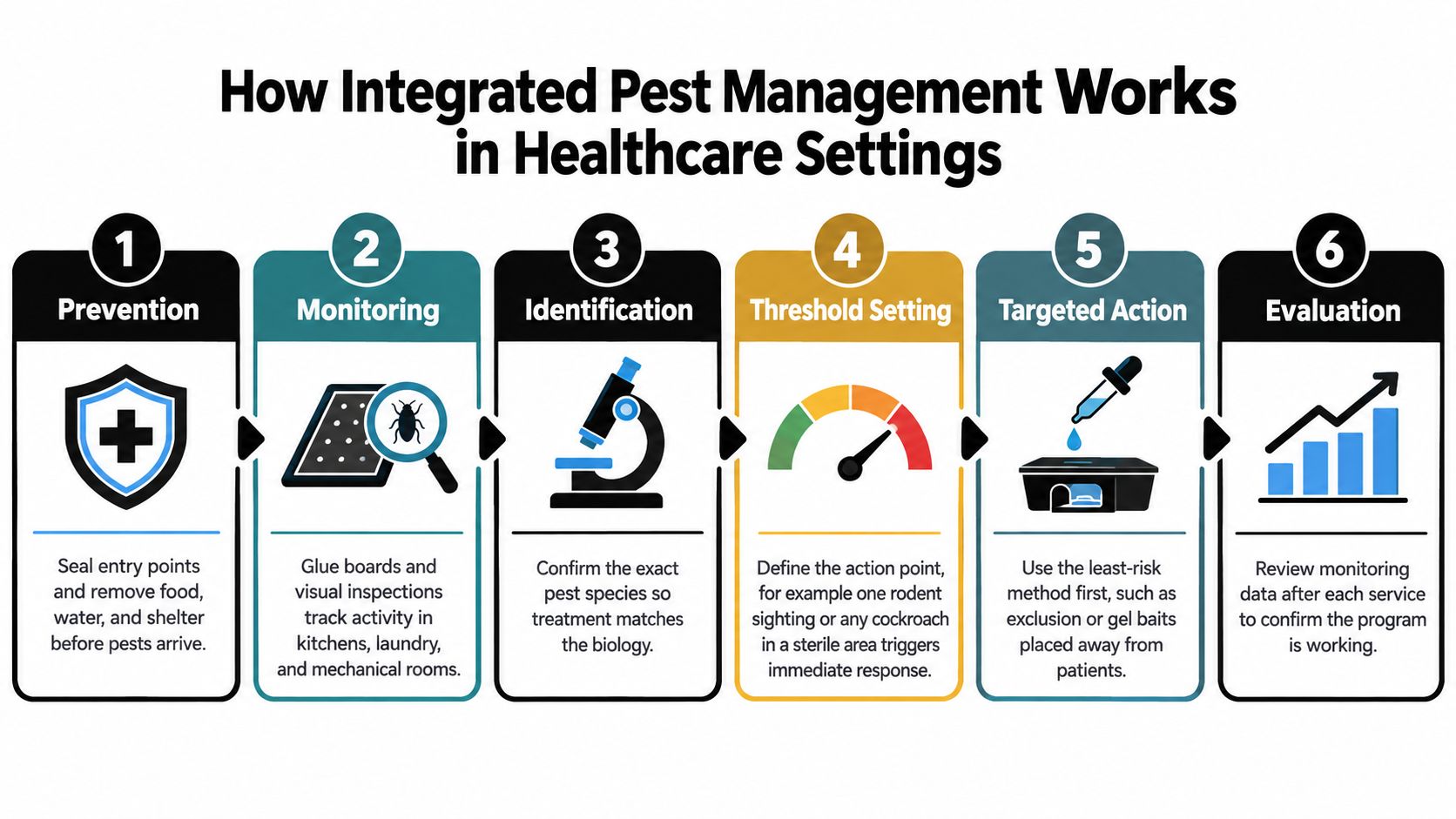
Six connected decisions
Prevention comes first. The facility removes food, water, and shelter while sealing gaps around doors, pipes, conduits, windows, and vents. A leaking pipe, unsealed loading-dock door, or uncovered food cart can create more pest pressure than a product can solve.
Monitoring turns sightings into information. Glue boards, visual inspections, and electronic devices can be placed on a defined map across kitchens, laundry rooms, waste areas, mechanical rooms, and other risk zones. The purpose isn't merely to count insects. Location, timing, species, and repeated activity reveal where building or workflow changes are needed.
Identification prevents the wrong response. A cockroach, drain fly, stored-product insect, and beetle may require different sanitation and exclusion decisions. Rodent evidence also needs species-level attention because entry routes and harborages can differ.
Threshold setting defines escalation. Patient-care areas generally require a more sensitive response than mechanical rooms. A single cockroach in a sterile or treatment zone may trigger immediate investigation, while a monitor finding in a remote service area may prompt intensified inspection and follow-up.
Targeted action uses the least-risk effective method. Exclusion, cleaning, drying, trapping, mechanical removal, tamper-resistant stations, gels, pastes, and crack-and-crevice applications can often address the source without broadcast spraying.
Evaluation closes the loop. The team reviews post-service findings, monitor results, open corrective actions, and recurring locations. If activity continues, the program changes the plan instead of repeating the same treatment.
A facility can document this cycle through an integrated pest management program that assigns responsibilities and connects service activity to prevention work.
For a visual explanation of how monitoring and targeted control fit together, the following video provides additional context.
The central benefit is predictability. Staff know what to report, managers know who responds, and infection prevention can see why a treatment was selected.
How Hospitals Actually Run Their Pest Programs Today
Hospital pest programs have adopted IPM broadly, but adoption doesn't guarantee consistent execution. Historical survey reporting cited by HFM Magazine found that 88% of hospitals used some form of IPM, while 60% used it throughout the entire hospital. The same reporting found that 94% employed outsourced pest-management services in some capacity, and 72% outsourced pest management entirely. These figures are documented in HFM's healthcare pest-control guidance.
The gap appears in written rules and evidence. Only 42% of hospitals had specific written protocols for when and where chemical pest-control products should be used, while another hospital report found that 64% had a written pest-management plan. Those results suggest that many facilities had a program or vendor, but fewer had fully defined chemical-use decisions and consistently defensible records.
| Practice Area | Reported Adoption | Guidance Expectation | Common Gap |
|---|---|---|---|
| Integrated pest management | 88% of hospitals used some form of IPM | A facility-wide, written, prevention-first program | IPM exists on paper but isn't applied consistently by department |
| Hospital-wide IPM | 60% used IPM throughout the entire hospital | Risk-based coverage across clinical and support areas | Remote zones, construction areas, and service corridors receive less attention |
| Outsourced service | 94% used outsourced services in some capacity | Credentialed specialists with defined responsibilities | The contract doesn't specify records, escalation, or corrective-action ownership |
| Fully outsourced service | 72% outsourced pest management entirely | Vendor work integrated with infection prevention and facilities | Internal staff can't explain the response process |
| Chemical-use protocols | 42% had specific written protocols | Site-specific rules for products, locations, and exposure controls | Product decisions depend on individual judgment |
| Written pest plan | 64% had a written plan | Current plan supported by logs and review | The plan isn't connected to trend data or governance meetings |
The figures describe historical practice, not a guarantee about any individual facility today. They also don't prove that larger teaching hospitals always perform better than smaller facilities. In practical terms, staffing can make audit preparation easier, but smaller sites often need the same core evidence, organized clearly and kept current.
Facilities comparing digital workflows may find it useful to compare healthcare EHS systems, especially when pest records need to connect with work orders, hazardous-materials files, and environment-of-care review.
Preventing Infestations Through Sanitation and Exclusion
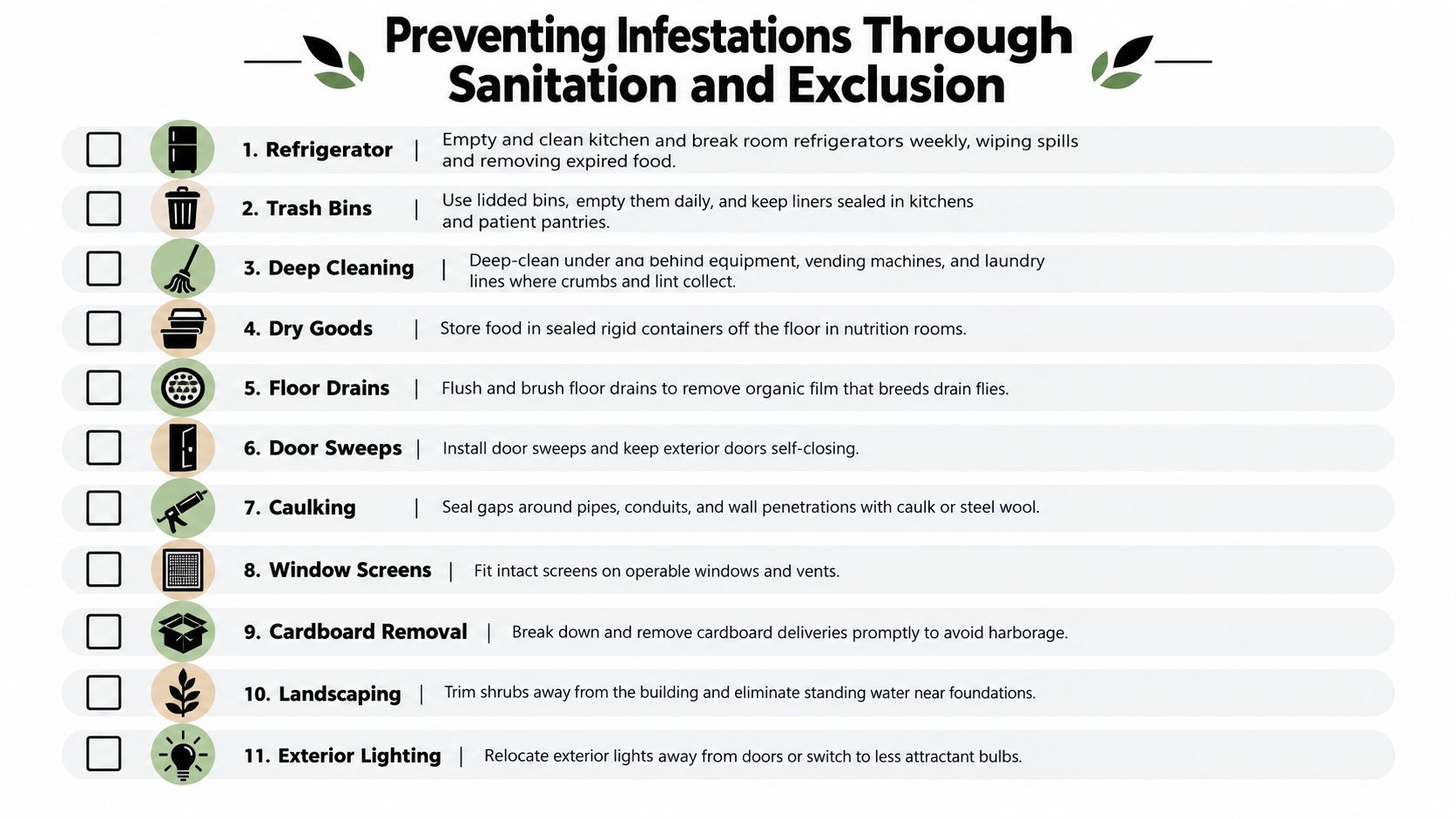
Treatment works better when the facility removes the conditions that attracted pests. Prevention starts with everyday operations, not with a spray schedule.
In kitchens and break rooms, food should leave work surfaces overnight, dry goods should stay in sealed containers, and spills should be cleaned under refrigerators, vending machines, and preparation equipment. Floor drains need routine cleaning because organic film can support drain-fly activity. Grease traps, mop sinks, dish areas, and waste staging zones deserve attention because moisture and food residue often overlap there.
Loading docks create a different exposure. Exterior doors should close fully, door seals should remain intact, and debris should be removed after deliveries. Staff can inspect incoming cartons and pallets for evidence of insects or rodents, then break down cardboard promptly rather than storing it beside food, linen, or medical supplies.
Patient and treatment areas require cleanable surfaces and controlled storage. Carts, IV poles, transport equipment, and furniture should be cleaned according to facility procedures. Linen should stay off floors, while baseboards, utility penetrations, and gaps behind wall-mounted equipment should be sealed so pests can't travel through concealed routes.
Match the repair to the pest
- Cockroaches: Reduce food residue, clean drains, seal pipe openings, and correct moisture.
- Rodents: Repair door sweeps, secure waste, close wall gaps with durable materials, and inspect loading areas.
- Flies: Remove organic buildup from drains, correct leaks, and protect food storage.
- Bed bugs: Use a defined inspection and containment process for mattresses, chairs, transport equipment, and personal belongings.
- Stored-product pests: Inspect deliveries, discard compromised goods, and improve dry-storage rotation.
The healthcare facility pest-management guidelines also highlight closed entry doors, screened windows, sealed utility openings, repaired leaks, sealed food and garbage containers, vegetation kept at least two feet from buildings, and fluorescent lights placed at least 100 feet from buildings when they must be used.
For a drain-related cockroach concern, facility teams can consult this practical resource on how to stop cockroaches coming up drains, then have maintenance verify drain covers, seals, and plumbing conditions.
Chemical Use Rules in Patient and Treatment Areas
Chemical treatment in a healthcare setting must account for where people are, what equipment is present, and how the product label controls use. U.S. defense medical guidance states that nonchemical controls, including sanitation, surveillance, and mechanical exclusion, should be the primary methods. It also says pesticide applications shouldn't occur while patients are in the immediate area.
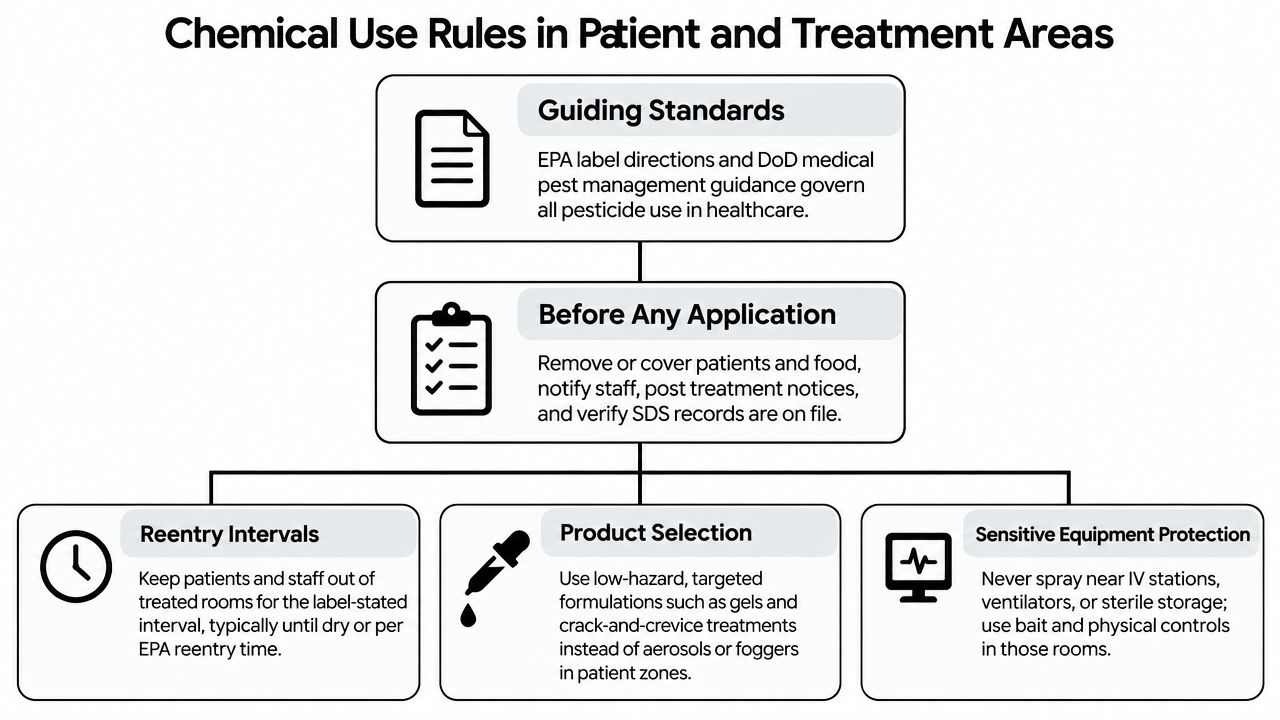
Before an application, the responsible team should identify the target pest, confirm that the product label permits use at that site, coordinate with clinical and facilities leaders, protect or remove patients and food, and communicate access restrictions. The EPA recommends limiting liquid sprays, foggers, and volatile formulations where possible, with preference for baits, gels, pastes, and crack-and-crevice treatments.
If equipment is infested, the medical guidance recommends removing patients from the room, using a nonresidual contact spray when treatment is unavoidable, and thoroughly cleaning equipment before reuse. The treated area must remain unavailable for the label-stated reentry interval, and staff should follow the product label rather than relying on an informal estimate.
Sensitive areas need a separate decision
Pharmacy cleanrooms, central sterile supply, food-preparation rooms, intensive-care spaces, neonatal units, and sterile compounding rooms need coordination before any product is selected. A technician shouldn't spray near IV stations, ventilators, sterile storage, medication preparation surfaces, or exposed supplies.
These restrictions aren't obstacles to effective pest control. They force the program toward exclusion, trapping, sanitation, monitoring, and precisely placed baits, methods that are easier to explain and audit than broad applications.
The EPA healthcare IPM toolkit supports this structure by requiring an official policy, assigned roles, inspection and monitoring, prevention, and documented communication. Product safety depends on the specific label and site, so every application record should preserve that decision trail.
Documentation and Evidence That Satisfy Surveyors
A service visit isn't complete when the technician leaves. It's complete when the facility can connect the visit to a finding, a response, a corrective action, and a follow-up review.
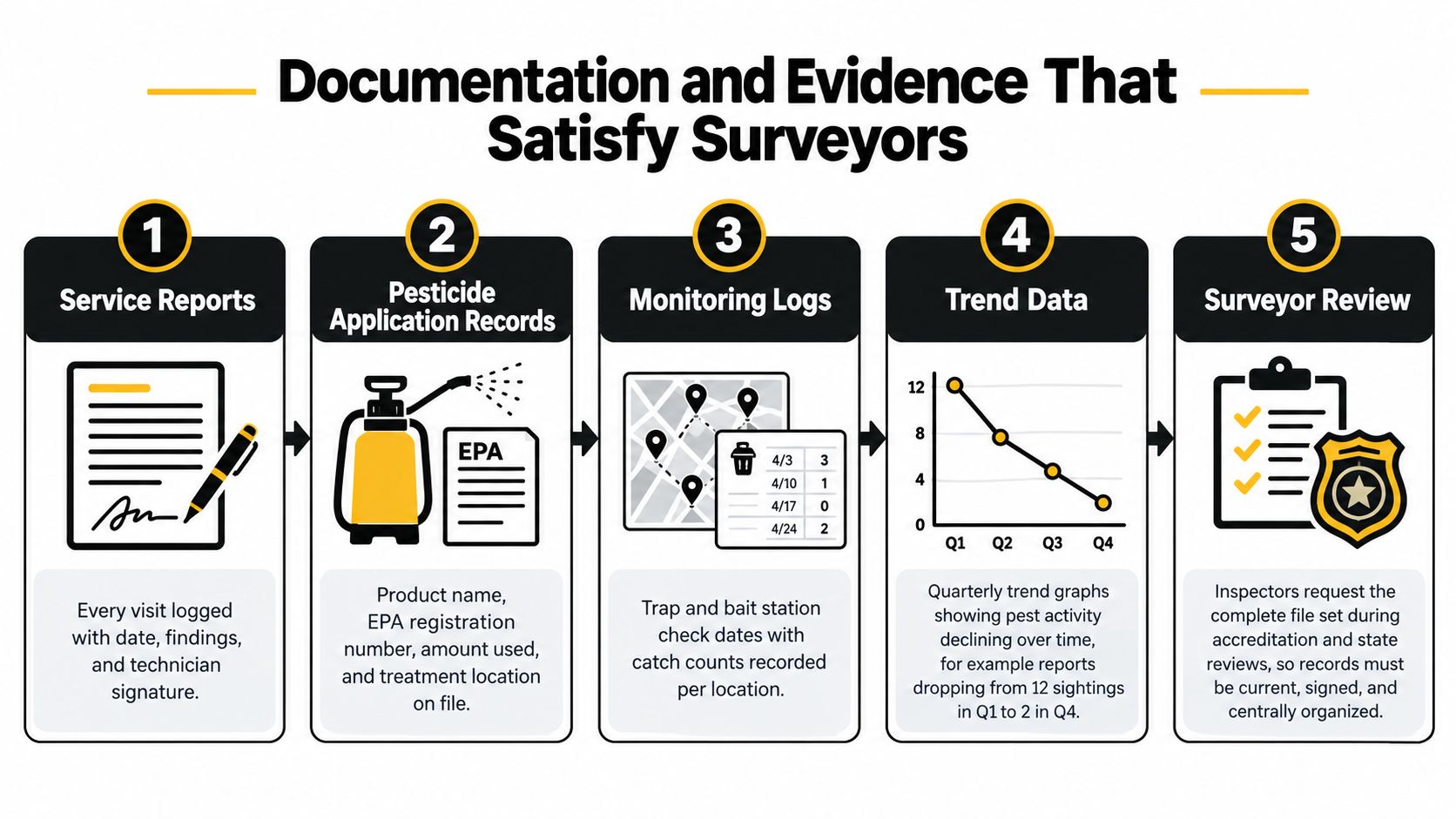
The core file should include signed service reports, pesticide application records, device maps, facility inspection logs, corrective-action tickets, and trend analysis. Application records should identify the product, EPA registration information, target pest, treatment location, amount used where required by the facility process, and reentry interval. Monitoring maps should show where traps, glue boards, and bait stations sit so staff can compare activity by location.
What a defensible record shows
Service reports establish what the technician saw and did. A vague entry such as “treated for insects” doesn't explain the pest, conditions, products, or next action.
Pesticide records show that the facility selected a product for the correct site and pest, followed label directions, and controlled reentry.
Monitoring logs reveal whether activity is isolated, recurring, or moving between departments. Catch counts matter, but the pattern matters more.
Corrective-action tickets connect pest findings to facilities work, such as sealing a wall penetration, repairing a leak, replacing a door sweep, or changing waste-handling practices.
Trend reviews show whether the program changes when evidence changes. A report that documents activity but never records evaluation leaves the most important question unanswered, namely whether the intervention worked.
The pest control monitoring service should fit into the facility's governance process rather than sit in a separate vendor folder. Environment-of-care committees, infection-prevention meetings, quality-assessment activities, or similar groups can review recurring locations, unresolved repairs, chemical-use decisions, and escalation events.
Surveyor-aligned guidance emphasizes that pest activity is often reviewed indirectly under general environmental safety standards rather than under one pest-specific rule. That makes accountability especially important. A facility should be able to identify the program owner, explain how staff report sightings, locate current records, and show that leadership reviews unresolved risk.
Choosing a Pest Management Partner for Your Facility
Selecting a healthcare pest vendor is more than a price comparison. It is a due-diligence exercise focused on whether the provider can operate inside clinical workflows and produce evidence your facility can defend.
Start with healthcare experience. Ask how many hospitals, clinics, or long-term care sites the company currently services, what types of clinical environments its technicians understand, and whether technicians hold relevant structural pest credentials or work with board-certified entomologists when identification requires deeper expertise.
Request sample documents before signing:
- Service reports: Do they identify findings, locations, products, recommendations, and follow-up actions?
- Monitoring maps: Can staff see every device and understand the checking schedule?
- Corrective-action records: Does the provider document building repairs and sanitation changes, or only applications?
- Trend reviews: Will someone explain recurring activity by department and recommend adjustments?
- Chemical records: Do the files preserve product details, site authorization, application information, and reentry requirements?
Product philosophy deserves direct questions. Ask which rodenticides and insecticides are in the facility formulary, where the company prefers bait, gel, trapping, exclusion, and crack-and-crevice work, and how it handles pharmacies, neonatal units, sterile compounding rooms, food preparation, and other sensitive locations.
You should also clarify operations:
- How does a staff member report an urgent sighting?
- Who decides whether a room closes temporarily?
- How does the provider coordinate with infection prevention and facilities?
- What response commitment applies to rodents, bed bugs, or activity in treatment areas?
- How are unresolved repairs escalated?
- Will the provider participate in mock surveys or compliance walkthroughs?
- How does a new vendor assume service without losing monitoring history or interrupting current controls?
- Are insurance, licensing, scope, records ownership, and termination terms clear?
The Green Advantage offers commercial pest inspections, targeted service plans, monitoring, and IPM-oriented support for businesses and facilities in Crown Point, IN and Northwest Indiana. Its family-owned team works with office staff and field technicians to coordinate scheduling, diagnose site conditions, and tailor environmentally mindful pest-management services.
If your healthcare facility needs a clearer response process and better survey-ready records, visit The Green Advantage to discuss commercial pest control, inspections, monitoring, and a site-specific prevention plan in Crown Point, IN and nearby Northwest Indiana communities. Request a consultation so your team can address pest activity with documented decisions, coordinated service, and practical exclusion work.