
Expert Commercial Pest Control for Crown Point
A customer points toward a baseboard. A warehouse employee finds gnaw marks near packaged goods. A restaurant manager notices movement behind the prep line right before lunch. In Crown Point, those moments don't just create stress. They put your reputation, inspection readiness, and daily operations on the line.
That's why commercial pest control has to be treated as part of normal business protection, not as an occasional emergency expense. In Northwest Indiana, businesses deal with seasonal pest pressure, shifting weather, older buildings, heavy traffic patterns, and the constant challenge of keeping doors, loading areas, kitchens, and common spaces clean and secure. The right plan addresses those realities before they become visible problems.
Businesses that wait until pests are obvious usually pay more in disruption than they would have paid in prevention. A proactive program protects inventory, supports compliance, reduces repeat issues, and helps your staff stay focused on work instead of reacting to complaints. For local owners searching for pest control near me, exterminator near me, or pest control in Crown Point, IN, the key question isn't whether pest management matters. It's whether the plan in place is built for a commercial property that has real operational demands.
Protecting Your Crown Point Business from Pest-Related Risks
A common call starts with urgency. A business owner has seen one mouse, one cockroach, one cluster of ants, or one suspicious stain near a dock door. The concern isn't just the pest itself. It's what that sighting means if an employee notices it, if a tenant reports it, or if a customer posts about it online before management can respond.
In Crown Point and nearby Northwest Indiana communities, that pressure hits restaurants, offices, warehouses, multifamily properties, and retail spaces differently, but the emotional reaction is usually the same. Panic first. Questions second. Is this a one-time issue, or has something been building behind the scenes for weeks?
Small building gaps become expensive problems
Many commercial infestations start with a simple access point. A damaged sweep under a service door, a gap around utility lines, torn screening, or worn seals along an overhead door can give pests routine access to a building. For facilities with loading zones or storage space, even a well-run operation can stay vulnerable if the envelope of the building isn't tight.
For that reason, property managers often review basics like sanitation and waste handling alongside physical exclusion upgrades such as industrial side seals for garage doors when dock areas or overhead openings are part of the problem. That kind of hardware doesn't solve every pest issue by itself, but it often removes one of the most predictable entry routes.
Practical rule: If pests keep returning after treatment, look at access points and conditions inside the building before assuming the product failed.
Fast action matters, but calm process matters more
The worst response is usually a rushed spray-and-hope approach. It may make a business owner feel like something happened, but it often leaves the underlying causes untouched. A better commercial response starts with inspection, identification, and a clear plan for what's attracting pests, how they're entering, and which areas need attention first.
That's what separates a temporary reaction from real risk management. A business doesn't need drama. It needs a process that restores control and keeps the problem from resurfacing during the next delivery, tenant turnover, or inspection cycle.
Why Professional Pest Management is a Business Essential
A pest issue isn't only a cleanliness problem. It's an operations problem. Once pests show up in a commercial setting, they can affect inventory, staff morale, maintenance budgets, and customer trust all at once.
The market reflects that reality. The commercial segment of the U.S. pest control industry posted a nearly 7.0% increase in service revenue in 2025, outpacing the overall industry's growth, which points to stronger demand for professional commercial service driven by health regulations, hygiene standards, and the financial pressure infestations create, according to Fortune Business Insights.

The hidden costs are usually bigger than the treatment cost
Business owners often focus on the immediate invoice for service. The larger expense usually sits elsewhere.
- Inventory loss: Rodents, stored product pests, and contamination issues can force businesses to discard affected goods.
- Operational interruption: A single visible pest sighting can disrupt dining rooms, leasing activity, receiving schedules, or production workflows.
- Facility damage: Rodents chew packaging, insulation, and wiring. Moisture-loving pests often point to leaks or neglected maintenance.
- Staff distraction: Employees lose time documenting sightings, moving product, fielding complaints, and working around problem areas.
These costs build quickly because they touch multiple departments at once.
Reputation damage happens faster than most owners expect
A business can recover from many routine problems without drawing public attention. Pest sightings rarely stay quiet. In food service, hospitality, and multifamily settings, people talk. They leave reviews. They mention conditions to inspectors, tenants, or corporate supervisors. Once that happens, the issue is no longer only about pest elimination. It becomes a brand repair problem.
A commercial pest program is often less about killing pests and more about preventing visible moments that customers never forget.
That's especially true in Crown Point, where local businesses rely on repeat customers, referrals, and community trust. One bad impression can undercut months of careful service and marketing.
Compliance risk makes reactive pest control a poor strategy
Some owners still treat pest control as something to call for only when there's evidence. That approach usually means the facility is already behind. By the time pests are visible, there may already be sanitation issues, structural gaps, or documentation problems that an inspector or auditor can flag.
Professional commercial pest control works better as a standing operating practice. It protects your bottom line in the same way preventive maintenance protects HVAC systems or refrigeration units. You don't wait for a total breakdown if the cost of failure is high.
Pest Solutions Tailored to Your Industry
A restaurant and a warehouse don't need the same pest plan. Neither does a multifamily property, office building, or hospitality site. The environment decides the pressure points. Food residue, moisture, deliveries, clutter, tenant behavior, loading access, and after-hours traffic all change what works.
What different properties in Northwest Indiana tend to face
Food service properties deal with the most immediate visibility risk. A fly issue in a dining area, roach activity in a kitchen, or rodent signs near dry storage can quickly turn into a compliance problem. Businesses that need more kitchen-specific guidance can review commercial kitchen pest control as part of a broader prevention plan.
Warehouses and light industrial spaces usually struggle with perimeter vulnerability, pallet storage, dock activity, and long periods where pest activity goes unnoticed in less-trafficked zones. Multifamily properties add a different challenge. Shared walls, turnover between units, trash handling, and inconsistent housekeeping can spread issues beyond one tenant space.
Industry-Specific Pest Risks and Solutions in Northwest Indiana
| Industry | Common Pests | Key Risks | Recommended IPM Strategy |
|---|---|---|---|
| Restaurants and commercial kitchens | Cockroaches, flies, rodents, ants | Health code concerns, food contamination, customer complaints | Frequent inspections, drain and sanitation review, exclusion around doors and utility lines, targeted monitoring in prep and storage areas |
| Warehouses and industrial facilities | Rodents, ants, occasional invaders, stored product pests | Inventory damage, unnoticed activity in low-traffic zones, dock door entry | Perimeter inspection, dock and door sealing, monitoring along walls and storage zones, clutter reduction |
| Multifamily housing | Rodents, cockroaches, ants, bed bugs, occasional invaders | Tenant complaints, spread between units, reputational harm | Unit-by-unit inspection where needed, sanitation coordination, exclusion, common-area monitoring, resident communication |
| Offices and retail spaces | Ants, spiders, rodents, flies | Employee concern, customer-facing sightings, breakroom activity | Breakroom sanitation checks, entry-point sealing, discreet monitoring, focused treatment in problem areas |
| Hospitality properties | Bed bugs, flies, cockroaches, rodents | Guest complaints, room downtime, online review damage | Room inspections, laundry and housekeeping coordination, targeted treatment, rapid reporting protocols |
A generic spray plan usually misses the real cause
The wrong commercial approach looks the same in every building. Same visit pattern, same materials, same assumptions. That usually leads to repeat complaints because the service isn't tied to how the property functions.
A better plan accounts for questions like these:
- Where does product enter the building? Receiving areas often create the first opportunity for pest introduction.
- Where do people eat or store food? Breakrooms, trash rooms, and tenant kitchens matter.
- Which zones are quiet and overlooked? Storage corners, utility rooms, and ceiling voids can become steady harborage areas.
- What happens after hours? Cleaning quality and overnight moisture conditions often determine whether pests settle in.
Different industries don't just have different pests. They create different habits, hiding places, and vulnerabilities.
That's why commercial pest control should be customized to the building's use, not copied from a generic route sheet.
The Green Advantage IPM and Eco-Friendly Approach
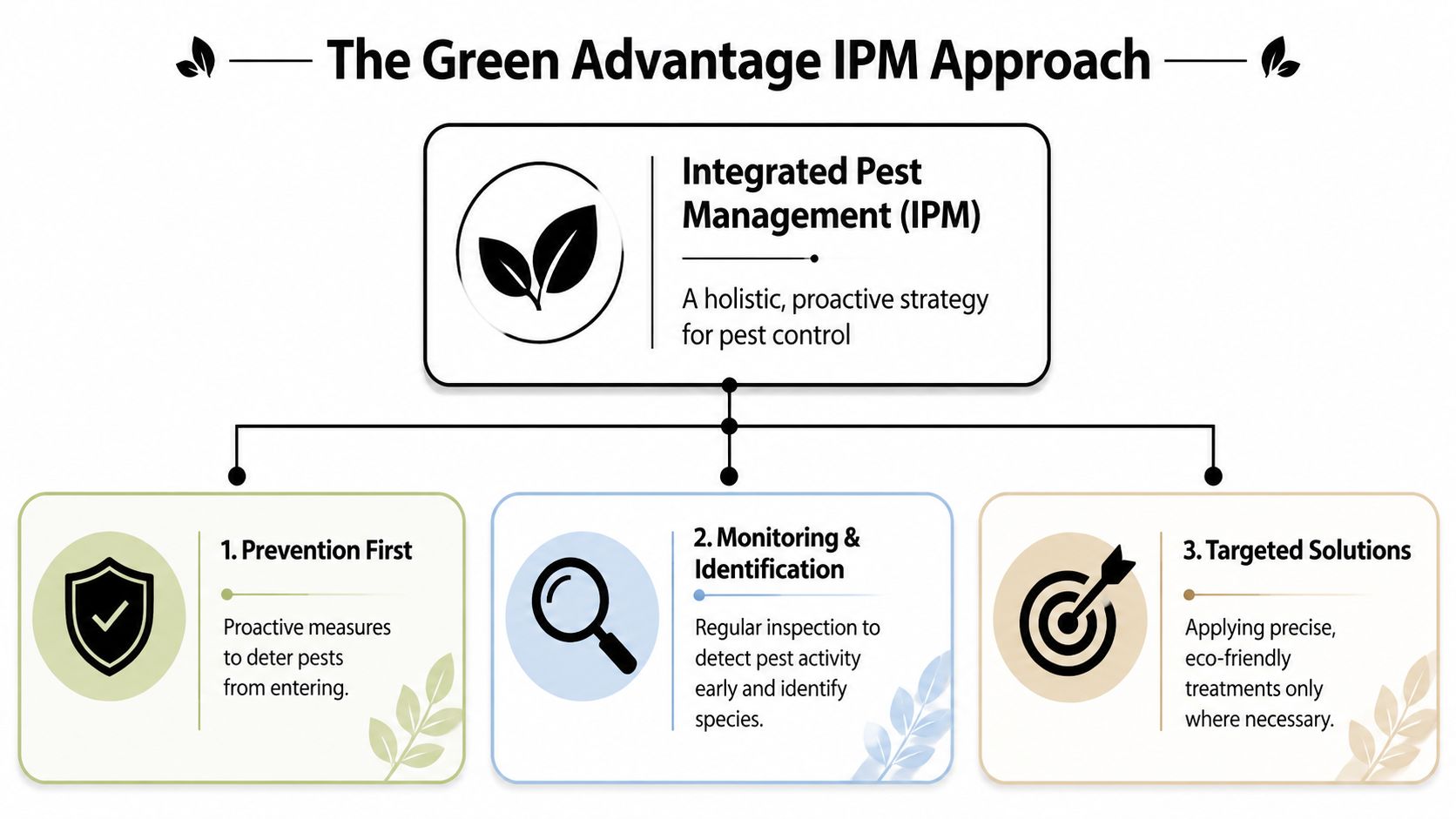
The strongest commercial programs don't start with broad chemical use. They start with Integrated Pest Management, or IPM. That means looking at why pests are present, how they're getting in, what supports them once they're inside, and where a precise response will work better than blanket treatment.
IPM programs prioritize non-chemical methods and can achieve up to a 70 to 90% reduction in pesticide applications while maintaining efficacy, and exclusion work such as sealing entry points with appropriate screening can reduce rodent ingress by 85 to 95%, according to the Department of Defense technical guidance on IPM.
Prevention beats repeated treatment
If ants keep appearing in a breakroom, the answer may involve food residue under cabinets, a moisture source, and an exterior gap near the wall line. If rodents keep showing up in a warehouse, the answer may be dock door light gaps, damaged sweeps, and poorly managed storage along the perimeter.
That's why IPM focuses on a few practical priorities:
- Exclusion: Sealing entry points, improving door sweeps, screening vents, and correcting structural gaps.
- Monitoring: Using traps, stations, and inspection patterns to detect activity before it becomes obvious to staff or customers.
- Sanitation and habitat correction: Reducing food, water, and harborage conditions that let pests settle in.
- Targeted treatment: Applying the least disruptive control where it's needed, instead of treating whole areas blindly.
Why eco-friendly doesn't mean weak
Some owners hear “green” and assume the service will be less effective. In commercial pest control, that's usually the wrong way to think about it. A lower-impact program can be more effective because it's tied to behavior, structure, and site conditions rather than overreliance on repeated spray applications.
For food-related operations, it also aligns better with day-to-day realities. Staff still need to work. Customers still need to feel comfortable. Sensitive areas still need to stay clean and well managed. A prevention-first system supports those needs better than heavy-handed treatment.
For businesses that want a plain-language overview of an integrated pest management approach for caterers, that framework mirrors what many commercial sites need. The details change by property, but the logic stays consistent.
What that looks like on a local route
In practice, a provider may inspect door thresholds, utility penetrations, floor drains, breakrooms, trash handling zones, and exterior transitions before deciding where any product belongs. The Green Advantage's integrated pest management service is one example of that model, using inspection, exclusion, monitoring, and targeted treatment as the basis for ongoing commercial service in Northwest Indiana.
Good IPM doesn't ask, “What can we spray?” It asks, “What's allowing this pest to survive here?”
That difference matters because commercial accounts need durable control, cleaner documentation, and fewer repeat surprises.
Navigating Health Codes and Regulatory Compliance
For many businesses, the pest itself is only half the problem. The other half is what you can prove. If an inspector, auditor, property owner, or corporate manager asks for pest control records, your answer needs to be organized and current.
Commercial pest control requires meticulous logging of pesticide applications, including EPA registration numbers and treatment locations, for compliance with standards such as the FDA Food Code. Non-compliance can risk fines up to $10,000 per violation, which is why audit-ready documentation matters, as explained in this guide to commercial property pest control compliance.
Documentation is part of the service, not extra paperwork
A commercial account should have records that make sense to an inspector and to your own team. If a sighting occurs, someone should be able to review what was found, where activity was noted, what was applied if anything was applied, and what corrective actions were recommended.
That usually includes:
- Service reports: What was inspected, what was found, and what was done.
- Application details: Product information, placement, and treatment locations where applicable.
- Site observations: Entry points, sanitation concerns, moisture issues, and structural recommendations.
- Trend tracking: Recurring activity in the same area tells you more than a single isolated sighting.
Restaurants, warehouses, and multifamily properties all need clear records
Food service operations often need documentation that supports inspection readiness. Warehouses may need logs that show perimeter management and corrective action around receiving zones. Multifamily properties benefit from clean records because complaints can involve units, common areas, and questions about who reported what and when.
A professional commercial pest program should help a manager answer practical questions quickly:
- Where was activity found?
- Was it isolated or recurring?
- What correction was recommended?
- Has the issue improved or spread?
Compliance works better when everyone knows their role
Pest control can't carry a commercial property alone. Staff training, maintenance response, cleaning routines, and reporting habits all affect results. The most reliable accounts usually have one point person who can share sighting information, approve access, and make sure facility corrections happen when they're needed.
If your records are incomplete, your pest control program is incomplete.
That's especially important in businesses where one inspection, tenant complaint, or food safety review can create immediate consequences.
Your Commercial Service Plan with The Green Advantage
Most business owners want the same thing from a pest control provider. They want a clear answer, a sensible plan, and no surprises. The process should feel organized from the first call forward.

The first visit sets the direction
A commercial service plan usually begins with a full inspection. That includes the obvious problem areas, but it also includes the places owners and staff may not look often enough. Exterior entry points, trash staging, utility access, storage practices, moisture sources, and employee food areas all matter.
From there, the plan should answer a few basic questions in plain language:
- What pest pressure is present right now?
- What conditions are encouraging it?
- Which corrections belong to the property, and which belong to the service provider?
- How often should the site be inspected and monitored?
A credible plan won't treat every building the same. A small office suite needs a different schedule and treatment footprint than a restaurant, warehouse, or multifamily complex.
Ongoing service should be easy to understand
After the initial work, the ongoing relationship matters more than the first treatment. Commercial clients should know what happens on routine visits, what gets documented, and how urgent issues are handled between scheduled services.
That often includes regular monitoring, targeted treatment where needed, and practical recommendations for sanitation or exclusion changes. It should also include communication that respects how the business operates. Service timing, tenant access, shift schedules, and customer-facing hours all shape what's realistic.
This short video gives useful context on maintaining results after professional treatment:
Cost depends on the property, not a canned package
Business owners often ask what drives cost. The honest answer is that pricing depends on the site. Facility size matters. So do pest history, building condition, service frequency, sanitation demands, and how complex access is.
A low-pressure office with a minor ant issue won't require the same level of work as a busy commercial kitchen, a shipping facility with multiple dock doors, or a multifamily property with recurring tenant complaints. The right service plan should explain that clearly instead of hiding behind vague package language.
The most cost-effective commercial program is usually the one that catches issues early and avoids disruption.
For businesses searching for exterminator in Crown Point, IN or commercial pest control that fits local conditions, transparency matters as much as treatment itself. You should know what's being done, why it's being done, and what role your team plays in keeping the site stable.
Choosing the Right Pest Control Partner in Crown Point
If you're comparing providers, focus on how they think. Any company can promise to treat pests. The better question is whether they understand commercial properties in Crown Point and the surrounding Northwest Indiana area well enough to prevent repeat problems.
What to look for before you sign
A strong commercial provider should offer:
- Local awareness: They should understand the seasonal patterns, building types, and common pressure points seen in this area.
- Licensing and professionalism: Commercial work requires proper handling, clear communication, and reliable documentation.
- An IPM mindset: Prevention, monitoring, exclusion, and targeted response should come before unnecessary product use.
- Operational fit: The service should work around your business hours, staff movement, and customer-facing needs.
A provider who skips inspection details, gives the same plan to every property, or talks only about spraying usually won't solve the root issue.
The right partner helps you run the business better
Commercial pest control should support your business, not add confusion to it. You want someone who can identify pressure points, explain the trade-offs, keep records straight, and help your staff know what to watch for. That matters whether you manage a restaurant, warehouse, office, retail space, or multifamily property.
For businesses looking for pest control in Crown Point, IN, the best choice is usually the company that treats pest management as part of facility protection, compliance readiness, and long-term cost control. That's the difference between a recurring nuisance and a stable property.
If your business needs commercial pest control in Crown Point or nearby Northwest Indiana, contact The Green Advantage to schedule an inspection or request a quote. A proactive plan can protect your reputation, support compliance, and keep pest problems from interrupting your operation.