
When Are Mosquitoes Most Active: Peak Hours by Species
Many common mosquitoes are most active at dawn and dusk, while Culex mosquitoes are active from dusk through dawn with a late-evening peak around 10 to 11 p.m. The exact window depends on species, so the mosquito biting you at lunch in the shade may not follow the same schedule as the one at your patio after dark.
Why do you still get bitten at midday if you've been told to avoid sunset? That gap is where most yard plans fail in Crown Point, IN. When repellent and a citronella candle aren't enough and you need pest control near me, start by matching your bites to a species window, then check shade, lighting and standing water. The Green Advantage helps Northwest Indiana homeowners do that with residential pest control and mosquito control built around how a property is used.
Peak Mosquito Hours by Species at a Glance
Many common mosquitoes peak at dawn and dusk, but there's no single hour that fits every species on your property. The CDC guidance on mosquitoes, ticks and other arthropods identifies Aedes aegypti and Aedes albopictus as crepuscular biters with primary peaks around dawn and dusk, while Culex quinquefasciatus commonly shows a pronounced late-evening peak around 10 to 11 p.m.
A 2025 report from the International Conference on Aedes-borne Diseases states that Aedes mosquitoes showed two peak biting periods, 5 to 9 a.m. and 4 to 7 p.m. Those are the daytime container breeders. They develop in small water holders near homes and can keep biting in shade between peaks.
| Mosquito group | Typical peak window | Activity pattern | Most exposed residents |
|---|---|---|---|
| Aedes (daytime container breeders) | 5 to 9 a.m. and 4 to 7 p.m. | Two peaks at dawn and dusk, can bite in shade during the day | Yard users at both ends of the day |
| Culex (house and northern house mosquitoes) | Around 10 to 11 p.m. | Dusk through dawn, resting in cool shaded vegetation | Porch and patio users, and sleepers with open windows |
| Anopheles | Dusk to 11 p.m., or 1 to 3 a.m. depending on species | Night-active or crepuscular, varying by species | Campers and late-night outdoor users |
| Mixed or unidentified bites | Late afternoon through early morning | Confirm species before choosing a window | Any property with repeated bites |
How to Read Your Own Bites
Culex pressure builds after sunset and continues overnight, so a quiet afternoon doesn't mean the yard is clear. Anopheles timing splits by species, which is why one property feels worst before bedtime and another feels worst well after midnight.
Simple check: Write down when bites happen for a few days, then match that time to the closest row before you change your schedule or buy a treatment.
If bites land in several rows, plan for a mixed population. That means coverage from late afternoon through early morning, plus shaded resting sites during the day, not just a spray timed for sunset. For pest control in Crown Point, IN, that distinction decides whether treatment focuses on containers, vegetation, drainage water, or all three.
How to Tell Which Mosquito Is Biting Your Family
A bite welt alone rarely names the species. Gather clues first, then use our guide to local mosquito species to compare what you found.
- Note the time for three days. Daytime and early morning biting points toward Aedes. Late-evening biting points toward Culex.
- Note where you were. Record whether you were on an open sunny lawn, along the shrub line, under a deck, or near a porch light after dark.
- Photograph an adult if you can. Aedes are small and dark with bold white bands on their legs. Culex are plain brownish with no leg banding. Anopheles rest with the rear end angled up and have spotted wings.
- Match time, place and appearance to the closest row in the species table.
- Treat a mismatch as information. A mixed or unclear pattern means you should plan protection for the whole day, not one window.
If the pattern stays unclear, a technician can set a carbon dioxide trap at dusk and collect it after dawn. That overnight catch identifies what's active while you're asleep, which daytime sightings miss.
Why Mosquito Peaks Shift With Shade, Light and Weather
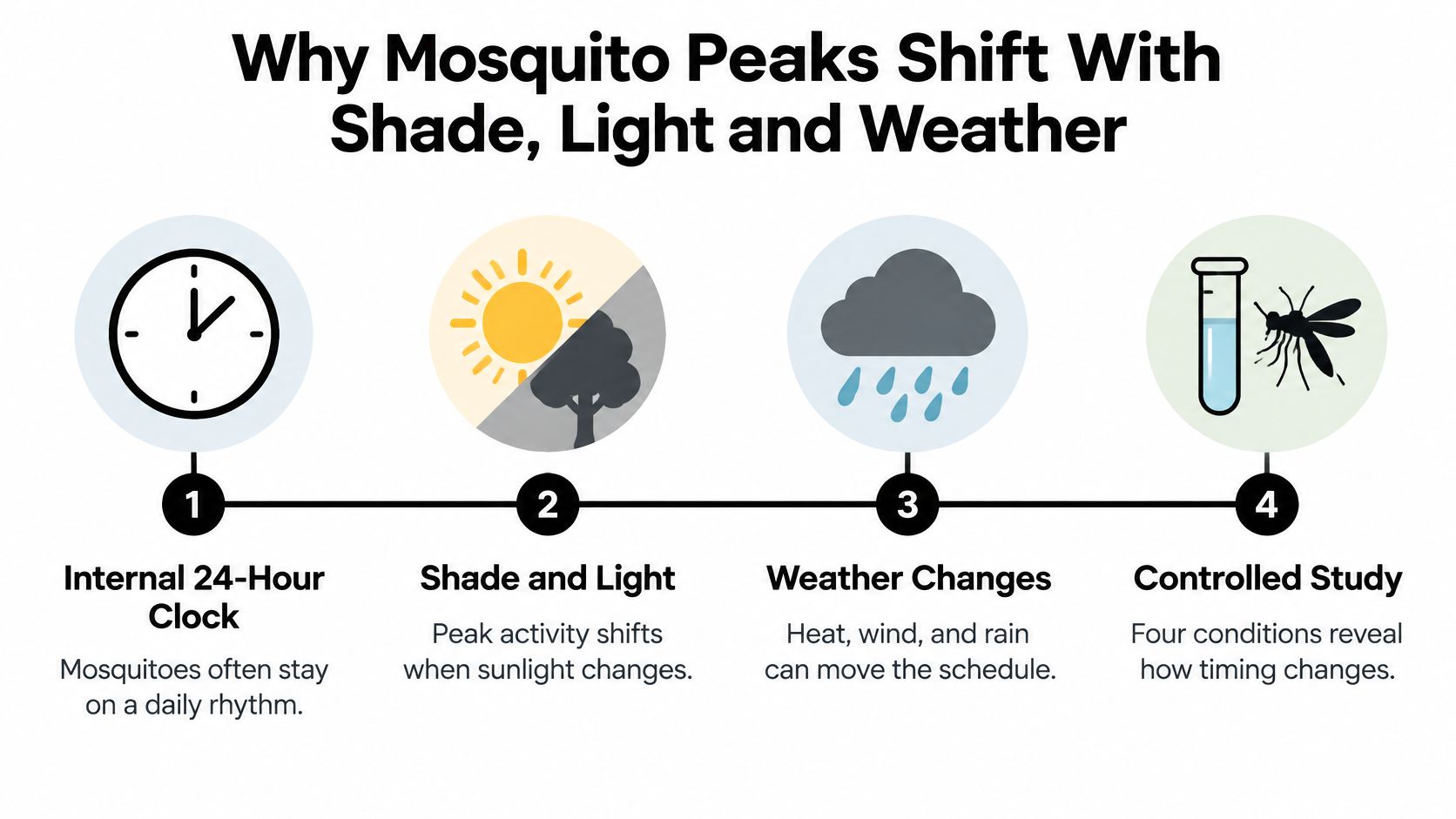
Think of a mosquito as a commuter with a fixed route. It leaves at roughly the same hours each day, unless weather, shade or light changes the conditions enough to move the trip.
That internal schedule is a 24-hour circadian rhythm. In a controlled study of four Aedes albopictus strains, the PLOS ONE study of Aedes albopictus biting activity recorded two clear daily biting peaks, approximately 06:30 to 09:30 in the morning and 18:30 to 20:30 in the evening. Lower light and cooler air at twilight make flight easier and help mosquitoes follow carbon dioxide and body heat to a host.
Why Midday Isn't Always Safe
Dawn and dusk move with the seasons, so the clock time shifts even when the pattern holds. Shade creates twilight conditions early. A sunny Crown Point lawn can feel quiet at noon while the hedge beside it stays cool, humid and busy.
The NIOSH West Nile virus update reports that some mosquitoes are also active during the day, particularly in weedy, brushy, wooded, or shaded settings. Dense shrubs, tall grass, irrigated beds, drainage areas and spaces under decks give adults a resting place close to where people sit.
- Still, humid evenings: Calm air lets weak fliers reach you and land.
- Windy, dry afternoons: Open areas feel better, but sheltered corners may not.
- Thick vegetation: Shade and moisture protect adults between feeding periods.
How Lighting Extends the Evening
Porch and patio lights can extend biting for day-active Aedes after dusk, while night-active species are already programmed for darkness. A lit patio next to a thick hedge combines host cues, shelter and low airflow in one spot, which explains bites long after sunset beside an otherwise comfortable yard.
Don't judge the whole property by the sunniest patch of grass. Check the hedge, the fence corner and the shaded side of the house.
That's the trade-off with simple clock advice. Avoiding sunset helps with one group, but it won't solve daytime shade biting or late-night activity. Check the whole property, not just the hour.
When Mosquito Activity Peaks Through the Northwest Indiana Year
Season matters as much as time of day. Warmth, rainfall and standing water drive the rise and fall, so a wet year in Northwest Indiana won't match a dry one.
In early spring, check before warm weather settles in. Clear clogged gutters, empty containers and fix low spots that hold water, because those become breeding sites once temperatures climb.
Summer Through Early Fall
During warmer months, bites often increase after warm, wet stretches that leave water pooled in yards and drainage areas. Mid-summer heat and humidity keep shaded resting sites active through the day, so tall grass and dense shrubs remain risky even when open lawn feels quiet.
Late summer and early fall bring a gradual taper as nights cool. Warm evenings can still produce biting, especially near sheltered vegetation. The dawn and dusk windows also move earlier as daylight shortens, so a dinner that felt safe in June may land in peak activity later in the season.
I recommend a property check before peak season and again in late summer. You'll catch new water holders, overgrowth and drainage changes that a spring-only check misses.
Timing Outdoor Activities Around Mosquito Peaks
For most families, the lowest-risk window for yard work is midday in open sun with a breeze. Use that window for the jobs and play sessions you can't move indoors, and treat shade as higher risk at any hour.
| Activity | Lower-risk window | Higher-risk window | Practical tip |
|---|---|---|---|
| Breakfast or coffee outside | After 9 to 10 a.m. in open sun | 5 to 9 a.m. | Sit away from shrubs and close to a fan |
| Yard or garden work | Midday in full sun | Early morning and 4 to 7 p.m. | Wear long sleeves and repellent during peak hours |
| Kids playing outside | Before 4 p.m. | 4 to 7 p.m. and dusk | Move play to open lawn away from hedges |
| Dinner or grilling | Early evening in a screened, fan-cooled space | Dusk through 10 p.m. | Use fans and screened spaces |
| Night gatherings or camping | Finish by 10 p.m. | Late evening to 3 a.m. | Keep lights low and use screened areas |
Breakfast outside gets easier after the morning Aedes peak fades, provided you're not sitting against a hedge. Garden work at midday avoids both Aedes peaks, but brushy beds still call for sleeves and repellent because you're entering resting habitat.
Kids playing after school run into the late afternoon rise. Moving play to open lawn helps more than moving it by thirty minutes, since distance from shrubs reduces contact with resting adults.
Habits That Lower Every Window
- Trim shrubs near seating: Less dense cover means fewer cool resting spots beside chairs and play areas.
- Empty containers weekly: Saucers, toys, buckets and tarps shouldn't hold water long enough for development.
- Keep screens closed and repaired: Porch screens only work if doors latch and mesh has no gaps.
- Run an outdoor fan: Moving air makes landing harder around a small seating area.
Schedule important outdoor work for midday or early afternoon when you can. Keep evening use to covered, fan-cooled spaces, and don't rely on a fan to fix breeding water elsewhere in the yard. It improves comfort where you sit. It doesn't reduce the population producing new adults.
How Professional Mosquito Control Times Treatment
Professional mosquito control starts with a survey, not a sprayer. A technician looks for breeding water and resting shade first, because treating open lawn while missing a clogged gutter wastes your money.
Look at the kinds of hidden water an inspection targets before any product is applied.
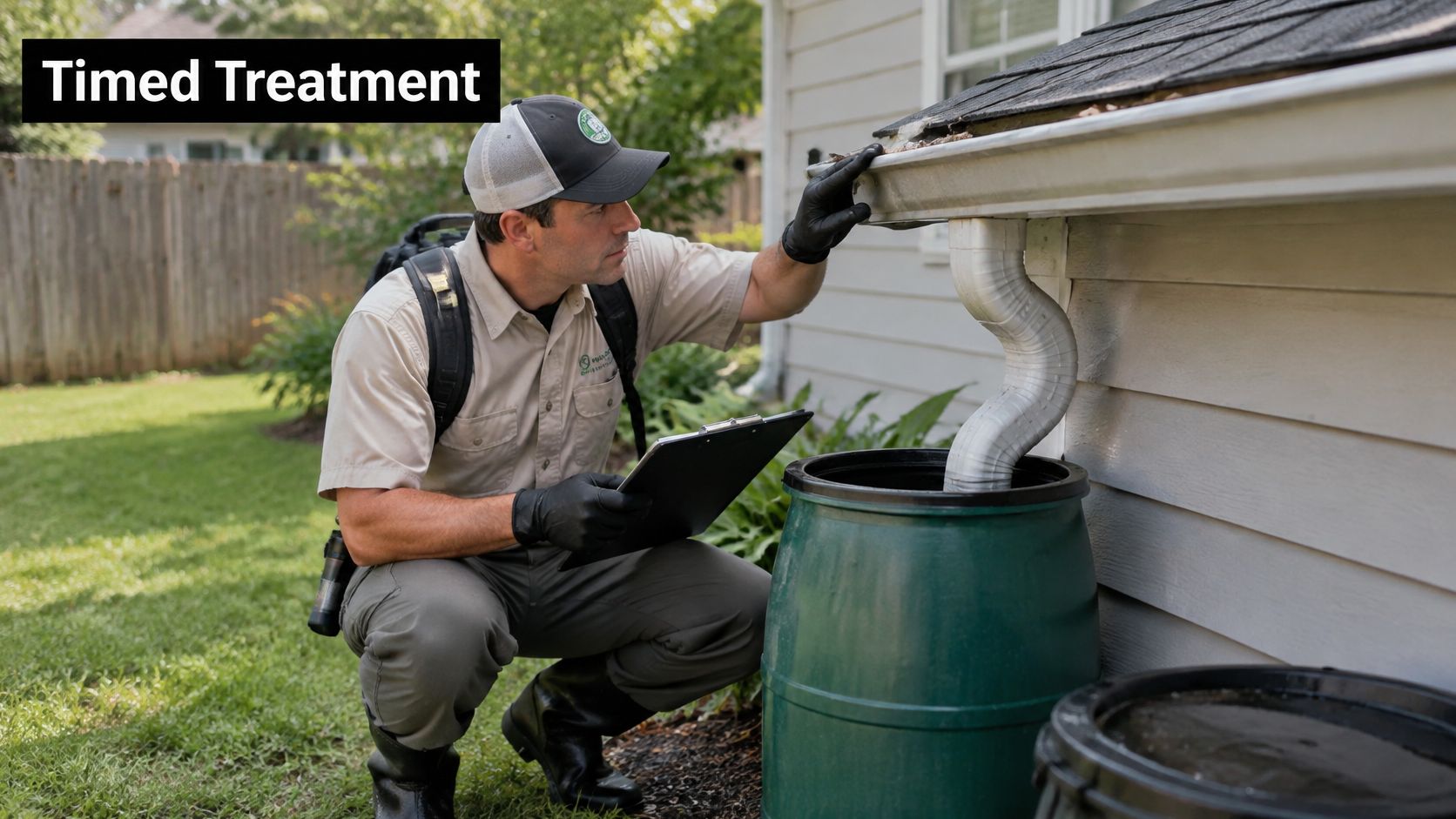
Breeding sites include standing water in containers, gutters, low areas and drainage features. Resting sites include dense shrubs, tall grass, ground cover and sheltered areas under decks. The survey also notes when your family uses the yard, since a breakfast patio and a late-night fire pit face different species windows.
Matching Treatment to the Species Window
Outdoor treatments target places adults rest during the day and routes they use toward seating areas at dusk. Larval control addresses suitable water before adults emerge. A sunset-only approach can miss daytime Aedes resting in vegetation, so a sound plan covers breeding, resting and active periods together.
Our breakdown of the best time to spray for mosquitoes explains how application timing fits those windows. Weather, wind and the property layout still shape the final schedule on the day of service.
Watch how a technician connects inspection findings to treatment placement in the video below.
- Survey the property for breeding water, resting shade and outdoor use areas.
- Match treatment to the likely species mix and the hours your family is outside.
- Schedule follow-up to check results and adjust as vegetation, rainfall and daylight change.
The Green Advantage adjusts Crown Point plans as the season shifts from spring to fall. That matters for commercial pest control too, where planted entrances and outdoor seating need site-specific timing, not a generic evening visit.
What to Expect From a Crown Point Mosquito Inspection
Start by telling us when bites happen. That one detail saves time and points the technician toward the right species window before the yard walk begins. For general pest control issues, we typically schedule service the same day or the next business day, depending on your convenience.
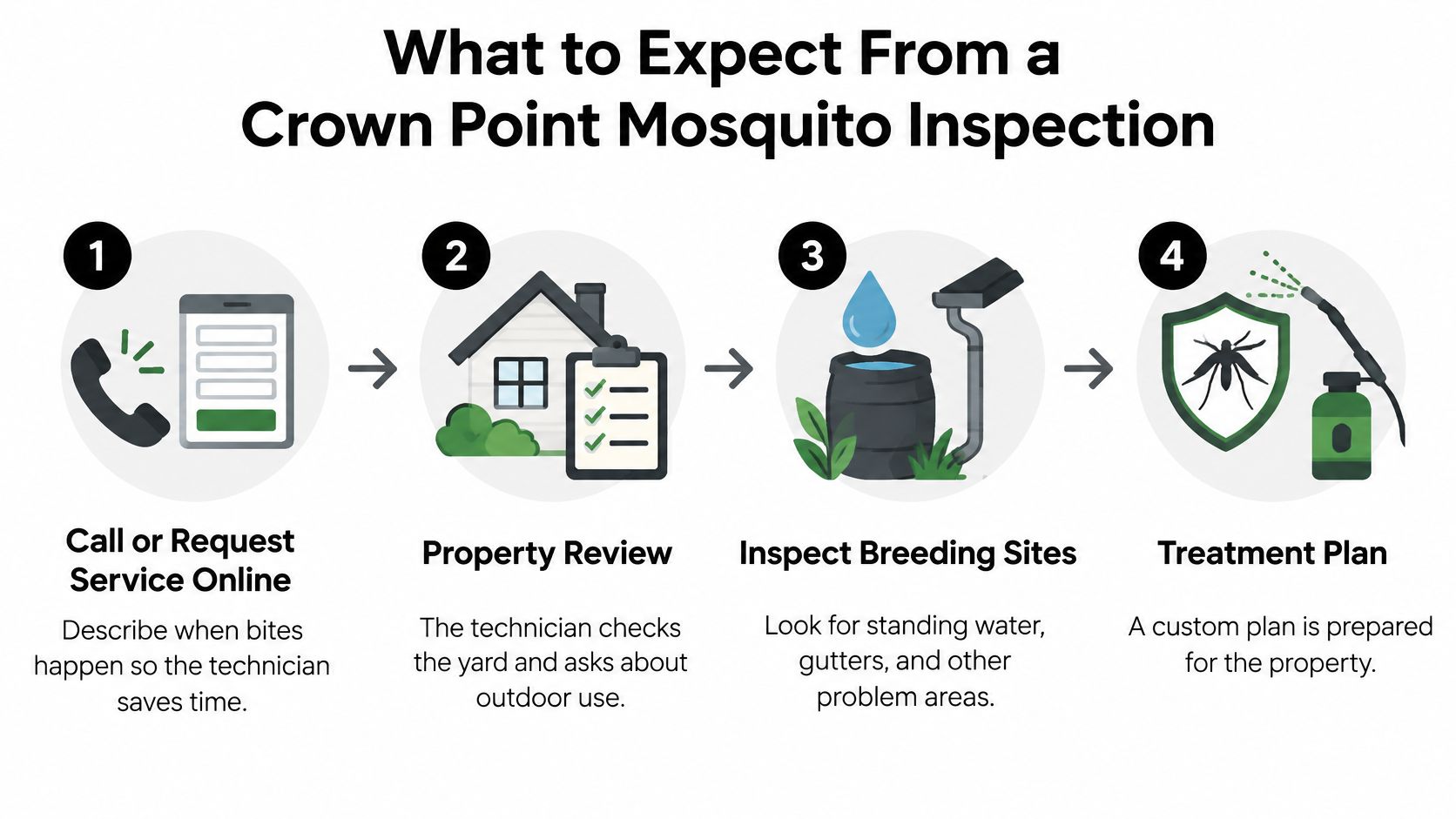
- Call or request service online. Describe bite times and the areas your family uses most.
- Review outdoor use with the technician. Mention breakfast outside, after-school play, grilling and late gatherings.
- Inspect breeding and resting sites. We check standing water, containers, gutters, dense shrubs, tall grass and lighting near patios or entrances.
- Explain findings in plain language. You get the treatment and timing plan before work begins.
- Schedule treatment and follow-up. The return visit confirms whether biting has dropped in the windows you reported.
What to Prepare Before We Arrive
Note bite times, clear access to the yard and shrubs, and point out children's play areas and pet spaces. For most general pest control services, you don't need to leave your home during treatment.
When overnight identity matters, the CDC mosquito trap guide says carbon-dioxide mosquito traps are most effective when placed at dusk and collected after dawn. That catch can show Culex activity a daytime visit underestimates, and it helps an exterminator in Crown Point, IN set the right plan instead of guessing.
Schedule Your Mosquito Inspection in Crown Point
Book an inspection when bites keep happening outside the window you expected. Three checks guide the decision: know the species window, inspect shade and lighting, and time outdoor use and treatment around the peaks you experience.
You'll get a plan that covers breeding sites, resting areas and both daytime and nighttime activity. Our outdoor mosquito control targets pests at all stages of life, from eggs to flying adults, and we also offer residential and commercial pest control, mosquito control, Tree Technology services, Lakeside Web Management, pest inspections, and an Insect ID resource. Related services such as ant control, termite control, rodent control, spider control and wasp removal can be discussed during the same visit if other seasonal pest issues show up.
Businesses and property managers can call our commercial line at (219) 779-9815, open Monday to Friday, 8:00 AM to 4:00 PM. If your office misses calls while staff are in the field, a contractor answering service can help callers reach a person instead of voicemail.
Homeowners searching for an exterminator near me in Crown Point or nearby Northwest Indiana communities can request a quote and schedule through our website. Tell us when and where bites happen, and we'll build the timing plan around your yard.
When Are Mosquitoes Most Active in your yard depends on species, shade and season, and The Green Advantage will identify that window, treat breeding and resting sites, and time follow-up around your family's outdoor routine. Visit The Green Advantage to schedule a mosquito inspection in Crown Point, IN and get a clear, eco-friendly pest control plan for your home or business.
Mosquitos in Backyard: Control Steps for Crown Point, IN
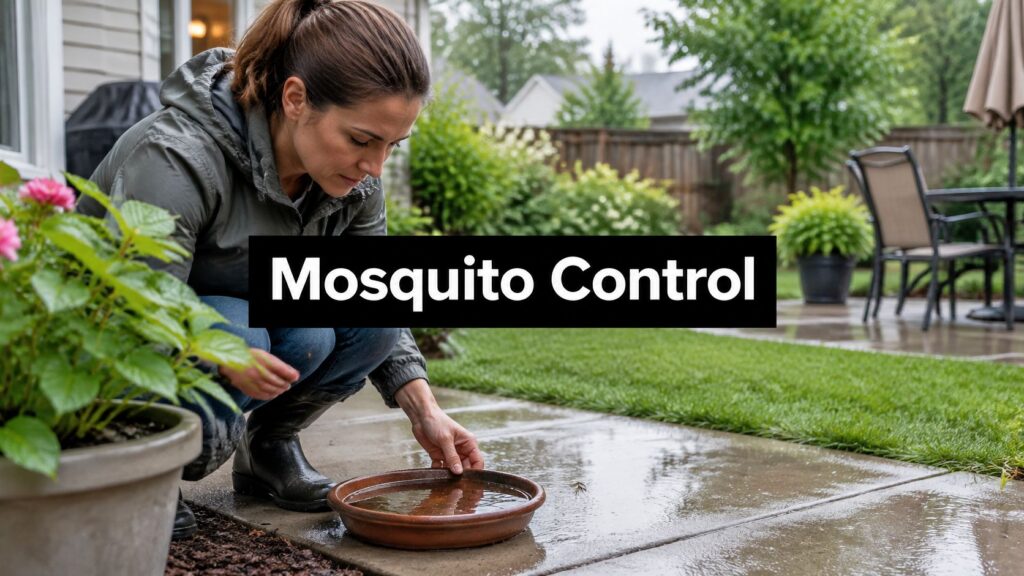
You step onto the patio with dinner, and mosquitoes start gathering around your ankles before you've settled into a chair. You've emptied the obvious bucket and cut the grass, so why are they still there? For homeowners looking for pest control in Crown Point, IN, The Green Advantage helps connect mosquito treatment with the yard conditions that keep the problem going.
The most useful starting point isn't a blanket spray. It's finding the water you've missed, removing eggs from reusable containers, and keeping a schedule that accounts for fresh rain and mosquitoes arriving from outside your property.
Why Backyard Mosquitoes Matter in Crown Point
A mosquito biting over a Crown Point patio is an annoyance, but mosquito prevention also has a practical health purpose. The Centers for Disease Control and Prevention identifies West Nile virus as the leading cause of mosquito-borne disease in the contiguous United States, causing about 2,000 illnesses each year, and reports that it has been found in all 48 contiguous states since its introduction in 1999.
That doesn't mean the mosquitoes in your yard are infected. It means preventing breeding around homes is worthwhile, even when the immediate concern is enjoying the deck without constant swatting.
Keep the risk in perspective
The World Health Organization identifies mosquitoes as transmitters of diseases including West Nile fever, dengue, and malaria. Those diseases don't all carry the same local relevance, so global disease totals shouldn't be treated as a forecast for a Crown Point backyard.
For local context, our information about mosquito-borne illnesses in Indiana can help homeowners understand why prevention matters without assuming every bite signals illness.
Practical rule: Treat mosquito prevention as routine property maintenance, not a reason to stop using your yard.
Northwest Indiana rain can refill an overturned cover or neglected planter after you've cleaned everything else. That makes recurring inspection more useful than relying on a spring cleanup alone.
The Green Advantage serves Crown Point and surrounding Northwest Indiana communities. Our role starts with identifying the conditions behind the problem, so homeowners know which changes they can make and where professional attention may help.
Where Standing Water Hides in Your Yard
Backyard breeding sites, water risk and what to do
| Breeding site | Water risk | Action | Check how often |
|---|---|---|---|
| Gutters and downspouts | Clogs hold rainwater for days | Clear debris and flush the line | After storms and monthly |
| Tires and buckets | Collect any rainfall | Empty, scrub and store upside down | Weekly |
| Toys and kiddie pools | Fill with rain and stay full | Empty and store upside down | Weekly |
| Plant saucers and trays | Hold water under potted plants | Empty or fill with sand | Weekly |
| Birdbaths and fountains | Water sits and gets refilled | Refresh or drain | At least weekly |
| Rain barrels | Open lids allow mosquito access | Cover tightly or use fine mesh | Weekly |
| Tarps and furniture covers | Folds pool rainwater | Reposition or drain | After every rain |
| Low spots and poor drainage | Standing water collects in dips | Regrade or fill low areas | After every rain |
| Pool covers and non-chlorinated pools | Covers pool water; untreated pools hold water | Drain cover or treat as labeled | Weekly |
Use this table as a maintenance checklist, not permission to leave newly collected water until the next scheduled visit. Indiana mosquito-control guidance warns that mosquitoes can develop in any puddle that remains for more than four days.
Start with places you can't see from the patio
Clogged gutters deserve attention because the yard can look dry while water remains overhead. Look for overflowing sections, debris at downspout openings, and discharge that collects against the foundation. Inspect from the ground where possible, and arrange safe access rather than stretching from a ladder.
Next, check tires, buckets, and outdoor toys. A toy truck bed or hollow play structure can hold water even when the surrounding lawn has dried. Store unused items under shelter or in a position that drains.
Lift plant pots to inspect their saucers. Check beneath furniture, along the shed wall, and behind stored materials, where a forgotten container is easy to overlook. Birdbaths and fountains need attention even when they look attractive and well maintained.
Follow the path rainwater takes
Run your hand along a grill cover to find sagging pockets. Pull tarps taut rather than allowing the visible puddle to pool, and inspect rain-barrel lids for gaps around the rim and downspout inlet.
For recurring lawn puddles, the Pool & Landscaping of Vistancia drainage tips, from Pool & Landscaping of Vistancia LLC, offer a useful resource for thinking through yard drainage problems. Any drainage change should keep runoff away from buildings without redirecting the problem onto a neighboring property.
Start your walk at the highest accessible part of the property and work downhill. Finish at the back fence, drainage outlets, and places where runoff enters from outside your lot.
Treat every container that retains rainwater as a potential breeding site, whether it's a large barrel or a small depression in a cover.
Covers and Larvicides for Water You Cannot Empty
Options for water you cannot empty
| Option | Best for | Limit |
|---|---|---|
| Empty and scrub | Buckets, toys, planters, tires | Works only if done every week |
| Tight cover or fine mesh | Rain barrels and water storage | Mesh openings must be smaller than an adult mosquito |
| Labeled larvicide, such as dunks or bits | Rain barrels, fountains, gutters, non-chlorinated pools, tree holes | Use exactly as the label directs and never in drinking water |
| Drain or regrade low spots | Puddles in yard dips | Needs ground work and a check after rain |
| Adult mosquito spray | Short-term relief before an outdoor event | Reduces numbers only temporarily and does not replace source control |
For stored water, physical exclusion is the simplest option. A lid must fit around the entire rim, not merely rest on top. Indiana's mosquito-bite prevention guidance recommends tightly covering water-storage containers or using mesh with openings smaller than an adult mosquito.
Choose treatment for the actual water feature
When water can't be dumped, drained, or covered, a larvicide targets mosquitoes before they become flying adults. The CDC's larvicide guidance identifies dunks or bits that can be applied by hand to small bodies of water, including suitable rain barrels, fountains, gutters, non-chlorinated pools, pool covers, tires, and tree holes.
Match the product label to the site. Don't assume a product intended for an ornamental water feature belongs in every pool, ditch, or barrel. Measure and apply the specified amount, and don't add extra product or shorten the reapplication interval.
- Drinking water: Never apply these treatments to water intended for drinking, including water your pets drink.
- Unused pools: Use a properly secured cover that doesn't collect puddles, and treat only where the product label permits.
- Persistent puddles: Correcting the drainage may be more useful than repeatedly treating the same depression.
Our explanation of what kills mosquito larvae provides more context for choosing between removing habitat and treating unavoidable water.
Adult spray addresses a different problem: mosquitoes already flying or resting around the yard. Don't use it as a substitute for fixing a water source you can remove.
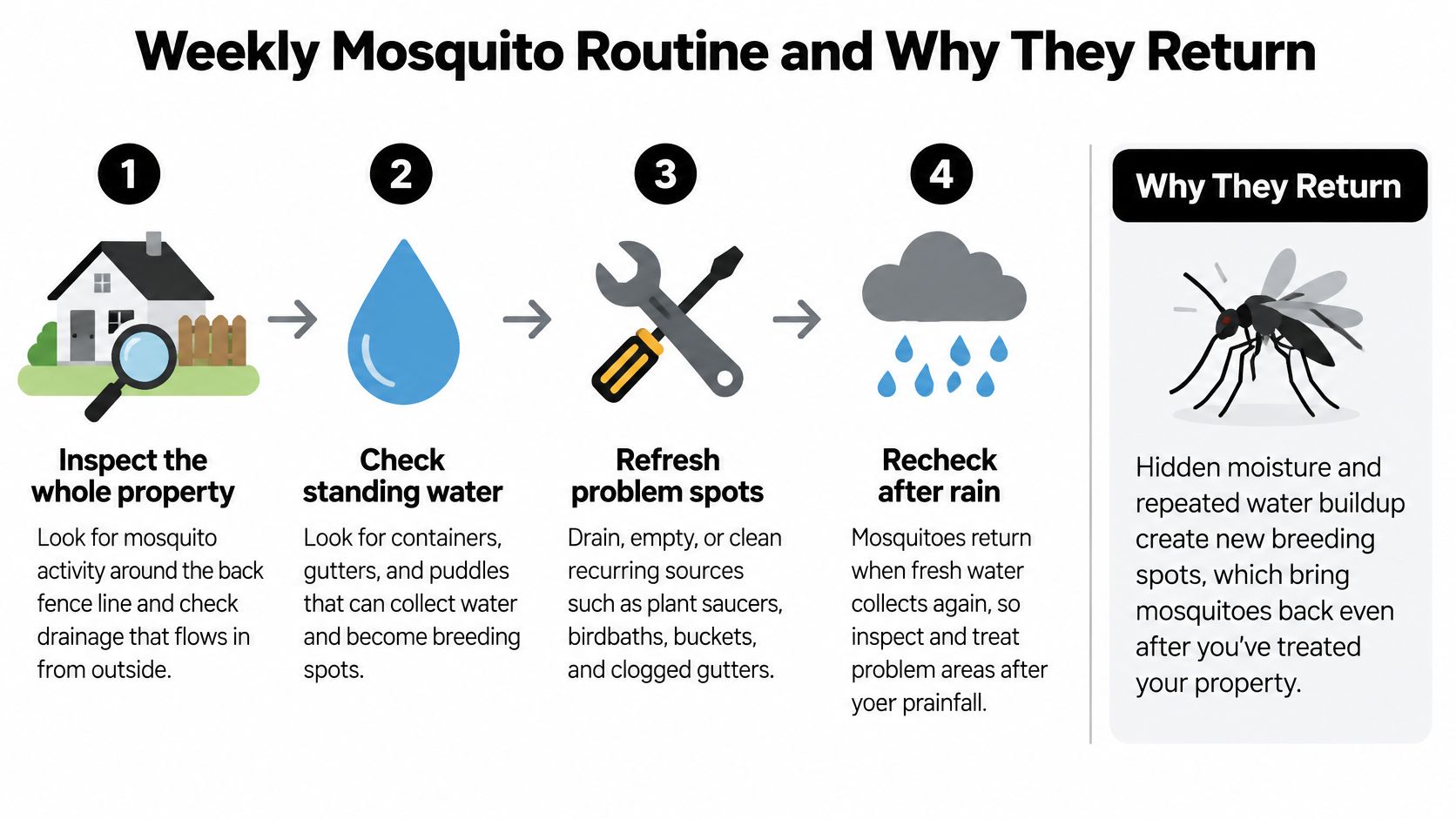
Weekly Mosquito Routine and Why They Return
Inspect the whole property. Follow the same walking route so the back fence, side yard, and incoming drainage don't get skipped. The common mistake is checking only the area where people are getting bitten, rather than the places mosquitoes may be developing.
Empty, scrub, turn over, or discard containers. Use a stiff brush on reusable container walls and around the old waterline before rinsing and storing them dry. Tipping out the water misses eggs attached to the surface.
Refresh intentional water features and trays. Drain and clean birdbaths, fountains, wading pools, and plant trays; manage rain barrels by refreshing them where practical or keeping them securely screened. Don't refill a dirty basin and assume the fresh water has solved the problem.
Treat only the water you can't otherwise manage. Use a labeled larvicide where emptying or covering isn't practical, excluding drinking water and pet drinking water. The common slip is treating an easy-to-see puddle while leaving a removable bucket untouched.
Reassess after rain. Walk the route again, looking for newly filled containers, shifted covers, and drainage changes. A completed checklist doesn't remain accurate after a storm rearranges the yard.
The CDC's home mosquito-control guidance recommends emptying and scrubbing, turning over, covering, or discarding water-holding items once a week, noting that mosquitoes can complete their life cycle in about a week and that eggs can remain attached to container walls after water is removed.
Put the routine on the calendar
Choose a recurring calendar appointment that fits your household, rather than waiting until bites become annoying. Start in spring when warm weather arrives and keep the habit going until the first hard frost. After heavy storms, repeat the full route rather than checking only the most obvious puddle.
Keep a notebook or phone checklist with the location, water condition, action taken, and next follow-up. A note such as “shed-side barrel screen loose” gives you something specific to fix. “Yard checked” doesn't tell you whether the same problem keeps recurring.
A useful record distinguishes between water that was removed, water that was covered, and water that was treated. If you apply a product, record its name and application details so you don't accidentally reapply too soon.
Don't forget items that move. A wheelbarrow may be stored upright after gardening, a child may leave a toy beneath a shrub, or a furniture cover may sag after windy weather. Your inspection route stays consistent, but the objects along it won't.
Why mosquitoes can return after cleanup
Mosquitoes present the following day don't automatically mean your work failed. Some adults were already resting in vegetation or sheltered structures when you emptied the containers. Others may arrive from neighboring yards, storm drains, ditches, or retention-pond edges.
There's also a difference between removing water and removing the conditions that allow it to return. Dumping a tarp puddle helps today, but securing the tarp so it sheds rain prevents you from repeating the same task indefinitely. The same reasoning applies to a blocked downspout or a barrel with a loose lid.
Walk the property boundary without entering neighboring land. If you spot a shared concern, describe the location and practical fix politely rather than blaming someone for your bites. For drainage systems or common areas, contact the responsible property manager or maintenance authority.
A clean yard can still receive mosquitoes from outside its boundaries. Judge your maintenance by the sources you've corrected, not by whether a mosquito ever crosses the fence.
Measure progress without expecting eradication
The Environmental Protection Agency's integrated mosquito-control guidance identifies egg- and larval-stage control as generally the most effective and least costly approach, while warning that source reduction isn't 100% effective.
Larvae can't fly away from the water being managed. That makes a small, identifiable water source easier to address than adults dispersed through shrubs, neighboring properties, and sheltered outdoor spaces.
Assess improvement over several weeks rather than declaring success after a quiet evening. Note where biting remains troublesome, whether rain preceded the increase, and whether a particular container keeps refilling. Those observations are more useful than a general impression that the yard feels worse.
Don't make mosquito traps your only measure of effort, either. A trap doesn't correct clogged gutters or remove competing breeding water. If traps are part of a broader plan, consistent placement and servicing matter more than setting one out and forgetting it.
DIY Cleanup or Professional Mosquito Control
DIY cleanup or professional help by situation
| Situation | DIY approach | Call a professional when |
|---|---|---|
| Few containers and bites are rare | Weekly tip and toss, covers on storage | Bites persist after several weeks of full cleanup |
| Hidden sources suspected | Walk the property line and check drainage | You cannot find the source after a full check |
| Pond, creek edge or large wet area | Weekly checks and labeled larvicide where permitted | Breeding is hard to reach or the area is large |
| Outdoor event within days | Clean, cover and empty water now | You need a treatment plan before the event |
| Many shared or neighboring water sources | Document sites and talk with neighbors | Reinvasion continues despite your cleanup |
DIY work makes sense when the sources are accessible and you can maintain them consistently. A small yard with removable containers doesn't necessarily need the same approach as a property bordering persistent wet ground.
Call sooner if inspecting the source would be unsafe, require entering someone else's property, or involve water you can't confidently identify and manage. Don't wade into a creek edge or apply a product to shared drainage just because mosquitoes are nearby.
What professional assessment adds
A professional inspection connects breeding locations, adult resting areas, drainage, and the places people use. A sound plan identifies removable sources first, selects labeled treatments where appropriate, and establishes how follow-up observations or trap counts will be compared under similar conditions.
The Green Advantage's outdoor mosquito control targets pests at all stages of life, from eggs to flying adults. Our technicians also note on the inspection report any steps the customer can take to prevent the pest problem.
The EPA's guidance on controlling mosquitoes at the larval stage explains how treating breeding habitat can reduce nearby adult populations. That's a reason to address the source, not a promise of permanent elimination.
Before an event: Arrange an assessment early enough to discuss access, preparation, treatment restrictions, and realistic expectations. A last-minute spray isn't a substitute for planning.
Both larval and adult treatments provide population reduction rather than permanent eradication. Professional service should protect health, comfort, and peace of mind through a clear plan, not imply that every mosquito will disappear.
It's time to contact an exterminator in Crown Point, IN when:
- Biting remains disruptive: Consistent maintenance hasn't made outdoor areas comfortable.
- The source remains unclear: Your inspection finds no explanation for continuing activity.
- The property is complicated: Shared drainage, inaccessible habitat, or an approaching gathering requires coordinated decisions.
Book a Backyard Mosquito Inspection in Crown Point
Keep a recurring yard walk on your calendar, with a follow-up check after heavy rain. That habit gives a technician a useful starting point and helps you maintain improvements between visits.
To arrange an inspection in Crown Point or nearby Northwest Indiana communities, call The Green Advantage's office. Our team schedules the visit, and a technician checks conditions around the property and records prevention steps on the inspection report. For general pest control issues, we typically schedule service the same day or the next business day, depending on your convenience; confirm mosquito-service availability when you call.
Contact our local team
Property managers and business owners can reach the commercial pest control line at (219) 779-9815, Monday through Friday, 8:00 AM to 4:00 PM. Describe the outdoor areas affected, any persistent water, and whether you're planning an event.
If you're also noticing ants, termites, rodents, or wasps, mention those concerns when arranging your residential pest control assessment. Ask about ant control, termite control, rodent exclusion, or wasp removal so the office understands the full situation.
The Green Advantage offers backyard mosquito control built around the conditions on your property, with practical prevention guidance alongside treatment. Visit The Green Advantage to request an inspection or quote for your Crown Point property and take the next step toward fewer mosquitoes and a yard you can enjoy this season.
Mosquito Control Treatment in Crown Point, in Explained

You step onto the patio with dinner, then head back inside because mosquitoes won't leave your ankles alone. You've emptied a few containers and considered spraying, but you're not sure what will help. For homeowners looking for pest control in Crown Point, IN, the useful starting point isn't choosing a stronger product. It's finding where mosquitoes are developing and where adults are resting.
A dependable mosquito control treatment plan connects those places to the right action. That means inspecting the yard, managing water, treating only where needed, and keeping records that help explain what worked. You should also know what to move before service, when children and pets can return, and what happens if bites continue.
Mosquito Control Treatment Options at a Glance
Mosquito control treatment types compared
| Treatment | What It Targets | Best Used When | Typical Effect Window |
|---|---|---|---|
| Barrier spray, or residual adulticide | Adult mosquitoes in shaded vegetation and other identified resting areas | Adults are active around outdoor living spaces | Product- and site-dependent; confirm the label and follow-up plan |
| ULV fogging | Flying adult mosquitoes | Monitoring supports a rapid adult-mosquito response | Contact treatment, not a lasting solution to breeding water |
| Larviciding | Immature mosquitoes in standing water | Water cannot reasonably be emptied, such as suitable ponds, catch basins, and drains | Varies by product, habitat, and inspection findings |
| Source reduction | The breeding sites themselves | Every property, before unnecessary pesticide use | Continues while the site stays dry or properly managed |
| Seasonal program | Breeding sources and adult activity across the season | Recurring mosquito problems need continuing evaluation | Visits adjusted to conditions and observed results |
No single row solves every mosquito problem. A yard with a water-holding drainage structure needs a different starting point from a patio surrounded by shaded vegetation. The EPA's integrated mosquito-control guidance supports choosing treatments according to habitat, environmental considerations, resistance, and practical use rather than relying on one universal application.
Match the treatment to the yard
For a backyard pond, the first question is whether mosquitoes are developing in it and whether a labeled larvicide fits that habitat. For an overturned wheelbarrow holding rainwater, emptying and storing it correctly is the more direct response. For adult activity beside a shaded seating area, a technician should inspect resting sites and determine whether targeted adult treatment is justified.
ULV fogging isn't another name for every yard spray. The EPA describes ultra-low-volume applications as fine aerosol droplets that kill flying mosquitoes on contact. A residual treatment and an airborne contact application have different jobs, so ask which method a quote includes.
A seasonal program is the service framework around these choices, not a separate chemical. Its value comes from checking conditions again and changing the response when the property changes.
Before accepting a quote: Ask what the treatment targets, what it leaves untreated, and what evidence will determine the next visit.
Be cautious about a promised protection window that doesn't identify the product or account for conditions. A useful estimate explains its limits rather than treating every Crown Point yard as identical.
Why Mosquitoes Keep Returning to Your Yard
The patio feels comfortable when you first sit down. Later in the evening, you're brushing mosquitoes away and wondering whether something changed. Rather than assuming the whole lawn needs treatment, look at the property as both a nursery and a hotel.
Water provides the nursery where immature mosquitoes develop. Shaded vegetation provides places for adults to rest. The distinction matters because a treatment directed at one location may leave the other untouched.
A peaceful-looking backyard can contain both kinds of habitat.

Look for water before blaming the lawn
Imagine walking from your back door toward the fence. A planter saucer holds water beside the steps. A folded tarp has collected rain behind the shed. Beyond it, dense shrubs border the patio.
Those observations suggest different inspection questions:
- Water-holding items: Can they be emptied, covered, repaired, or stored differently?
- Persistent wet areas: Is there a drainage problem, irrigation runoff, or a structure that needs professional assessment?
- Shaded vegetation: Are adults resting there, and does monitoring support targeted treatment?
- Property boundaries: Could an inaccessible water source help explain activity concentrated along one edge?
These are inspection examples, not a diagnosis of every yard. A birdbath isn't automatically the main source, and a thick hedge doesn't prove that spraying is necessary.
Understand what adult-only treatment leaves behind
The practical reason mosquitoes can return is that controlling adults doesn't necessarily address the water where more mosquitoes are developing. Likewise, fixing water on your property doesn't establish that every mosquito you encounter originated there.
For homeowners, the useful distinction is simple: a breeding site holds suitable water; a resting site shelters adults. Some areas may involve both.
A walk with a technician should turn those possibilities into a mapped plan. You shouldn't have to guess whether the next step is emptying a container, correcting drainage, treating persistent water, or addressing adult activity.
How Barrier Sprays and Larvicides Work Differently
After rain, a yard can have water where young mosquitoes develop and shaded spots where adults rest. Those are different treatment targets. Matching the method to the habitat matters more than spraying more, and no treatment creates a sealed, mosquito-free yard.

Barrier treatments address adult resting areas
A residual adulticide is applied to suitable, label-approved surfaces where adult mosquitoes rest. On service day, the technician should identify those areas and apply the product as its label directs, rather than coat every fence, deck, shrub, and patio surface.
The word barrier does not mean an invisible wall at the property line. Mosquitoes can enter the yard without contacting a treated surface, and an adult treatment does not address larvae developing in untreated water.
A spray drying does not, by itself, show that its residual activity has ended. How long a product remains active depends on the product, its approved use, application conditions, and performance over time. Ask the technician what surfaces are being treated and what the application can and cannot do.
Larvicides address development in water
Larvicides target immature mosquitoes before they become biting adults. A container, pond, and drainage structure are different habitats, so one product or application method may not suit them all. The CDC's mosquito prevention and control guidance explains that larvicide choice and application need to fit the site and follow label directions.
For a plain-language overview, see what kills mosquito larvae. Then ask the technician whether a persistent water source can be removed or needs a habitat-appropriate, labeled treatment.
Larviciding will not quickly remove adult mosquitoes already flying around the patio. Some products interrupt development, so their effect is not the same as an adult spray. The video below offers another visual reference for the treatment discussion.
Why follow-up should reflect actual performance
A 2025 field study published in Parasites & Vectors examined pyriproxyfen, a specific larvicide. Its findings should not be treated as a schedule or performance guarantee for other products. Larvicide effects can change with the product and habitat, so the technician should check how the treatment is performing instead of assuming it stays equally effective indefinitely.
If confirmed breeding water cannot be removed, larval control may be the appropriate first step. If active adults are the immediate concern, targeted adult control may also be suitable. A water-first plan, supported by inspection and service records, helps show which habitats were addressed and where follow-up may be needed.
Source Reduction Steps You Can Take Between Visits
Between professional visits, concentrate on changes you can maintain. Source reduction means removing or managing the places mosquitoes use to develop, not trying to sterilize the entire yard.
A practical route starts beside the house, continues through water features and storage areas, and finishes at the property edge.
Work through containers and drainage
- Portable containers: Empty unnecessary standing water from buckets, wheelbarrows, planter saucers, and toys. Store items so they won't immediately refill.
- Tarps and covers: Remove collected water and adjust the cover so folds don't become recurring collection points.
- Birdbaths and outdoor bowls: Refresh and clean them as part of regular care rather than letting water remain neglected.
- Gutters and drains: Remove accessible debris safely. Ask for help when height, hidden pipework, or an unfamiliar drainage structure makes the job unsuitable for you.
- Persistent water features: Ask whether maintenance changes or a habitat-appropriate, labeled treatment is needed.
The reason for grouping these tasks is practical: emptying a bucket helps little if a nearby drainage problem remains unnoticed. Walk the same route after rainfall so newly filled sites are easier to recognize.
Give rain barrels their own check
A 2025 University of Illinois study of residential rain barrels surveyed 115 barrels across 53 households and found that more than half of households had at least one mosquito-positive barrel. Mosquitoes were less likely to occur in barrels with mesh covering the lid.
That doesn't mean you must abandon water conservation. Inspect the lid and mesh, check openings and overflow arrangements, and repair leaks. Any treatment must be labeled for the setting and the water's intended use.
A rain barrel needs a prevention plan of its own. It shouldn't be treated as an ordinary bucket that you're expected to empty.
Finish by maintaining grass and dense vegetation around outdoor living areas. For hidden catch basins or water beyond your property, document the location and ask your technician about the appropriate next step. Don't enter neighboring land or add pesticide to unfamiliar water structures without permission and proper guidance.
What a Professional Mosquito Program Involves
A professional visit should begin with questions and inspection, not an application hose. You know where bites interrupt daily life. The technician brings a method for checking whether those observations match breeding water, resting habitat, or another source.
A clear service process makes those roles easier to understand.

From the first walk-through to treatment day
Initial inspection. Show the technician where you notice activity and which areas stay wet. The inspection should include containers, ornamental water, catch basins, drains, irrigation runoff, and shaded vegetation. Mention water you've noticed but can't safely reach.
Habitat map and treatment plan. The technician records relevant sites and matches each to an action. Some need homeowner maintenance, some may need larval treatment, and others may justify adult control. You should understand which locations won't be treated and why.
Preparation instructions. Before service, ask whether mowing or trimming is needed and move toys, pet bowls, and other items as directed. Tell the office about pets, health concerns, rain barrels, edible plants, and nearby beehives. Get product-specific instructions for keeping people and animals away and allowing them to return.
Targeted application. The technician treats appropriate mapped areas at label-authorized rates. You shouldn't expect treatment of every outdoor surface simply because it falls within the property boundary. Weather or unsuitable site conditions may require a change to the planned application.
Follow-up evaluation. A useful service record identifies what was applied, where it was used, relevant weather conditions, and what subsequent inspection found. Your observations help too, especially when they identify a specific location rather than a general impression.
Ongoing adjustments. Later visits should respond to what the technician finds. New standing water, changed landscaping, or continued activity may require a different action, not just repetition of the original application.
What makes the program integrated
The CDC's Integrated Mosquito Management framework combines surveillance, source reduction, larval control, adult mosquito control, insecticide-resistance testing, public education, and evaluation. That's a broader responsibility than scheduled adult spraying.
For a homeowner, this means someone should be able to explain the connection between the inspection and the proposed work. For commercial pest control, the same reasoning applies, with added attention to occupied outdoor areas, access arrangements, and communication with the property manager.
Residential pest control should be equally clear about preparation and follow-up. Ask who answers questions between visits and how to report a change in activity.
Understand the written quote
Property size matters, but it shouldn't be the only discussion. Ask how persistent water, difficult access, the treatment mix, and anticipated follow-up affect the proposed price.
A written quote should describe the service scope, visit arrangements, homeowner responsibilities, and any conditions attached to follow-up. It should distinguish mosquito reduction from a guarantee that no mosquito will ever enter the property.
Professional mosquito management supports outdoor comfort and health-conscious property care. It doesn't replace structural repairs, drainage work, or unrelated pest inspections. If you also need ant control, termite control, rodent control, spider control, or wasp removal, ask for a separate assessment rather than assuming mosquito service addresses those concerns.
Month-by-Month Timing for Northwest Indiana Yards
A Crown Point yard can need attention at a different time from a yard elsewhere in Indiana. Start with where water collects and where adult mosquitoes rest, then use inspection findings and service records to decide what to do. A calendar can prompt checks, but it cannot predict mosquito activity at an individual property.
A 2025 county health announcement reported a West Nile virus-positive mosquito pool in St. Joseph County. That county is outside the Crown Point area, so its announcement is not evidence of local mosquito levels or treatment timing in Crown Point. It does show why local surveillance is relevant, while property-level decisions still need to reflect what an inspection finds.
Seasonal planning guide for Northwest Indiana yards
| Month | What to check | Practical next step |
|---|---|---|
| April | Look for water that remains in gutters, containers, or low spots as yard maintenance begins | Clear drainage routes and note persistent water for inspection |
| May | Recheck places that hold water after spring rain, including birdbaths and containers | Empty or refresh manageable sources; discuss treatment only if inspection supports it |
| June | Check frequently used outdoor areas for resting sites and standing water | Compare findings with the service record before choosing adult or larval control |
| July | After storms, inspect rain barrels, low spots, and other water-holding features | Address removable water and record any recurring sources |
| August | Revisit the areas identified in earlier inspections and check for new water sources | Use observed activity and past treatment results to guide any follow-up |
| September | Check whether mosquitoes are still active around the yard and whether sources remain | Continue only measures supported by current conditions |
| October | Review drainage and remove leaves or containers that can hold water | Complete seasonal maintenance; don't assume a date alone determines when treatment should end |
Use the calendar as a planning aid
These month-by-month checks are general guidance, not a measured forecast for Northwest Indiana or a guarantee that mosquitoes will appear on schedule. The useful timing is tied to the yard: persistent water calls for source management, while resting areas may require a different inspection and treatment decision. Spraying more often does not fix a breeding source that remains untouched.
For application conditions, read about the best time to spray mosquitoes, then confirm the product-specific timing with your provider. Keep records of inspection findings and applications, so each visit can respond to what changed rather than repeat a calendar date.
Fixing Treatment Gaps and Booking Your Crown Point Inspection
If you've already tried treatment and still get bitten, it's understandable to want a stronger application. More spraying isn't automatically the correct fix. First, someone needs to determine whether the problem involves untreated habitat, application conditions, equipment, product selection, or resistance.
The symptoms below are starting points for investigation, not diagnoses you can make from bites alone.
Mosquito treatment symptoms, causes and fixes
| Symptom | Likely Cause | What to Do |
|---|---|---|
| Bites return soon after treatment | New adults, untreated habitat, or weather-related performance issues | Review weather, treatment records, and breeding sources before changing the visit interval |
| Bites are concentrated near one fence line | A nearby resting site or hidden water source may be involved | Inspect the boundary and coordinate access to off-site sources where permitted |
| Adults drop after spraying but larvae remain | Larval sources weren't adequately addressed | Reassess standing water and add suitable source management or larval control |
| The same product seems to stop working | Possible resistance, application error, or changed site conditions | Check technical factors and seek resistance guidance before changing modes of action |
| One area appears untreated | A coverage gap, access issue, or equipment problem may exist | Review the mapped plan, equipment calibration, and application record |
Separate resistance from an application problem
USDA mosquito monitoring identified impactful resistance-linked mutations in Aedes aegypti, with follow-up detections outside Indiana. Those findings are not evidence that mosquitoes in your Crown Point yard carry the same mutations.
They do show why professionals shouldn't assume every mosquito population responds identically. The CDC's insecticide-resistance guidance supports testing susceptibility and using the results to guide product decisions.
Before blaming resistance, a provider should review calibration, formulation, coverage, application timing, weather, and habitat. Where justified, a different mode of action may be appropriate. Changing brand names alone doesn't necessarily change how an insecticide works.
When reporting a problem: Describe where activity continues, when you notice it, and what changed since the visit. Those details are more useful than asking for extra spray everywhere.
Choose an inspection-led provider
If you're searching for pest control near me or an exterminator near me, compare the process behind the quote. A provider offering mosquito service should be able to answer practical questions before work begins:
- Inspection first: Which breeding and resting sites were found on the property?
- Measured application: How will the provider use only the label-authorized amount needed for the identified sites?
- Calibrated equipment: How are application accuracy and coverage checked?
- Clear records: What product, conditions, and follow-up findings will be documented?
- Realistic expectations: What should improve, what may remain, and what triggers reassessment?
The same questions help when choosing an exterminator in Crown Point, IN for a broader property assessment. Terms such as eco-friendly pest control should lead to an explanation of specific practices, not an assumption that a pesticide has no risks. Habitat management, justified treatment, and label compliance are more informative than a reassuring label alone.
Keep service-day safety specific
Ask for the actual product instructions. Keep children and pets away during treatment and until the label's re-entry requirements are satisfied. If drying is part of those instructions, wait for drying, but don't substitute that rule for a longer label requirement.
Point out blooming plants and pollinator activity before application. The technician should explain how label restrictions and site selection protect non-target areas.
You should receive equally clear guidance for treated water. Don't improvise with household chemicals or add a product just because it's marketed for mosquitoes.
Prepare for your inspection
Start by calling or requesting a quote, then describe the areas where bites interrupt your routine. Mention persistent water, rain barrels, pets, access restrictions, and any nearby water you don't control.
Schedule the inspection and ask to review the written treatment plan before the first application. Confirm preparation, re-entry instructions, seasonal visit arrangements, and how to report continued activity.
The benefit of professional help isn't a promise of a mosquito-free neighborhood. It's a reasoned plan for your property, with someone accountable for checking the results and explaining the next step.
The Green Advantage offers property inspections and targeted mosquito reduction programs for homeowners and businesses in Crown Point and surrounding Northwest Indiana communities. Visit The Green Advantage to request a mosquito inspection and written quote, and discuss a plan matched to your yard's water sources, resting areas, and outdoor routine.