
Pest Control for Apartment Buildings: A Practical Guide

A property manager takes one call about ants in apartment 3B, then hears about roaches in 2A and a mouse near the laundry room. By the afternoon, the issue is no longer a single service ticket. It's a building problem.
Effective pest control for apartment buildings requires more than spraying the unit where someone noticed activity. Shared walls, plumbing routes, utility spaces, common rooms, tenant habits, and maintenance conditions all influence how pests enter and move. The Green Advantage serves Crown Point, IN and nearby Northwest Indiana communities with residential and commercial pest control solutions built around inspection, targeted treatment, prevention, and follow-up.
Why Apartment Buildings Need a Different Approach
The first mistake in apartment pest control is treating the complaint location as the pest's entire territory. German cockroaches can move through utility risers, plumbing chases, electrical conduits, and wall voids. Rodents can use gaps around service doors, pipes, vents, and other building penetrations. Ants may follow moisture or food sources from one unit into a neighboring space.
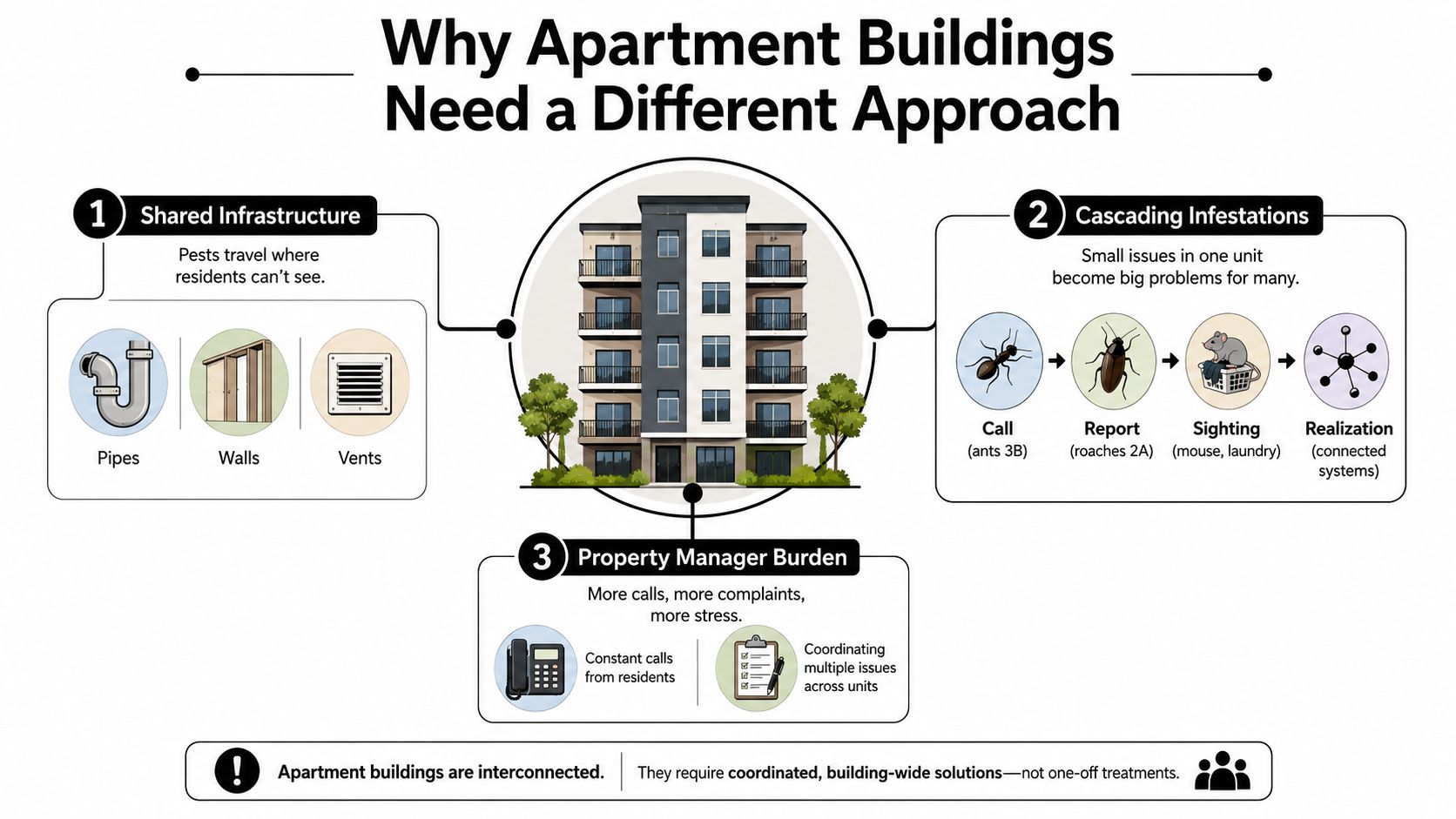
A complaint is often a signal
A single unit can be the first place where someone notices activity, not the place where the problem began. If technicians spray only that apartment, pests may remain in adjacent units or shared infrastructure and return after the product loses effectiveness. The resident then reports the same problem again, and management accumulates callbacks without learning where the pressure is coming from.
That pattern explains why isolated service tickets often feel repetitive. The provider responds to symptoms while untreated spaces continue to supply pests.
Practical rule: In connected housing, inspect the complaint unit, nearby units, common areas, and the pathways linking them.
Historical multifamily housing research found that 67% to 82% of pest-control work orders came from just 11% to 16% of apartments, according to the urban multifamily housing evidence summarized by Phys.org. That concentration makes early identification of repeat-problem units important, but it doesn't mean other apartments can be ignored. A small group may generate most calls while shared routes allow activity to spread.
A building-wide approach combines coordinated inspection, monitoring, exclusion, sanitation, targeted treatment, and resident communication. It also gives the property manager a defensible record of what was checked, what was found, who needed access, and what corrective work remains.
Inspecting the Building Before Treating Any Unit
A useful inspection starts outside, not with a spray tank. The technician checks landscaping that touches the facade, the condition of garbage enclosures, gaps around exterior utility penetrations, service doors, loading areas, and places where water collects near the foundation. These conditions can create entry points or sustain activity before pests ever reach an apartment.
Inside, mechanical rooms, utility risers, trash chutes, laundry facilities, storage areas, and shared hallways deserve focused attention. Moisture, food residue, overflowing waste, floor drains, and warm equipment areas can support pest activity even when individual apartments appear well maintained.
What gets checked inside units
A unit-by-unit inspection should be deliberate and repeatable. With a flashlight and probe, the technician examines:
- Kitchen equipment: Behind and beneath the refrigerator, around the stove gap, under the dishwasher, and near exposed plumbing.
- Cabinet interiors: Corners, hinges, shelf joints, and openings around pipes.
- Bathrooms: Sink cabinets, toilet supply lines, tub access panels, baseboards, and ventilation areas.
- Room edges: Baseboards, door thresholds, wall penetrations, and areas behind stored items.
- Activity evidence: Droppings, shed skins, nesting material, live insects, grease marks, gnawing, moisture damage, and odors.
The technician should document findings with photographs, location notes, and a condition rating for each inspected unit. Notes should separate sanitation concerns from structural openings and confirmed pest activity. A practical pest control inspection checklist helps keep the process consistent across apartments and common areas.
Inspection findings determine the scope
The inspection determines treatment boundaries, access priorities, sequencing, preparation instructions, and follow-up needs. It also identifies work that pest control alone can't solve, such as a leaking supply line, a damaged door sweep, an unsealed wall penetration, or waste-management conditions near a dumpster.
A vague ticket that says “treated” doesn't tell management whether the source was addressed. A useful report connects each location to an observation and a recommended action.
Single-Unit Treatment Versus Building-Wide IPM
A resident reports roaches, the technician treats that apartment, and the work order closes. The neighboring units, utility spaces, and shared travel routes remain unexamined. If activity persists there, pests can return through connected walls, plumbing openings, hallways, or service areas, and management pays for another isolated response.
A building-wide integrated pest management program changes the decision process. A structured integrated pest management program uses inspection and monitoring to identify where action is needed, then coordinates treatment with repairs and corrective work. Depending on findings, the scope may include every-unit inspections, adjacent-unit checks, common-area monitoring, sanitation corrections, exclusion repairs, targeted baiting, and scheduled reinspection.
The Journal of Integrated Pest Management study reported German cockroach infestation declining from 49% at baseline to 12% after 12 months in a multifamily building-wide IPM program. Bed bug infestation declined from 9% to 3% over the same period. The study also recorded overall building-wide infestation falling from 49% to 24% at six months and to 12% at 12 months.
| Metric | Single-Unit Treatment | Building-Wide IPM |
|---|---|---|
| Inspection scope | Complaint unit first | Units, common areas, exterior, and connected routes |
| Treatment decision | Often based on one report | Based on activity, monitoring, and conditions |
| Neighboring apartments | May remain untreated | Adjacent and at-risk spaces can be inspected |
| Follow-up | Frequently callback-driven | Scheduled reinspection and documented adjustments |
| Chemical use | Can encourage repeated broad applications | Supports targeted baiting and limited applications |
| Management outcome | Reactive tickets and recurring complaints | A coordinated record of progress and corrective work |
A separate community-wide IPM program in a 258-unit, 40-building housing complex reduced cockroach counts per apartment by 88% within seven weeks and eliminated 85% of infestations found in the initial survey by seven months, according to the Purdue IPM study PDF. Apartments were revisited and treated biweekly or monthly, giving managers a practical reference for scheduling follow-up rather than waiting for new complaints.
Tenant communication determines whether the system works in occupied housing. Explain why access to adjacent units may be requested, what residents must prepare, and how to report activity after treatment. For records, responsibilities, and facility controls, consult this guide to pest control compliance. Per-unit treatment can address an urgent symptom. Coordinated IPM verifies results and connects treatment with building-level corrective work.
Exclusion, Sanitation, and Monitoring as a Layered System
A tenant may report one cockroach in a kitchen, while the source sits beside a plumbing chase, trash room, or neighboring apartment. Spraying that unit alone can reduce sightings briefly, but it will not close the route, remove the food supply, or reveal whether the population is spreading. Lasting control requires several building-wide layers working together.
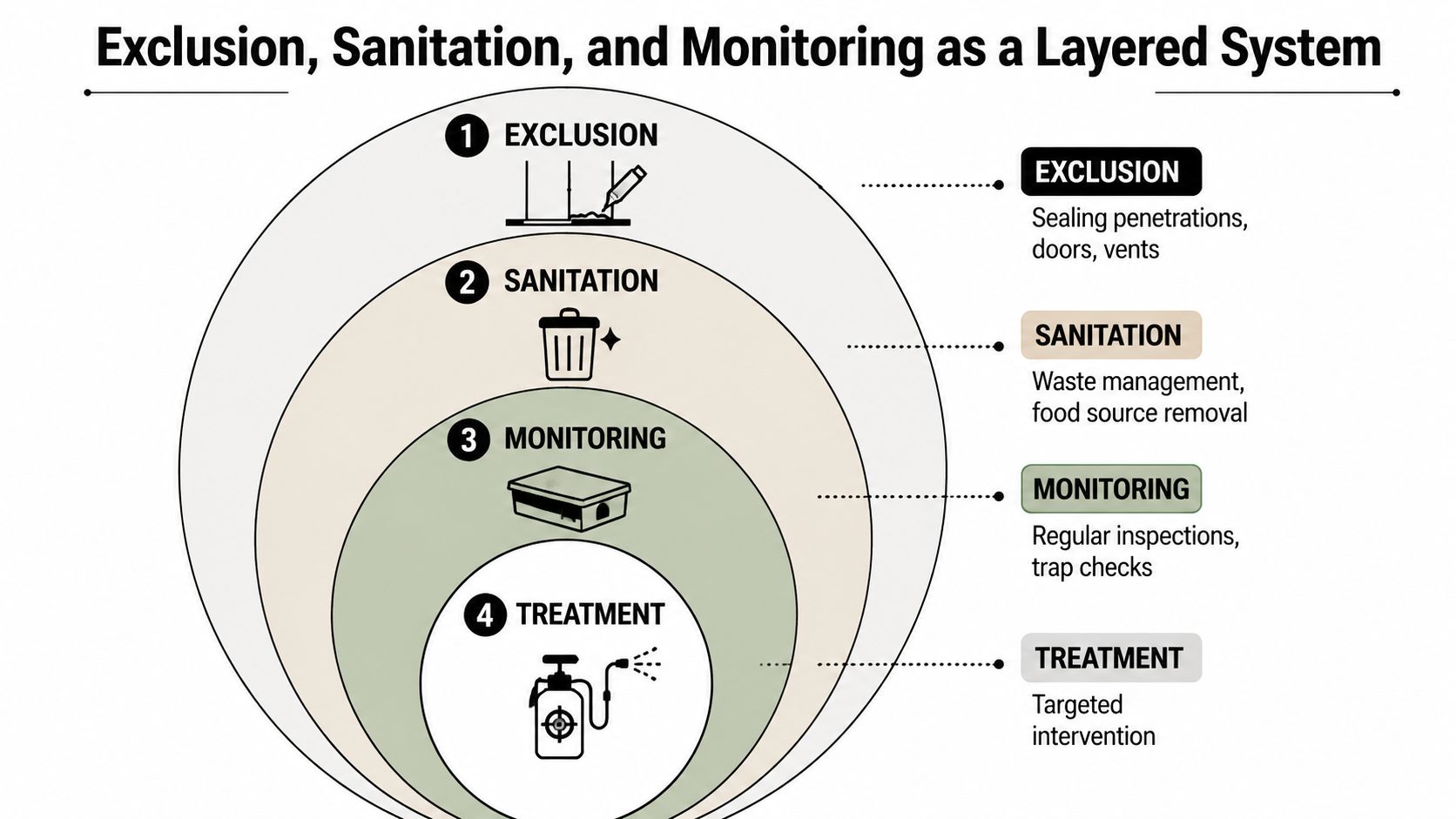
Four controls that support one another
Exclusion blocks the paths pests use to enter and move between spaces. Useful repairs include sealing utility penetrations, replacing worn door sweeps, closing wall openings, and securing rooftop vents. Stored tenant belongings can block a wall or mechanical area, so management must assign responsibility for clearing access and completing repairs. A technician can document the opening, but the property needs a process that turns that finding into corrective work.
Sanitation removes conditions that sustain activity. Dumpster placement, overflowing waste, food residue in recycling rooms, dirty floor drains, and unsealed trash can undermine treatment. Shared-space rules should be practical, posted, and enforced consistently. For recurring drain odors, moisture, or organic buildup, management may also arrange drain inspection services. Plumbing defects can maintain pest pressure after an apartment has been treated.
Monitoring supplies early warning instead of waiting for another complaint. Place sticky monitors along plumbing chases and other discreet travel routes. Bait stations may suit mechanical rooms or exterior areas when the product label permits their use and maintenance. A unit-by-unit log should record counts, dates, locations, and changes in activity, allowing staff to identify patterns across apartments and common areas.
Targeted treatment follows the evidence. Gel baits, crack-and-crevice applications, carefully placed dust, and limited perimeter work can address confirmed activity more precisely than broadcast spraying. Each record should identify the pest, location, product or method, reason for use, and required follow-up.
Where programs break down
Properties often inspect apartments while overlooking laundry rooms, trash areas, risers, storage spaces, and exterior entry points. Reliance on tenant reports alone delays detection and produces uneven information.
Residents need clear instructions on preparation, access, and early reporting. Management must coordinate access, correct building conditions, address common areas, and keep residents informed. The pest-management team must inspect, document, treat appropriately, and return to verify results.
Treatment Protocols That Hold Up Over Time
A treatment plan should function as an operating procedure, not a promise that one visit will end the problem. The first visit reduces active pressure and preserves the evidence needed to choose the next action across the property.
Start with targeted intervention
For cockroaches, a technician may place gel bait in suitable cracks, voids, and harborage areas, apply dust to appropriate wall cavities, and use limited perimeter treatment only where inspection supports it. Broad applications can create unnecessary exposure, miss hidden populations, and make later monitoring less reliable.
The service record should identify the species, exact location, observed activity, treatment method, product label information, tenant preparation notes, and access limitations. Use the same format at every visit. Management can then compare activity across apartments, common areas, and connected building spaces instead of trying to interpret unrelated service notes.
Build in reinspection
The community-wide IPM benchmark described in the Purdue study used repeated visits, with apartments revisited and treated biweekly or monthly for seven months. That schedule allows technicians to confirm bait acceptance, find newly active units, check monitors, and verify whether repairs or housekeeping changes were completed. Its study's reported cockroach and residue findings reinforce scheduled follow-up rather than dependence on a single service call.
During the first phase, inspections may occur more often. Once activity declines, management can shift to monthly or condition-based checks. Fresh captures, live sightings, new droppings, tenant reports, or signs of reinfestation should trigger another inspection, not an automatic building-wide spray.
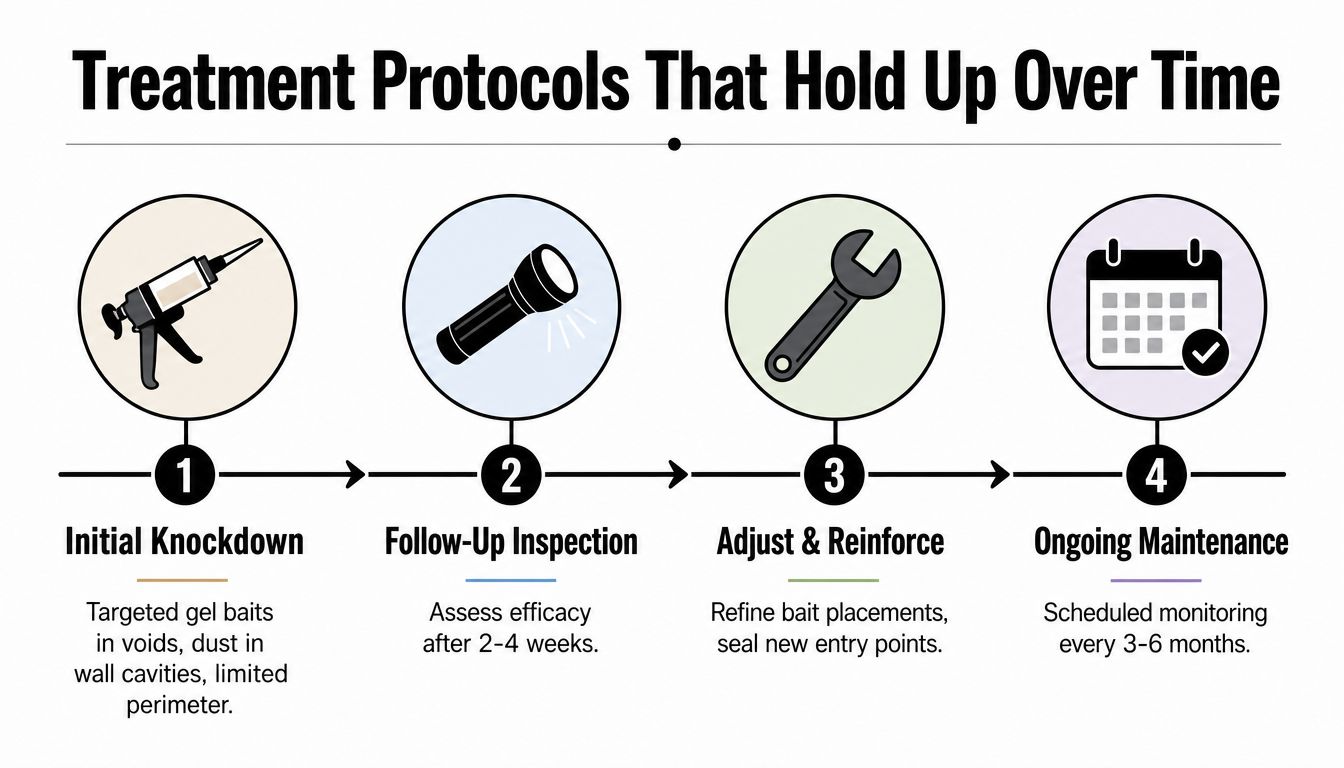
Define resolution clearly
A unit is not resolved because no pest appeared during one visit. Resolution requires monitoring to show declining or absent activity, correction of contributing conditions, reliable access, and no continuing source in neighboring or connected areas.
If activity remains, the next action may involve adjusting bait, inspecting further, repairing an entry point, correcting sanitation conditions, or checking adjacent units. The property manager should see that decision, its reason, and its follow-up date in the service record. Clear resident communication about preparation, access, and early reporting keeps the building-wide plan workable.
Eco-Friendly Pest Control Without Losing Effectiveness
Eco-friendly pest control isn't a ban on every chemical product. It's a disciplined effort to use the least disruptive effective method, in the right place, for a documented reason. Physical exclusion, sanitation, monitoring, baiting, and targeted applications can reduce dependence on broad spraying without leaving a property unprotected.
The Purdue community-wide IPM study reported that cockroach counts fell while detected pyrethroids also declined, from 6 ± 1 to 2 ± 1 in kitchens and from 5 ± 1 to 3 ± 1 in bedrooms, as documented in the research findings on targeted IPM. That result supports a practical point. Lower residue and stronger control can coexist when technicians replace routine broadcast applications with monitoring, baiting, sanitation, and targeted follow-up.
| Metric | Conventional Spray Program | Eco-Friendly IPM |
|---|---|---|
| Primary decision | Calendar or complaint driven | Inspection and monitoring driven |
| Product placement | May cover broad areas | Focused on confirmed routes and harborage |
| Prevention | Often secondary | Exclusion and sanitation are core parts |
| Follow-up | May depend on callbacks | Scheduled and evidence based |
| Chemical stewardship | Can create unnecessary applications | Uses targeted products where justified |
| Building responsibility | Frequently unclear | Assigns repairs, access, waste, and reporting duties |
Eco-friendly IPM may appear slower at the first visit because the technician spends time locating sources and correcting conditions. That work often shortens the total path to control by preventing repeated reinfestation. A quick spray can feel efficient while generating another complaint later.
Property managers should request current product labels, application records, technician licensing or certification information, monitoring documentation, and a written explanation of preparation and reentry requirements. The same attention to equipment and method that matters in professional window cleaners' tools and methods applies here as well. The visible result depends on the tools, the operator, and the process behind them.
What Working With The Green Advantage Looks Like
A serious apartment pest program starts with access and scope, not a generic appointment. The property manager should identify affected units, common areas, recent complaints, recurring work orders, photographs, leaks, renovations, and any access limitations before the technician arrives.
The Green Advantage is a family-owned pest control company serving Crown Point, IN and the broader Northwest Indiana community. Its residential and commercial pest control work includes general pest treatment, rodent control, termite services, pest inspections, mosquito reduction programs, and insect identification support.
Access and communication come first
The technician and property manager should agree on notice requirements, unit access, common-area access, privacy expectations, and the schedule for inspection or treatment. Residents need clear instructions about preparation, materials that may be used, areas that must remain accessible, and whom to contact if activity worsens or an appointment is missed.
That communication reduces confusion without blaming tenants. A resident may need to reduce clutter, clean food residue, report leaks, avoid moving infested items, or provide access. Building management remains responsible for shared spaces, waste handling, repairs, and conditions outside the resident's control.
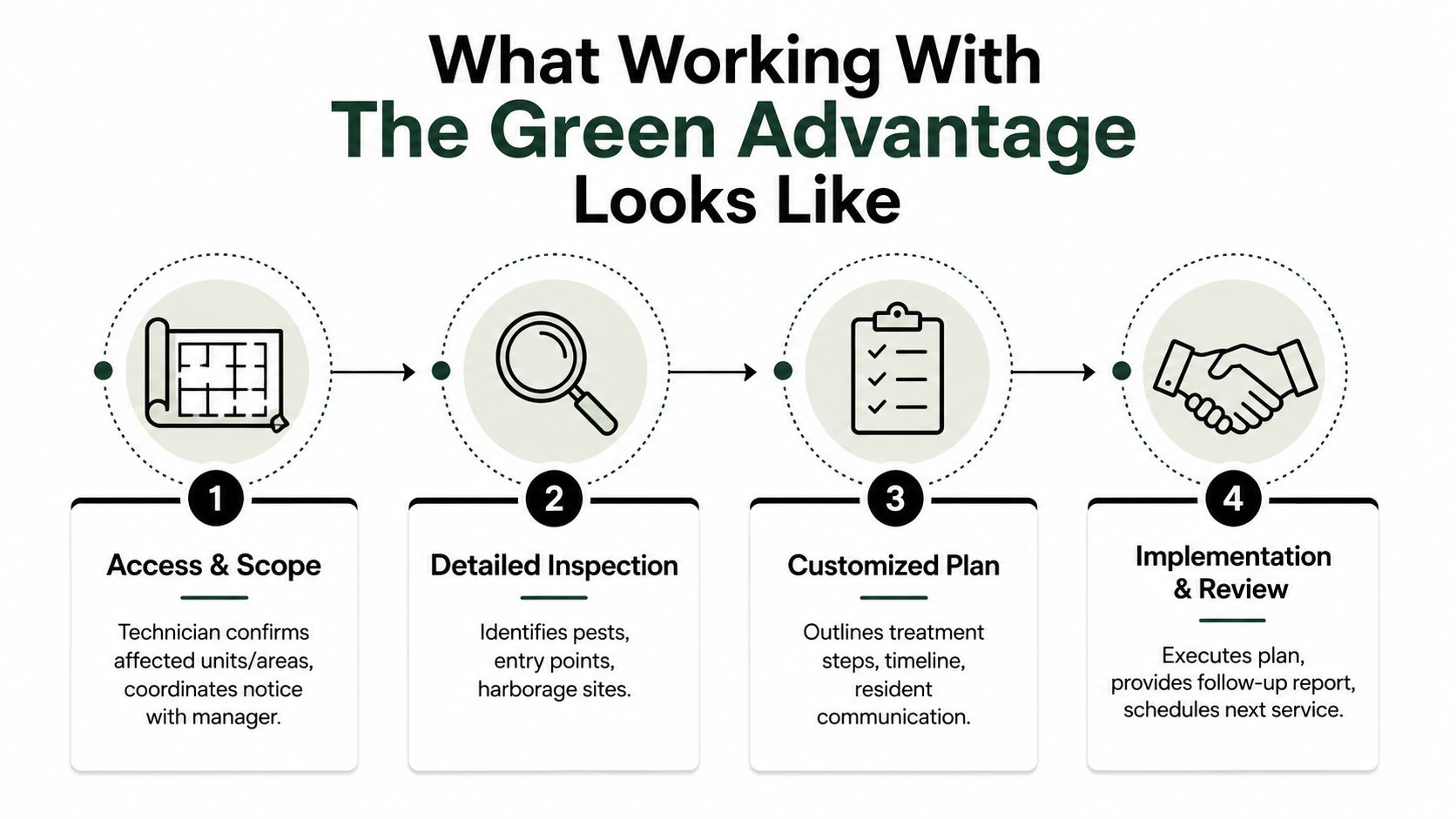
The initial visit should produce usable information
The first inspection should cover representative apartments when the property scope allows, then expand to every unit when activity, risk, or access requirements justify it. Hallways, laundry rooms, trash enclosures, mechanical rooms, storage areas, risers, and exterior entry points belong in the inspection record.
A useful report identifies:
- Pest activity: Species, signs, location, and apparent severity.
- Building pathways: Openings around pipes, conduits, vents, doors, and wall penetrations.
- Contributing conditions: Moisture, food residue, clutter, waste, leaks, and damaged surfaces.
- Treatment actions: Products or methods used, exact placement, and safety instructions.
- Outstanding work: Repairs, sanitation tasks, access needs, resident preparation, and next inspection dates.
Management should receive a written action plan covering exclusion, sanitation, monitoring, treatment, tenant notices, and reinspection. Service records, product labels, monitoring results, photographs, and corrective actions create accountability between residents, management, maintenance staff, and the pest-control provider.
Building conditions and resident duties must be separated
A tenant can keep food sealed and report activity quickly, but a tenant can't repair a shared plumbing chase or seal a gap behind a mechanical panel. Oregon rental guidance states that at the start of tenancy, housing must be safe, clean, sanitary, and free from rodents and vermin, and landlords must maintain common areas and repair conditions that could allow new infestations, as explained in the Oregon Law Help rental housing guidance. Requirements vary by location, so property managers should confirm applicable local rules.
For bed bugs, the EPA advises apartment residents to notify the landlord immediately because nearby units may need inspection and landlords may need to participate in treatment, according to the EPA guidance for residents. The EPA also says building management must participate diligently in bed bug control, and some researchers recommend treating adjacent units on both sides, above, and below, as described in the EPA guidance for landlords.
A professional program should be able to show what changed from one visit to the next, not just that someone arrived and applied a product.
One sighting doesn't always reveal the full source. Scheduling an inspection early gives the technician time to define affected areas, connected routes, contributing conditions, and sensible treatment boundaries. Acting before complaints multiply can limit disruption and keep a contained issue from becoming a building-wide burden.
The Green Advantage can help property managers, landlords, homeowners, and local businesses in Crown Point, IN and nearby Northwest Indiana service areas assess pest activity and build a practical treatment plan. Schedule an apartment-building inspection with The Green Advantage to identify affected units, shared pathways, and prevention work before a small pest complaint spreads.
How to Prevent Roaches in Apartment: Crown Point Guide

Finding one roach in your apartment can ruin your whole morning. You turn on the kitchen light, see something move near the coffee maker, and suddenly you are wondering what is behind the stove, under the sink, or inside the wall next to your neighbor’s unit.
That stress is common in apartment living across Crown Point and Northwest Indiana. Shared walls, pipe openings, hallway traffic, older utility penetrations, and seasonal weather shifts all give roaches more ways to move than they would have in a detached home. The good news is that prevention is possible. It just takes the right mix of inspection, sealing, daily habits, and knowing when a problem has moved beyond do-it-yourself control.
Your Local Guide to Roach Prevention in Crown Point Apartments
If you live in an apartment, roach prevention has to be approached differently. In a single-family home, you usually control the whole structure. In an apartment, you only control your unit, while pests can still travel through walls, under doors, around plumbing lines, and through shared utility spaces.

That is why people get frustrated. They clean thoroughly, take the trash out, wipe the counters, and still see activity. In many cases, that is not because they are doing anything wrong. Approximately 11.3% of U.S. housing units report seeing roaches annually, with apartments and renter-occupied units facing significantly higher risks due to shared walls and structural vulnerabilities that allow pests to travel easily between homes, according to the U.S. Census Bureau.
Why apartments in Northwest Indiana can be tricky
Crown Point apartments deal with the same pressures seen across Northwest Indiana. Weather changes push pests to look for stable shelter. Utility rooms stay warm. Moisture around kitchens, bathrooms, and laundry areas gives roaches what they need to survive. In multi-unit buildings, one neglected leak or one open trash area can affect more than one family.
A lot of renters assume prevention means spraying something under the sink and hoping for the best. That usually is not the answer. Roach prevention works better when you think like a technician and ask a few practical questions:
- Where are they getting water
- Where are they hiding during the day
- How are they moving in and out of the unit
- What conditions inside the apartment make it easy for them to stay
What works
The most reliable way to learn how to prevent roaches in apartment settings is to stop treating the problem like a mystery. Roaches need food, moisture, shelter, and access. If you make those four things harder to get, you change the unit from easy habitat to difficult habitat.
A clean apartment helps, but a fortified apartment helps more.
That means checking hidden areas, sealing obvious entry points, managing clutter, drying damp zones, and using targeted control when needed. It also means documenting building-related issues so management has something specific to act on instead of a general complaint.
Residents in Crown Point often feel stuck between “do it yourself” and “call somebody right away.” In reality, there is a useful middle ground. You can do a careful inspection, tighten up your unit, improve your routine, and spot the signs that tell you a larger building-wide problem is underway.
Your Apartment Roach Inspection Checklist
Many residents only inspect the places they can see standing up. Roaches spend most of their time where people rarely look. A useful inspection is slow, close-up, and focused on heat, moisture, crumbs, and dark shelter.
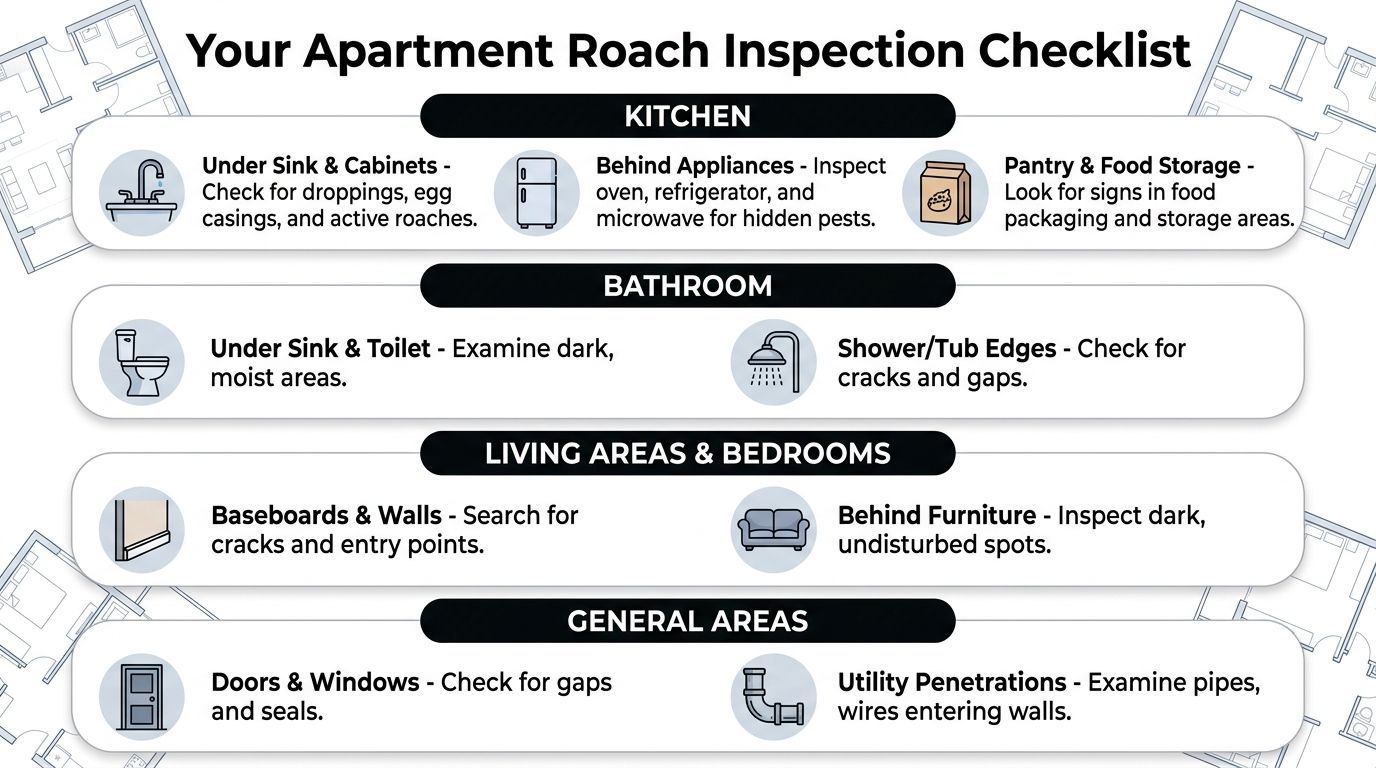
Start in the kitchen
The kitchen is the first place I would check in almost any apartment.
Pull a flashlight out and inspect under the sink first. Look around the pipe openings where drain lines and supply lines disappear into the wall. Check the cabinet floor, the back corners, and the underside of the sink lip. You are looking for live roaches, pepper-like droppings, egg cases, staining, or a stale musty odor.
Then move to the appliances.
- Behind the refrigerator. Warm motor area, crumbs, and hard-to-clean dust make this a common hiding spot.
- Around the stove. Check the sides, the back, and the drawer area if your unit has one.
- Inside lower cabinets. Pay attention to hinge corners and shelf pin holes.
- Pantry shelves. Look at food packaging, especially opened dry goods and pet food.
Roaches thrive on crumbs, spills, and standing water. Regular cleaning, wiping counters, and storing food in airtight containers drastically reduces attractants. Because they require water, fixing even minor leaks in kitchens and bathrooms is a critical prevention step, as noted in this housing and health research from the National Center for Healthy Housing archive.
If you want a fuller breakdown of food and moisture triggers, this page on what attracts cockroaches to your home is a useful companion to your inspection.
Check the bathroom like a plumber would
Bathrooms often get overlooked because there may not be much food there. Roaches still like them because water matters more than people realize.
Inspect these spots carefully:
- Under the bathroom sink. Focus on pipe entry holes, cabinet corners, and leaks.
- Around the toilet base. Look for gaps where plumbing passes through the wall or floor.
- Tub and shower edges. Check for cracked caulk, soft drywall, or hidden moisture.
- Exhaust fan area and nearby walls. Humidity can keep these zones favorable.
A small drip under a sink can support activity for longer than tenants expect. If the cabinet floor feels damp, warped, or stained, treat that as a pest issue and a maintenance issue at the same time.
Inspect living rooms, closets, and bedrooms
People tend to assume roaches stay only in kitchens. Light activity often starts there, but established infestations spread.
Use a flashlight along:
- Baseboards
- Corners of closets
- Behind furniture that rarely moves
- Around outlet covers and cable openings
- Window frames and sliding door tracks
You do not need to tear the room apart. Just focus on quiet, dark, undisturbed areas where a roach can flatten itself against a surface.
What signs matter most
Some findings deserve more attention than others. This quick table helps sort that out.
| Sign | What it often means | What to do next |
|---|---|---|
| Live roach at night in kitchen | Early or moderate activity | Inspect moisture and food sources, start sealing gaps |
| Roaches seen in several rooms | Movement through wall voids or larger infestation | Document locations and notify management |
| Droppings in cabinets or drawers | Regular harboring nearby | Empty area, clean thoroughly, inspect cracks |
| Egg cases | Active reproduction nearby | Increase urgency, especially in multi-unit buildings |
| Musty odor in hidden spaces | Established harboring | Check adjacent walls, appliances, and voids |
Inspect with your phone camera too. A close photo of pipe gaps, droppings, or damaged caulk gives you a better record when you talk to maintenance.
General areas people miss
A final pass should include the spots that connect your apartment to the rest of the building.
Check:
- Front door threshold
- Door sweep condition
- Window screens and frame gaps
- Laundry hookups
- Utility penetrations behind washer or water heater closet if accessible
This kind of inspection does two things. It helps you find active problems, and it helps you find vulnerabilities before roaches use them.
How to Seal Your Apartment and Block Roach Entry Points
If inspection tells you where the weak spots are, sealing is what turns that knowledge into protection. In apartment buildings, exclusion is not optional. It is one of the main things that keeps a neighbor’s problem from becoming your problem.
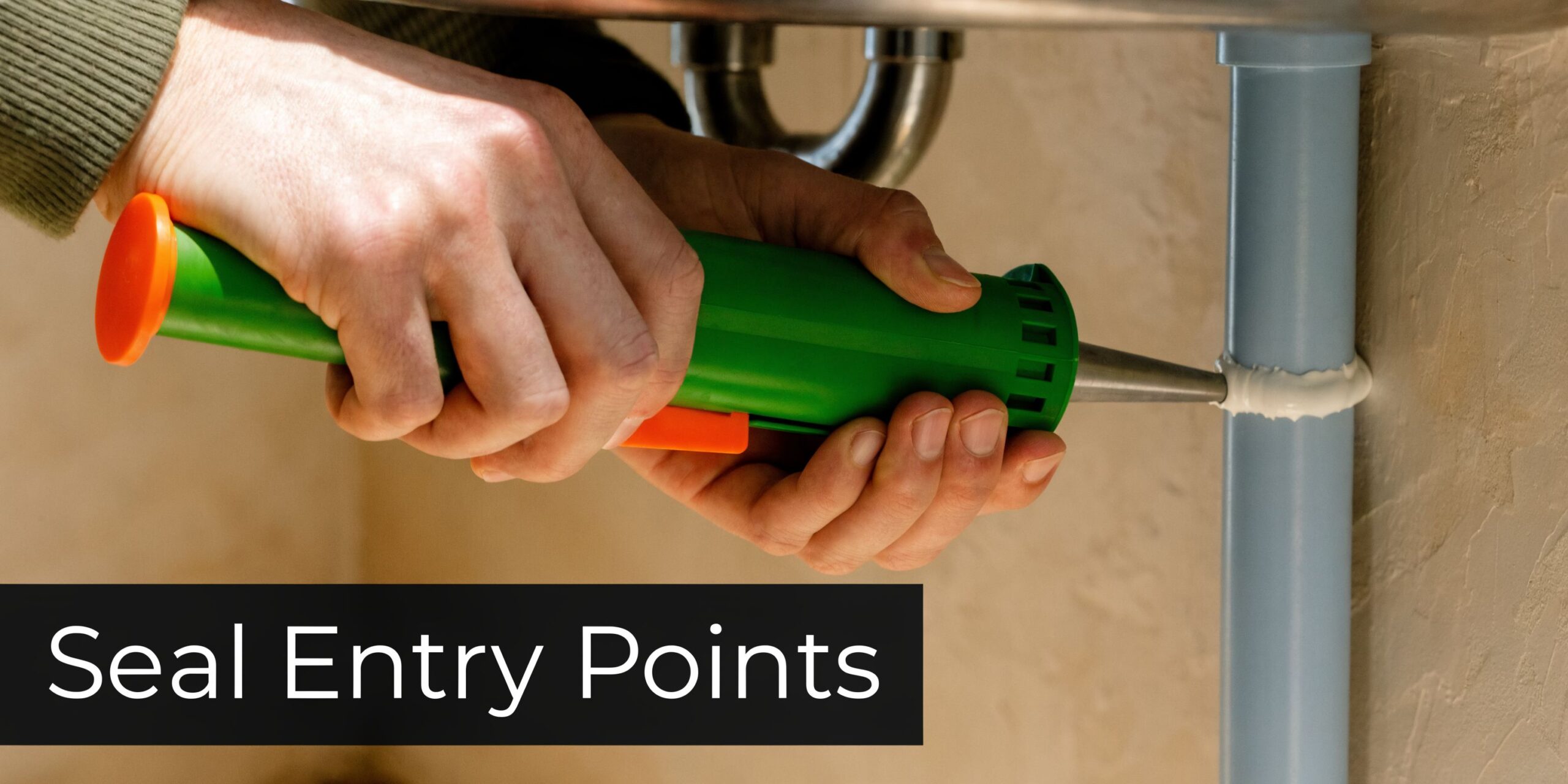
Proactive sealing of gaps and cracks can prevent 80-90% of cockroach reinfestations in multi-unit housing by blocking migration from neighboring units. Roaches can squeeze through gaps as small as 1/16-inch, making thorough exclusion essential, according to this article on multifamily cockroach prevention from Apartment Pest Experts.
Focus on the highest-value gaps first
Not every crack matters equally. In apartments, the most important openings are the ones around shared utility routes.
Start with:
- Pipe openings under sinks
- Gaps where supply lines enter the wall
- Openings around gas lines and appliance hookups
- Baseboard separations in kitchens and bathrooms
- Voids under cabinets where plumbing or wiring passes through
- Gaps around outlet covers on shared walls
For small stationary gaps, acrylic latex or silicone caulk usually does the job. For larger openings around pipes, copper mesh or steel wool can help fill the void before sealing. If a pipe opening has a missing trim ring, adding an escutcheon plate can close a gap that tenants often ignore for years.
Materials that make sense in an apartment
Here is the practical version.
| Area | Best first choice | Why it works |
|---|---|---|
| Small wall or trim cracks | Caulk | Clean finish and easy application |
| Larger pipe gaps | Copper mesh plus sealant | Fills space and resists easy passage |
| Under entry doors | Door sweep | Blocks hallway migration |
| Window and vent openings | Tight screens | Reduces pest entry from outside and shared areas |
| Missing pipe trim | Escutcheon plate | Covers a common ring-shaped gap |
Some renters ask whether expanding foam is useful. It can have a place for certain voids, but it is not a cure-all. If you are comparing options for larger gaps, this guide on spray foam insulation keep mice out gives a helpful way to think about where foam helps and where a more complete exclusion detail is still needed.
Seal in a smart order
Work in a loop instead of jumping around.
First, seal the kitchen sink cabinet. Then move to the bathroom sink. Then the toilet supply line area. Then the stove and refrigerator wall. Then your entry door. That sequence handles the most common travel routes first.
A few practical cautions matter:
- Do not seal around anything you are not allowed to alter if your lease forbids it.
- Do not block ventilation that is meant to stay open.
- Do not ignore active leaks. Sealing around a wet area without fixing the moisture leaves part of the problem in place.
What to ask management to handle
Tenants can handle many minor gaps. Building-level defects usually need maintenance.
Ask management to address:
- Broken door sweeps in common hallways
- Damaged weatherstripping
- Large plumbing penetrations
- Missing wall patching after repairs
- Chronic leaks under sinks or behind walls
- Cracks near shared trash or utility areas
Be specific. “I found open pipe gaps under the kitchen sink and around the bathroom supply line” gets a better response than “I think bugs are getting in.”
This video gives a useful visual on sealing and blocking access points in tight spaces.
If you can see daylight under the apartment door or around a service penetration, assume a roach can use it too.
Sealing does not eliminate an existing infestation by itself. It does something just as important. It slows movement, limits re-entry, and gives every other prevention step a better chance to work.
Daily Habits and Routines for a Roach-Free Apartment
Good prevention comes from boring routines done consistently. That is true in houses, and it is even more true in apartments where one overlooked habit can give roaches a steady food or water source every night.

The goal is not perfection. The goal is to make your unit consistently inconvenient for pests.
Night routines matter most
Roaches do most of their foraging when your apartment is quiet and dark. That makes your evening routine more important than your afternoon cleanup.
A solid nightly routine looks like this:
- Wash dishes or load the dishwasher. Do not leave plates in the sink overnight.
- Wipe counters and stovetop. Grease film and crumbs count.
- Empty standing water. Check the sink basin, dish rack tray, and pet bowls.
- Bag trash securely. Use a bin with a lid if possible.
- Pick up pet food. Open bowls left out overnight are an easy meal.
For readers who want help building steadier household systems, these simple, actionable cleaning habits and routines can make the day-to-day side of prevention easier to stick with.
Clutter control is more than tidiness
Roaches do not just eat around clutter. They live in it.
Cardboard boxes, stacks of paper, grocery bags, and rarely opened storage piles give them cover. In apartments, that matters because clutter near a shared wall or utility line can turn a travel path into a resting area.
Try these adjustments:
- Replace cardboard storage with plastic bins
- Keep the floor clear under sinks
- Avoid paper piles in closets
- Break down delivery boxes quickly
- Do not store unused small appliances with crumbs inside them
What if the neighbors are the primary source
This is the part most generic articles skip. A tenant can do many things right and still get activity from another unit.
Even a perfectly clean apartment can become infested if roaches travel from neighboring units through shared plumbing and wall voids. In such cases, using targeted gel baits in your unit can be more effective than cleaning alone, as roaches share the bait and spread it through the colony, as explained in this article on how roaches travel between floors and units from Combat Bugs.
That changes the strategy.
If you suspect migration from another unit, focus on three actions at once:
- Keep up the cleaning habits
- Maintain the exclusion work
- Use targeted bait placements in protected spots rather than random spraying
Small gel bait placements behind the refrigerator, behind the stove, and in hidden cabinet corners make more sense than coating baseboards with aerosol products. The baits stay where roaches travel. Sprays often push them deeper into walls or into adjacent rooms.
A realistic apartment routine
A weekly rhythm usually works better than waiting for a “deep clean day.”
| Frequency | Focus |
|---|---|
| Nightly | Dishes, wipe-down, trash, pet food pickup |
| Twice weekly | Check under sinks for moisture, sweep appliance edges |
| Weekly | Vacuum pantry, wipe cabinet shelves, inspect baseboards |
| Monthly | Pull out movable appliances, review seals and door gaps |
In apartments, consistency beats intensity. Fifteen minutes repeated is more useful than one huge cleanup after activity has already spread.
In preventing roaches in apartment living, these routines often lead to significant success. Not from one dramatic product. From ordinary routines that remove easy access to food, water, hiding places, and nighttime comfort.
When to Call a Professional Exterminator in Crown Point IN
There is a point where prevention and light DIY work are no longer enough. The hard part is recognizing that point early, before the problem gets entrenched inside walls, cabinets, and neighboring units.
A single sighting does not always mean a severe infestation. Repeated sightings in more than one room, daytime sightings, or activity that returns after you clean and seal are different. Those are the situations that justify professional help.
Signs the problem has moved beyond casual DIY
These signs usually mean you are not dealing with an isolated straggler:
- You see roaches during the day
- You find activity in the kitchen and bathroom
- You are spotting droppings or egg cases
- The same areas stay active after sealing and cleaning
- You believe the issue involves neighboring units or shared walls
At that point, over-the-counter sprays often make things worse. Tenants use them because they feel quick and visible. In practice, they can scatter roaches into new hiding spots, contaminate bait placements, and create a cycle where the apartment smells treated but the infestation keeps going.
Why professional IPM works better
Integrated Pest Management, or IPM, distinguishes itself from basic spray service through this approach.
Integrated Pest Management protocols are proven to be significantly more effective than traditional spraying, achieving 3.1 times higher odds of reducing cockroach populations. This approach combines inspection, sanitation, exclusion, and targeted treatments for long-term control, according to a study available through the National Library of Medicine.
That approach fits apartment work because apartments are systems, not isolated boxes. A technician has to look at activity, access, harborage, sanitation, and migration together.
What a technician may use instead of broad spraying
Professional roach control usually relies on targeted tools placed with intention.
| Method | Best use | Why it helps |
|---|---|---|
| Gel baits | Hidden travel routes and harborages | Roaches feed in concealed areas where sprays do not reach well |
| Dusts in voids | Wall gaps and penetrations | Helps treat spaces between units |
| Insect growth regulators | Breeding interruption | Supports longer-term suppression |
| Monitoring devices | Kitchens, baths, utility areas | Confirms where activity is centered |
This is also why a property-wide or at least building-aware response matters. If one tenant gets a quick spray while neighboring units stay untreated and unsealed, the pressure often just shifts around the structure.
For homeowners and renters who want more detail on treatment options, this guide on how to get rid of cockroaches gives a fuller look at what control typically involves.
What to expect from a real service visit
A useful pest service should not start and end with a can in hand.
A technician should inspect the likely harborages, ask about where and when you have seen activity, look for moisture, point out structural gaps, and explain what you can do between visits. In apartment settings, they should also be honest about the building-wide side of the issue. If the source appears to be in wall voids or nearby units, that needs to be said clearly.
One practical option for residents and property managers in Northwest Indiana is The Green Advantage, which provides residential pest control and commercial pest control services in Crown Point, IN using targeted pest management methods for issues like cockroaches, along with support for related problems such as ant control and rodent control.
When to stop trying random products
If you have already bought multiple store products and the pattern keeps repeating, that is your answer. Random product switching is not a plan. It is usually a sign that the infestation has structure behind it.
If roaches keep returning after cleaning, sealing, and careful baiting, the underlying problem is often inside the building envelope, not just on your kitchen floor.
Calling a professional exterminator near me is not about giving up. It is about shortening the problem and avoiding the common mistakes that let it spread.
Your Partnership with The Green Advantage Pest Control
The easiest service experience is the one that feels clear from the first call. Individuals who contact a pest company generally are not looking for a lecture. They want to know what is happening, what can be done, and what they should expect next.
That is especially true with apartment roach issues. Tenants are often juggling a landlord, a lease, neighbors, children, pets, and the discomfort of seeing pests where they cook and sleep.
What the process should feel like
A good first conversation should narrow things down quickly.
You describe where you have seen activity, whether it is mainly in the kitchen or bathroom, whether you have noticed droppings or odors, and whether the building has any ongoing leak or maintenance issues. That helps set expectations before a visit is even scheduled.
From there, a technician should arrive ready to inspect, not just treat. In apartment work, details matter. A small pipe gap behind the sink, a missing sweep under the hall door, or chronic moisture inside a cabinet can say more than a broad visual pass through the room.
What clear communication looks like
People trust service when they know why something is being recommended.
That means hearing plain explanations such as:
- These are the most likely entry points
- This part is a sanitation issue
- This part is a building maintenance issue
- This area needs monitoring after treatment
- This product placement should stay undisturbed
That kind of communication helps tenants talk to property managers with confidence. It also helps owners and managers understand whether they are dealing with an isolated unit issue or a wider structural pattern.
The most useful pest visit leaves you with fewer surprises, not more.
Why follow-up matters in apartments
Apartment pest control is rarely a one-moment event. It works better as a sequence.
An initial visit identifies the pressure points. Treatment addresses active areas. Follow-up confirms whether activity is dropping, whether migration is still happening, and whether sanitation or maintenance corrections have been completed.
That follow-up matters because apartment conditions change quickly. A repaired leak helps. A new tenant next door can change the situation again. A vacancy, a renovation opening, or trash room issue can shift activity across a floor.
A local service relationship goes further
In Crown Point and the rest of Northwest Indiana, people usually want practical answers from people who understand local housing conditions. Older buildings, newer complexes, mixed-use properties, and seasonal changes all influence how pest issues play out.
A family-owned company serving the local area should understand that pest control is not just about killing insects. It is about protecting comfort, keeping homes usable, and helping people feel settled again. That same mindset often matters across other services too, including mosquito control, rodent control, termite concerns, spider issues, and routine preventative pest treatments.
If you are a renter, a property manager, or a business owner dealing with recurring roach pressure, the right partnership should feel straightforward. You should know what was found, what was treated, what still needs to be sealed or repaired, and what results to watch for next.
If you are dealing with roaches in an apartment and want a practical next step, contact The Green Advantage for a pest inspection or quote in Crown Point, IN and nearby Northwest Indiana service areas. A clear inspection, honest recommendations, and a building-aware treatment plan can help you protect your space and get back to feeling comfortable at home.