
You notice ants moving along the kitchen baseboard, find mouse droppings near the garage door, or see mosquitoes gathering around a clogged gutter. By the time pests become obvious, the conditions supporting them have often been present for weeks or longer. Preventative pest control gives Crown Point homeowners and businesses a better option, one built on inspection, exclusion, sanitation, monitoring, and targeted treatment instead of automatic spraying.
The Green Advantage serves Crown Point, IN and surrounding Northwest Indiana communities with licensed, certified residential and commercial pest control. The practical goal is simple: keep pests outside, identify risk early, use fewer unnecessary chemicals, and protect your property, health, and peace of mind.
Why Crown Point Homeowners Are Choosing Prevention Over Reaction
A homeowner in Crown Point may first notice ants in early spring, when warming weather exposes small entry points around a foundation or kitchen window. Another may discover mouse droppings in the garage after the first cold snap, when rodents start searching for indoor shelter. Neither problem begins with the first visible sign. The sighting is usually the point at which a hidden opportunity, such as food, moisture, shelter, or an unsealed gap, has become useful to pests.
Reactive service treats the visible problem. Preventative pest control in Crown Point, IN looks for the reason pests arrived and removes that reason before activity expands. The approach follows integrated pest management, or IPM, which prioritizes preventing pests from becoming a threat before relying on chemical treatment. The EPA's documented IPM example identifies prevention, monitoring, exclusion, sanitation, and selective control as practical ways to reduce pest activity and unnecessary pesticide exposure.
Prevention starts with evidence
A good prevention plan doesn't promise that a property will never have a pest sighting. It establishes what counts as meaningful activity, where technicians need to inspect, and which repairs or sanitation steps deserve priority.
For a Crown Point home, that may mean checking door sweeps, utility penetrations, screens, crawl-space vents, gutters, moisture sources, and garage storage. For a local business, it may include loading areas, waste storage, exterior doors, drainage, and concealed service spaces. Landlords need a repeatable process across units, not a different guess for every complaint.
The Green Advantage was built around this local, prevention-first model for homeowners, landlords, and businesses in Crown Point and nearby Northwest Indiana communities. Fewer pests and fewer unnecessary treatments are not separate goals. They come from managing the building and grounds before an infestation becomes difficult to control.
Practical rule: Treat the conditions that attract pests, not just the pests you can see.
What Preventative Pest Control Actually Means
Preventative pest control is the building-envelope checkup before pest pressure becomes an infestation. It isn't the same as applying a product on a fixed schedule and hoping the problem stays away. A structured plan uses integrated pest management to identify risk, monitor activity, correct conditions, and intervene only when evidence supports action.
The EPA's building IPM guidance treats monitoring and documented evaluation as core parts of successful pest management. Its practical logic is straightforward. Pests need food, water, nesting places, and shelter. Remove or restrict those resources, and the property becomes harder to establish in.
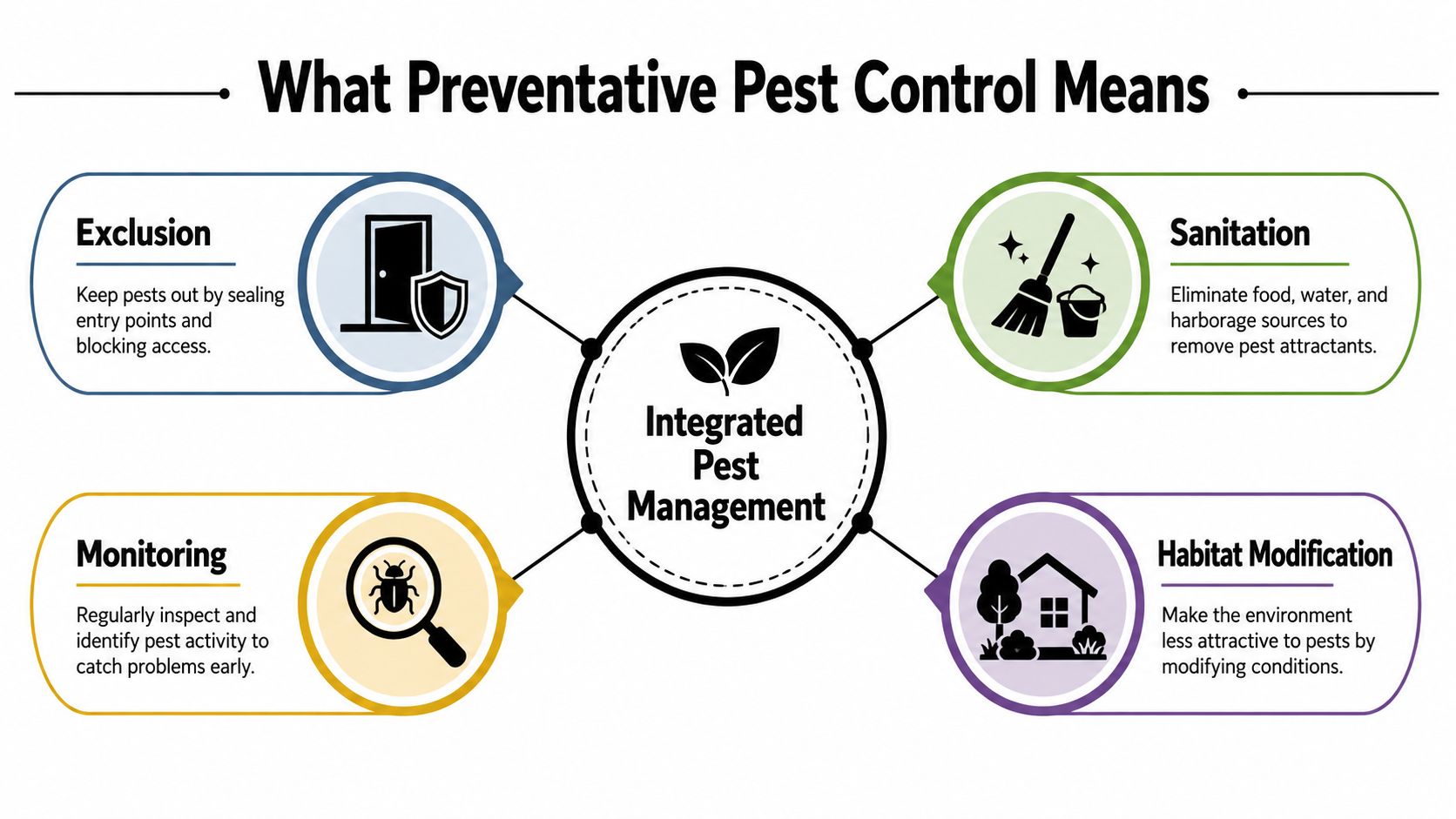
Four working parts of a prevention plan
Inspection identifies vulnerable areas and establishes a baseline. A technician looks for droppings, gnaw marks, nests, trails, moisture, damaged screens, cracks, clutter, and other evidence. Accurate pest identification matters because ants, rodents, termites, mosquitoes, and wasps require different responses.
Exclusion blocks entry. Sealing cracks, repairing screens, improving door sweeps, and closing openings around pipes and vents can prevent pests from using the structure as shelter.
Sanitation and habitat correction remove resources. Food should be stored in sealed containers, garbage should stay closed, leaks should be repaired, and clutter or standing water should not remain available to pests.
Monitoring and targeted treatment connect action to evidence. Sticky traps, pheromone traps, visual inspections, and documented findings show whether activity is increasing, declining, or absent. A plan then uses an action threshold, the level at which pest activity creates a nuisance, health concern, or economic risk.
That framework is explained in greater detail in what integrated pest management means. The key point is that prevention isn't synonymous with monthly spraying. A property may need no pesticide treatment after an inspection, or it may need a carefully placed bait, trap, or other targeted control because monitoring shows a justified risk.
DIY Prevention Versus Professional Service in Crown Point
Homeowners can handle many useful prevention tasks. Seal accessible gaps with appropriate materials, keep food in sealed containers, close trash and compost, trim vegetation away from the structure, correct leaks, and empty water-holding containers regularly. These actions reduce the food, water, shelter, and entry routes that support common household pests.
The CDC's rodent guidance recommends sealing holes and gaps larger than approximately 1/4 inch in diameter, including openings around foundations, doors, windows, pipes, vents, and utility penetrations. It also recommends durable materials such as cement, mortar, metal sheeting, or appropriately sized hardware cloth because weak temporary repairs may not withstand rodent activity.
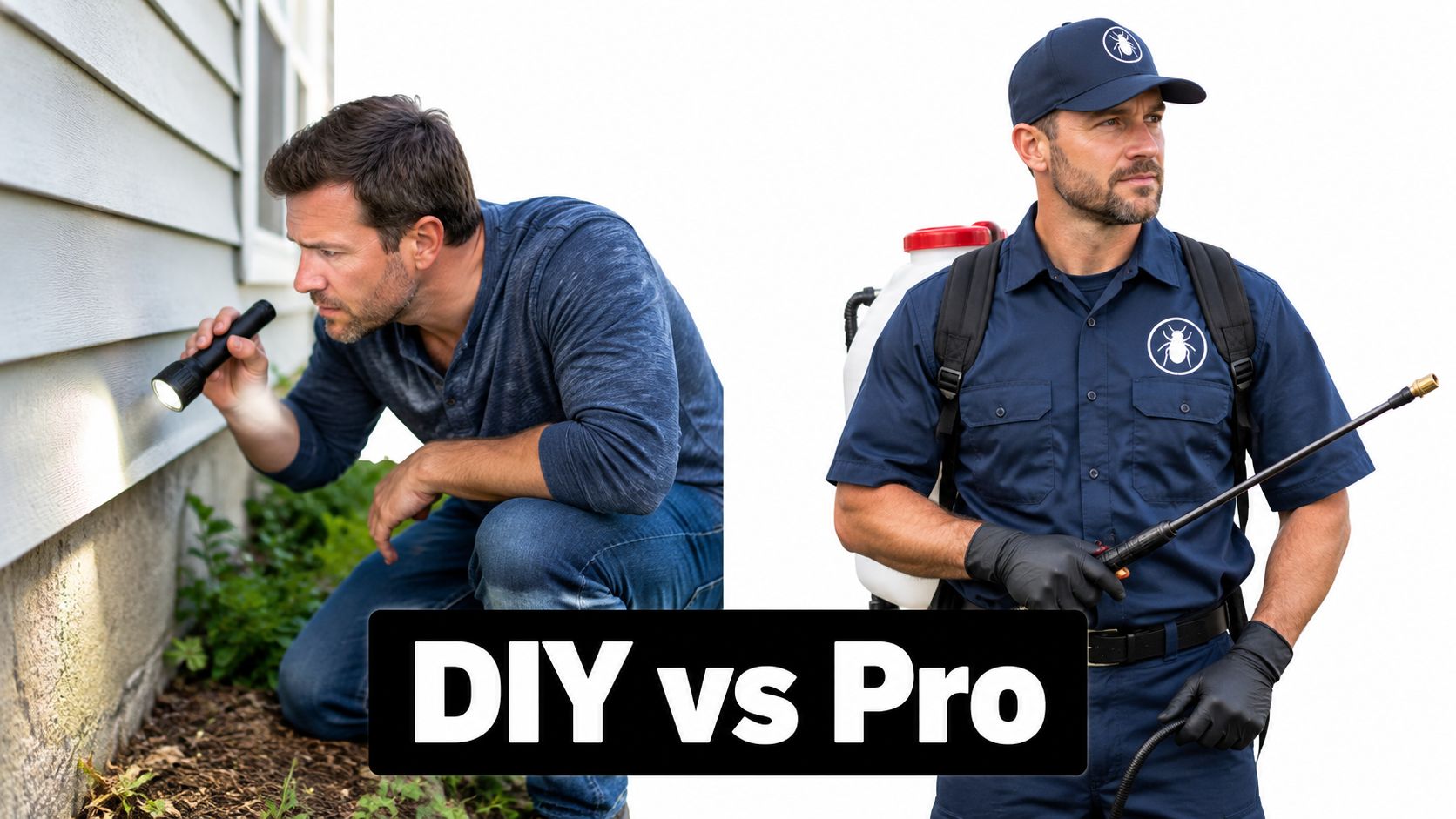
Where DIY works well
DIY maintenance is a strong first line of defense when the risk is visible and accessible.
- Seal entry points: Check door thresholds, screens, foundation penetrations, and openings around utility lines.
- Remove resources: Store food correctly, close garbage, clean spills, and eliminate unnecessary clutter.
- Manage water: Empty containers, correct leaks, clean gutters, and improve drainage.
- Watch for evidence: Record where you find droppings, trails, nests, damaged wood, or repeated sightings.
DIY becomes less reliable when the source is concealed. Termites can remain hidden in structural wood, rodents may travel through attic or wall voids, and moisture can persist behind walls or under fixtures. Spraying a visible ant trail won't necessarily correct the entry route, and placing a trap without identifying the path may produce an isolated result rather than a durable solution.
When professional service earns its place
Professional residential pest control adds site mapping, species identification, documented monitoring, follow-up, and treatment decisions based on findings. That combination matters more for landlords managing multiple units, businesses facing sanitation or health-code exposure, and homeowners who need a repeatable plan rather than occasional product use.
The Green Advantage provides residential and commercial pest control in Crown Point with inspection and IPM planning that can combine exclusion, monitoring, sanitation, habitat correction, and targeted treatment. DIY maintenance still matters. Professional service makes those efforts more reliable when the property is complex, the pest is hidden, or activity keeps returning.
A Seasonal Prevention Calendar for Northwest Indiana
Northwest Indiana pest pressure changes with weather and property conditions. A useful prevention calendar doesn't treat every month identically. It concentrates attention when local homes, yards, commercial properties, and drainage features create the greatest opportunity for pests.
Spring
Inspect the foundation, roofline, screens, utility penetrations, and mulch or vegetation near the structure. Ant activity often becomes easier to spot as temperatures rise, while termite swarmers deserve prompt inspection rather than a quick dismissal. Clean gutters and look for moisture that can support insects or attract other pests.
Summer
Mosquito prevention starts with water management, not broad spraying alone. The CDC's home mosquito guidance recommends emptying and scrubbing, turning over, covering, or discarding water-holding items once a week, including tires, buckets, planters, toys, pools, birdbaths, flowerpot saucers, and trash containers.
The CDC also advises keeping stormwater structures from holding water for more than 72 hours whenever possible, because longer retention can create mosquito-breeding habitat. Property managers, schools, homeowner associations, and businesses should inspect low spots, retention features, ornamental water, drainage structures, and areas near patios or play spaces.
Late summer
Check eaves, roof overhangs, sheds, decks, and landscaping for wasp or yellowjacket nests. Don't disturb an active nest casually. A professional can identify the pest, evaluate the location, and select nest removal or targeted treatment appropriate to the site.
Fall and winter
Before cold weather settles in, inspect for rodent entry around the garage, foundation, vents, doors, and utility lines. Store pet food and bird seed securely, close trash and compost, and correct leaks or standing water. Rodents seek warmth and shelter, so exclusion before entry is more effective than waiting for droppings inside.
A seasonal visit should review the conditions that changed since the previous inspection, not just repeat the same treatment. The Green Advantage aligns quarterly general pest control visits with seasonal service windows, beginning with an initial service followed by three regular visits through the year. Customers should know what the technician is checking, what was found, and which corrections matter before the next visit.
Matching the Right Method to Common Local Pests
A pest sighting doesn't automatically justify the same treatment used for a different species. Indiana's IDEM IPM guidance identifies exclusion, sanitation, monitoring, mechanical controls, improved maintenance, and carefully selected pesticide use as parts of an integrated approach.
| Pest | Primary Prevention Method | Homeowner Action | When to Call a Professional |
|---|---|---|---|
| Rodents | Exclusion and habitat modification | Seal openings, close food and trash containers, remove shelter, and correct leaks | Call when droppings, gnaw marks, scratching, or repeated entry signs continue |
| Ants | Sanitation and crack-and-crevice baiting | Clean food residue, seal openings, and address moisture | Call when trails return, colonies are concealed, or activity spreads indoors |
| Termites | Moisture management and wood-contact correction | Keep wood and debris away from the structure and correct moisture sources | Call for swarmers, shed wings, damaged wood, or suspected structural activity |
| Mosquitoes | Source reduction and monitoring | Empty or cover water-holding containers and inspect after rainfall | Call when breeding areas persist or outdoor use remains heavily affected |
| Wasps | Nest identification and targeted removal | Keep distance from active nests and avoid disturbing them | Call when nests are near doors, play areas, rooflines, or high-traffic spaces |
The decision should follow the evidence
For rodents, exclusion has priority because removing access to food, water, and shelter reduces the conditions that allow indoor populations to establish. For ants, sanitation and carefully placed crack-and-crevice baits can make more sense than spraying exposed surfaces. For termites, a visible sign may justify a focused inspection because surface treatment alone doesn't explain what is happening inside structural wood.
Mosquito control also needs a split decision. Remove breeding sources first. If water can't be eliminated, monitoring and targeted larval control may be more appropriate than repeated adulticide applications. Wasp service should focus on the nest location, species, and exposure risk.
This is why a technician should not arrive with one answer for every property. The inspection determines whether the right next step is a repair, a trap, a bait, source reduction, nest removal, or a carefully selected pesticide.
Eco-Conscious Approaches That Actually Reduce Risk
A Crown Point property does not need a calendar of automatic sprays. It needs a threshold-based plan tied to documented evidence. The Green Advantage should first identify what makes the property attractive to pests, record activity, and recommend treatment only when conditions or pest levels justify it.
The EPA's guidance on safer pest control supports integrated pest management because pesticides can affect people, animals, and the environment. Start with exclusion, sanitation, moisture correction, habitat management, and monitoring. Add reduced-risk products, baits, traps, or other selective controls when the evidence reaches the action threshold.
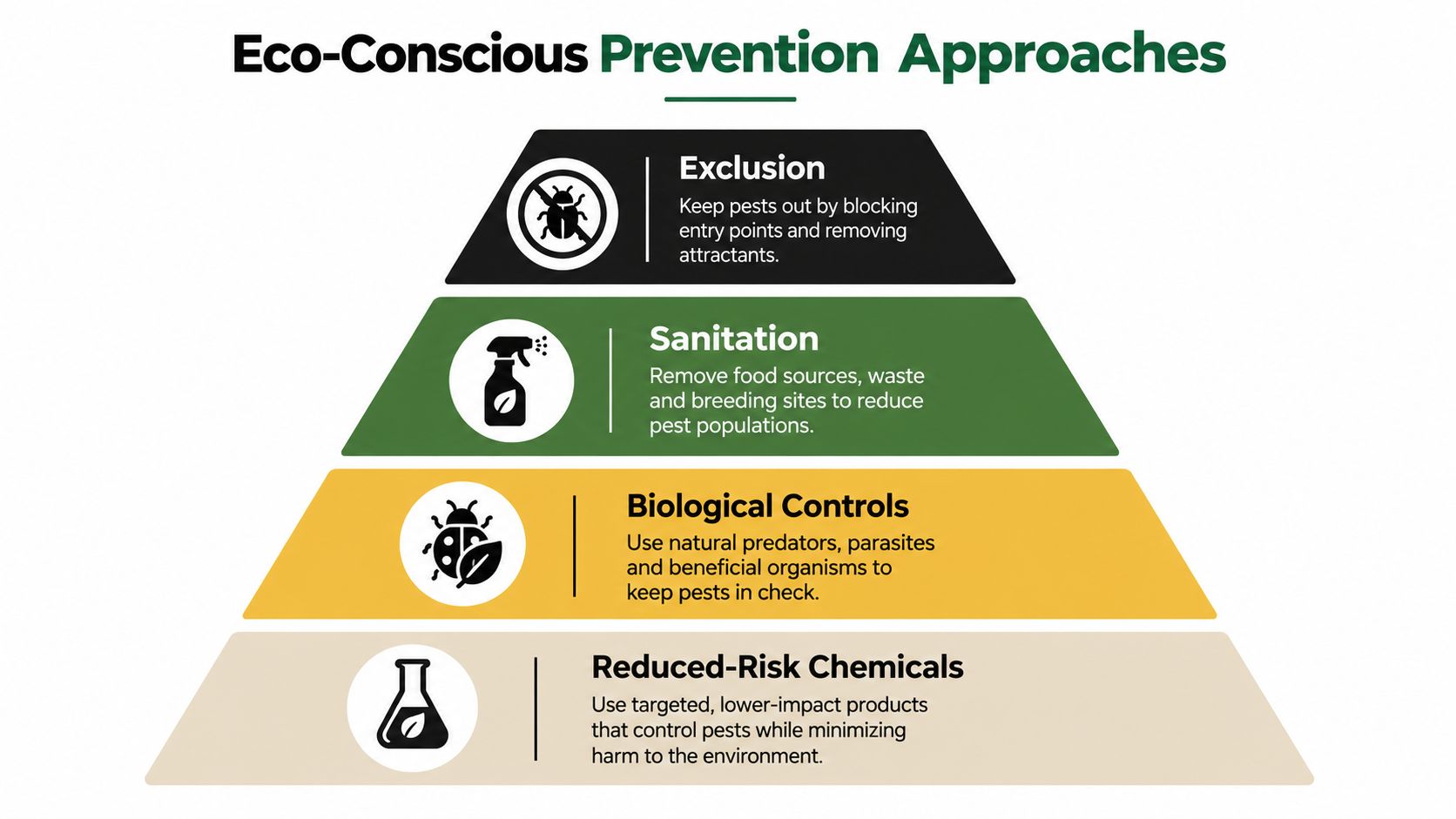
A practical risk-reduction hierarchy
Begin with the property's seasonal weak points. In Crown Point, spring moisture, summer vegetation and standing water, and fall entry pressure can change the risk quickly. Close openings, repair screens, improve drainage, manage vegetation, and remove water-holding items. Indoors, correct leaks and limit food, waste, clutter, and shelter.
Monitoring turns those recommendations into decisions. The technician can document inspection dates, trap locations, pest counts, corrective work, and post-treatment results. That record shows whether conditions are improving or whether the threshold has been reached for a more focused response.
An Indiana school district that adopted IPM cut pesticide use sharply while lowering pest-control costs, according to EPA material describing the program. The program replaced routine spraying and fogging with targeted tools, including baits and traps.
Crown Point homeowners should apply the same principle at a smaller scale. The Green Advantage's lawn and outdoor-care background supports attention to local moisture, vegetation, structures, and changing seasonal conditions. Use the least treatment necessary to manage a documented risk, not the most treatment available.
See environmentally friendly pest control methods for more examples of this approach.
What to Expect From The Green Advantage in Crown Point
A professional pest inspection should feel organized, not mysterious. Your first call should establish the property type, pest concern, visible evidence, access needs, and scheduling priorities. Knowledgeable office staff can handle questions and coordinate the visit, while the field technician focuses on diagnosing the site.
During the inspection, expect attention to the building envelope and surrounding property. The technician may review foundations, doors, screens, vents, utility penetrations, gutters, moisture, vegetation, trash areas, drainage, attic or crawl-space access, and signs such as droppings, trails, nests, or damaged wood.
Clear findings and practical options
After the inspection, ask for findings that connect each recommendation to an observed condition. A useful plan should explain whether the priority is:
- Exclusion: Repairing gaps, screens, door sweeps, or penetrations.
- Sanitation: Removing food, waste, clutter, or moisture resources.
- Monitoring: Tracking pest activity with traps, inspections, or documented observations.
- Targeted treatment: Applying a bait, trap, nest treatment, or other selective control where justified.
Service options can be structured for homeowners, landlords, and commercial facilities. Pricing factors commonly include property size, pest pressure, treatment type, and visit frequency. Those factors should be discussed before work begins so customers understand what they're paying for and why the plan fits the property.
The broader service menu can include termite treatments, mosquito reduction programs, rodent exclusion, general residential pest control, and commercial service plans. Preventative service isn't about filling a calendar with chemicals. It exists to keep pests outside through diagnosis, maintenance, monitoring, and timely intervention.
Scheduling Your Next Pest Inspection in Crown Point
The decision is simpler than the pest problem often appears. If activity is limited and the cause is accessible, disciplined homeowner maintenance may solve it. If signs keep returning, the source is hidden, the property is large, or the consequences of failure are serious, professional preventative pest control gives you a documented system instead of repeated guesses.
That system has four connected parts: inspection, exclusion, sanitation, and targeted treatment. Monitoring determines whether action is needed, and an action threshold keeps the plan focused on meaningful risk rather than automatic spraying.
The approach works for residential pest control, commercial pest control, landlords, property managers, homebuyers, and businesses with outdoor areas in Crown Point and surrounding Northwest Indiana communities. It also applies across seasonal concerns, from ant control and termite inspections to mosquito control, rodent exclusion, spider control, and wasp removal.
Schedule a pest inspection, request a quote, or contact The Green Advantage when you want a clear diagnosis and a practical prevention plan. The office team can help with questions and scheduling, and licensed, certified technicians can evaluate the property and recommend service based on what they find. Early action protects property, health, and peace of mind.
The Green Advantage provides preventative residential and commercial pest control in Crown Point, IN, including inspections, IPM plans, termite treatments, mosquito reduction, rodent exclusion, and seasonal service. Visit The Green Advantage to schedule an inspection or request a quote before a small pest issue becomes a larger one.