
You hear the buzzing first. Then you spot the traffic pattern. A few wasps dip under the siding, disappear behind a shutter, or circle a gray paper nest under the eaves. That's the moment most Crown Point homeowners start asking the same questions. Is this dangerous? Can I spray it myself? What if my kids or dog get too close?
Those concerns are reasonable. Social wasps defend their nests fast, and online advice often makes the problem harder by treating every wasp like the same pest. In Northwest Indiana, safe wasp control starts with two things: correct identification and the right response for the nest location.
If you're searching for pest control near me, exterminator near me, or pest control in Crown Point, IN, it helps to know what works before you grab a can from the garage. Good residential pest control protects people first, then solves the nest without creating a bigger issue inside walls, under concrete, or around pollinators. The same goes for commercial pest control on offices, retail buildings, rentals, and multi-unit properties across Crown Point and nearby Northwest Indiana service areas.
A Wasp Nest Near Your Home in Crown Point What to Do Next
A common call starts like this: someone is mowing, trimming shrubs, or carrying groceries in from the driveway when wasps suddenly start circling from one corner of the house. The nest wasn't obvious at all. It may be tucked under a roofline, behind a light fixture, or inside a gap near the foundation. By the time a homeowner notices a pattern, they're already worried about the next trip outside.
The first move is simple. Back away and reduce activity near the nest area. Don't swat. Don't block the entrance. Don't spray into a crack unless you know exactly where the colony is and what species you're dealing with. Agitated social wasps often respond to vibration and repeated disturbance more than people expect.
What to do right away
- Keep distance: Move kids and pets away from that side of the yard or house.
- Watch the flight line: From a safe distance, note where wasps enter and exit.
- Avoid sealing the opening: Trapping active wasps inside a wall or soffit often creates a worse problem.
- Check other access points: Windows, attic vents, torn screens, and door sweeps matter. A practical complete bug proofing checklist can help you tighten up those weak spots while you arrange inspection.
Practical rule: If you can see steady wasp traffic to one exact point, treat it like an active nest site until proven otherwise.
In Crown Point, nest issues often show up during normal yard use, not during a careful inspection. That's why the safest response isn't panic. It's controlled distance, a little observation, and a plan to deal with the nest based on where it is and how the wasps are behaving.
Identifying Common Wasps and Nests in Northwest Indiana
Not every wasp around your house is a major threat. That distinction matters. Over 98% of the world's 30,000+ wasp species are solitary and non-stinging, while the 1.5% that are social live in colonies and are the main concern near homes according to U.S. Department of Agriculture research on wasp categorization.
Social wasps versus solitary wasps
A solitary wasp usually works alone, doesn't build a large exposed colony, and rarely behaves aggressively around people. A social wasp does the opposite. It builds a defended nest, supports a colony, and reacts when people get close to the structure.
That's why homeowners in Northwest Indiana usually need help with yellowjackets, paper wasps, and bald-faced hornets, not with every wasp they see in the yard. If you're unsure whether what you're seeing is even a wasp, this guide on telling bees from wasps apart is useful because mistaken ID leads to bad decisions.
Common Social Wasps in Northwest Indiana
| Wasp Type | Appearance | Nest Location | Aggression Level |
|---|---|---|---|
| Paper wasp | Slender body, long legs, narrow waist | Open umbrella-shaped nests under eaves, railings, fixtures | Lower than yellowjackets, but defensive near nest |
| Yellowjacket | Compact body, fast flight, bright yellow and black pattern | Ground voids, wall voids, siding gaps, foundation cracks | High, especially when nest is disturbed |
| Bald-faced hornet | Larger black-and-white wasp | Enclosed gray paper nests in trees, shrubs, roof edges | High near active nest |
What the nest tells you
Open comb under an overhang usually points to paper wasps. A hidden entry point in the ground or wall often points to yellowjackets. A large enclosed paper nest hanging in a visible spot often suggests bald-faced hornets.
The nest location often matters more than the insect color. A hidden colony in a wall or ground void changes the risk level immediately.
A quick visual check helps, but behavior closes the gap. Fast, repeated traffic into one crack, deck gap, or siding seam usually means a social colony is established. Once that's confirmed, the question isn't just what insect it is. The question is whether the nest can be safely reached and removed without pushing wasps deeper into the structure.
Assessing the Risk DIY Wasp Control vs Professional Help
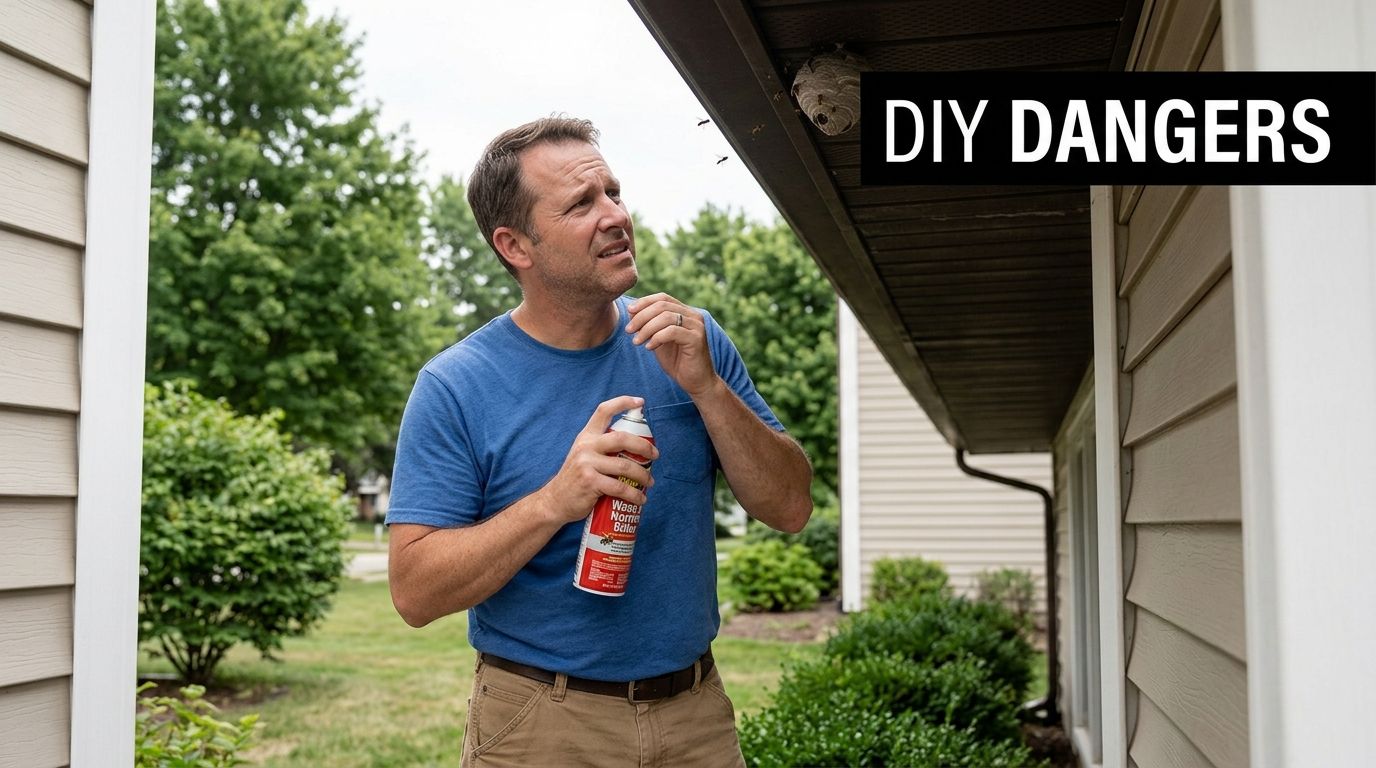
A hardware store spray can looks easy because the label suggests distance and speed. In real life, nest location decides whether DIY is reasonable or reckless.
When DIY may be reasonable
There are a few narrow cases where a homeowner might handle a wasp issue carefully. Think of a very small, newly started paper wasp nest in a low-risk area that's fully visible and away from doors, decks, play areas, and pet traffic. Even then, timing and protective clothing matter, and the nest has to be easy to access without a ladder over concrete or landscaping.
That's a small category. Most calls don't fit it.
When it's time to call for help
A 2025 analysis found that 54% of severe wasp infestations in suburban areas like Crown Point came from hidden nests in places such as behind shutters, under decks, or in ground cracks, which is why visual guesswork and consumer sprays often fail in these cases, according to the National Institute of Environmental Health Sciences study on urban pest infestations.
Professional help is the safer move when you're dealing with:
- Hidden nest entries: Behind shutters, inside walls, under siding, beneath deck framing, or in ground voids.
- Aggressive species: Yellowjackets and hornets escalate quickly when disturbed.
- Ladder work: Rooflines and upper-story eaves turn a sting risk into a fall risk too.
- Repeated activity after spraying: That usually means the colony core was never reached.
There's a good comparison of decision-making in DIY or hire a pro, what's right for you, especially for homeowners weighing cost against safety and effectiveness.
If the nest entrance is visible but the colony itself is hidden, spray often hits the doorway and misses the problem.
There's a similar lesson in outdoor tree work. The article on the benefits of professional tree lopping gets at the same issue. Jobs that look simple from the ground often become dangerous once height, hidden structure, and protective behavior are involved.
DIY fails most often when people treat wasps like surface pests. Social wasp nests are colony problems. If the colony is hidden, the treatment has to reach the colony.
The Green Advantage Eco-Friendly Wasp Removal Process
A lot of homeowners ask for eco-friendly pest control because they want wasps gone without trading one problem for another. That's where the marketing gets muddy. Many services use the word “green” loosely, even when the treatment still puts bee-toxic materials into the environment.
A 2024 study found that 72% of pest control ads using the term “eco-friendly” still relied on pyrethrin-based sprays toxic to bees, based on the Xerces Society for Pollinator Conservation study from 2024. That gap matters in Crown Point neighborhoods where flowering beds, vegetable gardens, and pollinator-friendly landscaping sit just a few feet from the nest site.
What nature-based wasp control actually means
Nature-based doesn't mean ignoring the problem. It means the method matches the risk and avoids broad, unnecessary exposure. In practical terms, that starts with identifying the species, locating all active nest points, and deciding whether physical removal, exclusion, or a tightly targeted product is the least disruptive option.
For exposed nests, timing matters. Dusk or dawn often gives the best conditions for safe physical removal because colony activity is lower. For hidden nests, the goal is precision, not fogging the whole area and hoping for the best.
The process used on a real service call
One option homeowners in Crown Point can consider is environmentally friendly pest control methods that focus on inspection first, then the least disruptive correction that will solve the nest.
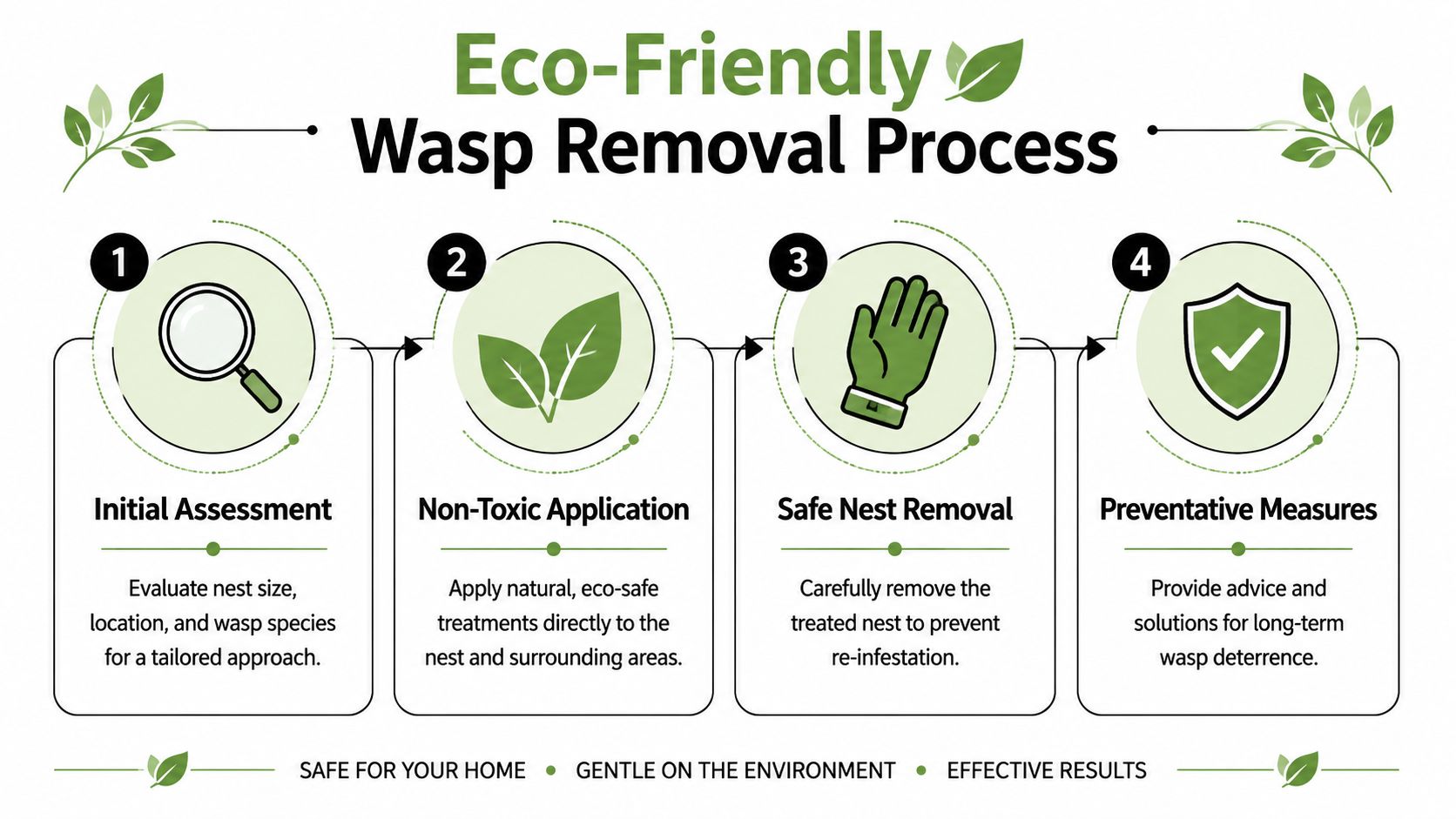
A practical wasp removal process looks like this:
Inspection and identification
The technician tracks flight patterns, confirms the species, and determines whether the colony is exposed, enclosed, or underground.Nest-specific treatment plan
An open paper nest near an eave gets a different response than yellowjackets entering a foundation seam.Physical removal when appropriate
If the nest can be removed safely, that prevents reuse of the structure and cuts down lingering activity around the same spot.Targeted follow-up and prevention
Entry points, attractants, and structural gaps are reviewed so the site is less inviting next time.
Broad spraying around the yard feels active. Precise treatment solves more.
This is the true dividing line in pest control wasps work. “Green” isn't the label on the truck. It's whether the method protects your family without needlessly harming bees and other beneficial insects nearby.
Benefits of Professional Pest Control in Crown Point
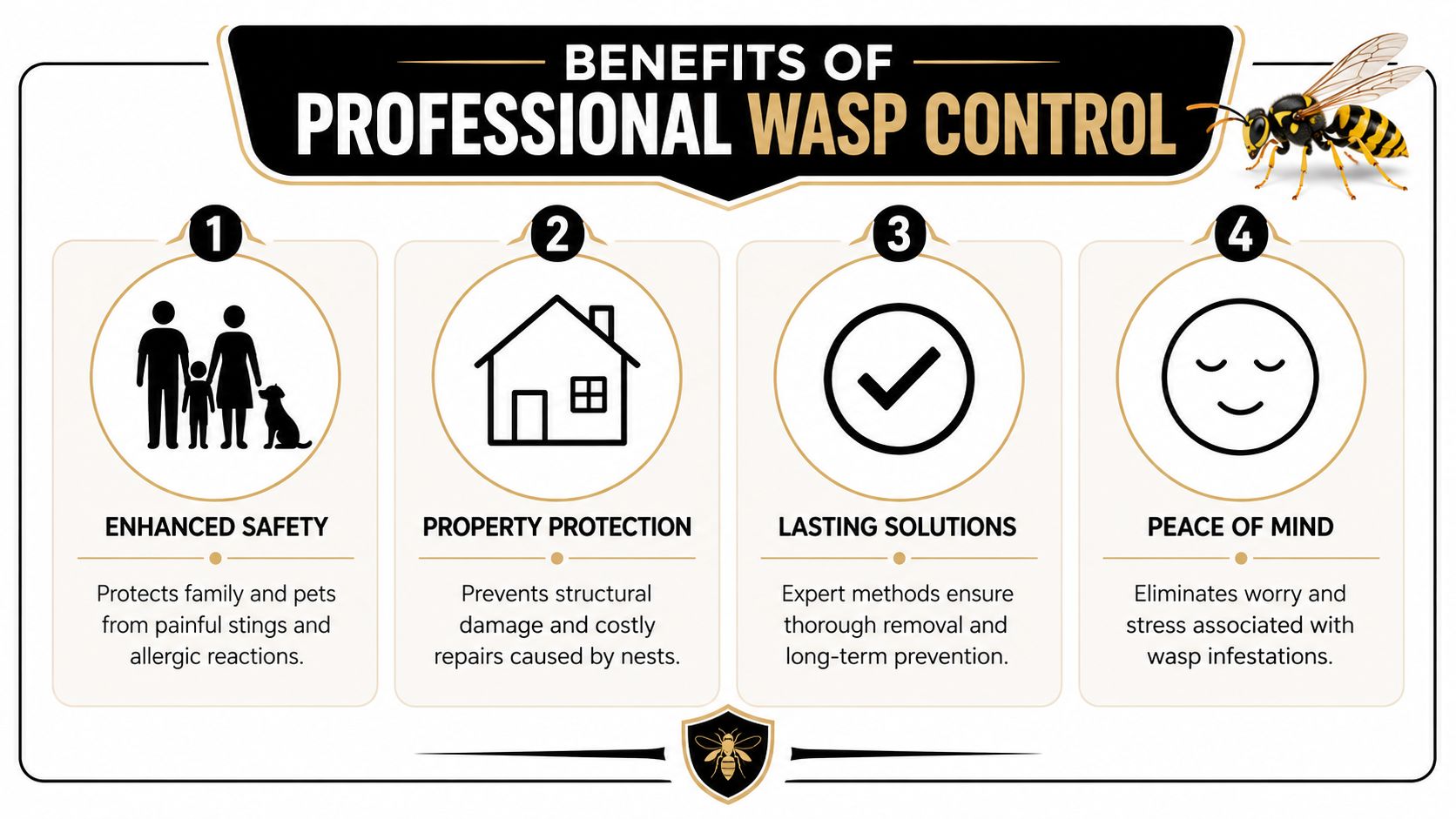
Professional wasp control protects more than a corner of the house. It protects the people using the property, the structure itself, and the routines that make a home feel comfortable again.
Health and safety
Wasp stings are responsible for nearly 80 human fatalities annually in the U.S. due to severe allergic reactions, and professional pest control for a standard home averages $400 to $950, according to 2026 ConsumerAffairs and U.S. Bureau of Labor Statistics data. For families with children, pets, older adults, or anyone with sting sensitivity, that puts the decision in perspective.
A safe yard matters. So does a safe entryway, mailbox area, garage door, and deck.
Property protection
Wasps don't need a huge opening to establish a problem. They use eaves, soffits, wall voids, and foundation gaps because those areas stay protected from weather and traffic. Once the colony is active, homeowners often start seeing wasps where they shouldn't. Around windows, inside garages, near attic vents, or along basement walls.
That's why wasp work connects naturally with broader residential pest control and commercial pest control planning. A property that attracts nesting wasps may also need attention for ant control, spider control, mosquito control, rodent control, seasonal pest issues, or exclusion work that keeps insects from getting established in the first place.
Peace of mind
The biggest benefit is usually the simplest one. People want to use their property without thinking about getting stung.
- For families: The yard feels usable again.
- For landlords and property managers: Tenants get a safer exterior environment and clearer documentation of what was found.
- For businesses: Entry points, dumpster zones, loading areas, and outdoor customer spaces stay more manageable.
Professional service turns an unpredictable nest into a defined problem with a defined solution.
Your Local Solution Partnering with The Green Advantage
When a homeowner in Crown Point calls about wasps, the process should be straightforward. You describe what you're seeing, where the activity is, and whether anyone has already tried to spray it. From there, the inspection focuses on the flight path, the nesting point, and what kind of access the technician has.
Some jobs are simple. An exposed nest under an eave can often be handled directly. Others need more patience. Ground nests, foundation voids, and spaces under patio slabs are different because the visible opening is only the entrance, not the colony itself.
What the service experience should feel like
You should get plain-language answers. If the nest is visible, you should hear what can be removed and when. If the nest is hidden, you should hear why that changes the treatment plan. If there's a prevention issue such as gaps, attractants, or recurring activity in the same zone, that should be part of the conversation too.
For inaccessible nests such as those under concrete patio slabs, standard aerosol sprays are ineffective. Professional protocol requires direct application of insecticidal dusts into the entrance using specialized equipment so the treatment reaches the deep nest core, based on industry standard practices for ground nest removal.
The right treatment depends on where the colony lives, not on how dramatic the spray looks.
That local, case-by-case approach is what homeowners and property managers need in Northwest Indiana. If you're also dealing with related issues such as ants, spiders, rodents, mosquitoes, or general preventative pest treatments, it helps to address the property as a whole instead of treating each symptom in isolation.
If wasps have taken over part of your yard, roofline, deck, or foundation area, it's time to get a clear answer and a safe plan. Contact The Green Advantage to schedule a pest inspection, request a quote, and get practical help for wasp removal and ongoing pest control in Crown Point, IN and nearby Northwest Indiana service areas.