
A lot of office pest problems in Crown Point start the same way. Someone notices a line of ants near the coffee station. A cleaner finds droppings behind a trash can. A tenant mentions a strange odor in a storage room that nobody uses much anymore. At that point, the issue still feels small. In many buildings, that’s exactly why it gets worse.
Office buildings create steady opportunities for pests. Breakrooms provide food. Utility rooms provide warmth. Wall voids, pipe gaps, loading doors, and roof penetrations give pests a path inside. Hybrid schedules add another layer. Some areas sit quiet for stretches, trash pickup becomes inconsistent, and moisture issues can go unnoticed longer than they used to.
That shift matters. A 2025 National Pest Management Association survey found that 68% of commercial facilities reported higher rodent sightings during low-occupancy periods compared to pre-pandemic levels, tied to irregular waste removal and unchecked moisture buildup in hybrid-work buildings, as noted in this office pest prevention summary.
For property managers and business owners in Northwest Indiana, pest control for office buildings isn’t just about getting rid of what’s already visible. It’s about protecting staff, tenants, equipment, reputation, and daily operations before a small warning sign turns into a building-wide distraction.
Protecting Your Crown Point Business from Unseen Threats
A property manager in Crown Point usually doesn’t call after seeing a dramatic infestation. The call comes after a few subtle clues start stacking up. One employee mentions seeing ants near the sink. Cleaning staff report droppings in a copy room. A tenant on the first floor says they’ve started hearing scratching in the wall after hours.
Those details matter because office pests rarely stay confined to the place where they’re first noticed. Mice travel wall lines and utility pathways. Roaches settle near moisture and then spread into adjacent spaces. Ants turn a forgotten spill into a dependable food source.
Why office buildings are vulnerable
Northwest Indiana office buildings face pressure from both the structure and the season. Cold weather pushes rodents toward warmth and shelter. Wet periods can increase moisture issues around foundations, drains, and HVAC systems. Summer activity often means more open doors, more deliveries, and more opportunities for pests to slip inside unnoticed.
Hybrid work has changed the pattern too. A fully occupied office creates daily disturbance, regular cleaning, and faster reporting. A lightly occupied office can leave trash in place longer, allow leaks to linger, and give pests more quiet time to settle in.
Practical rule: If staff are seeing pests during business hours, the activity behind the walls or above the ceiling is often more established than it appears.
What smart managers do first
The right response is calm and methodical. Start by identifying where activity was seen, what time of day it happened, and what nearby conditions might be supporting it. In office settings, that usually means checking:
- Breakrooms and coffee stations: Crumbs, syrup residue, drains, and trash liners draw ants, flies, and roaches.
- Storage and supply rooms: Cardboard, clutter, and low foot traffic create hiding spots.
- Mechanical spaces: Pipe penetrations, floor drains, condensation lines, and utility chases support both insects and rodents.
- Exterior transitions: Entry doors, dock areas, and landscaping near the foundation often tell the story.
A good commercial program doesn’t just react to the sighting. It traces the reason the pest was comfortable enough to stay.
Common Pests in Northwest Indiana Office Buildings
In commercial buildings, the pest list is usually predictable. The trouble is that each pest behaves differently, enters differently, and creates a different kind of business risk. That’s why a technician shouldn’t treat every office issue like a generic infestation.
An Orkin survey found that 89% of office tenants have encountered at least one pest in their building within the past 12 months, with ants, roaches, and rodents among the most common invaders in commercial spaces, according to industry findings on office tenants.
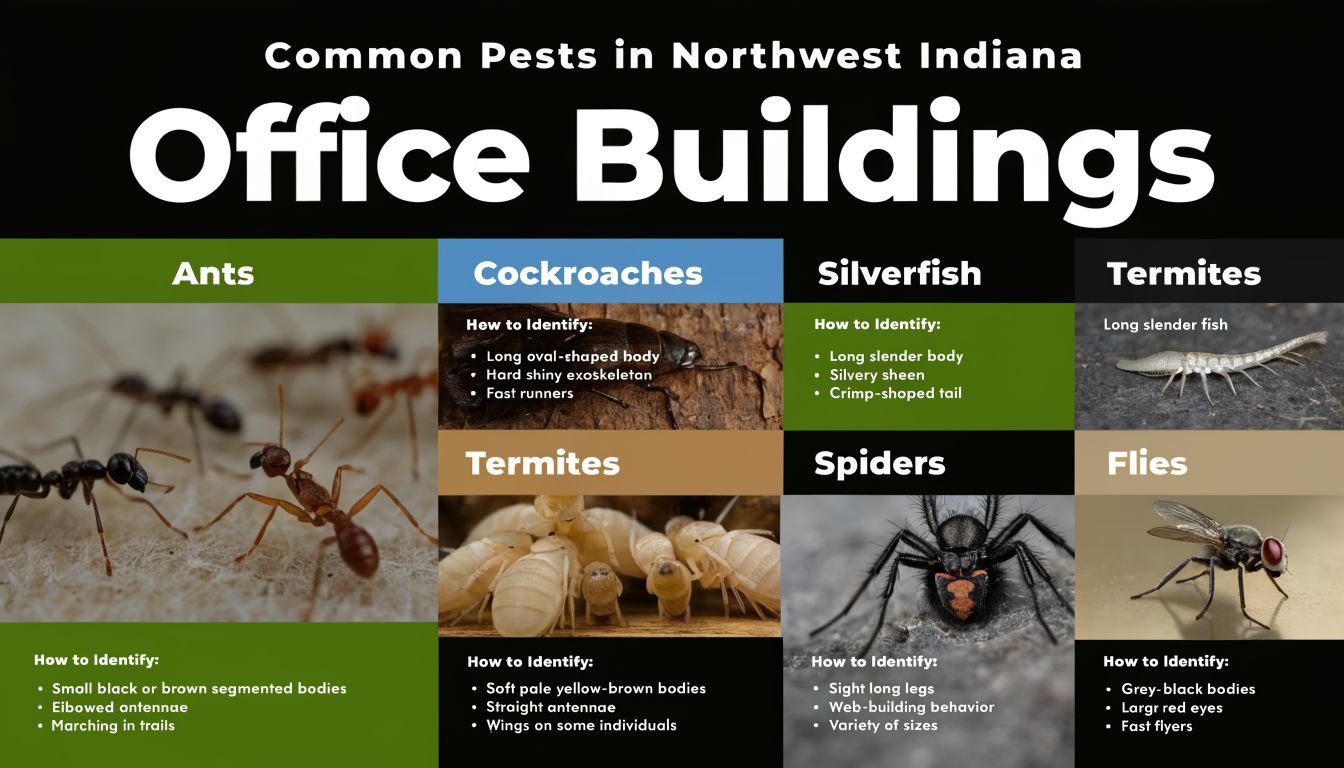
Rodents
Mice and rats are a major concern in office settings because they use the building itself like a highway. They move through wall voids, above drop ceilings, around electrical penetrations, and along loading or service areas. In winter, Crown Point buildings often see more pressure as rodents seek warmth and shelter.
Signs include droppings, gnawing, greasy rub marks, nesting material, and scratching sounds after hours. The risk goes beyond discomfort. Rodents contaminate surfaces, damage insulation, and can chew wiring or low-voltage cabling in places staff never see.
Ants and occasional invaders
Ants are common in breakrooms, reception areas with candy dishes, and anywhere sweet residue builds up around sinks or counters. Property managers often assume ants mean a housekeeping problem alone. Sometimes they do. Other times, the issue is an exterior colony finding an easy route through cracks, expansion joints, or gaps around doors.
Spiders, beetles, and similar occasional invaders also show up in offices, especially around windows, basements, and low-traffic corners. They may not be the most damaging pests, but they still shape how tenants and visitors judge a building.
Cockroaches and moisture pests
Cockroaches thrive where moisture, warmth, and food residue overlap. In offices, that often means janitor closets, kitchens, vending areas, utility spaces, and floor drains. A single sighting in daylight matters because roaches prefer to stay hidden. If they’re visible during the day, the underlying pressure may be more advanced.
Moisture-loving pests such as silverfish and small flies also deserve attention in hybrid offices. Areas that sit unused can develop drain issues, condensation, or stale air that keeps those pests comfortable longer than managers expect.
One pest sighting doesn’t always mean a major infestation. Repeated sightings in the same zone usually mean the building is supporting activity.
Termites and wood-destroying concerns
Not every office pest problem is visible in a breakroom. In some commercial properties, the biggest risk sits in structural wood, trim, or expansion joints near grade level. Termite issues typically show up more subtly through damaged wood, mud-like sheltering evidence, or swarming activity at the wrong time of year.
For office owners in Northwest Indiana, termite control belongs in the larger conversation about commercial pest control because structural pests affect long-term property value, not just daily comfort.
Our Proactive Approach Integrated Pest Management
The most effective pest control for office buildings isn’t based on routine spraying and hoping the problem stays away. That older approach misses the reason pests are there in the first place. In a commercial building, lasting control comes from identifying the pressure points, monitoring activity, and correcting the conditions that allow pests to survive.
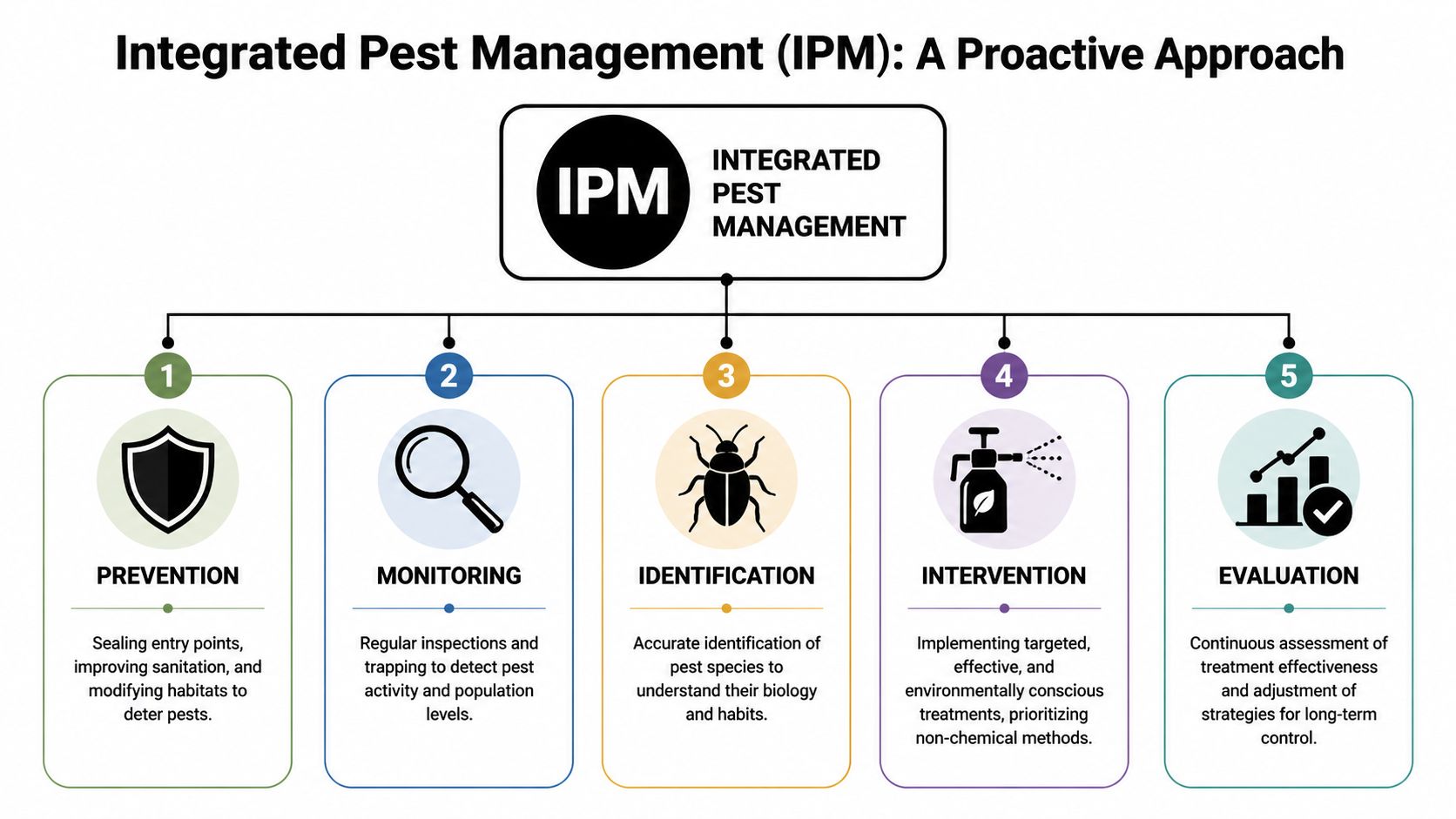
That’s where Integrated Pest Management, or IPM, matters. According to U.S. federal benchmarks summarized by the IPM Institute program guidance, IPM prioritizes monitoring and action thresholds and can reduce the need for broad chemical applications by up to 50-70% while maintaining effective pest suppression.
A visual summary helps clarify the process.
Prevention comes first
A strong IPM program starts with the building, not the product shelf. Technicians look for how pests are entering, where they’re hiding, and what’s feeding them. In an office, common corrections include sealing pipe gaps, improving door sweeps, adjusting waste handling, fixing leaks, and reducing clutter in storage areas.
That’s why a generic treatment schedule often disappoints property managers. If the breakroom drain stays wet, if the rear door doesn’t seal, or if boxes stay stacked against the wall, the building keeps inviting pests back.
Monitoring shows what is really happening
Commercial pest service should produce evidence, not guesswork. Monitoring devices, glue boards, trap placement, sanitation notes, and exterior observations show where the activity is concentrated and whether it’s increasing or declining.
That matters in larger offices because staff reports only tell part of the story. Employees usually notice the visible pest. Monitoring shows the hidden route.
A practical IPM program for an office often includes:
- Routine inspections: Focused attention on kitchens, vending areas, janitor closets, utility penetrations, and perimeter doors.
- Targeted monitoring tools: Devices placed where technicians can measure activity instead of relying on occasional sightings.
- Building corrections: Exclusion work and sanitation recommendations tied to the actual findings.
- Selective treatment: Baits, dusts, traps, or crack-and-crevice applications used only where needed.
Treatment should be targeted, not broad
When treatment is necessary, the goal is precision. A technician should choose products and placement that match the pest, the environment, and the level of activity. Offices require care because treatments happen in spaces people use every day.
For example, baiting a cockroach issue in a utility room makes more sense than broad interior application across an entire office suite. Mechanical trapping for rodents near identified travel routes is more useful than reacting only after someone sees a mouse in daylight.
This short video gives a helpful overview of how a structured pest program works in practice.
Evaluation keeps the plan honest
A commercial pest plan should never stay static if the building conditions change. Renovation work, seasonal weather, tenant turnover, and hybrid occupancy patterns all affect pest pressure. Good IPM means reviewing what worked, what didn’t, and what the next adjustment should be.
A service report should answer three questions clearly. What was found, why it was happening, and what needs to change next.
For businesses comparing vendors, this is one area where the details matter. A company like The Green Advantage can build commercial service around inspection findings, exclusion needs, and environmentally mindful treatment choices rather than a one-size-fits-all route stop.
What to Expect During Your Commercial Pest Inspection
The inspection process should feel straightforward, not mysterious. Most property managers already juggle vendor scheduling, tenant requests, maintenance issues, and after-hours access. Pest service works better when everyone knows what will happen before the technician arrives.
The first step is usually a conversation about what has been seen, where it has been seen, and whether the issue seems isolated or recurring. The office staff may ask about building age, floor plan, food service areas, trash handling, and recent maintenance concerns such as leaks or door problems. Those details shape where the technician starts and what tools to bring.
Before the technician arrives
It helps to gather a few practical details in advance. A manager doesn’t need to create a formal report, but it’s useful to note patterns. Was the rodent sighting near a rear exit? Are ants only appearing after weekend occupancy? Did cleaning staff notice activity in a vacant suite or storage room?
Many of the same observations used in broader facility maintenance inspection points overlap with pest risk. Door seals, moisture intrusion, roof drainage, clutter, and wall penetrations often explain why pests gain a foothold.
A technician may also ask for access to areas that employees rarely enter, such as:
- Breakrooms and kitchenettes: Including sinks, cabinets, appliances, and trash storage.
- Janitor and mechanical rooms: These spaces often reveal leaks, drains, and hidden harborages.
- Exterior perimeter areas: Foundations, dumpster pads, entry doors, and landscaping beds tell an important part of the story.
- Ceiling and utility access points: Pest activity often follows pipes, conduit, and HVAC pathways.
What happens on site
A good commercial inspection isn’t a quick walk-through with a flashlight. The technician is looking for signs of current activity, signs of past activity, and conditions that support future activity. That includes droppings, rub marks, shed skins, grease trails, nesting evidence, frass, moisture, harborage, and structural openings.
In office buildings, rooftop equipment and HVAC areas matter more than many people realize. Condensation, gaps around service entries, and roof-level access points can support insect and rodent movement that later shows up inside on a lower floor.
When a building has hybrid occupancy, the inspection usually pays extra attention to underused areas. Conference rooms, storage closets, low-traffic suites, and secondary restrooms can support pests because nobody is there often enough to notice the warning signs early.
What you receive afterward
The most useful inspection report doesn’t just say “treated” or “no activity found.” It should identify the problem zones, note likely causes, and recommend practical corrections. Some of those corrections fall on sanitation. Others belong to maintenance, janitorial teams, or tenant behavior.
If you want a clearer sense of how modern tools improve that process, this article on advanced equipment for pest inspection accuracy in Crown Point is worth reviewing. Better inspection methods help technicians find hidden activity sooner, especially in commercial properties with wall voids, utility chases, and large common areas.
The inspection should leave you with a plan, not just a receipt.
That plan usually includes where service should start, what should be corrected right away, how often follow-up should happen, and how communication with management or tenants will work going forward.
Upholding Compliance and Protecting Employee Health
A pest issue in an office building can start as a maintenance concern and quickly become a health, reputation, and compliance issue. That’s why experienced property managers treat prevention as part of building operations, not as an occasional emergency purchase.
Commercial tenants notice how a building is managed. If pests appear in common areas, breakrooms, restrooms, or lobbies, they don’t separate that from the overall quality of the property. They see it as a sign that something is being missed.
Health concerns are real even in office settings
People sometimes assume office pests are mostly an image problem. They’re not. Roaches can contribute allergens. Rodents contaminate surfaces and storage areas. Flies and similar pests can spread filth from drains, waste, and exterior sources into occupied spaces.
That affects how employees feel in the building. Once staff start worrying about what’s in the breakroom cabinet, under the sink, or behind the vending machines, morale drops fast. Productivity suffers when people are distracted by recurring sightings or uneasy about bringing food, bags, or personal items into shared areas.
A clean-looking office can still have a hidden pest pressure problem. Most serious issues start behind equipment, above ceilings, and around moisture.
Compliance, documentation, and vendor coordination
Many office buildings don’t face the same inspection environment as restaurants or healthcare sites, but that doesn’t reduce the need for documentation. A property manager still needs service records, inspection notes, and evidence that problems were addressed responsibly. That matters for tenant communication, internal risk management, and maintenance coordination.
Pest control also fits into a larger building health conversation. For example, when managers review projects involving air quality, demolition, or older building materials, they often have to compare priorities and costs across multiple vendors. A resource on understanding asbestos removal budgets can be useful in that broader planning context because it shows how environmental building issues require clear scopes, careful documentation, and professional handling. Pest issues deserve the same operational discipline.
Why proactive service costs less disruption
Reactive service creates scheduling pressure, tenant complaints, and rushed decision-making. Proactive service allows managers to address conditions while they’re still manageable. That usually means fewer surprises, cleaner communication, and less disruption to employees and visitors.
For Crown Point offices, the goal isn’t just eliminating pests when they show up. It’s protecting the building’s daily function and preserving confidence in the property. That makes pest control part of risk management, not a side task.
How to Choose a Commercial Pest Control Partner in Crown Point
Hiring a commercial exterminator near you shouldn’t come down to who can spray fastest. Office buildings need a provider who understands how business properties function, how pests exploit those spaces, and how to work without creating unnecessary disruption for staff or tenants.
If you’re comparing options for commercial pest control in Crown Point, IN, the right questions are practical. You want to know how the company inspects, how it communicates, how it documents findings, and whether it can adapt to your actual building instead of forcing your property into a standard route plan.
Look for local building experience
Northwest Indiana has its own pest rhythms. Seasonal rodent pressure, moisture issues, snow-season entry gaps, and summer insect activity all affect office service. A provider with local experience will understand why rear vestibules, loading areas, perimeter landscaping, and hybrid occupancy patterns matter in this region.
That local awareness also helps when service needs to coordinate with janitorial teams, maintenance staff, and tenant schedules. Office buildings don’t run like warehouses, and they don’t behave like homes either.
Ask how they handle the process
A capable provider should be able to explain the service process plainly. If the answer is vague, that’s a warning sign. You should hear specifics about inspection, monitoring, documentation, sanitation recommendations, exclusion, and targeted treatment options.
Use this checklist when evaluating a commercial pest partner:
- Licensing and insurance: Confirm the company is properly credentialed for commercial work.
- IPM commitment: Ask whether they rely on inspection and monitoring first or default to broad routine application.
- Communication standards: Find out who receives reports, how findings are documented, and how urgent issues are escalated.
- Building-specific planning: A downtown office suite, a medical office, and a multi-tenant building with a cafeteria should not receive the same service blueprint.
- Experience with related risks: Rodent exclusion, termite concerns, and seasonal exterior pressure should all be within scope.
Consider how they fit into your wider property team
The strongest pest vendor usually works well with other building specialists. If you’ve ever had to coordinate repairs after a leak, fire, or contamination issue, you already know that vendor communication matters as much as technical skill. A good example of that broader support role is what a commercial restoration company provides after major property events. Pest control isn’t the same service, but the same principle applies. You need a partner who documents clearly, responds predictably, and understands how their work affects the rest of the building.
Red flags to avoid
Some companies sound fine on the first call and disappoint once service starts. Watch for these patterns:
- No real inspection: They quote a treatment plan before seeing the property.
- Generic recommendations: Every building gets the same frequency and the same approach.
- Minimal reporting: The service note says little more than “completed.”
- Poor follow-through: Management has to chase answers after each visit.
- No exclusion mindset: They treat symptoms but never address gaps, drainage, clutter, or door seals.
The best commercial pest control near you should feel like part of your building operations team. That means fewer surprises, faster answers, and service that matches how your property is used.
Sample Service Plans and Proactive Prevention Checklists
Property managers usually ask two practical questions. How often should this building be serviced, and what can our team do between visits to lower risk? The answer depends on building use, food activity, occupancy patterns, and how many structural vulnerabilities the property has.
In general, low-risk offices can often operate on a lighter service schedule, while food-related offices may need much tighter attention. The broader commercial market data from Fortune Business Insights on pest control notes that weekly or bi-weekly service is common for food-related offices, while quarterly service may fit lower-risk sites.

Sample commercial pest control service schedules
| Risk Level / Facility Type | Recommended Frequency | Common Target Pests |
|---|---|---|
| Low-risk professional office with limited food use | Quarterly | Ants, occasional invaders, spiders, mice |
| Standard multi-suite office building with shared breakrooms | Monthly | Ants, rodents, cockroaches, flies |
| Hybrid office with recurring low-traffic zones and moisture concerns | Monthly, with added monitoring as needed | Rodents, moisture pests, flies, roaches |
| Office with heavy employee food traffic or pantry areas | Bi-weekly | Ants, cockroaches, flies, rodents |
| Office space tied to food preparation or frequent food handling | Weekly or bi-weekly | Rodents, flies, ants, cockroaches |
Prevention work that pays off
Service frequency matters, but building corrections matter more. Structural pest-proofing can block 70-90% of potential infestations by sealing gaps, installing door sweeps, and maintaining landscaping, according to the AFPMB structural pest-proofing guide. In practice, that means the biggest savings often come from fixing access points before pest pressure builds.
For managers who want more building-focused ideas, these commercial pest prevention strategies in Crown Point are a useful companion to a service plan.
Small exclusion fixes often outperform repeated treatment in the same problem area.
Fall checklist for rodent season
As temperatures drop in Northwest Indiana, rodents begin testing office buildings more aggressively. Fall is the time to close off access and reduce nesting opportunities.
- Inspect door sweeps: Replace damaged sweeps on rear doors, side entries, and service doors.
- Seal utility gaps: Check around conduit, plumbing, cable entries, and line sets.
- Clear storage clutter: Keep cardboard and paper stock off the floor and away from walls.
- Review dumpster areas: Make sure lids close properly and spills are cleaned promptly.
- Trim exterior growth: Reduce dense vegetation touching the foundation.
Spring and summer checklist for insects
Warmer months bring more crawling insects, occasional invaders, and activity around drains and exterior entry points. Prevention is simpler when managers catch the easy attractants first.
- Check for moisture issues: Repair leaks under sinks, around rooftop units, and near utility rooms.
- Deep-clean breakrooms: Focus on appliance edges, cabinet corners, and under vending equipment.
- Inspect window and door seals: Flying insects take advantage of worn screens and gaps.
- Update outdoor upkeep practices: Keep mulch, plantings, and debris from crowding the building edge.
- Monitor underused spaces: Hybrid offices need regular checks in quiet suites and conference rooms.
Everyday habits that help between visits
Even the best commercial pest program can struggle if building habits keep feeding the problem. Staff and janitorial teams don’t need pest expertise. They just need a clear reporting path and a few consistent routines.
The basics are simple. Report sightings quickly. Empty trash reliably. Store food neatly. Keep sinks and floors dry. Don’t let supply rooms become permanent clutter zones. Those habits make every professional treatment plan work better.
Secure Your Business with The Green Advantage Today
Office pest problems rarely solve themselves. They spread through wall voids, settle into underused spaces, and create bigger concerns for tenants, employees, and property managers the longer they’re ignored. In Crown Point and across Northwest Indiana, the smartest approach is early inspection, building-specific prevention, and steady follow-up.
If you’re searching for pest control near me, commercial pest control in Crown Point, IN, or an exterminator near me for an office building, focus on a partner who understands how local buildings work and how pests exploit them. The right plan protects more than the structure. It protects daily operations, employee confidence, and your reputation.
Need practical help with pest control for office buildings in Crown Point, IN or nearby Northwest Indiana communities? Contact The Green Advantage to schedule an inspection, request a quote, or talk through a commercial service plan built around your property’s actual risks.