
You step onto the patio with dinner, and mosquitoes start gathering around your ankles before you've settled into a chair. You've emptied the obvious bucket and cut the grass, so why are they still there? For homeowners looking for pest control in Crown Point, IN, The Green Advantage helps connect mosquito treatment with the yard conditions that keep the problem going.
The most useful starting point isn't a blanket spray. It's finding the water you've missed, removing eggs from reusable containers, and keeping a schedule that accounts for fresh rain and mosquitoes arriving from outside your property.
Why Backyard Mosquitoes Matter in Crown Point
A mosquito biting over a Crown Point patio is an annoyance, but mosquito prevention also has a practical health purpose. The Centers for Disease Control and Prevention identifies West Nile virus as the leading cause of mosquito-borne disease in the contiguous United States, causing about 2,000 illnesses each year, and reports that it has been found in all 48 contiguous states since its introduction in 1999.
That doesn't mean the mosquitoes in your yard are infected. It means preventing breeding around homes is worthwhile, even when the immediate concern is enjoying the deck without constant swatting.
Keep the risk in perspective
The World Health Organization identifies mosquitoes as transmitters of diseases including West Nile fever, dengue, and malaria. Those diseases don't all carry the same local relevance, so global disease totals shouldn't be treated as a forecast for a Crown Point backyard.
For local context, our information about mosquito-borne illnesses in Indiana can help homeowners understand why prevention matters without assuming every bite signals illness.
Practical rule: Treat mosquito prevention as routine property maintenance, not a reason to stop using your yard.
Northwest Indiana rain can refill an overturned cover or neglected planter after you've cleaned everything else. That makes recurring inspection more useful than relying on a spring cleanup alone.
The Green Advantage serves Crown Point and surrounding Northwest Indiana communities. Our role starts with identifying the conditions behind the problem, so homeowners know which changes they can make and where professional attention may help.
Where Standing Water Hides in Your Yard
Backyard breeding sites, water risk and what to do
| Breeding site | Water risk | Action | Check how often |
|---|---|---|---|
| Gutters and downspouts | Clogs hold rainwater for days | Clear debris and flush the line | After storms and monthly |
| Tires and buckets | Collect any rainfall | Empty, scrub and store upside down | Weekly |
| Toys and kiddie pools | Fill with rain and stay full | Empty and store upside down | Weekly |
| Plant saucers and trays | Hold water under potted plants | Empty or fill with sand | Weekly |
| Birdbaths and fountains | Water sits and gets refilled | Refresh or drain | At least weekly |
| Rain barrels | Open lids allow mosquito access | Cover tightly or use fine mesh | Weekly |
| Tarps and furniture covers | Folds pool rainwater | Reposition or drain | After every rain |
| Low spots and poor drainage | Standing water collects in dips | Regrade or fill low areas | After every rain |
| Pool covers and non-chlorinated pools | Covers pool water; untreated pools hold water | Drain cover or treat as labeled | Weekly |
Use this table as a maintenance checklist, not permission to leave newly collected water until the next scheduled visit. Indiana mosquito-control guidance warns that mosquitoes can develop in any puddle that remains for more than four days.
Start with places you can't see from the patio
Clogged gutters deserve attention because the yard can look dry while water remains overhead. Look for overflowing sections, debris at downspout openings, and discharge that collects against the foundation. Inspect from the ground where possible, and arrange safe access rather than stretching from a ladder.
Next, check tires, buckets, and outdoor toys. A toy truck bed or hollow play structure can hold water even when the surrounding lawn has dried. Store unused items under shelter or in a position that drains.
Lift plant pots to inspect their saucers. Check beneath furniture, along the shed wall, and behind stored materials, where a forgotten container is easy to overlook. Birdbaths and fountains need attention even when they look attractive and well maintained.
Follow the path rainwater takes
Run your hand along a grill cover to find sagging pockets. Pull tarps taut rather than allowing the visible puddle to pool, and inspect rain-barrel lids for gaps around the rim and downspout inlet.
For recurring lawn puddles, the Pool & Landscaping of Vistancia drainage tips, from Pool & Landscaping of Vistancia LLC, offer a useful resource for thinking through yard drainage problems. Any drainage change should keep runoff away from buildings without redirecting the problem onto a neighboring property.
Start your walk at the highest accessible part of the property and work downhill. Finish at the back fence, drainage outlets, and places where runoff enters from outside your lot.
Treat every container that retains rainwater as a potential breeding site, whether it's a large barrel or a small depression in a cover.
Covers and Larvicides for Water You Cannot Empty
Options for water you cannot empty
| Option | Best for | Limit |
|---|---|---|
| Empty and scrub | Buckets, toys, planters, tires | Works only if done every week |
| Tight cover or fine mesh | Rain barrels and water storage | Mesh openings must be smaller than an adult mosquito |
| Labeled larvicide, such as dunks or bits | Rain barrels, fountains, gutters, non-chlorinated pools, tree holes | Use exactly as the label directs and never in drinking water |
| Drain or regrade low spots | Puddles in yard dips | Needs ground work and a check after rain |
| Adult mosquito spray | Short-term relief before an outdoor event | Reduces numbers only temporarily and does not replace source control |
For stored water, physical exclusion is the simplest option. A lid must fit around the entire rim, not merely rest on top. Indiana's mosquito-bite prevention guidance recommends tightly covering water-storage containers or using mesh with openings smaller than an adult mosquito.
Choose treatment for the actual water feature
When water can't be dumped, drained, or covered, a larvicide targets mosquitoes before they become flying adults. The CDC's larvicide guidance identifies dunks or bits that can be applied by hand to small bodies of water, including suitable rain barrels, fountains, gutters, non-chlorinated pools, pool covers, tires, and tree holes.
Match the product label to the site. Don't assume a product intended for an ornamental water feature belongs in every pool, ditch, or barrel. Measure and apply the specified amount, and don't add extra product or shorten the reapplication interval.
- Drinking water: Never apply these treatments to water intended for drinking, including water your pets drink.
- Unused pools: Use a properly secured cover that doesn't collect puddles, and treat only where the product label permits.
- Persistent puddles: Correcting the drainage may be more useful than repeatedly treating the same depression.
Our explanation of what kills mosquito larvae provides more context for choosing between removing habitat and treating unavoidable water.
Adult spray addresses a different problem: mosquitoes already flying or resting around the yard. Don't use it as a substitute for fixing a water source you can remove.
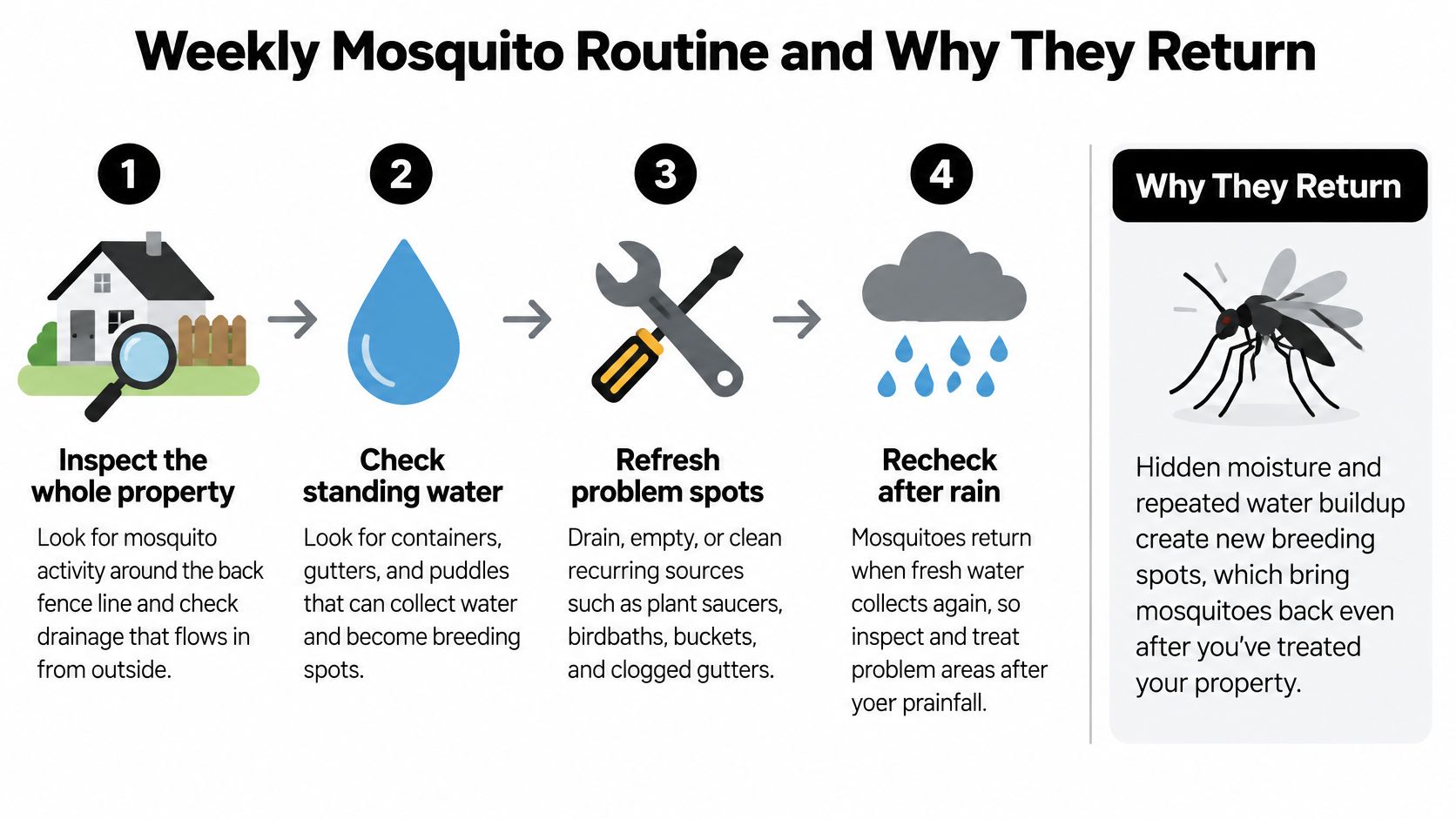
Weekly Mosquito Routine and Why They Return
Inspect the whole property. Follow the same walking route so the back fence, side yard, and incoming drainage don't get skipped. The common mistake is checking only the area where people are getting bitten, rather than the places mosquitoes may be developing.
Empty, scrub, turn over, or discard containers. Use a stiff brush on reusable container walls and around the old waterline before rinsing and storing them dry. Tipping out the water misses eggs attached to the surface.
Refresh intentional water features and trays. Drain and clean birdbaths, fountains, wading pools, and plant trays; manage rain barrels by refreshing them where practical or keeping them securely screened. Don't refill a dirty basin and assume the fresh water has solved the problem.
Treat only the water you can't otherwise manage. Use a labeled larvicide where emptying or covering isn't practical, excluding drinking water and pet drinking water. The common slip is treating an easy-to-see puddle while leaving a removable bucket untouched.
Reassess after rain. Walk the route again, looking for newly filled containers, shifted covers, and drainage changes. A completed checklist doesn't remain accurate after a storm rearranges the yard.
The CDC's home mosquito-control guidance recommends emptying and scrubbing, turning over, covering, or discarding water-holding items once a week, noting that mosquitoes can complete their life cycle in about a week and that eggs can remain attached to container walls after water is removed.
Put the routine on the calendar
Choose a recurring calendar appointment that fits your household, rather than waiting until bites become annoying. Start in spring when warm weather arrives and keep the habit going until the first hard frost. After heavy storms, repeat the full route rather than checking only the most obvious puddle.
Keep a notebook or phone checklist with the location, water condition, action taken, and next follow-up. A note such as “shed-side barrel screen loose” gives you something specific to fix. “Yard checked” doesn't tell you whether the same problem keeps recurring.
A useful record distinguishes between water that was removed, water that was covered, and water that was treated. If you apply a product, record its name and application details so you don't accidentally reapply too soon.
Don't forget items that move. A wheelbarrow may be stored upright after gardening, a child may leave a toy beneath a shrub, or a furniture cover may sag after windy weather. Your inspection route stays consistent, but the objects along it won't.
Why mosquitoes can return after cleanup
Mosquitoes present the following day don't automatically mean your work failed. Some adults were already resting in vegetation or sheltered structures when you emptied the containers. Others may arrive from neighboring yards, storm drains, ditches, or retention-pond edges.
There's also a difference between removing water and removing the conditions that allow it to return. Dumping a tarp puddle helps today, but securing the tarp so it sheds rain prevents you from repeating the same task indefinitely. The same reasoning applies to a blocked downspout or a barrel with a loose lid.
Walk the property boundary without entering neighboring land. If you spot a shared concern, describe the location and practical fix politely rather than blaming someone for your bites. For drainage systems or common areas, contact the responsible property manager or maintenance authority.
A clean yard can still receive mosquitoes from outside its boundaries. Judge your maintenance by the sources you've corrected, not by whether a mosquito ever crosses the fence.
Measure progress without expecting eradication
The Environmental Protection Agency's integrated mosquito-control guidance identifies egg- and larval-stage control as generally the most effective and least costly approach, while warning that source reduction isn't 100% effective.
Larvae can't fly away from the water being managed. That makes a small, identifiable water source easier to address than adults dispersed through shrubs, neighboring properties, and sheltered outdoor spaces.
Assess improvement over several weeks rather than declaring success after a quiet evening. Note where biting remains troublesome, whether rain preceded the increase, and whether a particular container keeps refilling. Those observations are more useful than a general impression that the yard feels worse.
Don't make mosquito traps your only measure of effort, either. A trap doesn't correct clogged gutters or remove competing breeding water. If traps are part of a broader plan, consistent placement and servicing matter more than setting one out and forgetting it.
DIY Cleanup or Professional Mosquito Control
DIY cleanup or professional help by situation
| Situation | DIY approach | Call a professional when |
|---|---|---|
| Few containers and bites are rare | Weekly tip and toss, covers on storage | Bites persist after several weeks of full cleanup |
| Hidden sources suspected | Walk the property line and check drainage | You cannot find the source after a full check |
| Pond, creek edge or large wet area | Weekly checks and labeled larvicide where permitted | Breeding is hard to reach or the area is large |
| Outdoor event within days | Clean, cover and empty water now | You need a treatment plan before the event |
| Many shared or neighboring water sources | Document sites and talk with neighbors | Reinvasion continues despite your cleanup |
DIY work makes sense when the sources are accessible and you can maintain them consistently. A small yard with removable containers doesn't necessarily need the same approach as a property bordering persistent wet ground.
Call sooner if inspecting the source would be unsafe, require entering someone else's property, or involve water you can't confidently identify and manage. Don't wade into a creek edge or apply a product to shared drainage just because mosquitoes are nearby.
What professional assessment adds
A professional inspection connects breeding locations, adult resting areas, drainage, and the places people use. A sound plan identifies removable sources first, selects labeled treatments where appropriate, and establishes how follow-up observations or trap counts will be compared under similar conditions.
The Green Advantage's outdoor mosquito control targets pests at all stages of life, from eggs to flying adults. Our technicians also note on the inspection report any steps the customer can take to prevent the pest problem.
The EPA's guidance on controlling mosquitoes at the larval stage explains how treating breeding habitat can reduce nearby adult populations. That's a reason to address the source, not a promise of permanent elimination.
Before an event: Arrange an assessment early enough to discuss access, preparation, treatment restrictions, and realistic expectations. A last-minute spray isn't a substitute for planning.
Both larval and adult treatments provide population reduction rather than permanent eradication. Professional service should protect health, comfort, and peace of mind through a clear plan, not imply that every mosquito will disappear.
It's time to contact an exterminator in Crown Point, IN when:
- Biting remains disruptive: Consistent maintenance hasn't made outdoor areas comfortable.
- The source remains unclear: Your inspection finds no explanation for continuing activity.
- The property is complicated: Shared drainage, inaccessible habitat, or an approaching gathering requires coordinated decisions.
Book a Backyard Mosquito Inspection in Crown Point
Keep a recurring yard walk on your calendar, with a follow-up check after heavy rain. That habit gives a technician a useful starting point and helps you maintain improvements between visits.
To arrange an inspection in Crown Point or nearby Northwest Indiana communities, call The Green Advantage's office. Our team schedules the visit, and a technician checks conditions around the property and records prevention steps on the inspection report. For general pest control issues, we typically schedule service the same day or the next business day, depending on your convenience; confirm mosquito-service availability when you call.
Contact our local team
Property managers and business owners can reach the commercial pest control line at (219) 779-9815, Monday through Friday, 8:00 AM to 4:00 PM. Describe the outdoor areas affected, any persistent water, and whether you're planning an event.
If you're also noticing ants, termites, rodents, or wasps, mention those concerns when arranging your residential pest control assessment. Ask about ant control, termite control, rodent exclusion, or wasp removal so the office understands the full situation.
The Green Advantage offers backyard mosquito control built around the conditions on your property, with practical prevention guidance alongside treatment. Visit The Green Advantage to request an inspection or quote for your Crown Point property and take the next step toward fewer mosquitoes and a yard you can enjoy this season.