
You walk into the kitchen in Crown Point, flip on the light, and spot a line of ants running along the counter edge toward a crumb you missed earlier. That moment is frustrating because it rarely stays a one-ant problem for long. In Northwest Indiana, kitchen ant issues often flare up when humidity rises and homes offer easier food and moisture than the yard.
A lot of online advice treats every ant the same. That’s one reason homeowners waste time on sprays, random traps, and strong-smelling remedies that only slow traffic for a day or two. In our area, species matters. Odorous house ants make up 60% of kitchen infestations in Northwest Indiana homes, and humid conditions common in Crown Point summers can weaken natural deterrents quickly, with peppermint oil showing 70% reduced efficacy after 48 hours in 80%+ humidity according to the fact set tied to this background reference on kitchen ant control.
Your Guide to an Ant-Free Kitchen in Crown Point IN
Why local ant problems need a local approach
Kitchen ants in Crown Point usually aren't showing up by accident. They’re following moisture, food residue, and access points that fit our local conditions, especially around sinks, baseboards, window trim, and foundation gaps. Clay-heavy soils, summer humidity, and seasonal movement in homes all change how ants get in and where they nest.
That’s why generic advice often falls flat. A sweet bait may help one species and get ignored by another. A scented spray may scatter visible ants while leaving the actual nest untouched. If the species isn’t identified first, the treatment plan becomes guesswork.
Practical rule: If ants keep returning to the same sink area, window, or pantry shelf, the issue usually isn't surface cleanliness alone. It's access plus a hidden resource they’ve already mapped.
What homeowners usually get wrong
Acting fast is an understandable initial response. This often involves wiping the trail, spraying visible ants, and putting out a product from the hardware store. Sometimes that knocks activity down for a short stretch. Then the ants come back through the same seam in the backsplash or the same gap under the sill.
The bigger issue is that how to keep ants out of kitchen spaces depends on three things working together. You have to remove attractants, erase trails, and close the route they’re using. Miss one of those, and the traffic often starts again.
Here in Crown Point, ant control also overlaps with broader home pest prevention. The same moisture issues that draw ants can also support other pest activity. That’s one reason homeowners looking for pest control near me, exterminator near me, or pest control in Crown Point, IN are usually better served by a full inspection mindset instead of a one-product fix.
A calmer way to handle it
Start by assuming the ants are telling you something useful. They’ve found food, water, or a path that’s easy to repeat. Once you treat the problem that way, the next steps get much clearer.
This guide focuses on what works in real kitchens, what tends to fail, and when a recurring problem has moved beyond DIY. If you're dealing with an active trail now, don't panic. There is a practical path forward.
Identifying the Unwanted Guests in Your Kitchen
Not every small brown or black ant in a kitchen behaves the same way. That matters because the wrong bait, wrong placement, or wrong cleanup method can keep an infestation going. Across the world there are over 10,000 ant species, but kitchen invasions in U.S. homes usually involve only 10 to 20 species, and ants remain the #1 homeowner pest complaint, affecting 30 million U.S. households annually according to the fact set summarized with this Popular Science reference on keeping ants out of the house.
In Northwest Indiana, activity is more intense because our humid microclimate creates favorable foraging conditions. That local pressure is one reason homeowners here often see ants around kitchens before they notice them anywhere else.
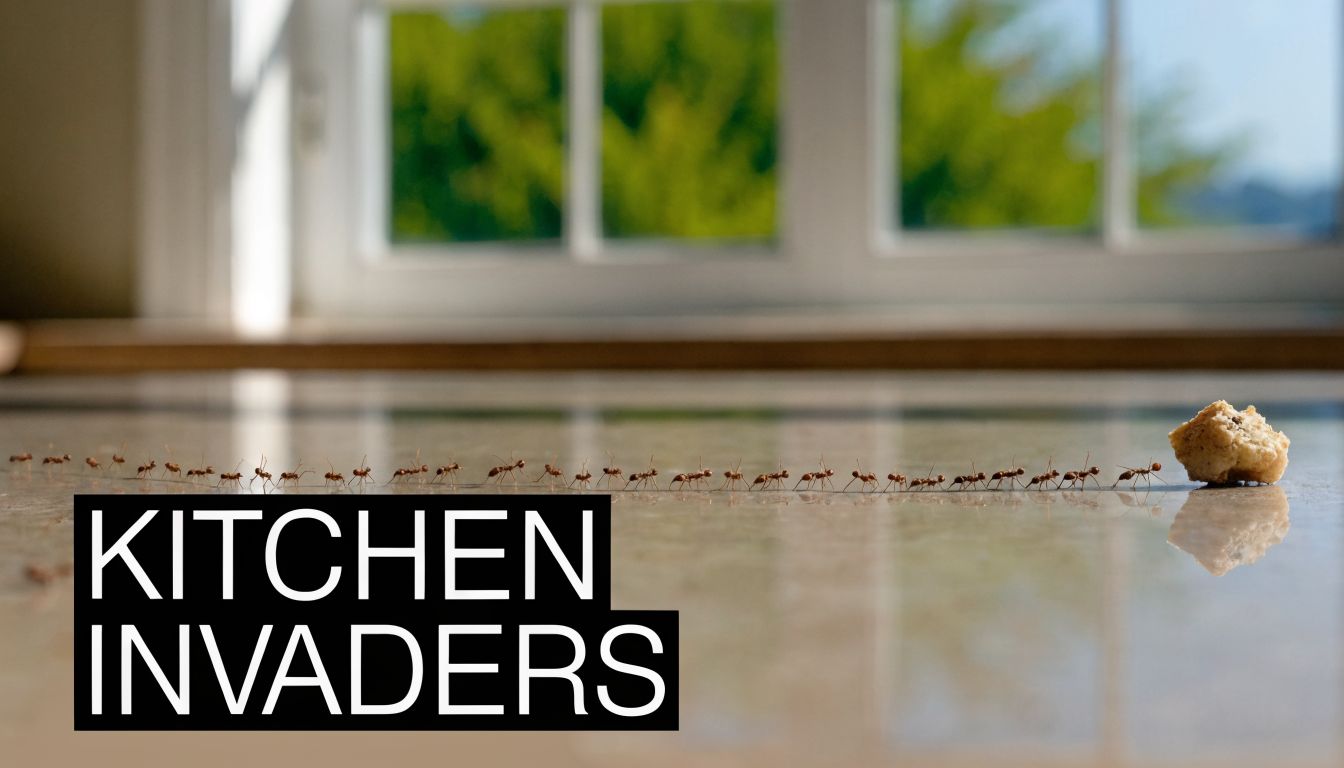
Common kitchen ants around Crown Point
The two kitchen invaders many local homeowners run into most often are odorous house ants and pavement ants.
Odorous house ants usually prefer moisture and often show up under sinks, near dishwashers, around refrigerator water lines, and along damp trim. If crushed, they can give off a distinct odor many people describe as rotten coconut. Their trails can look less organized than other species, especially once they’ve established multiple routes indoors.
Pavement ants often nest near slabs, sidewalks, garage edges, and foundation cracks. They may enter through low wall gaps and follow more defined foraging lines toward crumbs, grease residue, or pantry spills. In kitchens, they tend to exploit overlooked lower-level access points.
When bigger ants mean a different problem
Large ants indoors deserve more attention. While many kitchen problems are nuisance infestations, carpenter ants can point to damp wood, voids, or structural conditions that need inspection. Homeowners sometimes mistake all large ants for the same pest, which can delay the right response.
If you see larger ants near sinks, windows, or damaged wood, don’t rely on a kitchen-only fix. That’s a good time to think beyond ant control and consider whether a broader residential pest inspection is needed. In some homes, concerns about moisture pests can overlap with conversations about termite control, wood damage, or exclusion repairs.
A quick field check
Use this simple comparison before you buy products:
| What you notice | Likely clue | Why it matters |
|---|---|---|
| Ants near sink moisture | Odorous house ant behavior | Moisture correction matters as much as bait choice |
| Ants entering from slab or foundation seam | Pavement ant pattern | Exterior crack sealing becomes a priority |
| Larger ants near damp wood | Possible carpenter ant concern | Inspection should include structural areas |
The best ant treatment starts with the right identification. If the bait doesn't match what the colony wants, the ants may walk right past it.
Your First Line of Defense A Practical DIY Prevention Plan
DIY ant prevention works best as a routine, not a one-time treatment. In Crown Point kitchens, the right routine depends on which ant is visiting. Odorous house ants keep coming back to moisture and sweet residue. Pavement ants are more likely to track in from foundation cracks and slab edges. If you match your cleanup and sealing work to the species pattern, you get better results and waste less time.
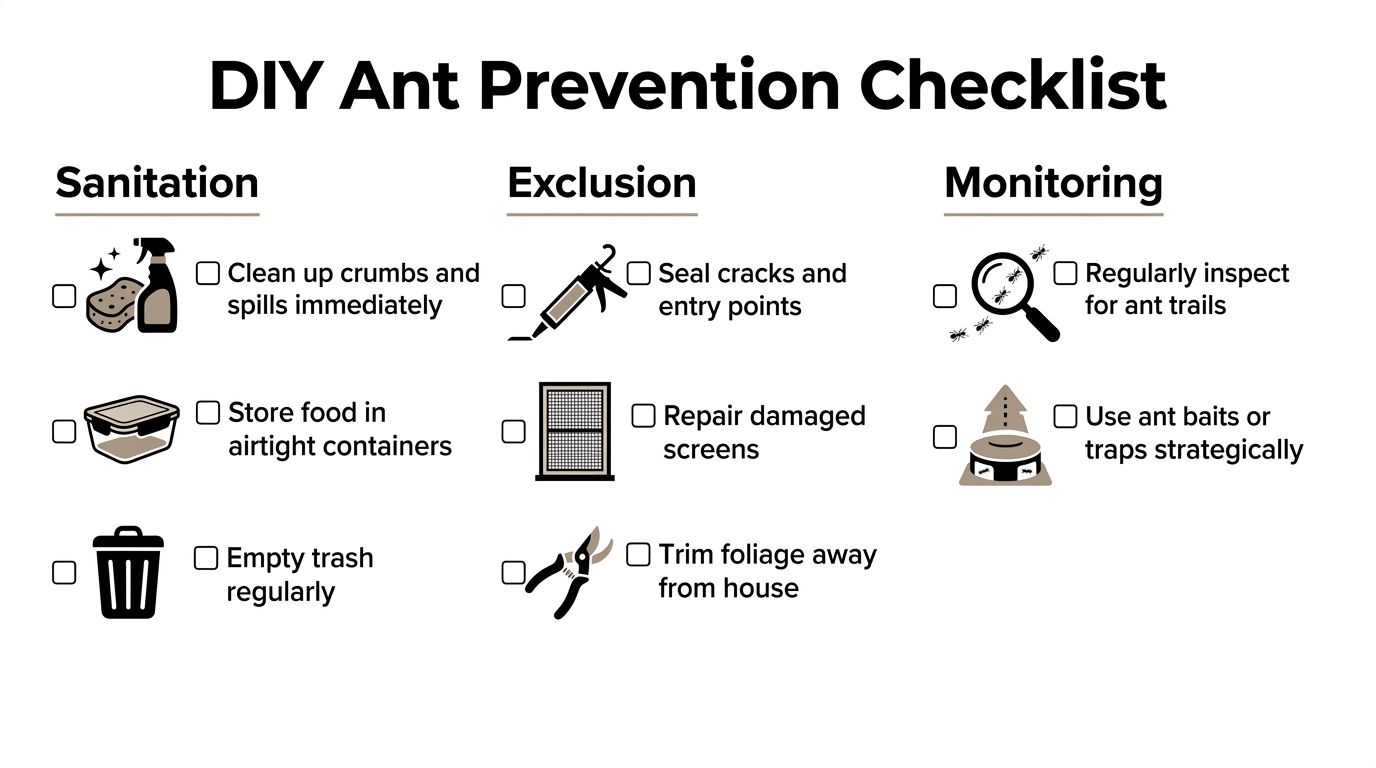
Start with sanitation that changes ant behavior
“Keep it clean” is too broad to solve an ant issue. Ants respond to tiny, repeatable food and water sources. The goal is to remove the reward that keeps that trail active day after day.
Pay close attention to the spots homeowners miss:
- Pet feeding areas: Wipe under bowls, not only around them. Kibble dust and water rings are enough to hold a trail.
- Cabinet seams and small appliances: Lift and clean under the toaster, coffee maker, and microwave if activity is nearby. Crumbs collect along backsplash joints and counter edges.
- Trash and recycling: Empty both often and rinse sticky containers before they sit overnight.
- Produce and pantry goods: Move sugar, cereal, flour, snacks, and pet treats into sealed containers instead of cardboard or loosely folded bags.
- Sink zones: Dry the counter around the faucet and check under the sink for slow leaks.
That last point matters more with odorous house ants than many homeowners expect. Around Northwest Indiana, I see plenty of kitchens where a minor drip under the sink keeps the problem alive even after the counters are spotless.
For more step-by-step help with exclusion work around the home, see this guide on preventing ants from entering the house.
Seal the routes ants are using
Ants do not need a wide opening. In older homes and newer homes alike, they use tiny gaps around trim, plumbing, thresholds, and utility lines. Crown Point’s freeze-thaw cycles can open small separations over time, especially near windows and where materials meet.
Start with these areas:
- Window trim and sills where caulk has pulled away
- Pipe penetrations under sinks and behind appliances
- Baseboards where flooring meets the wall
- Door thresholds and worn weatherstripping
- Foundation transitions where wires and pipes enter
Use silicone caulk on narrow, accessible gaps. The job is simple. Seal the full opening cleanly instead of smearing product over the surface and leaving side gaps.
Remove the active trail before sealing. If ants are still using that route, they often shift a few inches and keep foraging.
Erase the trail, not just the ants you can see
A visible trail is a scent path. If that scent stays in place, new workers can rebuild traffic fast.
For kitchen surfaces, use a cleaner that removes residue well, then wipe the entire path from the food source back toward the entry area. Plain vinegar can help with cleanup, but in the field it often leaves enough trail behind that ants return sooner. A glass cleaner paired with dish soap usually does a better job on hard, non-porous surfaces. Test any product first if you are working on natural stone or a delicate finish.
Use it this way:
- Inspect during active periods: Check baseboards, the area behind the coffee maker, under the dishwasher edge, and around window corners.
- Treat the full route: Clean the complete trail, not only the cluster you spotted first.
- Wipe thoroughly: Use a microfiber cloth or paper towel and remove all visible residue.
- Repeat as needed: If traffic starts to rebuild, clean the route again for the next few days.
A quick visual walkthrough can help if you want a simple refresher before you start:
What to avoid
A few common DIY habits make kitchen ant problems harder to solve.
- Random spraying: Fast-kill aerosol sprays can break up the visible trail while pushing the colony to split or reroute.
- Using every product at once: Repellents, bait, essential oils, and contact sprays can interfere with each other.
- Skipping the exterior check: If ants are entering at a window frame or foundation seam, indoor cleanup alone rarely holds.
- Leaving easy food nearby: An open snack bag or sticky pantry shelf can beat your treatment every time.
A light, recent ant issue often responds well to this plan. If you clean thoroughly, seal the likely access points, remove the trail, and the ants still rebuild in the same kitchen, that usually means the colony is established in a wall void, under a slab, or outside along the structure. That is where local species knowledge matters, especially with odorous house ants that shift nesting sites and keep pressure on the same room.
When DIY Ant Control Is Not Enough
A kitchen trail makes the problem look small because you only see the ants that are out foraging. The colony behind that trail can be much larger. Verified data shows ant colonies can contain 10,000 to 100,000 workers, which is why surface spraying usually feels successful at first and then disappoints a few days later. That same fact set notes that 80% of kitchen ant infestations recur within 2 weeks if entry points and the nest remain unaddressed, while professional interventions that target the queen can reduce recurrence by 95%, based on the provided reference to this ant infestation source.
The real limit of kitchen-only treatment
The ants on your counter are workers. They’re replaceable to the colony. Killing them doesn't remove the nest, the queen, or the route network feeding new workers into the house.
That’s why certain patterns should change your decision from DIY to professional help:
- Ants return after thorough cleaning: You removed food access, but traffic rebuilt anyway.
- Activity spreads to other rooms: Now you’re seeing ants in bathrooms, laundry areas, or near windows.
- Store products get ignored: The bait sits untouched or the ants switch routes after spraying.
- You keep finding new entry points: Each closed gap is followed by activity somewhere else.
What recurring activity usually means
Persistent ants often signal one of two things. Either the colony is well-established in or near the structure, or the species and bait strategy don’t match. Both problems require more than a wipe-down and a spray can.
A targeted service approach looks at nest location, moisture conditions, access points, and species behavior together. Homeowners dealing with repeat invasions can learn more about that process in this local page on how residential ant control service in Crown Point solves home ant problems.
If you’ve cleaned carefully and still see ants on schedule, the colony has a system. The fix needs a system too.
The Green Advantage Professional Ant Control for Crown Point Homes
Professional ant control works best when it starts with diagnosis, not assumptions. In Crown Point homes, that means looking at where ants are active, what species behavior fits the pattern, where moisture is supporting them, and how they’re getting inside. A kitchen trail is only one clue.

What a professional visit should include
A useful service call doesn’t begin and end at the countertop. It should include inspection around sinks, dishwashers, refrigerators, baseboards, window lines, utility entry points, and exterior transition areas. In a lot of homes, the kitchen is where the ants are noticed first, not where the underlying problem starts.
Treatment planning should also reflect household priorities. Some homeowners want the least indoor disruption possible. Others want broader prevention because they’re already dealing with seasonal spiders, wasps, rodent activity, or yard mosquito pressure. That’s where residential pest control becomes more practical than chasing one pest at a time.
Why consistency matters
One-time treatment can help, but recurring pressure often comes from changing weather, ongoing moisture, and exterior activity. A broader prevention mindset is useful here. If you want a non-pest-specific read on that idea, this article from Calibre Cleaning on consistent pest control explains why regular prevention tends to be more reliable than reacting only after pests show up.
For local homeowners searching exterminator in Crown Point, IN, pest control near me, or support for a rental or commercial property, the same principle applies. Lasting results come from combining exclusion, species-aware treatment, and follow-up instead of relying on a single visit to do all the work forever.
What homeowners can expect in practice
A straightforward ant service process usually looks like this:
| Stage | What happens | Why it matters |
|---|---|---|
| Inspection | Active areas, access points, moisture, and ant behavior are checked | Finds the cause, not just the symptom |
| Treatment plan | Baits, exclusion advice, and targeted applications are selected | Reduces trial-and-error |
| Follow-up | Activity is reevaluated and adjustments are made if needed | Confirms the colony is actually declining |
In Northwest Indiana, one available option for this type of work is The Green Advantage, which provides residential and commercial pest control, inspections, mosquito reduction programs, and treatment plans built around local conditions. For ant problems, that local focus matters because species behavior and moisture patterns in Crown Point homes aren’t exactly the same as what national articles assume.
If an inspection turns up signs of another issue, such as wood-risk conditions or broader entry-point problems, that can also shape the next step. That’s often more helpful than treating ants in isolation and missing the rest of the picture.
Protect Your Home and Health with Year-Round Prevention
An ant-free kitchen isn’t just about comfort. It’s about protecting the spaces where your family stores food, cooks meals, and starts the day. When ants keep showing up, they create stress, force repeated cleanup, and usually point to moisture or structural gaps that deserve attention.
The most practical long-term mindset is prevention. Keep food sealed. Keep sink areas dry. Watch for tiny gaps at trim, pipes, and sills. Respond early when you see scouting ants instead of waiting for a steady trail. That approach also supports wider pest prevention, since the same conditions that attract ants can support other unwelcome activity in the home.

Clean homes help, but they aren't the whole answer
Good housekeeping matters, but it’s only one part of control. Deep cleaning can remove food residue from overlooked surfaces, rugs, and edges where pests forage. For a related read, this article on the role of carpet cleaning in pest control offers useful context on how sanitation supports broader pest prevention.
The key is to think in layers. Cleanliness reduces attraction. Sealing reduces access. Proper treatment addresses the colony. Ongoing monitoring helps you catch changes before they become another frustrating kitchen invasion.
A calm kitchen usually comes from quiet prevention. Most successful ant control happens before the next trail ever appears.
If you're in Crown Point or nearby Northwest Indiana communities, a year-round approach also gives you one point of contact for seasonal pest issues beyond ants, including spiders, rodents, wasps, and mosquito concerns around the yard. That kind of continuity protects your home, your routine, and your peace of mind.
If ants keep coming back to your kitchen, stop guessing and get the problem inspected at the source. Contact The Green Advantage to schedule a pest inspection, request a quote, and get a practical plan for ant control and year-round pest protection in Crown Point, IN.