
What if the mosquitoes biting you in Crown Point weren't blowing in from a swamp, but hatching ten feet from your patio in water you walked past this morning? That's the gap in how people think about local mosquito control. Spraying adults feels like action, but it doesn't stop the next generation already developing in a saucer, gutter, or toy. I would start with the breeding sites on your property, rank them, fix what you can every week, and use targeted treatment only where inspection shows it's needed.
Local Mosquito Control Options Compared
Most homeowners face the same first choice: handle it yourself, hire help, or rely on your town. Each option covers different ground, and the strongest plan in Crown Point, IN usually combines two of them.
Mosquito control options at a glance
| Option | Who Runs It | Typical Coverage | Strengths | Limits |
|---|---|---|---|---|
| DIY yard work | You, on a weekly routine | Your property only | Low cost and full control over timing | Misses hidden water and neighborhood sources |
| Contractor program | Licensed pest control technicians | Your property, on a set schedule | Inspection, targeted treatment and follow-up visits | Recurring cost; scope depends on the plan |
| Municipal program | Local mosquito-control district or town | Public land, catch basins and community breeding sites | Area-wide surveillance and treatment | Focus is public areas; private yard service is limited by program scope |
What the Municipal Layer Actually Does
Organized mosquito control started as a public responsibility, not a yard service. A CDC history in Emerging Infectious Diseases notes South Orange, New Jersey established an organized mosquito-control program in 1901, and by 1997 a national survey identified 345 mosquito-control districts or programs serving approximately 97 million people, nearly 37% of the country's population at that time.
Those programs grew to include habitat management, surveillance, larval control, and drainage on public land. That's valuable work, but it isn't designed to empty your plant saucers or check a rain barrel behind your garage. Your yard needs its own plan alongside area-wide work.
Practical rule: Choose DIY if you have few water sources and can check weekly. Choose a contractor when biting persists after your efforts or you want documented inspections.
Use municipal services alongside either choice for community breeding sites. For pest control in Crown Point, IN, think in layers. The district handles the neighborhood scale, you or an exterminator near me search result you vet carefully handles your lot, and neither layer replaces the other.
Why Yard Mosquitoes Keep Coming Back
Look first at the small water you've already seen, not a distant pond.
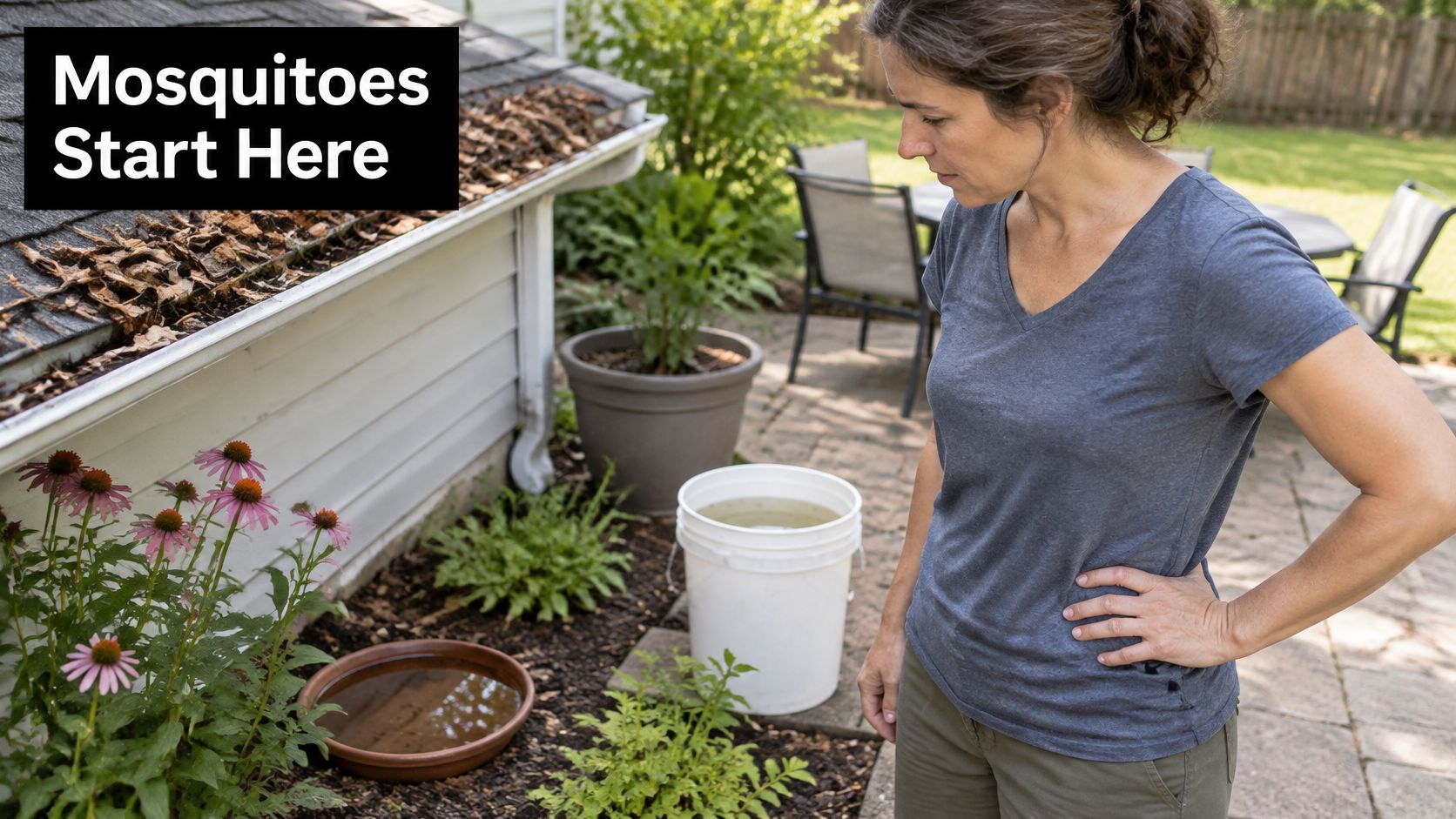
The CDC life cycle guide for Aedes mosquitoes explains they can develop from egg to adult in approximately 7 to 10 days, so two ignored weeks can produce a new generation. Females lay eggs on container walls just above the waterline, and rain or sprinkler water floods them so they hatch.
Common Culprits in Northwest Indiana Yards
- Plant saucers and buckets: They refill with every watering and storm.
- Tires and toys: Curved shapes hold water where you can't easily see it.
- Birdbaths and rain barrels: Loose lids and still water invite egg laying.
- Clogged gutters: Leaves trap a long, shallow trough of water.
- Low corners: Water pools after heavy rain and sits in shade.
Emptying alone isn't enough. That same CDC guide notes Aedes eggs can survive without water for up to eight months and hatch when re-flooded, so containers need scrubbing, covering, or removal. A CDC Aedes life cycle summary adds larvae can develop into pupae in as few as five days, which is why weekly checks catch them before adults emerge.
This short video shows how quickly that cycle turns in ordinary containers.
For soggy corners that stay wet, learning to improve drainage after heavy rain helps you move water away instead of treating the same puddle all season. Hidden small containers, not only ponds, drive most backyard populations.
How to Run a Weekly Yard Mosquito Routine
A weekly walk beats an occasional cleanup because it interrupts development before adults emerge. The WHO guidance on larval source management identifies container and waste management, environmental modification, larviciding, and biological control as complementary interventions, and notes larviciding is most suitable where breeding sites are relatively few, fixed, identifiable, and easy to treat.
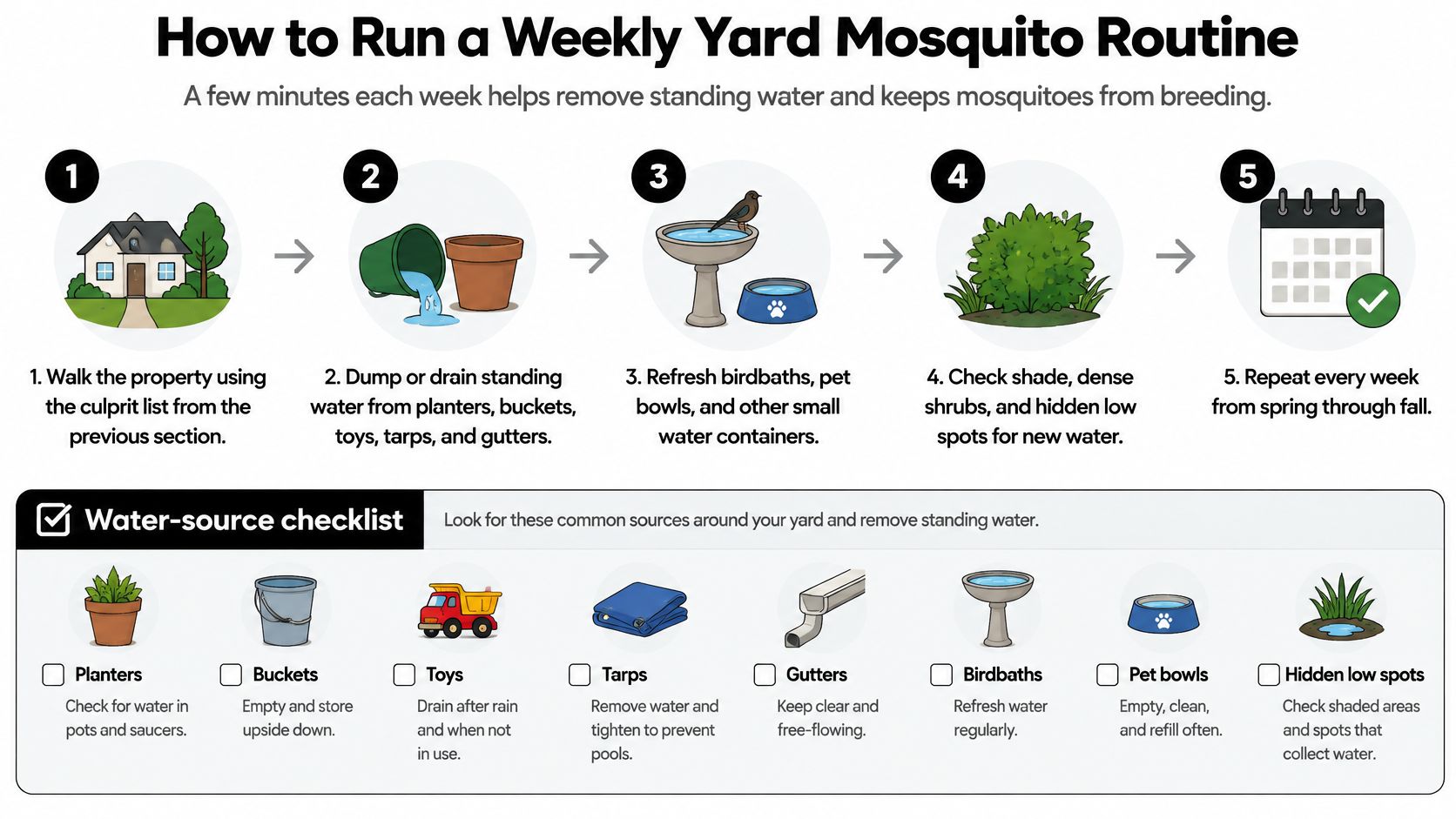
Your Repeatable Six Step Walk
- Walk the whole property. Note every spot holding water, including shaded and low areas behind sheds and shrubs.
- Empty, scrub, and flip containers. Scrubbing removes eggs stuck to walls, and storing items upside down keeps them dry.
- Clean gutters and check downspouts. Water should carry away from the house, not spill beside the foundation.
- Cover what must hold water. Use tightly fitting lids or fine screen on rain barrels and similar containers.
- Handle sites you can't empty. Drain ornamental ponds or tire piles where possible, or use a larvicide labeled for mosquito larvae exactly as the label directs.
- Recheck after rain or sprinklers. New water can restart the cycle within days.
Common water sources and what to do
| Water Source | Action | Check How Often |
|---|---|---|
| Plant saucers and buckets | Empty, scrub and store upside down | Weekly |
| Rain barrels and birdbaths | Cover with tight lids or fine screen; clean and refill as needed | Weekly |
| Gutters and low corners | Clean gutters; fix drainage so water runs away from the house | After each storm |
| Tires, ponds and tire piles | Drain, or treat with a mosquito larvicide used as the label directs | After rain; recheck weekly |
| Irrigation and sprinkler areas | Check for pooling after each cycle | After each cycle |
Sketch your yard on paper and mark recurring hotspots with dates. You'll quickly see that two or three sites cause most trouble, and you can spend effort there first instead of treating every damp inch equally.
You're winning when the weekly walk finds no standing water and biting drops around patios over several weeks.
Diffuse or hard to reach habitats, such as a wet wooded edge you don't control, need broader measures. That's a good point to ask about residential pest control support rather than adding more spray on your own.
Products, Misting Claims and Environmental Trade-Offs
Which product makes sense depends on what you find on the property. Start with breeding sites, then consider targeted treatment only when monitoring supports it. More frequent spraying alone does not address water where mosquitoes can keep developing.
Misting Systems and Gadgets
The EPA guidance on mosquito misting systems says residential misting systems have not been studied sufficiently to establish their effectiveness against mosquitoes or other yard pests. They have not been scientifically proven to prevent West Nile virus or other mosquito-borne diseases. A system may kill mosquitoes near its spray, but that does not prove it prevents disease.
Sound-wave devices deserve similar scrutiny. The EPA explanation of insect repellent registration notes that some sound-wave mosquito devices are not EPA-registered, so the agency has no safety or effectiveness data for them. Marketing claims are not proof that a device works.
The Integrated Approach
EPA and CDC recommend integrated pest management: remove breeding habitat, use screens and barriers, target larvae where practical, and reserve adult treatments for situations supported by monitoring. The EPA integrated mosquito control guidance says product choice should account for species, insecticide resistance, weather, cost, and environmental risk. It reports no documented resistance to Bti and minimal toxicity to honey bees.
Bti targets mosquito, black-fly, and fungus-gnat larvae. A labeled dunk or granule in water that cannot be emptied has a different trade-off from broad adult spraying. Before choosing a yard-wide adult product, ask providers how they protect pollinators. The Green Advantage has information on mosquito control and pollinators.
Adult products also carry trade-offs. EPA notes that pyrethrins and permethrin can kill bees, butterflies, and ladybugs, while pyrethroids are particularly toxic to fish and bees. Ask providers how they will handle flowering plants, fish ponds, wind, and rain, and how long children and pets should stay off treated areas while the product settles, as directed by its label.
For personal protection, apply repellent to exposed skin or clothing only. Keep it away from eyes, mouth, cuts, and irritated skin, and follow the container's EPA registration number and label directions.
Buying filter: Is the product EPA-registered? What evidence supports its claims? Does it address a breeding source?
If a seller cannot answer clearly, keep looking. Killing adult mosquitoes while leaving breeding sites in place can mean the problem returns.
What a Professional Mosquito Program Includes
A professional visit should start with diagnosis, not a sprayer. When you're comparing pest control near me options, this order tells you whether you're buying inspection or just application.
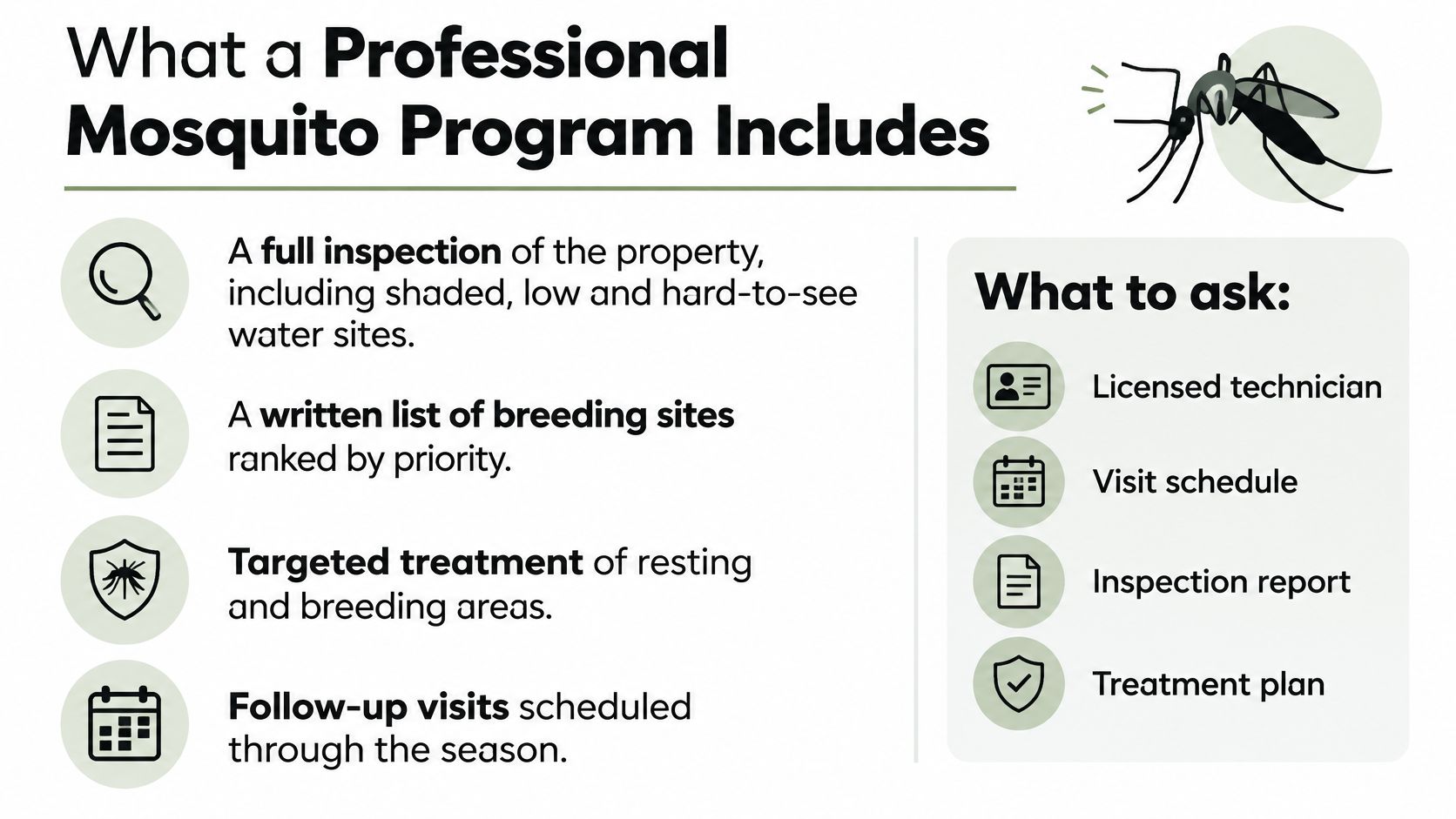
What Should Happen on the Visit
- Full property inspection. The technician checks shaded, low, and hard to see water sites, plus resting areas in dense shrubs where adults shelter during the day.
- Ranked breeding site list. WHO's dengue vector surveillance guidance explains pupal surveys can reveal the most productive containers, and treating only high-output containers can be as effective as treating all containers while requiring fewer resources.
- Recorded prevention steps. Our technicians note on the inspection report any steps you can take to prevent the pest problem, such as gutter cleaning, drainage fixes, and container removal.
- Targeted larval treatment. Sites that can't be emptied get a product chosen for that water, its shade, and how long it persists.
- Adult treatment where people gather. Patios, play areas, and entryways get attention only when inspection and biting pressure support it.
- Follow-up through the season. Reinspection after heavy rain matters because newly filled containers can restore breeding quickly.
Before work starts, you should hear which products will be used, where they'll go, and what precautions apply to your family and pets. All our technicians are licensed for structural pest control by the Department of Public Health, and each technician holds licences in certain sub-categories. That licensing matters because product labels carry legal directions, not suggestions.
For landlords and property managers, the ranked list is especially useful. It turns apartment courtyards, dumpster pads, stormwater features, and loading docks into a short set of recurring checkpoints your maintenance crew can verify between visits. Commercial pest control works the same way, with documented hotspots instead of vague promises.
A strong program pairs inspection with treatment, so work targets the sites actually producing mosquitoes on your property.
If a quote skips inspection and goes straight to a spray schedule, you're missing the part that makes treatment efficient. I would ask for the written site list before approving recurring visits.
What Results to Expect Through the Season
Judge a program by measurable signs, not by whether you see a single mosquito. Adults can fly in from untreated areas nearby, so no honest provider should promise a mosquito-free yard.
A Realistic Timeline
First two weeks: The goal is finding and fixing water sources. You should have a written, ranked list of breeding sites and clear prevention steps you can do between visits.
Next four to six weeks: Expect fewer biting adults around patios and play areas as containers stay empty or covered and larval treatments interrupt new generations. For timing between visits, our explainer on how long mosquito treatment lasts covers what affects that window.
Rest of the season: Progress depends heavily on weather. Heavy rain or irrigation can create fresh habitat quickly, so a wet stretch may temporarily raise biting even in a well managed yard.
Three Signs to Watch
- Biting where people gather: Are evenings on the patio noticeably easier than before service started?
- Weekly walk results: Are you finding no standing water, or the same three containers every time?
- Inspection reports: Are repeat breeding sites shrinking in number across visits?
If biting stays high but your yard is dry, the source may be off your property, such as a neighbor's neglected containers or a community catch basin. A good provider will say that plainly and adjust the plan, rather than spraying more often.
Start in spring before populations build, and keep the routine through the warm months. Seasonal pest issues in Northwest Indiana reward early source reduction far more than late summer catch-up work.
What Affects Cost and How to Choose a Provider
Quotes differ because properties differ. Pricing varies based on the size of the home or business, the type of pest, the service required, and the materials used, and mosquito work adds a few drivers of its own.
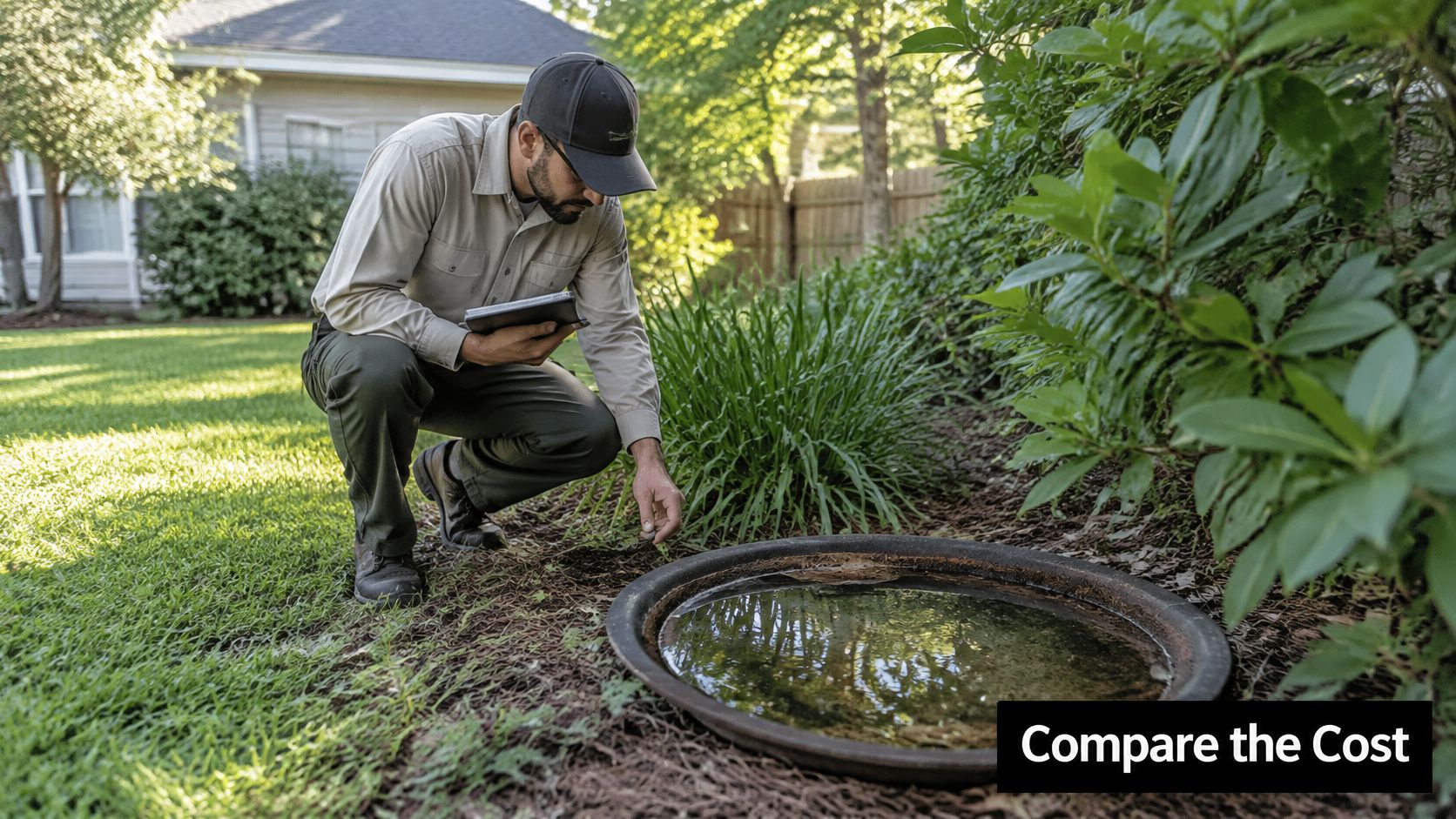
Property size, amount of standing water, dense vegetation, number of visits per season, one-time versus ongoing service, products selected, and how hard problem areas are to reach all change the price. A small dry lot and a shaded acre with a pond shouldn't cost the same.
Provider Checklist for Crown Point
- Licensing confirmed: Our pest control professionals are licensed technicians, and our website describes them as certified.
- Written inspection report: It should list breeding sites and prevention steps you own between visits.
- Clear product explanation: You should hear the product name, where it goes, and label precautions for pets and family.
- Breeding site focus: The plan should target sources first, with adult treatment as one tool, not the whole service.
- Follow-up and rain policy: Ask how visits shift after storms and what triggers a recheck.
- Direct communication: Every customer who signs up communicates directly with our office staff for scheduling and information, so licensed technicians can focus on solving the pest issue.
- Local references: Ask neighbors in Crown Point and nearby Northwest Indiana communities about responsiveness, not just price.
Request a written quote that separates inspection, source reduction advice, and treatment. That breakdown makes comparisons fair when one exterminator in Crown Point, IN quotes only spraying and another quotes a full program. The cheaper number often covers less work.
Schedule a Mosquito Inspection in Crown Point
Which spots on your property hold water after a rain or watering? Start with a slow walk around the yard, checking tucked-away places such as the area behind the garage and beneath the deck. Mark what you find, then empty or address water sources you can safely manage.
If mosquito activity persists, The Green Advantage can inspect your property and explain where to focus. Its outdoor mosquito control targets pests at every life stage, from eggs to flying adults. For general pest control issues, service is typically scheduled the same day or the next business day, depending on your convenience.
An inspection can help prioritize breeding sites and identify prevention steps. You can discuss what treatment, if any, fits the findings before deciding how to proceed. For ideas on outdoor living upgrades, Outdoorbrite offers lighting and patio resources.
Ready to stop guessing which product to try next? Contact The Green Advantage to schedule a mosquito inspection in Crown Point and discuss a plan for your property. The company serves homes and businesses in Crown Point and Northwest Indiana. Visit The Green Advantage to get started.