
Your patio is full, your second shift is heading to the loading dock, and customers are swatting mosquitoes at the front door. When looking for pest control near me or an exterminator in Crown Point, IN after a week of rain, you're probably not asking for one spray. You're asking for outdoor areas people can use.
That's why commercial mosquito control works best as a written, site-specific program, not a blanket schedule. The Green Advantage serves Crown Point, IN and nearby Northwest Indiana communities with commercial pest control built around inspection, source work, and targeted treatment.
Commercial Mosquito Control Options and Program Steps
Say a Crown Point warehouse manager gets complaints at the dock after a rainy week. A quick fog might quiet that evening, but a roof drain holding water overhead can keep producing adults all week. I would start with the drain, not the fogger.
The right question isn't which product to spray first. It's which problem you're solving in each spot. A retention pond, a clogged catch basin, and a shaded patio don't need the same tactic, and treating them as if they do wastes product and time.
Commercial Mosquito Control Tactics Compared
| Tactic | Targets | Best Used When | Lasts |
|---|---|---|---|
| Source reduction | Standing water in drains, containers and low spots | Always, as the first step | As long as the water stays removed |
| Larvicide | Larvae in water that cannot be drained | Ponds, basins and other water that stays wet | Repeats every 7 to 14 days per label |
| Adulticide spray or fog | Adult biting mosquitoes | Biting adults stay high after source work | Short-lived, limited area |
| Habitat modification | Chronic wet areas, shade and vegetation | Water keeps collecting in the same place | Lasts until drainage or grading changes |
| Surveillance and monitoring | Adult counts, breeding sites and complaints | Every visit and after every treatment | Ongoing |
That sequence reflects integrated mosquito management, or IMM. CDC guidance on integrated mosquito management describes surveillance, habitat removal, larval and pupal control, adult control, and follow-up evaluation as connected components, with adulticide providing short-lived suppression when larval habitats remain productive.
The Program Order That Actually Works
- Survey first: Count adults where you track them, find larval habitats, log employee or customer complaints, and map spots that breed again and again. Species and location guide every later choice.
- Reduce sources: Empty, drain, fill, or regrade standing water in roof drains, catch basins, containers, irrigation low spots, and ornamental features. When those sites dry out, they stop replenishing adults.
- Larvicide what stays wet: Treat retention ponds, wet catch basins, and other water you can't drain, following that product's label exactly. This stops the next generation before it flies.
- Use adulticide only when justified: Spray or fog when biting adults stay high after source and larval work, or when you need rapid knockdown before an event. Relief is short-lived and covers a limited area, so it never replaces fixing the breeding site.
- Modify stubborn habitat: Regrade pavement or soil, clear ditch vegetation, and thin dense shade where water and resting adults keep returning. This is construction-type work, but it's often the permanent fix.
- Re-survey and record: Recheck the same drains, basins, and complaint areas. Write down the inspection date, habitat findings, treatment locations, product or active-ingredient class, weather, equipment calibration, and post-treatment observations.
Practical rule: If a report only lists what was sprayed, you can't tell knockdown from control. If it lists what was found, cleared, treated, and rechecked, you can.
Different zones need different mixes from that same list. Planted grounds lean on irrigation fixes and vegetation work. Storm drains and shaded drainage lean on source reduction and larvicide. Loading areas often need container cleanup plus adult work around lights and doors. Water features need circulation, edge maintenance, or larvicide on a cycle.
A monthly loop keeps this manageable for most commercial sites. You survey, check sources, apply labeled larvicide where water remains, use adulticide only if counts stay high, and get written results before the next visit. Weekly checks by your own staff between visits catch new buckets, tarps, and clogged drains early.
This is also how you avoid paying for blanket work. Our customized commercial program lets you target problem areas and avoid charges for unnecessary treatments, because the survey tells us where mosquitoes are coming from at your property.
Survey Your Property Before Choosing Treatments
Treating the wrong spot is the most expensive mistake in mosquito work. You can fog a patio every Friday and still lose the patio if larvae are developing in a catch basin twenty feet away.
Walk the site in a fixed order, and write down what you find in each zone. That order matters because water flows downhill, and the source is often above or behind the complaint area.
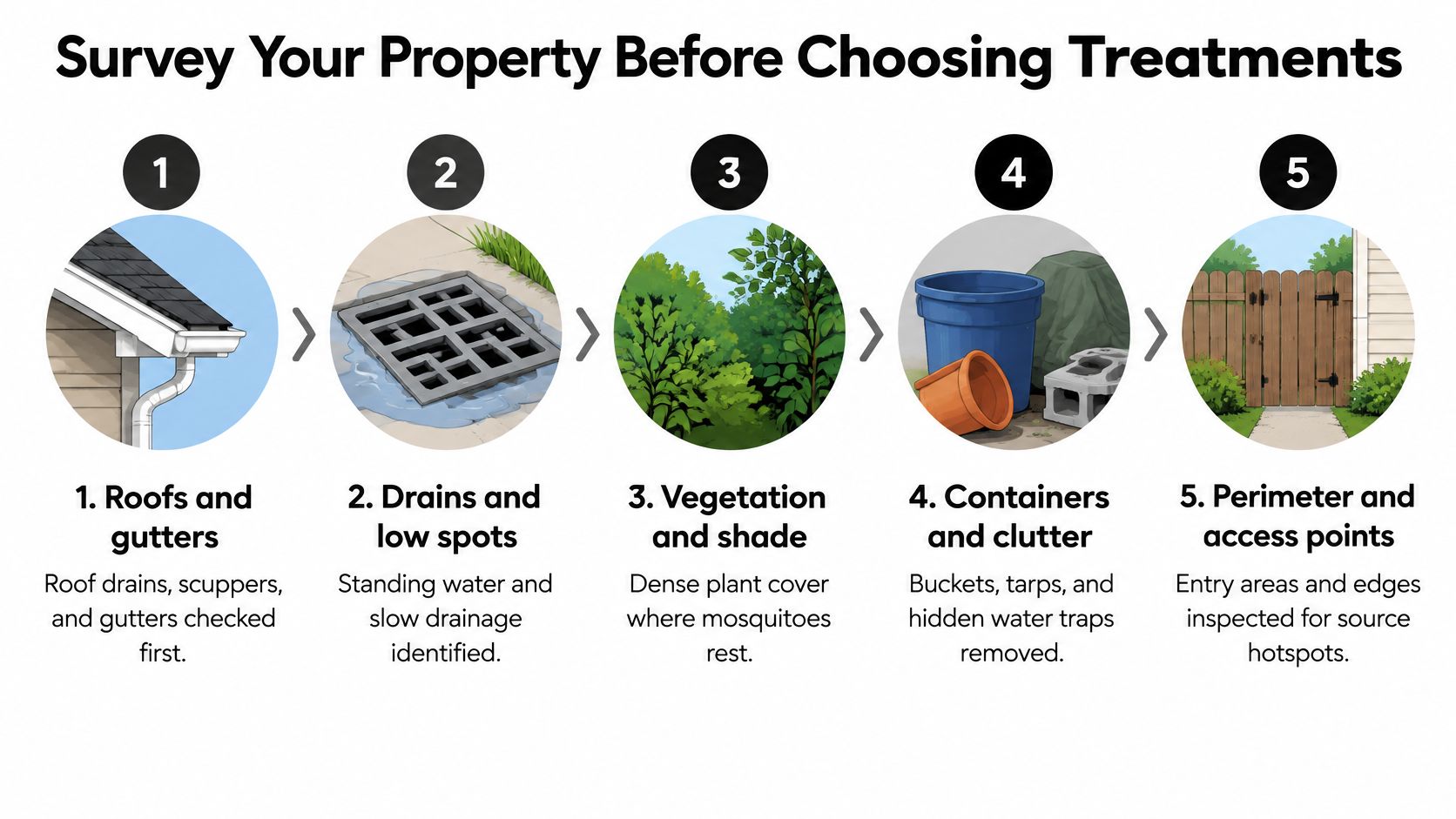
Walk These Five Zones in Order
- Roofs and gutters: Look for roof drains, scuppers, and clogged gutters holding water after rain. Any standing water up there is a finding, and flat roofs need a recheck after every heavy storm.
- Drainage: Check catch basins, storm drains, and low spots in parking lots, lawns, and loading areas. Slow or standing water here is a prime larval site, so recheck weekly in warm weather.
- Water features: Inspect retention and detention ponds, fountains, decorative basins, and birdbaths. Stagnant edges, heavy algae, and still corners count as findings even when the center looks clean.
- Containers and debris: Turn over pallets, tires, buckets, tarps, and stored equipment. Anything holding even a small amount of water goes on the list for dumping, drilling, covering, or removal.
- Landscaping and irrigation: Check shaded beds, irrigation low spots, dense shrubs, and dumpster pads. Overspray that puddles daily can breed mosquitoes as reliably as a pond.
Records Worth Keeping From Day One
Keep the inspection date, habitat locations with photos, adult species and counts where you track them, and complaint dates by area. Add weather notes, especially heavy rain, and flag likely sources beyond your property line, such as a neighbor's ditch or an unmanaged lot.
You can do a first walk-through this week with those five zones as your checklist. When you want a second set of eyes and a written baseline, our commercial pest inspection for Crown Point properties documents those same zones before any treatment is chosen.
Larvicide Rates and Seasonal Timing for Your Site
A larvicide dose is a measured quantity taken from the product label. The label also sets the interval between applications, and that interval is the part crews skip when schedules get tight.
Rates change with surface area, depth, organic matter, and larval stage. Measure length and width to get surface area, and probe depth in a few spots before treating. Shallow, dirty water in a catch basin is not the same dose as clean pond water, even when both look similar from the bank. Underdosing wastes a visit; overdosing wastes product without buying extra control.
Larvicide Label Rates and Repeat Intervals
One EPA-registered larvicide label gives an example of how area and water condition change the dose: 1 teaspoon per 25 square feet of water, 4 ounces per 1,000 square feet for relatively clean water, and a 7- to 14-day interval between applications. Treat that as one product's example, not a universal rate for every basin, ditch, or pond.
| Water Condition | Area Covered | Example Label Rate | Repeat Interval |
|---|---|---|---|
| Small standing water, teaspoon rate | 25 square feet | 1 teaspoon | 7 to 14 days |
| Small standing water, tablespoon rate | 75 square feet | 1 tablespoon | 7 to 14 days |
| Larger area, relatively clean water | 1,000 square feet | 4 ounces | 7 to 14 days |
Write the area, water condition, product, rate, and interval on the service record before you treat. That record is what separates a repeatable program from a route that only looks busy. If the same catch basin needs the same dose every week, the site has a source problem, not a dosing problem.
There's no universal amount for a basin, a ditch, or a pond. Area plus water condition sets the dose, every time.
A Seasonal Calendar for Northwest Indiana
- Spring, April and May: Clear drains, clean gutters, and check water features before warm weather settles in. Fix grading and container storage now, while pressure is low.
- Summer, June through August: Run weekly walk-throughs and keep larvicide cycles timed to the label. Recheck basins and low spots after heavy rain, because storms refill sites you'd already cleared.
- Early fall, September and October: Clear leaves from gutters and drains, drain containers, and close out seasonal water features. Leaf-clogged drainage in fall becomes a spring breeding site if you leave it.
Timing shifts with local weather. A wet June may need tighter cycles, while a dry stretch may need fewer. Your inspection records, not the date alone, should drive that call. No calendar and no rate table can guarantee a mosquito-free property if standing water keeps returning.
Measuring Results and Spotting Failed Treatments
Fewer bites after a visit feels like proof, but it isn't enough. A cool evening or a breeze can cut biting for a night while every drain on the property stays productive.
Start by separating two outcomes in your records. The photo below shows the kind of standing-water check that supports the second one.
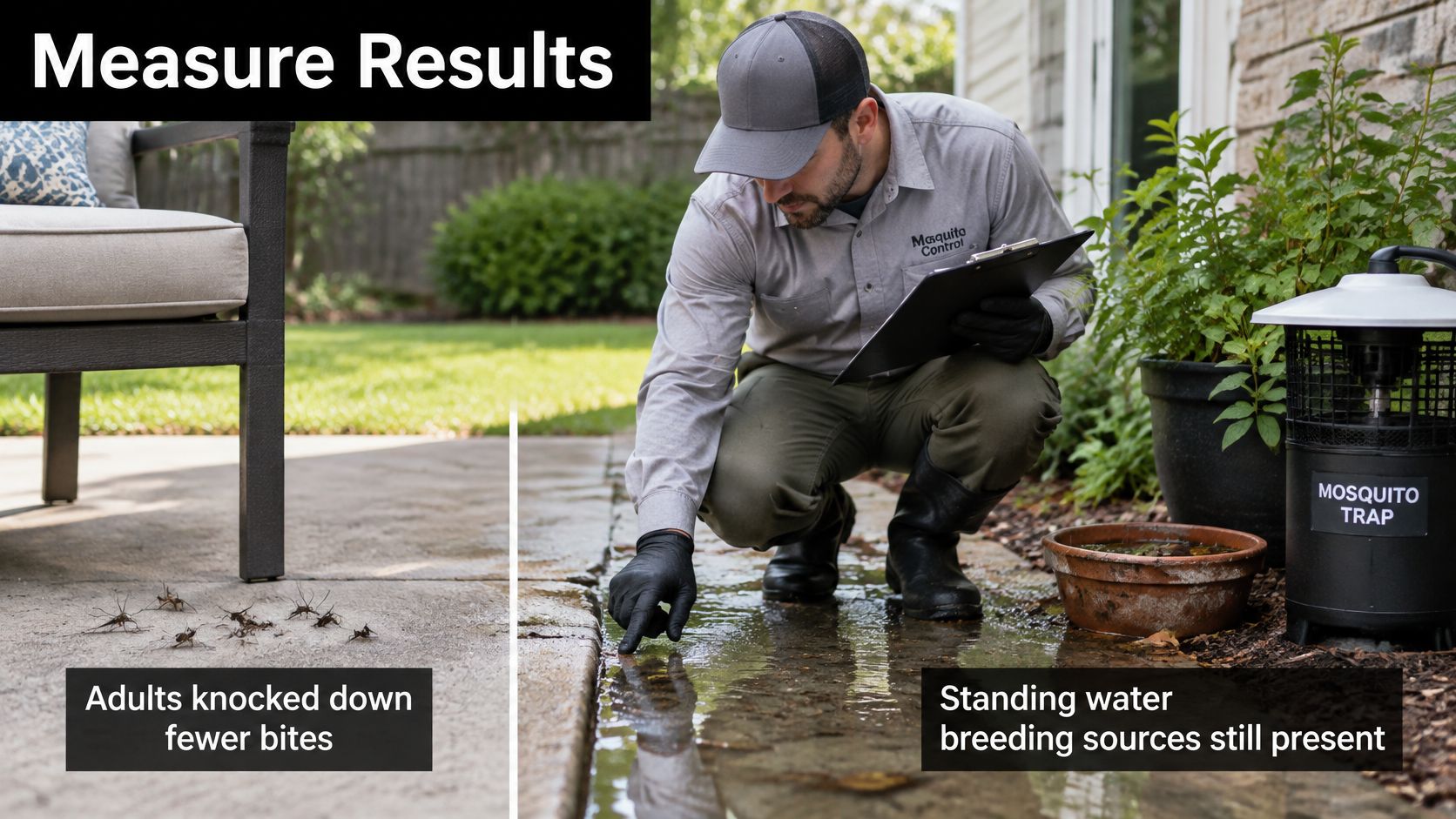
Adult knockdown means biting mosquitoes dropped right after treatment. Durable source reduction means breeding sites stay dry, drained, or treated visit after visit. The first is comfort, and the second is control.
What to Track After Every Visit
Track adult trap counts or inspection findings, breeding sites found and cleared, treatment dates, and rainfall. Log complaints by area, not just by total, so a dock problem doesn't hide inside a property-wide average.
Call a treatment failed in concrete terms. Larvae are back in the same drain within the label interval, complaints continue at the same doors after treatment, or adults stay high even after source work is complete.
The short video below walks through what a technician looks for during that kind of follow-up check.
Check the Application Before Blaming the Product
Don't respond to a weak result by spraying more often. The WHO guidance on insecticide resistance testing notes that laboratory resistance results do not directly prove field effectiveness, and that poor calibration, incorrect dilution, application timing, weather, inadequate coverage, or off-specification material can also cause control failure.
Work through those causes first. Check calibration and dilution records, confirm coverage reached shaded resting areas, and review wind and rain at application time. One poor visit, on its own, doesn't prove resistance.
If failures repeat after the application checks out, suspected insecticide resistance should be confirmed through qualified laboratory or program testing. In the meantime, combine source reduction and larval control with adult control, rotate active-ingredient classes where label rules permit, and avoid repeated exposure to one mode of action.
Set one expectation plainly with your team and your tenants. No outdoor program can guarantee zero mosquitoes, especially when breeding continues beyond your property boundary and adults fly in. What a good program guarantees is documented work and measurable reduction at your site.
Safety, Notice and Environmental Trade-Offs
Who's in the building during treatment? That's the first safety question on any commercial site, and it shapes timing more than product choice does.
Treatments should be done by certified applicators who know integrated pest management. All of our technicians are licensed for structural pest control by the Department of Public Health, and our pest control professionals are certified.
Notice, Timing and Paperwork
The EPA Integrated Pest Management Toolkit says staff should generally be notified 24 to 48 hours before an application except in emergencies, and that pesticides should not be applied when people are present or expected, following the labeled re-entry requirement or at least eight hours after application, whichever is greater.
That toolkit also recommends spot treatment of infested areas and limiting liquid sprays, foggers, and volatile formulations when possible. Labels, consumer information sheets, and Safety Data Sheets should stay accessible on site. Food service, childcare, school, healthcare, and apartment properties need extra coordination on all of this. If occupant safety is your main concern, our overview answering whether spraying for mosquitoes is safe around people and pets covers the questions tenants and staff usually ask.
Environmental Trade-Offs, Stated Honestly
Products differ in their effects on non-target insects, including pollinators, aquatic life, and beneficial insects. A site-specific risk assessment should cover pets, employees, guests, flowering plantings, and runoff pathways to ponds or drains before anything is applied.
"Natural" doesn't mean automatically safer, and spraying doesn't mean automatically effective. The fit for your site decides both.
I would ask any provider three things before the first application. How will you notify occupants, what re-entry time will you follow, and what records will you leave behind? Clear answers protect your people and your property.
Why Crown Point Properties Need Mosquito Control
Commercial lots in Crown Point and nearby Northwest Indiana towns hold water in predictable places. Roof drains, clogged gutters, catch basins, pallet voids, tire storage, and tarps all collect rain and keep it.
Add irrigation low spots and ornamental ponds, and a property can breed mosquitoes in a dozen places at once. During warm, humid stretches, water that sits undisturbed gives larvae time to develop, which is why one fogging visit can't keep a dock or patio comfortable.
What Professional Control Protects
- People: Fewer bites for employees, guests, and customers, and less worry about mosquito-borne illness during outdoor work and events.
- Operations: Outdoor seating, entry walks, patios, and evening shifts stay usable instead of becoming seasonal dead space.
- Your time: A written plan cuts the cycle of complaints followed by emergency sprays that property managers end up chasing all summer.
We build that work into a commercial inspection and a written plan for your actual site, whether you found us searching pest control in Crown Point, IN or exterminator near me. Our technicians also note prevention steps you can take on the inspection report, so your staff knows what to dump, fix, or watch between visits.
The same properties often need related help. Rodent control and exclusion matter where dumpsters and docks meet the building, wasp removal comes up around eaves and entries, and preventative pest treatments handle ants, spiders, and other seasonal pests common across Northwest Indiana. We handle those pests alongside mosquitoes, termites, and roaches.
On a first visit, expect a zone-by-zone survey, notes on occupied hours and any food-service or childcare limits, and a quote for targeted work. Ask for notice, re-entry timing, and documentation in writing before treatment starts.
Book a Commercial Mosquito Survey in Crown Point
A survey turns guesswork into a plan you can budget and defend. You stop paying for blanket treatments and start paying for work tied to breeding sites, complaint areas, and recheck results.
After you call our office for a quote, our team identifies the pest problem and designs a customized commercial pest elimination program for your property. Commercial customers can request a free quote, and our commercial line is open Monday through Friday, 8:00 AM to 4:00 PM, at (219) 779-9815.
Have This Ready Before You Call
- Site basics: A site map or simple list of buildings, docks, patios, and parking areas.
- Water spots: Areas with standing water, slow drains, ponds, or repeated puddling after rain.
- Complaint history: Dates and locations where employees or customers reported biting.
- Occupancy limits: Occupied hours plus any food-service, childcare, school, or healthcare constraints.
- Past records: Previous treatment dates, products if you have them, and what results you saw.
Expect the first visit to follow the zones in this guide, roof to perimeter, followed by a written plan. You'll communicate directly with our office staff for scheduling and information, so our licensed technicians can focus on solving the pest issue in the field. If you keep vendor records in a local business directory or operations platform such as LocalHQ, add the plan, notice terms, and re-entry times there so your whole team works from the same page.
Request your quote, schedule the survey, and get notice, timing, and documentation terms in writing before any treatment begins.
If mosquitoes are taking over your patio, dock, or entryways, The Green Advantage will survey your Crown Point property, target breeding sites and adults at every life stage, and document results visit by visit. Visit The Green Advantage to request your free commercial quote and schedule your mosquito survey today.