
You notice ants moving along the kitchen counter, spiders gathering in the basement, or mice leaving signs near the garage, and the question comes quickly: Do you really need monthly pest control service in Crown Point, IN? Usually, no. Monthly visits can be the right tool for active infestations and high-pressure properties, but they're overkill for many well-maintained homes.
The Green Advantage serves Crown Point and nearby Northwest Indiana communities with residential pest control, commercial pest control, pest inspections, mosquito reduction, and prevention-focused service. The right plan should match what's happening on your property, not lock you into the most frequent schedule.
What Monthly Pest Control Service Really Means for Crown Point Homeowners
A Crown Point homeowner might see the first warning signs in spring. Ants form a trail toward the pantry. Spiders appear in the basement corners. A mouse leaves droppings near stored boxes in the garage. At that point, a salesperson may present monthly service as the obvious answer, but frequency alone doesn't solve every pest problem.
Monthly pest control service means a licensed technician returns on a recurring schedule, generally every four weeks, to inspect, monitor, and treat the property. It isn't the same as a one-time spray. A proper visit looks at current activity, likely entry points, exterior conditions, and changes since the last appointment.
Northwest Indiana homes can face sustained pressure from ants, spiders, mosquitoes, rodents, wasps, and other seasonal pests. Older housing, wooded lots, dense vegetation, moisture, and nearby natural areas can give pests more routes into basements, garages, kitchens, and wall voids. That doesn't mean every Crown Point property needs a technician every month, but it explains why monthly service exists as a legitimate category.
Local rule: Choose monthly visits because your property produces recurring pest problems, not because a frequent schedule sounds more protective.
A monthly plan can provide regular perimeter maintenance, monitoring, and a faster opportunity to respond when activity returns between longer service intervals. That matters for homes with repeated sightings, rental properties where tenants need quick attention, and businesses that can't tolerate visible insects or rodent evidence.
The same principle applies to online visibility. Businesses that depend on local searches often need a consistent process for getting calls from Google Maps, just as a property with recurring pest pressure needs consistent monitoring. In both cases, regular attention works best when it responds to real conditions.
For most homeowners, the decision should begin with three questions:
- What pest is appearing? Ants, mice, mosquitoes, termites, and bed bugs require different strategies.
- Where is activity occurring? A basement, kitchen, crawl space, attic, and yard each point to different risks.
- How quickly does the problem return? Recurring sightings justify more frequent service than an isolated seasonal nuisance.
What a Monthly Pest Control Visit Typically Includes
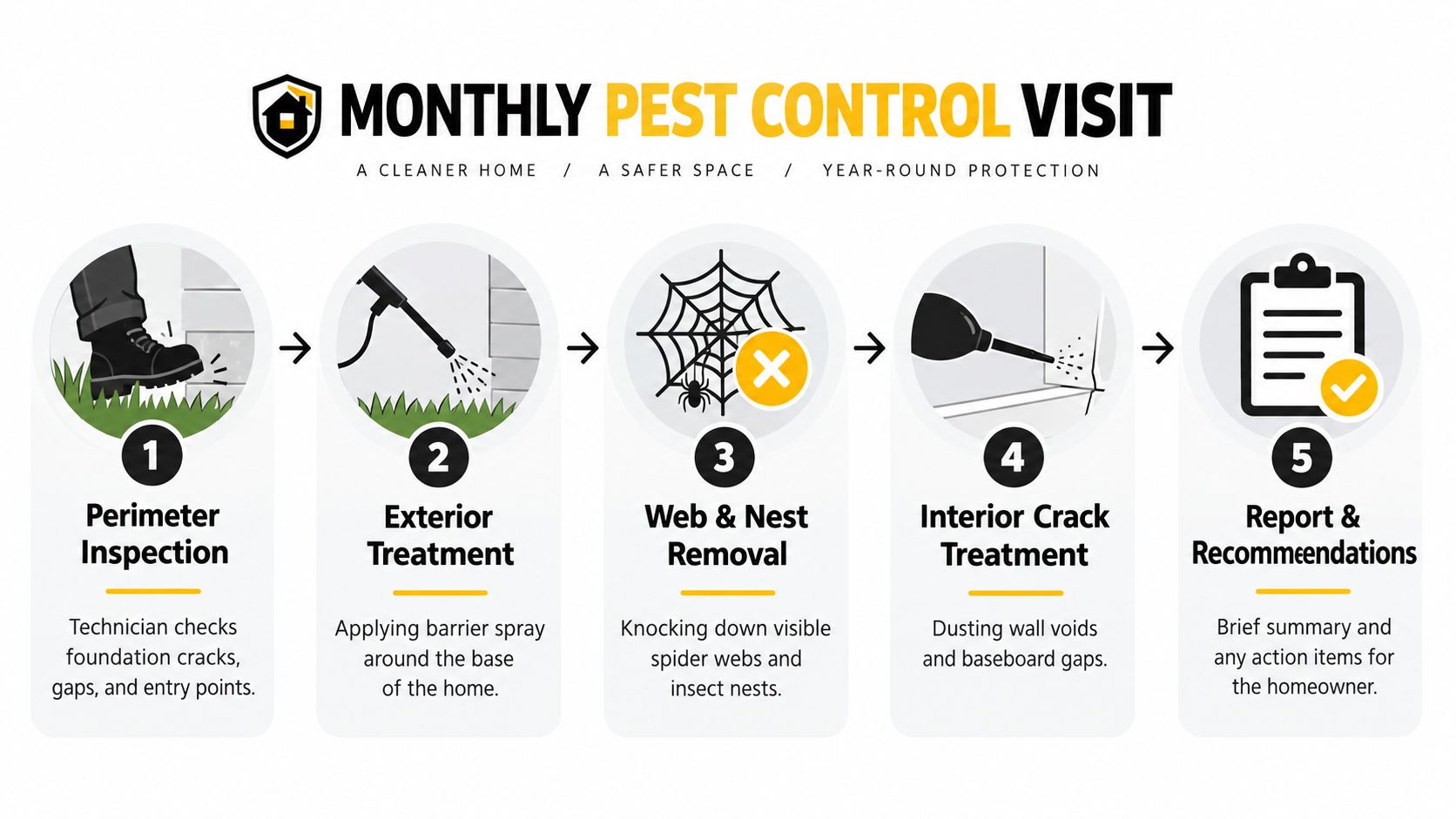
A worthwhile monthly visit should feel like an inspection and maintenance appointment, not a quick pass around the house with a spray wand. The technician should look for why pests are present and document what needs attention.
The exterior inspection comes first
The technician typically walks the foundation, garage perimeter, door thresholds, utility penetrations, window wells, and other potential entry points. Foundation cracks, gaps around pipes, damaged weather stripping, and clutter against exterior walls can help insects and rodents reach the house.
The technician may also check conditions that support pest activity, including standing moisture, dense vegetation touching the structure, firewood placement, and openings beneath siding or trim. These observations matter because treatment works better when the property owner corrects the conditions attracting pests.
Treatment stays targeted
Exterior work may include a carefully applied barrier treatment around the foundation, removal of visible spider webs, and inspection of wasp nests or other insect activity. Bait stations may be checked where rodent monitoring is part of the service plan.
Inside, a professional should inspect kitchens, bathrooms, basements, utility areas, and garages. German cockroaches and mice often reveal themselves through droppings, odors, feeding damage, grease marks, or activity around food and water sources. Interior crack-and-crevice treatment should be used where activity is confirmed, not sprayed indiscriminately across living areas.
The visit ends with documentation
A good service includes written notes describing pest findings, treatments performed, and practical corrections such as sealing gaps, reducing moisture, or storing food securely. Ask whether the plan includes follow-up communication, callbacks, and identification of new pest activity.
Monthly general pest service usually doesn't include every pest category. Termite control, wildlife removal, and bed bug treatment often require separate inspection and treatment programs because those pests behave differently and demand specialized methods.
Monthly vs Bi-Monthly vs Quarterly Service
Most Crown Point homes don't need monthly service throughout the year. The better choice depends on pest pressure, property design, surrounding habitat, and how quickly activity returns after treatment.
| Cadence | Best Fit | Typical Annual Cost | Pest Pressure Level |
|---|---|---|---|
| Monthly | Active infestations, recurring rodents, heavy wooded exposure, commercial properties, or persistent year-round activity | About $660 annually when based on a $55 monthly plan, Greenhow pricing data | High or persistent |
| Bi-monthly | Suburban homes with moderate activity or seasonal concerns | About $408 annually based on the same pricing guide | Moderate |
| Quarterly | Most single-family homes needing general prevention | About $525 annually, with the plan averaged to $44 per month | Low to moderate |
The cost figures are benchmarks, not promises for a Crown Point property. A local quote can change with home size, pest type, access, treatment requirements, and whether specialized services are included.
When monthly service makes sense
Monthly visits are justified when pests keep returning before the next scheduled appointment. A home with an active cockroach problem, repeated mouse evidence, persistent ants, or heavy spider activity may need closer monitoring while the technician interrupts the problem.
Monthly service can also fit properties surrounded by woods, dense vegetation, or wet areas where insects and rodents have more habitat. Commercial kitchens, apartment buildings, offices, and facilities with frequent foot traffic often need a tighter schedule because activity can affect customers, employees, inspections, and operations.
When less frequent service works better
Bi-monthly service is often the sensible middle ground for a suburban home with occasional activity. It provides more oversight than quarterly visits without paying for a monthly appointment when the property doesn't need one.
Quarterly service commonly fits newer construction, tightly sealed homes, and properties with little pest history. Seasonal ramp-ups can also make sense. A homeowner might use a lower-frequency general plan and add focused mosquito control, wasp removal, or rodent work when conditions call for it.
My recommendation: Start with the least frequent schedule that controls the problem, then increase visits only when inspection findings and repeat activity support it.
Monthly Pest Control Service Cost in Crown Point
Monthly service pricing gives Crown Point homeowners a useful starting point, but the property determines the quote. General plans commonly run $40 to $75 per visit, and the HomeGuide pest control pricing guide places the average general plan at about $51 per month. Initial inspections or first treatments often add $150 to $300.
Greenhow's pest control cost report lists a national monthly range of $44 to $70 and notes that some higher-cost regions run 15% to 25% above the national average. Use those figures to screen quotes, not to predict the price of service at your Crown Point home.
| Service Type | Price Range per Visit | Typical Add-On Cost |
|---|---|---|
| General monthly pest plan | $40 to $75 | Initial fees may apply |
| General plan benchmark | About $51 per month | Depends on coverage |
| Mosquito or tick service | $88 to $150 per month during active seasons | Often seasonal and separate |
| Rodent monitoring | Qualitative range varies by property and activity | Bait station setup, refills, or exclusion may be separate |
| Termite service | Requires a separate inspection and program | Treatment and monitoring are not standard general pest visits |
The $88 to $150 seasonal range applies to mosquito and tick programs. A general pest package does not automatically include yard mosquito reduction or tick management. Those services cover different areas and often use separate schedules.
Crown Point properties near wooded lots, retention ponds, or dense landscaping can need more outdoor work than a basic foundation treatment. Older homes with crawl spaces, unfinished basements, utility openings, or persistent moisture may also require preparation or repairs before treatment can hold.
Before accepting a recurring quote, ask whether it covers:
- Initial inspection and first treatment
- Exterior barrier applications
- Interior crack-and-crevice work
- Web removal and wasp nest treatment
- Bait station checks and refills
- Flea or rodent follow-up
- Callbacks between scheduled visits
- Termite, mosquito, and tick coverage
Recurring household services should be compared by scope, not by the advertised monthly fee. The average pool service bill 2026 shows why recurring-service comparisons need the same approach. Check what labor, follow-up, and add-ons are included before judging the price.
For local pricing details, review monthly pest control cost information from The Green Advantage, then request a written quote based on your home, pest pressure, access, and service limits.
Benefits and Trade-Offs of Monthly Service
Monthly service earns its price when it solves a recurring problem. It can shorten the time between a new sighting and a professional response, keep exterior pressure under observation, and reduce the chance that a small issue grows unnoticed.
Crown Point homes with older construction, heavy tree cover, damp areas, or a history of ants, spiders, or mice may benefit from that regular attention. A technician can track patterns instead of treating every visit as a fresh mystery. That record helps reveal whether activity is declining, shifting to another area, or returning because an entry point remains open.
The practical advantages
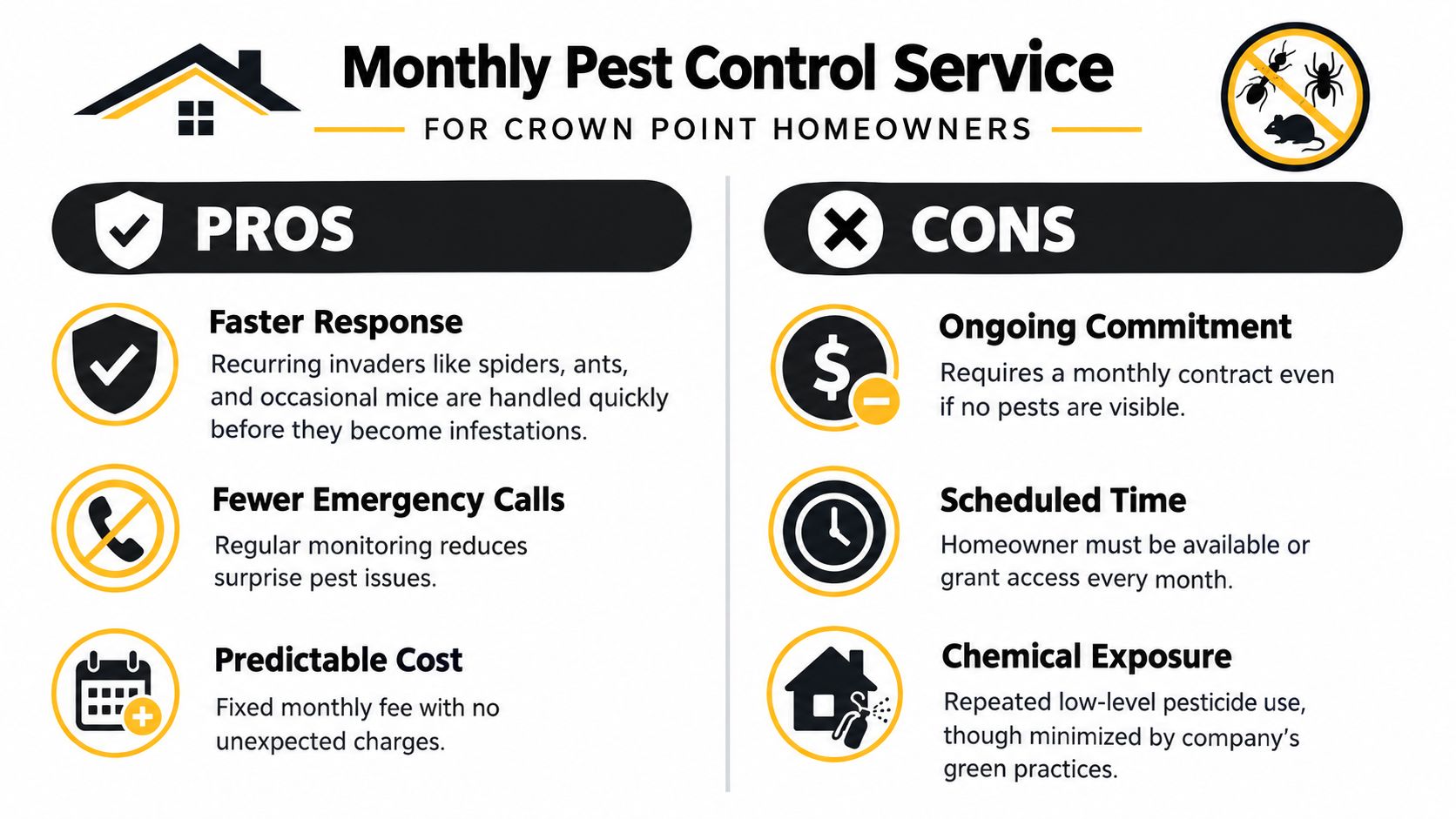
- Faster response: Recurring invaders such as ants, spiders, and occasional mice receive attention before sightings become harder to manage.
- Fewer emergency calls: Routine monitoring can identify changes before the homeowner faces a sudden infestation.
- Predictable budgeting: A recurring fee can make pest management easier to plan than sporadic emergency visits.
- Better documentation: Written service notes help homeowners, landlords, and property managers track conditions and recommended repairs.
- More consistent prevention: Regular exterior work can support a broader integrated pest management approach.
Monthly service also has real drawbacks. You're paying for ongoing visits even when no pest is visible, and someone must provide access or coordinate scheduling. Repeated pesticide applications may concern families with children, pets, gardens, or environmental priorities, which is why targeted treatment and low-toxicity product selection matter.
Where monthly service is probably wasteful
A newer home on a clean, open lot with no infestation history may not need monthly visits. The same applies to a well-sealed property where minor seasonal activity is manageable between quarterly appointments.
Monthly service is also a poor fit if the provider can't explain what each visit includes. If the technician performs the same unexplained spray every month without checking entry points, moisture, sanitation, or pest evidence, the schedule is doing more work for the contract than for the homeowner.
Ask for a plan that can step down when conditions improve. A good pest program should respond to the property, not make the homeowner defend a decision to cancel unnecessary frequency.
Choosing and Preparing for Service in Crown Point
Choosing an exterminator near me should involve more than checking the first map result. A provider working in Crown Point should understand local homes, seasonal pest issues, basements, garages, wooded lots, moisture conditions, and the needs of nearby Northwest Indiana properties.
Questions to ask before signing
- Is the company licensed and registered with the Indiana Department of Agriculture? Ask for a clear answer before treatment begins.
- Does the plan use integrated pest management? Look for prevention, monitoring, exclusion recommendations, and targeted applications instead of blanket spraying.
- What happens during the initial inspection? A technician should examine the structure before recommending a recurring cadence.
- Which pests are included? Confirm whether ants, spiders, mice, wasps, mosquitoes, ticks, termites, fleas, and bed bugs fall under the quoted plan or require separate service.
- What does the price cover? Ask about callbacks, bait refills, interior treatments, cancellation terms, and seasonal changes.
- Does the company actively serve Crown Point? Local availability affects response time and familiarity with neighborhood housing conditions.
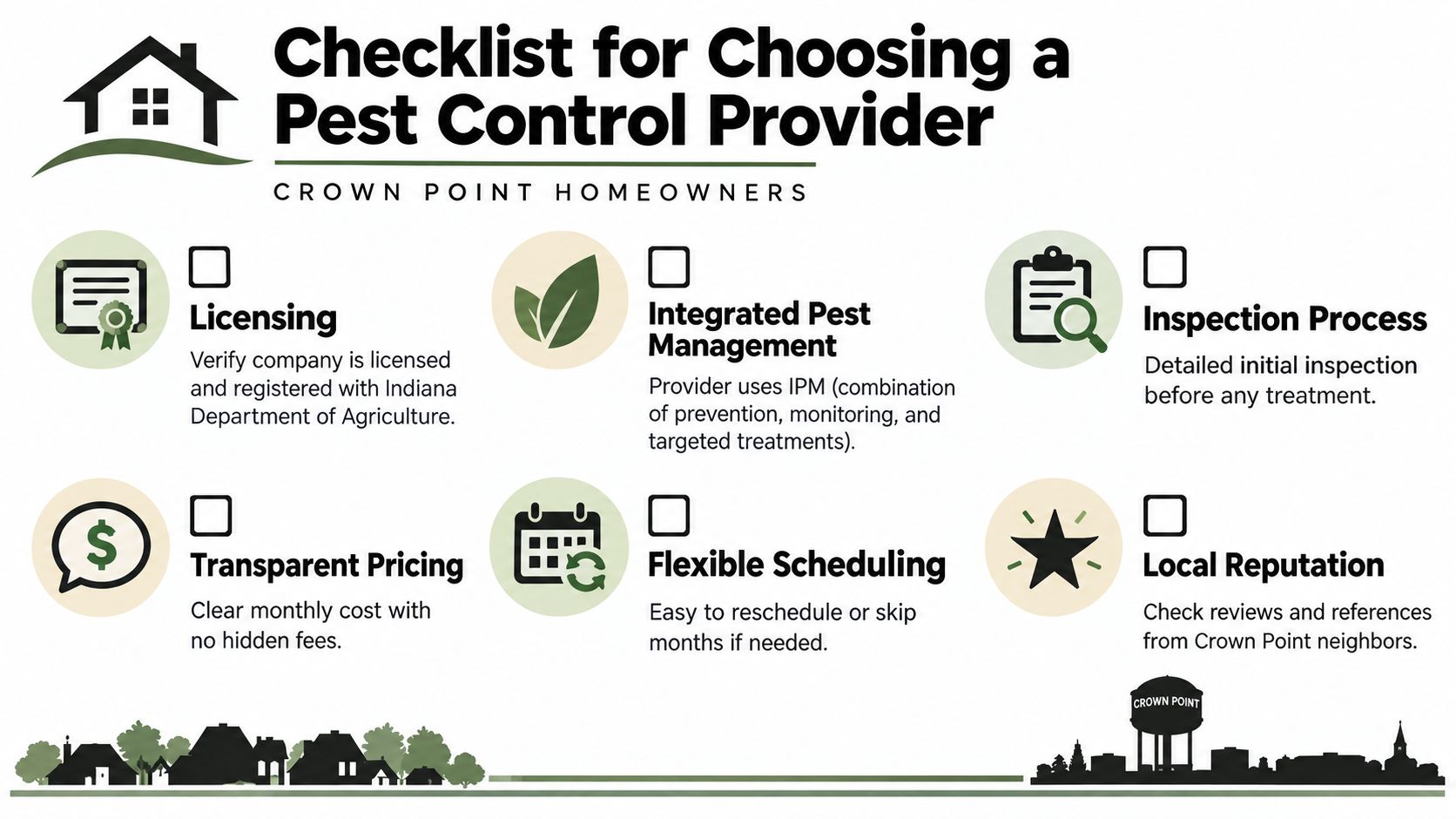
Read reviews for details about communication, technician arrival, treatment explanations, and follow-up. Then request the service plan in writing. A low quote can become expensive if every interior treatment, rodent visit, or wasp nest carries a separate charge.
Prepare the property properly
Before the first appointment, clear garage corners and move stored items away from foundation walls. Secure pet food, clean food spills, address dripping fixtures, and tell the technician about moisture, leaks, or recent sightings.
Don't apply household insecticide immediately before the visit. It can disturb pest activity and make it harder to identify where insects are entering. Instead, take photos, save details about where you saw activity, and point out the exact rooms or exterior areas involved.
The Green Advantage provides preparation guidance so Crown Point customers know what to move, what to leave accessible, and what information will help the technician diagnose the issue. That preparation makes the first inspection more useful and keeps later visits focused.
What to Expect Working With The Green Advantage
The customer journey should feel straightforward. A Crown Point homeowner starts with a phone call or online inquiry, explains the pest concern, and receives scheduling information before a technician visits the property.
At the first appointment, the technician arrives in a marked vehicle and begins with an exterior walk-around. The inspection focuses on pest evidence, entry points, moisture, landscaping, garages, foundations, and other conditions that can influence treatment. Findings are documented in writing so the homeowner understands what the technician saw and what actions may help.
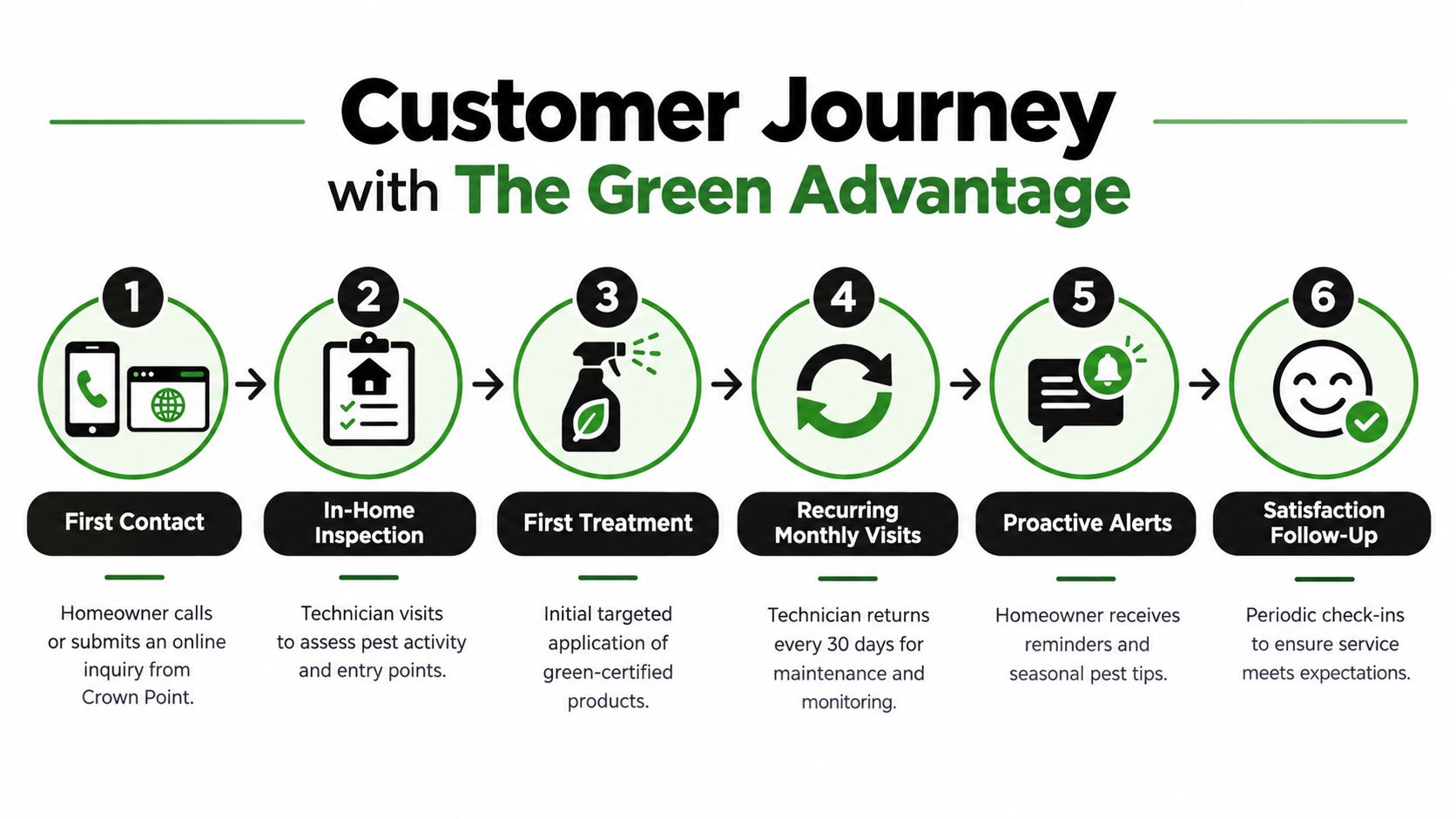
The first treatment uses targeted applications rather than automatically blanketing the property. Depending on findings, the work may include exterior perimeter treatment, web removal, crack-and-crevice treatment, monitoring, or recommendations for sealing and moisture reduction.
Customers receive text or email reminders before scheduled visits, and bilingual communication options are available. After the first 30 days, a follow-up call checks whether activity has changed and whether the homeowner has noticed new evidence.
Recurring visits continue according to the agreed plan. The technician reviews previous notes, checks for new activity, maintains relevant monitoring equipment, and adjusts treatment when conditions change. That process is more useful than repeating an identical application regardless of what the property shows.
The company uses low-toxicity product selections and family- and pet-conscious application protocols where appropriate. Its satisfaction guarantee provides a free interior callback if pests reappear between scheduled visits, subject to the service terms.
For more detail about the company's approach, visit why choose The Green Advantage for pest control. The important question isn't whether monthly service sounds impressive. It's whether the inspection, treatment, communication, and follow-up match the pest pressure in your Crown Point home or business.
The Green Advantage provides residential pest control, commercial pest control, inspections, mosquito reduction, and recurring prevention plans for Crown Point and surrounding Northwest Indiana properties. Visit The Green Advantage to request a pest inspection or quote, and ask for a service cadence based on what's active at your property.