
You're hearing scratching behind the wall, finding ants along the kitchen counter, or watching mosquitoes take over the yard at dusk. In Crown Point, IN, those problems often start with ordinary conditions, such as moisture, food residue, foundation gaps, or standing water. Organic pest control solutions can reduce that pressure, but serious infestations rarely respond to a single spray or a product chosen without identifying the pest first.
The Green Advantage serves Crown Point and nearby Northwest Indiana communities with environmentally mindful residential pest control, commercial pest control, inspections, and prevention programs. The practical question isn't whether an organic label sounds appealing. It's whether the method matches the pest, the property, and the severity of the problem.
Why Homeowners in Crown Point Choose Organic Pest Control
A Crown Point family may notice a few ants near the sink after rain, mosquitoes gathering around a birdbath, or a spider population increasing in the basement. Their first concern is usually safety. They want to protect children, pets, indoor air, landscaping, and the structure without making a small issue harder to manage.
That concern is reasonable, but organic doesn't mean automatic, harmless, or universally effective. It describes a category of materials and methods, while actual performance depends on identification, placement, timing, weather, and follow-up. A botanical treatment aimed at exposed insects won't solve a hidden nest, and a mosquito larvicide won't address adult mosquitoes resting in shaded vegetation.

What organic means in practical pest management
The most useful framework is Integrated Pest Management, or IPM. The U.S. Environmental Protection Agency's IPM principles define IPM as an effective, environmentally sensitive approach that uses information about pest life cycles and environmental interactions to manage damage economically, with the least possible hazard to people, property, and the environment. EPA also notes that growers using IPM don't have a national certification equivalent to the certification associated with organic foods.
That distinction matters. A responsible program starts with inspection and monitoring, then uses exclusion, sanitation, moisture correction, physical controls, and targeted products when needed. Homeowners looking for additional context can review environmentally friendly pest control methods that place treatment inside a broader prevention plan.
Federal policy has supported this prevention-first direction for decades. In 1972, President Nixon directed federal agencies to advance IPM across agriculture, forestry, and related sectors. By 1993, USDA, EPA, and FDA had set a goal of implementing IPM practices on 75% of U.S. crop acres, and a USDA history reports approximately $180 million per year in federal investment in IPM-related research and education since the early 1970s. Those figures come from the USDA history of federal IPM.
Practical rule: Choose the least hazardous effective method, but don't confuse “natural” with “one-size-fits-all.”
For a Crown Point homeowner, that may mean sealing an entry point before treating ants, correcting a damp crawl space before addressing spiders, or removing mosquito breeding water before scheduling yard service. The goal is a comfortable home with fewer pest opportunities, not merely a stronger product.
Identifying Common Pests and Why They Invade Northwest Indiana
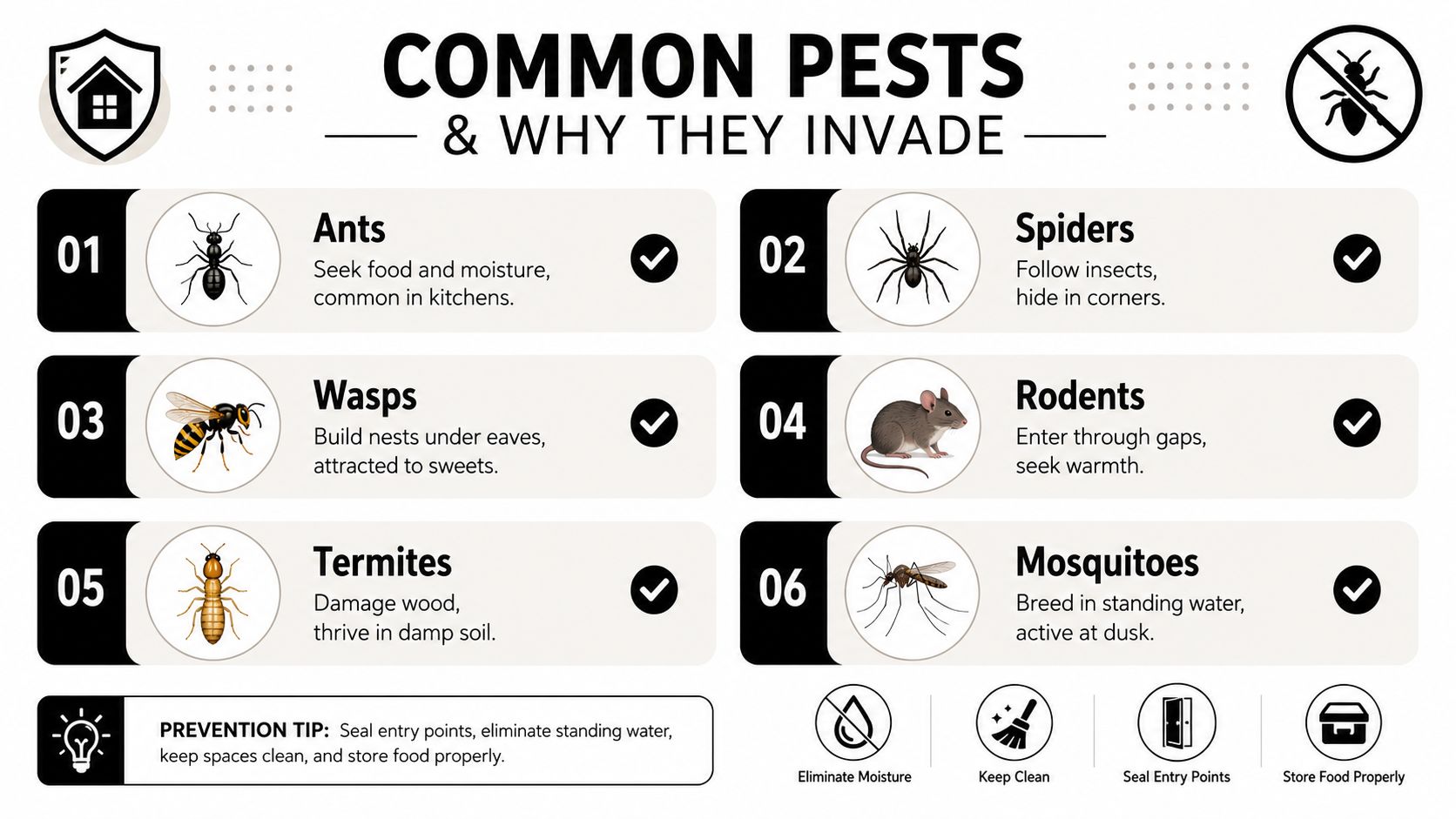
Correct identification changes the treatment decision. Ants, termites, rodents, wasps, spiders, and mosquitoes can all appear around a Crown Point property, but they don't share the same entry routes or control requirements.
Start with visible signs
- Ants: Trails near sinks, pet bowls, windows, or foundation edges usually point to food, moisture, or an opening that gives workers access. Repeated trails after cleaning suggest the colony remains nearby.
- Spiders: Webs in corners, garages, eaves, and basement areas often indicate that other insects are available as prey. A sudden increase can follow outdoor lighting, vegetation growth, or an open entry point.
- Wasps: Nests beneath eaves, decks, soffits, or porch roofs require caution. Activity around sweet drinks, trash containers, or flowering plants can increase encounters.
- Rodents: Droppings, gnaw marks, scratching, nesting material, and a musky odor indicate more than a stray outdoor sighting. Mice and other rodents seek warmth and shelter through gaps around doors, foundations, utility penetrations, and garages.
- Termites: Mud tubes, damaged wood, discarded wings, or wood-to-soil contact deserve a professional inspection. Moist soil and concealed structural areas can make termite activity difficult to judge from a quick glance.
- Mosquitoes: Standing water in containers, clogged drainage areas, tires, gutters, and low spots can support larvae. Adults commonly rest in shaded vegetation and become noticeable around outdoor living areas, particularly at dusk.
Check the property in a logical order
Walk the exterior first. Look at foundation cracks, door sweeps, window screens, utility openings, dense mulch, firewood, leaking spigots, clogged gutters, and containers that hold rainwater. Indoors, inspect under sinks, around pipes, behind appliances, in basements, near stored food, and along garage walls.
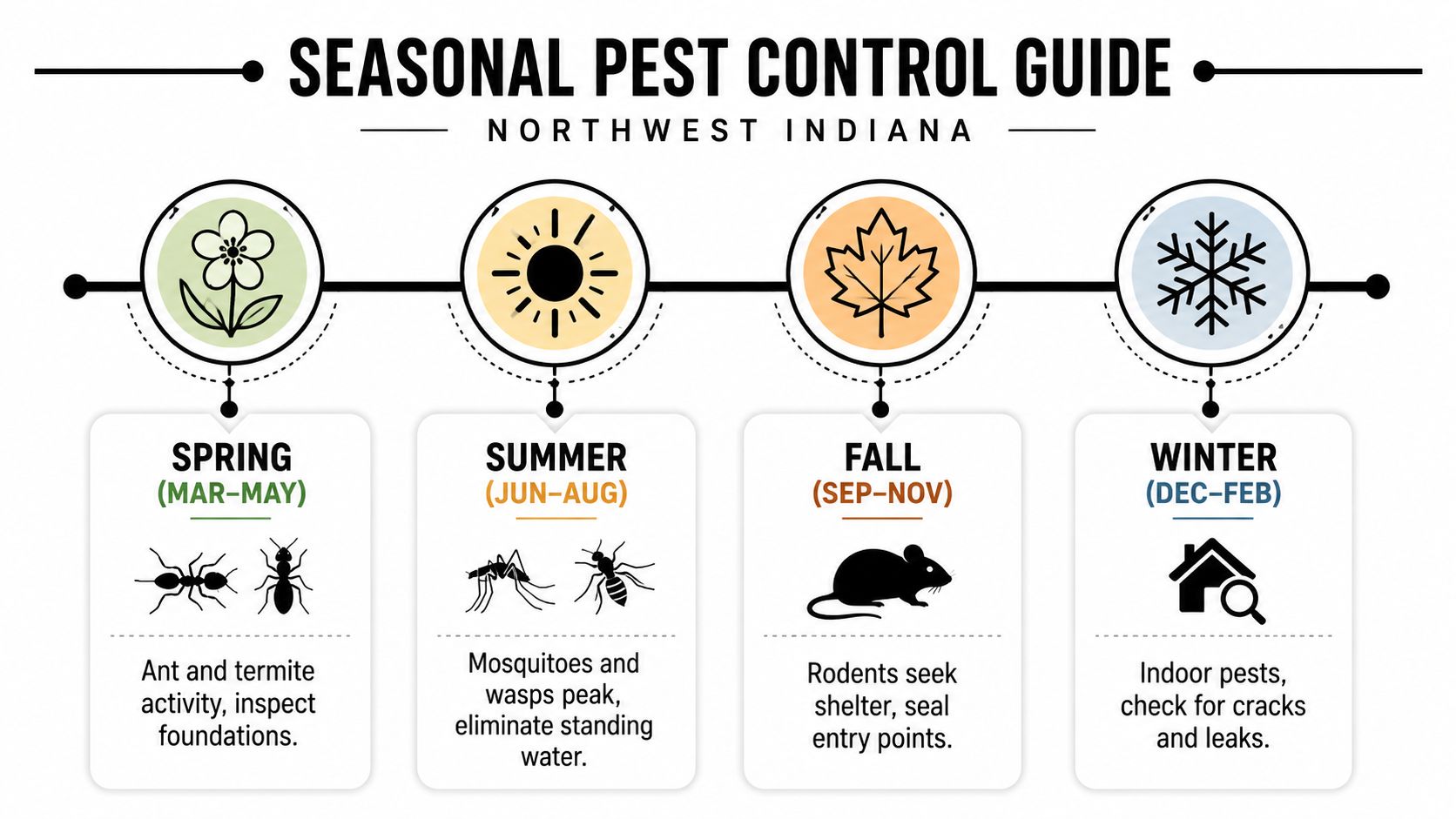
Seasonal shifts also change the pattern. Spring can bring visible ant activity and termite concerns, summer increases mosquito and wasp pressure, and cooler fall conditions push rodents toward sheltered spaces. Infestations often return when a homeowner treats the visible insects but leaves the food, water, harborage, or entry condition unchanged.
Independent organic IPM guidance recommends prevention, monitoring, and targeted intervention rather than relying on one application. It includes sanitation, resistant plant varieties where relevant, physical barriers, trap crops, row covers, planting adjustments, and mechanical removal before biopesticides are considered. The organic IPM guidance explains why cultural, biological, and physical controls are especially important when synthetic chemistry is restricted.
Prevention and Monitoring That Make Organic Treatments Work
Organic treatments perform better when pests have fewer reasons and fewer ways to reach the property. Prevention isn't a substitute for treatment during a serious infestation, but it makes targeted treatment more durable and reduces repeated exposure to the same problem.
Build a Crown Point prevention routine
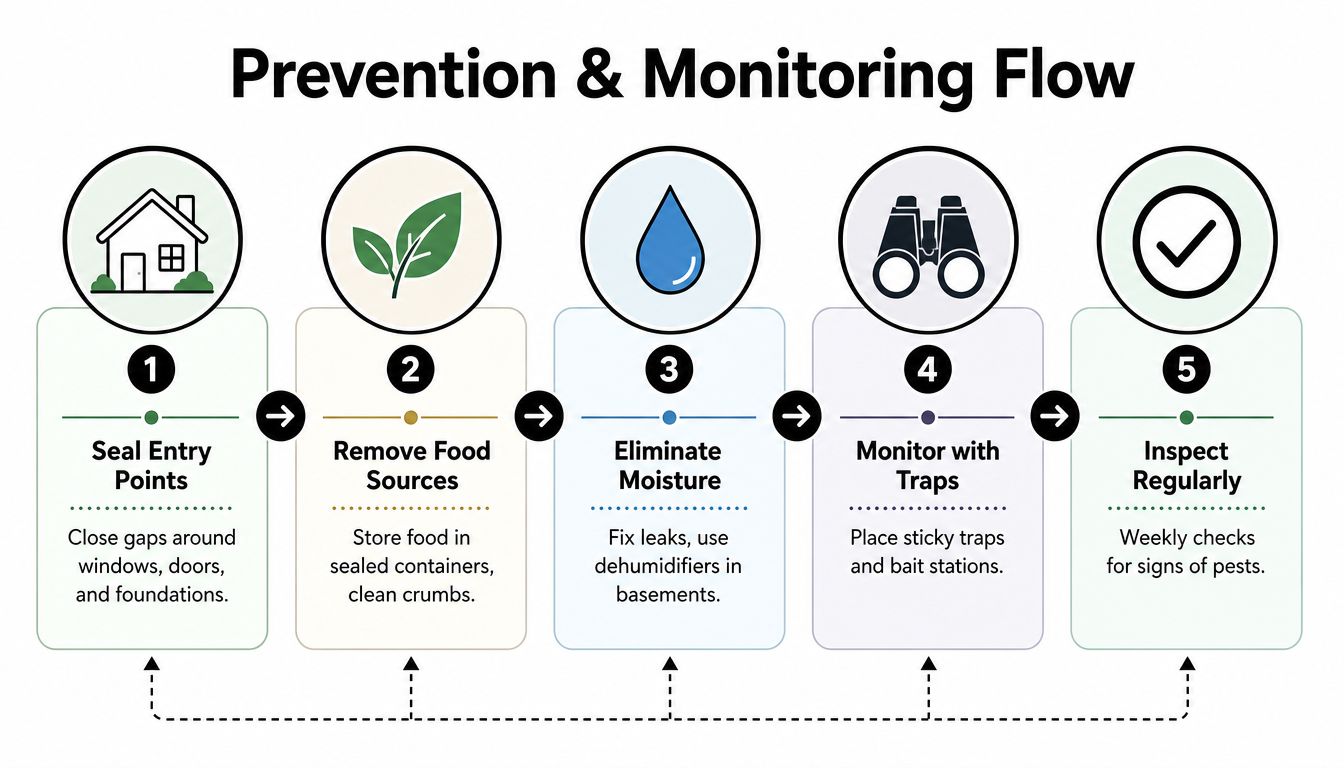
Begin with the building envelope. Seal gaps around windows, doors, foundation penetrations, vents, and utility lines. Replace damaged screens and worn door sweeps. Keep firewood and stored materials away from exterior walls, and trim vegetation so branches don't create a sheltered bridge to the structure.
Inside, focus on conditions pests can use:
- Food control: Store pantry goods in sealed containers, clean crumbs promptly, and manage pet food rather than leaving it exposed.
- Moisture control: Repair leaks, improve drainage, empty containers, and use a dehumidifier where basement or crawl-space dampness supports pest activity.
- Sanitation: Clean grease, crumbs, spills, and recycling residue. Commercial kitchens and multifamily properties need documented routines because small omissions can support recurring activity.
- Harborage reduction: Remove clutter from garages, basements, utility rooms, and storage areas so inspections remain possible and pests have fewer hiding places.
Monitoring tells you whether those changes are working. Sticky traps can reveal indoor movement, while exterior inspections can document trails, droppings, nests, damaged wood, or fresh webbing. Place monitoring tools where people and pets won't disturb them, and record the location and condition during regular checks.
Use 30, 60, and 90 days as decision points
A useful schedule looks for direction rather than instant perfection.
- At 30 days: Confirm that entry points, moisture sources, food storage, and outdoor breeding areas have been addressed. Note whether sightings are declining, unchanged, or spreading.
- At 60 days: Review trap observations, new damage, nest activity, and seasonal pressure. Persistent evidence usually means the pest was misidentified, the source remains active, or the treatment needs adjustment.
- At 90 days: Decide whether the property needs continuing maintenance, seasonal service, exclusion work, or a more thorough inspection.
Reapplication may be necessary after rain, irrigation, or other moisture events, depending on the product label and target pest. Timing often matters more than applying a greater quantity. Never use a product outside its label directions, and don't assume a food-grade or garden product is appropriate for structural pest control.
Biological control also requires realistic expectations. A meta-analysis found that about 33% of introduced exotic agents established successfully, while only about 10% achieved satisfactory control of target insect pests, according to the USDA Agricultural Research Service review. The lesson for homeowners is straightforward. Releasing or applying a biological tool without matching it to the pest, climate, life stage, and follow-up plan may produce little improvement.
Applying Safe Organic Treatments at Home and With Professional Support
DIY organic pest control can make sense for a small, clearly identified problem with a manageable source. Professional service becomes more valuable when pests are hidden, structural, medically concerning, persistent, or spread across a large residential or commercial property.
Match the material to the pest
For mosquitoes, Bacillus thuringiensis israelensis, or Bti, targets larvae rather than adult mosquitoes. EPA describes Bti as a naturally occurring soil bacterium whose toxins specifically target mosquito, blackfly, and fungus gnat larvae. EPA also lists 48 pesticide products containing five registered Bti strains approved for residential, commercial, and agricultural use, as explained in its Bti mosquito control guidance.
One EPA label gives a concrete direction for a Bti product used in containerized standing water, one teaspoon per 25 square feet or one tablespoon per 75 square feet, with the label stating that it can provide a quick kill within 24 hours. Always follow the exact label for the product you own, because formulations and approved uses differ. Bti won't eliminate adult mosquitoes resting in shrubs, and it won't solve a property-wide problem if breeding sites remain.
Diatomaceous earth also requires care. The National Pesticide Information Center's diatomaceous earth guidance warns that not every product is suitable for pest control. Food-grade and unlabeled products may not have undergone pest-control risk checks, even though the guidance notes that diatomaceous earth added to food at up to 2% is generally recognized as safe by the U.S. Food and Drug Administration. Use only a properly labeled pest-control product for the intended site, and avoid creating airborne dust.
Neem and spinosad illustrate why “organic” doesn't guarantee identical results. In replicated trials summarized in organic IPM technical guidance, spinosad-based Entrust reduced infestations by 73.9% overall, while azadirachtin or neem-based products ranged from 61.7% to 46.1%, depending on formulation and target pest. Those results show that active ingredient, pest biology, and life stage matter more than the label alone.
Choose the level of help that fits the risk
For general garden education, Little Green Leaf's organic pest guide offers examples of physical barriers and garden-focused methods. Structural infestations need a different evaluation, especially when rodents, termites, wasps, or recurring ants are involved.
| Pest Scenario | Best Organic Tactic | DIY or Professional | What Success Looks Like |
|---|---|---|---|
| A few ants near a clean, accessible food source | Remove the source, clean trails, seal the opening, and use a labeled bait or treatment suited to the species | DIY can be reasonable when activity is limited | Trails stop returning and no new interior activity appears |
| Mosquito larvae in removable standing water | Empty, cover, or manage the water, then use a labeled Bti product when appropriate | DIY for small containers, professional help for broad yard pressure | Fewer breeding sites and less activity around living areas |
| Spiders appearing with abundant outdoor insects | Reduce prey and harborage, then inspect exterior entry points | DIY maintenance or professional inspection | Web and sighting frequency declines as insect pressure falls |
| Wasp nest near a doorway, play area, or business entrance | Avoid disturbing the nest and arrange targeted removal | Professional service is the safer choice | The nest is removed and activity is monitored before normal use resumes |
| Rodent signs inside walls, attics, or kitchens | Locate entry points, remove access, and use a coordinated exclusion and monitoring plan | Professional service is usually appropriate | Fresh droppings and noises stop, with no new entry evidence |
| Termite evidence or suspected structural damage | Obtain a detailed inspection before choosing treatment | Professional inspection required | The source, extent, and follow-up plan are documented |
For homeowners who want a deeper explanation of microbial and living control tools, what biological pest control means provides useful background. The Green Advantage can combine inspection, exclusion, monitoring, and appropriately selected environmentally mindful treatments for residential pest control, commercial pest control, mosquito reduction, and related service needs in Crown Point.
Seasonal Tips for Lasting Results in Crown Point and Northwest Indiana
Northwest Indiana properties change with the calendar, so prevention should change with them. A treatment that works well as a spring barrier may not address a summer mosquito source or a fall rodent entry route.
Spring from March through May
Ants become easier to spot as activity increases around foundations and kitchens. Inspect foundation joints, window frames, plumbing penetrations, and damp areas before trails become established. Termite concerns also deserve attention where wood contacts soil or drainage keeps the foundation area wet.
Summer from June through August
Mosquitoes and wasps create the greatest nuisance around patios, playgrounds, decks, and commercial outdoor areas. Empty containers, correct drainage, maintain gutters, and inspect shaded vegetation. Recheck areas after rain or irrigation because new water can create new breeding opportunities.
Fall from September through November
Rodents look for protected spaces as outdoor conditions change. Seal garage doors, foundation gaps, attic openings, and utility penetrations before activity moves indoors. Store feed and food securely, reduce clutter, and inspect insulation, crawl spaces, and wall voids for signs.
Winter from December through February
Indoor pest evidence becomes more important. Check cracks, leaks, stored goods, basement corners, and areas around heating equipment. Winter monitoring can identify an entry or moisture issue before spring activity expands.
Biological products also serve different roles by category and setting. Recent market reporting says biofungicides held about 47.4% of the biopesticide market in 2025, while bioinsecticides are forecast to be the fastest-growing segment and seed treatments and liquid formulations are growing fastest in their categories, according to FreshFruitPortal's biopesticide market coverage. For a homeowner, that trend reinforces a practical point. A biological product must still be selected for the specific pest, location, formulation, and timing.
When to Call The Green Advantage and What to Expect Next
Call a licensed exterminator near me in Crown Point, IN when prevention hasn't stopped activity, when you can't identify the pest, or when the problem involves structural, sanitation, or health concerns. Termites, rodents inside walls, active wasp nests near entrances, and persistent mosquitoes around occupied outdoor areas shouldn't be managed by guesswork.
The same applies to businesses and property managers. Commercial pest control requires attention to kitchens, loading areas, waste storage, tenant spaces, documentation, and recurring inspection points. A product that seems suitable for a backyard may not be appropriate for a food-service area, multifamily property, office, or shared outdoor space.
What a professional visit should accomplish
A useful inspection should identify:
- Where the pest is active
- How it is entering or breeding
- What conditions support it
- Whether the issue affects structure, occupants, employees, or customers
- Which prevention, monitoring, and treatment steps fit the property
The Green Advantage is a family-owned company serving Crown Point and the broader Northwest Indiana community. Its licensed and certified technicians provide home pest control, commercial service plans, pest inspections, mosquito reduction programs, and environmentally mindful treatment options, while office staff coordinate questions and scheduling directly with customers.
Expect clear recommendations rather than a promise of a one-spray cure. Depending on the pest, the plan may include exclusion, sanitation changes, moisture correction, targeted organic products, monitoring, and follow-up. That approach gives homeowners a way to judge progress over time and gives property managers documentation they can use to keep recurring issues under control.
If you're searching for pest control near me, pest control in Crown Point, IN, or an exterminator in Crown Point, IN, start with an inspection when the cause isn't obvious. The right solution protects the building and the people using it while keeping treatment focused on the actual source.
The Green Advantage provides organic pest control solutions, residential pest control, commercial pest control, inspections, mosquito reduction, rodent exclusion, and seasonal prevention for Crown Point and nearby Northwest Indiana properties. Visit The Green Advantage to request a quote or schedule a pest inspection with a local team that can match the treatment plan to your pest, property, and comfort needs.