
A school pest problem usually starts small. A custodian spots ant trails along a cafeteria wall before first period. A teacher reports a wasp problem near a playground door. A mouse crosses a hallway after an evening event, and suddenly the concern isn't just the pest. It's student safety, parent communication, sanitation, scheduling, and whether the problem is going to come back next week.
For schools in Crown Point, IN and nearby Northwest Indiana communities, that pressure is real. You need school pest control that protects students and staff, supports your building team, and fits the way a school operates. That means more than calling an exterminator near me and asking for a quick spray. It means building a program that works in classrooms, cafeterias, gyms, kitchens, storage rooms, and bus loading areas without creating unnecessary disruption.
A strong school pest control plan should feel practical. It should help you solve the immediate issue, prevent repeat activity, and document what was done. It should also reflect local pest pressures in Northwest Indiana, where seasonal changes, older buildings, food service areas, and frequent door traffic create steady opportunities for ants, rodents, spiders, and stinging insects.
Protecting Your School Starts with a Local Partner
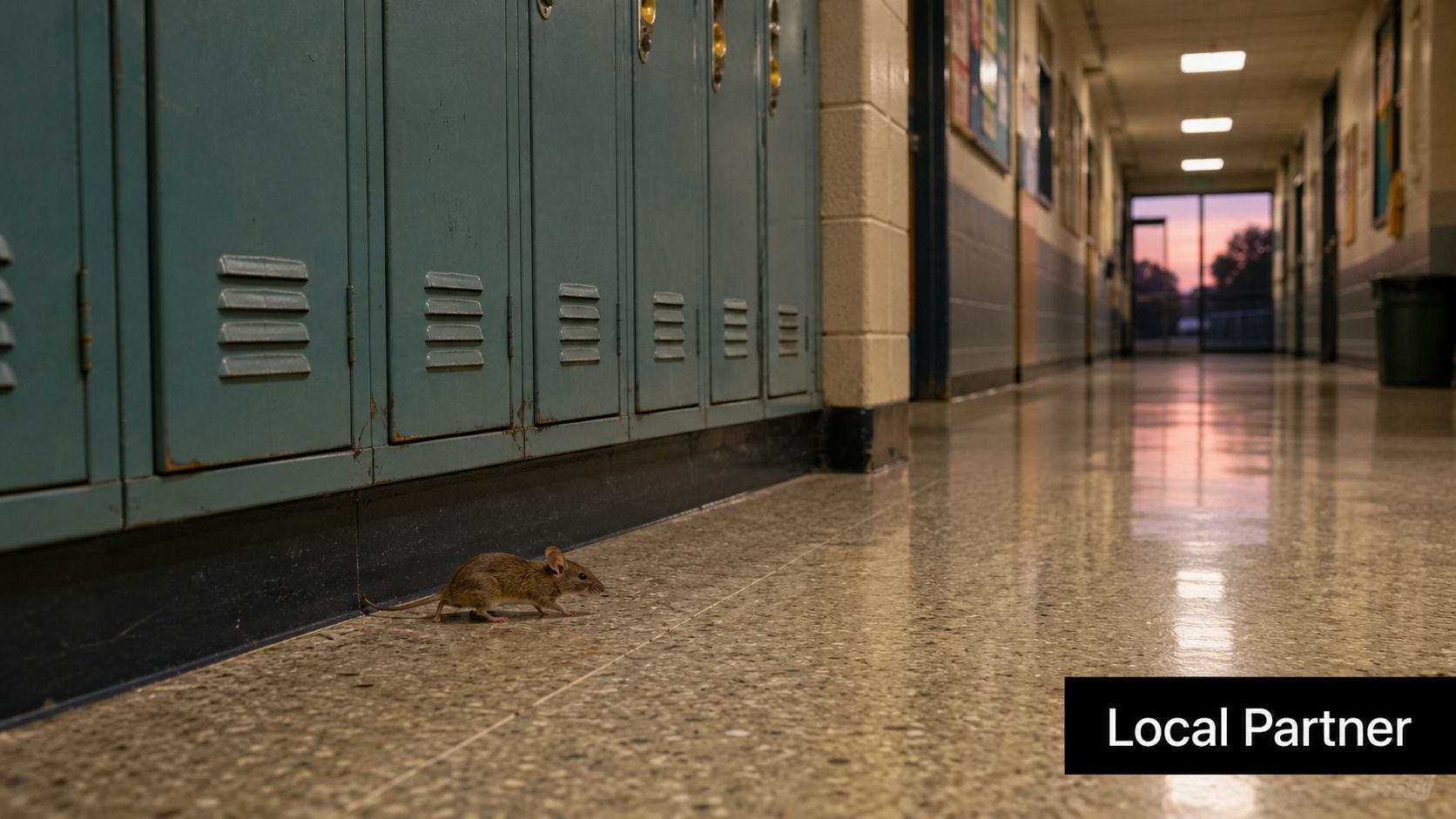
A principal opens the front office early, starts reviewing maintenance notes, and sees a report from the night crew: mouse activity near a hallway storage closet. Later that morning, cafeteria staff mention ants near a serving line. By lunch, the issue already feels bigger than pest control. It touches food service, custodial work, parent confidence, and the daily rhythm of the building.
That's how these calls usually begin. Not with a dramatic infestation, but with a problem that puts pressure on staff to act quickly and carefully.
What schools in Crown Point are really dealing with
In Northwest Indiana schools, pests show up where buildings are busy and access points stay active. Exterior doors open constantly. Deliveries move through kitchen and receiving areas. Students bring snacks, backpacks, and sports gear from one room to another. Staff members do their best, but even a well-run building can develop conditions that support pest activity.
Common triggers include:
- Food and moisture sources: Cafeterias, staff lounges, concession areas, mop closets, and leaking plumbing all attract pests.
- Easy entry points: Door gaps, utility penetrations, worn sweeps, and foundation cracks give rodents and insects a way in.
- Harborage areas: Storage rooms, boiler rooms, stage areas, and cluttered closets give pests a place to hide during the day.
A school doesn't need to be dirty to have a pest problem. It just needs food, water, shelter, and access.
Practical rule: In a school, the first reported pest sighting is rarely the whole problem. It's a signal to inspect the surrounding area, the route that led there, and the conditions keeping that pest active.
Why local knowledge matters
School pest control in Crown Point, IN isn't the same as residential pest control or a basic commercial pest control account. Schools have tighter safety expectations, more stakeholders, and less tolerance for disruption. The approach has to match that reality.
A local program also needs to reflect Northwest Indiana conditions. Seasonal ant pressure, rodent movement as temperatures change, spider activity around entry points, and wasp nesting near rooflines or playgrounds all require different timing and different responses. A provider who knows the area can anticipate those patterns instead of just reacting when staff report them.
That's the difference between a one-time treatment mindset and a school program built to protect the building community.
Why a Proactive IPM Program Is Essential for Schools
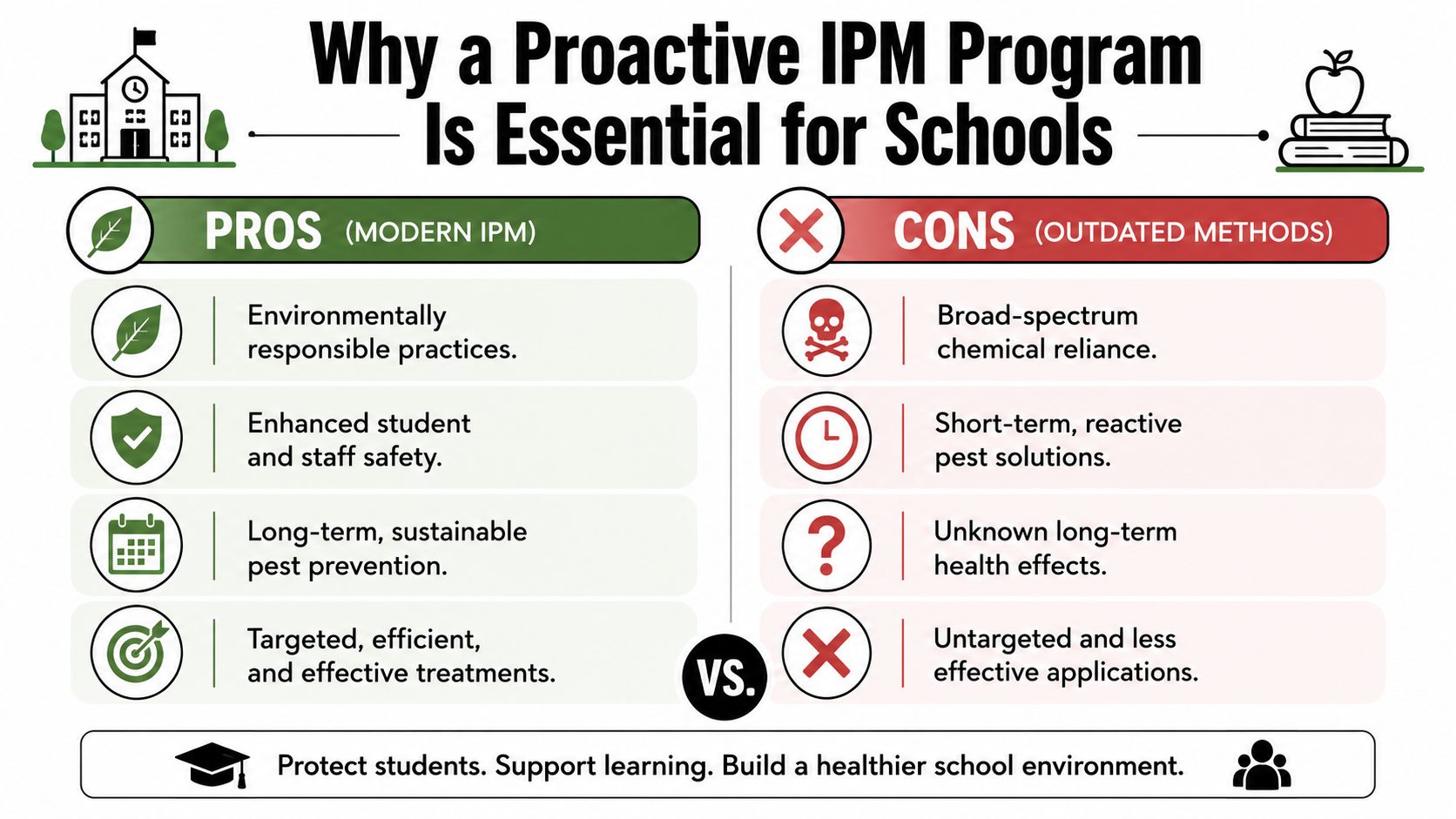
Reactive pest control sounds simple. See pests, spray pests, move on. In schools, that approach usually creates repeat issues because it doesn't fix the conditions drawing pests in. A modern Integrated Pest Management, or IPM, program works differently. It starts with inspection, monitoring, sanitation, exclusion, and building corrections. Chemical treatment is reserved for situations where it's needed and chosen carefully.
Why the old model falls short
Routine blanket spraying may feel decisive, but it often misses the source of the problem. If ants are using a wall void because moisture is present, or mice are entering through a door gap behind the kitchen, broad treatment doesn't solve the opening or the attractant. Staff may see temporary relief, then the same complaint returns.
That's one reason schools across the country have shifted toward IPM. In Keller, Texas, a district with 40 buildings and 33,000 students achieved a 90% reduction in both pest infestations and pesticide bills after adopting IPM, according to Northeast IPM's school case example. The same body of guidance emphasizes preventive actions such as sealing cracks, repairing leaks, improving sanitation, and moving dumpsters away from buildings.
Another strong benchmark comes from the business case for school IPM. That report notes schools can reduce pest complaints by 78% to 90% without a long-term increase in operational costs, and it highlights monitoring as the core tool that makes those outcomes possible, as outlined in Texas A&M's school IPM paper.
What a proactive program looks like day to day
A good IPM plan changes the conversation from “What do we spray?” to “Why are pests here, and how do we stop the next one?”
That means:
- Tracking activity: Glue boards, device checks, sighting logs, and follow-up inspections show where pressure is building.
- Fixing conditions: Door sweeps, sanitation corrections, leak repair, crack sealing, and storage changes remove the reasons pests stay.
- Treating with precision: If treatment is needed, it's targeted to the pest, the location, and the level of risk.
For schools reviewing broader safety procedures, Safety Space's school risk guide is a useful companion resource because pest issues often overlap with food safety, maintenance, and building-use risk assessments.
This is also where a structured provider helps. A practical integrated pest management program gives a school a repeatable process instead of a string of one-off responses.
Later in the decision process, many facilities teams find it helpful to watch how IPM is explained in simple terms:
Building Your School's Pest Defense Foundation
The strongest school pest control program starts before treatment. It starts with a building walk. If you're responsible for facilities in Crown Point or nearby Northwest Indiana schools, the most valuable first step is a slow, deliberate inspection of the places pests use, not just the places where staff happen to see them.
Start with the rooms pests prefer
A school “crawl-through” should focus on high-pressure areas first. Kitchens, cafeterias, teacher lounges, boiler rooms, loading doors, custodial closets, stage storage, vending areas, locker rooms, and trash holding points deserve close attention. Look for droppings, gnawing, rub marks, grease trails, insect fragments, nesting material, water stains, and food debris under fixed equipment.
Then shift from the symptom to the route.
Ask:
- Where is the pest getting in?
- What is it feeding on?
- Where is it hiding between sightings?
- Which building or housekeeping issue is keeping the problem active?
School IPM programs commonly begin with site assessments, assigning an IPM coordinator, and basic exclusion work. One example cited by Green Schools National Network notes that installing door sweeps can reduce infestations by 65%, as described in its overview of integrated pest management for healthy schools.
The best exclusion fix is often the simplest one. A tight door sweep, sealed pipe gap, or corrected leak can do more than repeated treatment in the same room.
Focus on low-cost fixes that matter
Many school pest issues in Northwest Indiana come down to maintenance details. These aren't glamorous corrections, but they work.
- Seal narrow entry points: Ants and other crawling insects use tiny wall and floor gaps. Caulk around utility penetrations, baseboard separations, and hairline cracks where activity is showing.
- Tighten doors: Exterior doors that don't close flush invite rodents, spiders, and flying insects. Replace damaged sweeps and check daylight at thresholds.
- Improve waste handling: Keep dumpsters and exterior waste containers managed carefully and away from direct building contact where possible. Watch for spilled liquid, open lids, and overflow near receiving doors.
- Control moisture: Repair drips under sinks, behind ice machines, near floor drains, and in mechanical spaces. Water keeps cockroaches, ants, and rodents active.
Sanitation has to support the physical work. Cafeteria deep cleaning, floor-edge cleaning, grease removal, and better food storage make every other pest control step more effective. When schools want a clearer picture of how cleaning practices support facility health, specialized cleaning for educational facilities offers a useful outside reference for the standards busy buildings often need.
Assign ownership inside the building
A school IPM foundation is strongest when one person coordinates the moving parts. That doesn't mean one person does everything. It means one person tracks service reports, maintenance corrections, pest sighting logs, and follow-up dates so issues don't drift between departments.
A workable internal structure usually includes:
| Role | Main responsibility |
|---|---|
| Facilities lead | Oversees repairs, exclusion, and vendor coordination |
| Custodial team | Supports sanitation corrections and sighting reporting |
| Food service lead | Monitors storage, spills, and kitchen conditions |
| Front office or administration | Handles communication when needed |
When schools skip this coordination, pests turn into recurring complaints. When they build it in, the program gets sharper every month.
Smart and Safe Treatment Strategies for Schools
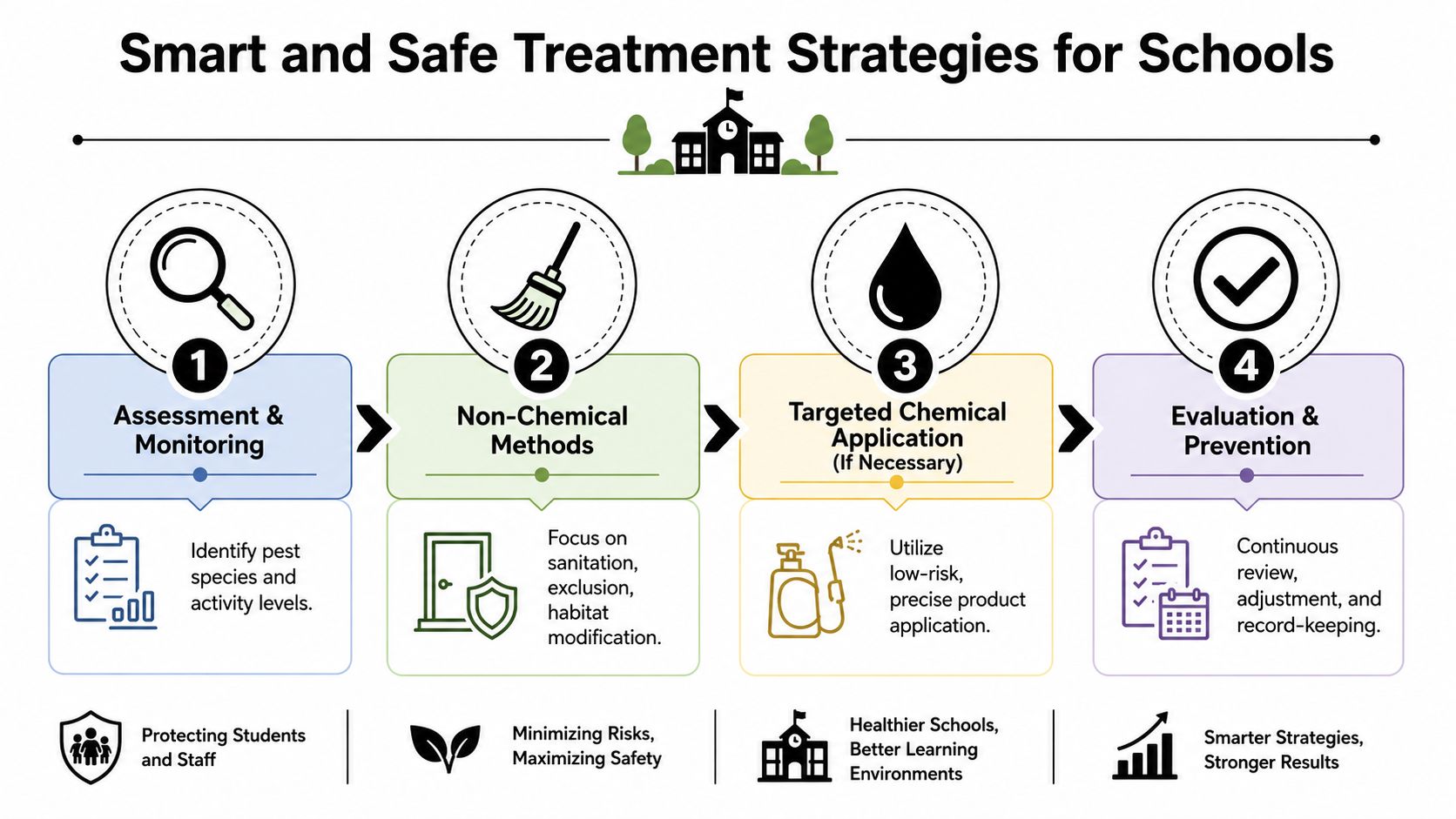
When pests are confirmed in a school, treatment should follow a clear order. Safety comes first, but safety doesn't mean inaction. It means using the least disruptive method that will solve the specific problem and documenting each step.
Start with identification and monitoring
A mouse, an ant trail, and a wasp nest don't belong in the same response plan. First, identify the pest correctly. Then determine whether the sighting reflects an isolated incident or an ongoing pattern. Monitoring devices, inspection notes, and staff reports help sort that out.
Monitoring is the most important technical tool for reducing costs and avoiding unnecessary treatment. The school IPM business case from Texas A&M explains that monitoring tells pest managers if, when, and where action is warranted, which allows spot treatment instead of blanket spraying and keeps least-toxic pesticide use as a last resort.
Use the treatment pyramid
A smart school pest control program moves up in stages.
- Assessment and verification: Confirm species, location, and extent of activity.
- Non-chemical action: Vacuuming, trapping, sanitation correction, exclusion repair, and habitat modification come next.
- Targeted material use if needed: Gel baits, crack-and-crevice applications, or tamper-resistant rodent stations are used carefully in the right locations.
- Review and adjust: Reinspect the site, update logs, and correct anything that could trigger a repeat problem.
If a treatment plan doesn't name the pest, the access point, and the correction that follows, it isn't a complete school IPM response.
Why broad spraying usually isn't the right school answer
Broad applications may seem faster, but schools are sensitive environments. Classrooms, cafeterias, offices, nurse areas, and student gathering points all require careful product selection and placement. Targeted methods are usually better because they reduce exposure potential and concentrate effort where pests are active.
That's especially important for recurring issues like:
- Ant control: Baits and crack sealing usually outperform random perimeter interior spraying.
- Rodent control: Tamper-resistant stations, trapping, sanitation, and exclusion work better than chasing sightings from room to room.
- Spider control: Exterior web removal, harborage reduction, and entry-point correction address the source.
- Wasp removal: Nest treatment and removal should be timed and placed to protect student traffic patterns.
The best treatment plan is quiet, deliberate, and specific. Staff should know what happened, why it was chosen, and what building correction comes next.
Choosing the Right Pest Control Partner in Northwest Indiana
Schools shouldn't choose a pest vendor the same way they choose a one-time service for a minor office issue. The right partner needs to understand school operations, documentation, local pest pressure, and the difference between activity control and long-term prevention.
Questions worth asking before you sign
A useful interview process starts with direct questions.
Ask any provider:
- How do you handle school IPM programs? Listen for monitoring, exclusion, sanitation, and reporting. Be cautious if the answer is mostly about products.
- Who will inspect and who will treat? Schools need consistency and accountability.
- How do you document findings and recommendations? A service ticket that just says “treated as needed” isn't enough for a school environment.
- What happens after a pest sighting between visits? Emergency response, follow-up timing, and communication matter.
- Can you coordinate with maintenance and custodial teams? The best pest control partner works with the building, not around it.
Look beyond price alone
Cost matters, but a lower quote can become expensive if the program relies on repeated callbacks, generic treatment, or weak reporting. Schools need value in the form of fewer recurring issues, better communication, and safer decision-making.
This is especially important as school design itself shifts. An EPA-related projection notes that by 2025, over 60% of U.S. school districts are expected to mandate IPM-compatible architectural standards in new builds, which means pest prevention is increasingly treated as part of the building itself, not just a service layered on later. That trend raises the bar for providers working in both older campuses and newer facilities.
For many schools, that's where a provider with true commercial pest control experience becomes more relevant than a company focused mainly on one-time household calls.
What strong school service should feel like
A good school pest control partner should bring clarity, not confusion. Reports should identify conditions, not just treatments. Recommendations should be specific enough for your maintenance team to act on. Service should fit your school calendar, not disrupt it.
Schools need a pest partner who can say, “Here's the pest, here's why it's here, here's what we corrected, and here's what to watch next.”
That standard helps facilities managers compare providers on substance, not sales language. It also makes it easier to protect your building and answer questions from administrators, staff, and families.
Communication and Compliance to Keep Everyone Informed
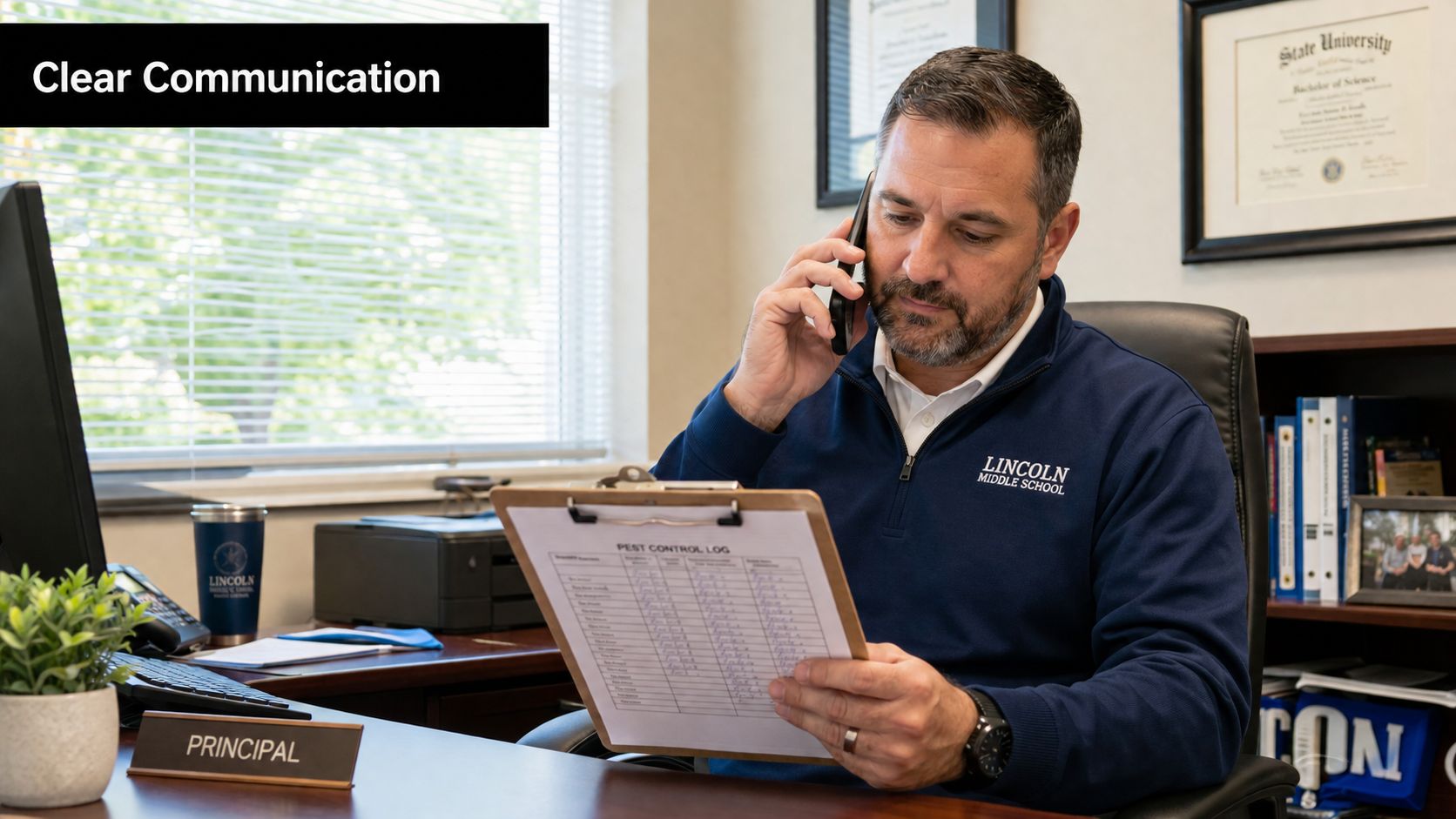
In a school, pest control isn't just a maintenance matter. It's a trust matter. Parents, teachers, support staff, and administrators all want to know that issues are being handled safely and responsibly. That's why communication and record-keeping should be part of the pest program from the start, not added after a complaint.
Use transparency as a best practice
One of the clearest examples comes from outside Indiana. Minnesota's Parents' Right to Know Act of 2000 requires K-12 schools to notify employees and parents by September 15th each year about pesticide applications, according to the Minnesota Department of Health's summary of school pesticide notification requirements. Even when a district isn't operating under that exact law, the principle is strong: clear communication reduces confusion and builds confidence.
A school notification process should answer basic questions before they become rumors:
- What pest was found
- Where the issue was observed
- Whether action was preventive, corrective, or treatment-based
- Any scheduling information that affects room access or building use
- Who to contact with questions
Keep records that support decisions
A reliable school IPM file should include more than invoices. It should show what was observed, what thresholds triggered action, what correction was recommended, and whether the problem resolved.
A practical record system often includes:
| Record type | Why it matters |
|---|---|
| Pest sighting log | Tracks recurring areas and timing |
| Inspection reports | Documents evidence, likely causes, and next steps |
| Service records | Shows what action was taken and where |
| Maintenance follow-up notes | Confirms repairs like door sweeps, sealing, or leak correction |
| Parent or staff notices | Supports transparency and consistency |
These records protect the school in several ways. They help evaluate trends, support budget requests for exclusion or repair work, and show that decisions weren't arbitrary.
Simple notice templates work best
Schools don't need legal-sounding notices for every situation. They need clear, calm language. A short parent or staff communication can be enough when it includes the pest issue, location, timing, and contact person.
For internal use, many schools benefit from a standard incident form with fields for date, room number, pest seen, evidence collected, maintenance issue noted, and action assigned. That keeps custodial staff, administration, and the pest provider on the same page.
When communication is routine and records are organized, the entire program becomes easier to defend, easier to improve, and easier for the community to trust.
Your School IPM Checklist and Next Steps in Crown Point
A workable school pest control plan doesn't need to be complicated. It needs to be consistent. The schools that handle pest pressure well usually do the basics every time. They inspect thoroughly, fix access points, tighten sanitation, communicate clearly, and bring in help before a minor issue turns into a district-wide headache.
School IPM Program Start-Up Checklist
| Action Item | Category | Status |
|---|---|---|
| Walk kitchens, cafeterias, storage rooms, boiler rooms, and exterior entry points | Inspection | ☐ |
| Assign a school IPM coordinator | Program management | ☐ |
| Start a pest sighting log for staff and custodians | Documentation | ☐ |
| Check door sweeps, thresholds, and utility penetrations | Exclusion | ☐ |
| Review plumbing leaks, floor drains, and moisture sources | Maintenance | ☐ |
| Tighten food storage and after-hours cleanup routines | Sanitation | ☐ |
| Inspect dumpster areas and trash handling practices | Exterior management | ☐ |
| Set a parent and staff communication process | Compliance and trust | ☐ |
| Review vendor reporting standards and follow-up expectations | Procurement | ☐ |
| Schedule routine monitoring and periodic program review | Ongoing prevention | ☐ |
What deserves attention first
If you're deciding where to begin, start where pests gain the most from your building. Kitchens, trash areas, loading doors, and cluttered storage spaces usually give the fastest return on effort. Then move to the structural details that keep problems repeating.
For Northwest Indiana schools, it also helps to think seasonally. Rodent pressure often rises as outdoor conditions change. Ants become more visible when moisture and food access line up. Wasps and spiders tend to show themselves around exterior traffic points, rooflines, and athletic or playground areas. A calendar-based review makes those patterns easier to manage before staff are reacting in real time.
The next step should be simple
If your school has had one pest complaint, several recurring issues, or just wants a cleaner plan in place, don't wait for the next urgent sighting. A site assessment can identify where pests are entering, what conditions are supporting them, and which corrections should happen first.
That's the practical value of a real school IPM program. It turns pest control from a reactive series of interruptions into a structured process that protects the building, supports staff, and gives families confidence.
If you're looking for pest control in Crown Point, IN, or searching for an exterminator near me who understands the demands of school facilities, The Green Advantage can help you build a safer, more organized IPM program for your campus. Whether you need support with school pest control, broader commercial pest control, rodent exclusion, ant control, spider control, wasp removal, or preventative pest treatments in Northwest Indiana, the team can help you assess the site, prioritize corrections, and create a practical plan. Contact The Green Advantage to schedule a pest inspection, request a quote, or start a conversation about protecting your school community.