
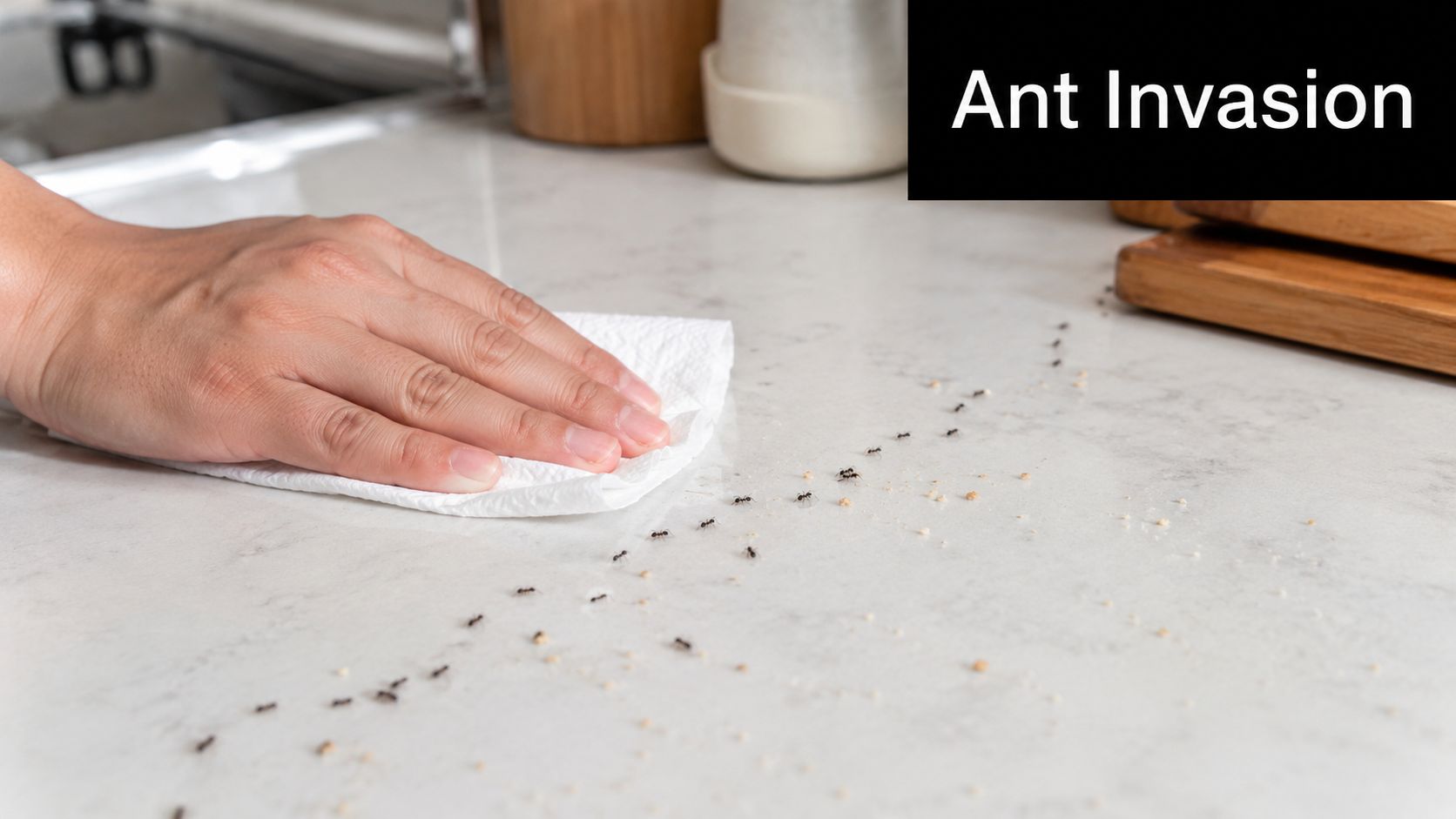
You wipe the counter. You throw out the crumbs. You spray the line of ants you can see. By the next morning, there's another trail moving along the backsplash or under the coffee maker like nothing happened.
That's the moment most homeowners in Crown Point hit the same conclusion. This isn't a cleaning problem alone, and it isn't going away with a quick store-bought fix. In Northwest Indiana, ants keep showing up because they've already found what they need: food, moisture, shelter, and a hidden route in.
A permanent answer starts by treating the infestation like a system, not a nuisance. The ants on the counter are the visible part. The underlying problem is the colony behind them, plus the trail that keeps bringing new workers back inside. If you've been searching for pest control near me, exterminator near me, or reliable pest control in Crown Point, IN, this is the practical version of what works and what wastes time.
Your Local Guide to a Permanently Ant-Free Home
A lot of ant calls start the same way. A homeowner notices a few tiny ants near the sink, cleans them up, then finds a longer trail later that week near pet food, the dishwasher, or a window. In Crown Point and across Northwest Indiana, that pattern is common because ants don't need a big opening or a dramatic mess. They need one reliable food source and one route they can use over and over.
Why the problem feels endless
Ants are frustrating because they create the illusion that you're losing ground overnight. You clear one trail, then another appears by the pantry or back door. In reality, the colony is sending workers where conditions make sense. Kitchens, bathrooms, utility areas, and window lines are common because they offer moisture, food residue, and access points.
That's also why local experience matters. Homes in Northwest Indiana deal with spring moisture, changing temperatures, slab edges, foundation gaps, and older seals around doors and windows. Those details affect how ants move in and where they settle.
If your screens and window edges are part of the issue, the Sparkle Tech Window Washing LLC guide gives a useful homeowner view of how vulnerable openings around screens can contribute to bug entry.
What permanent control actually looks like
The permanent solution isn't one product. It's a sequence. First remove what's attracting them. Then break their trail. Then use a colony-level treatment that reaches the nest. Then close the routes they used.
Practical rule: If you only kill the ants you can see, you're treating the symptom and leaving the source behind.
For homeowners trying to stop repeat invasions before they start, this guide on how to prevent ants from entering your house is a good companion to what you'll read here.
If you own a home or manage a business in Crown Point, IN, the same principle applies whether you're dealing with a small kitchen trail or recurring activity around a commercial break room. Residential pest control and commercial pest control both work better when the plan targets behavior, access, and nesting conditions together.
Identifying the Ant Problem in Your NW Indiana Home
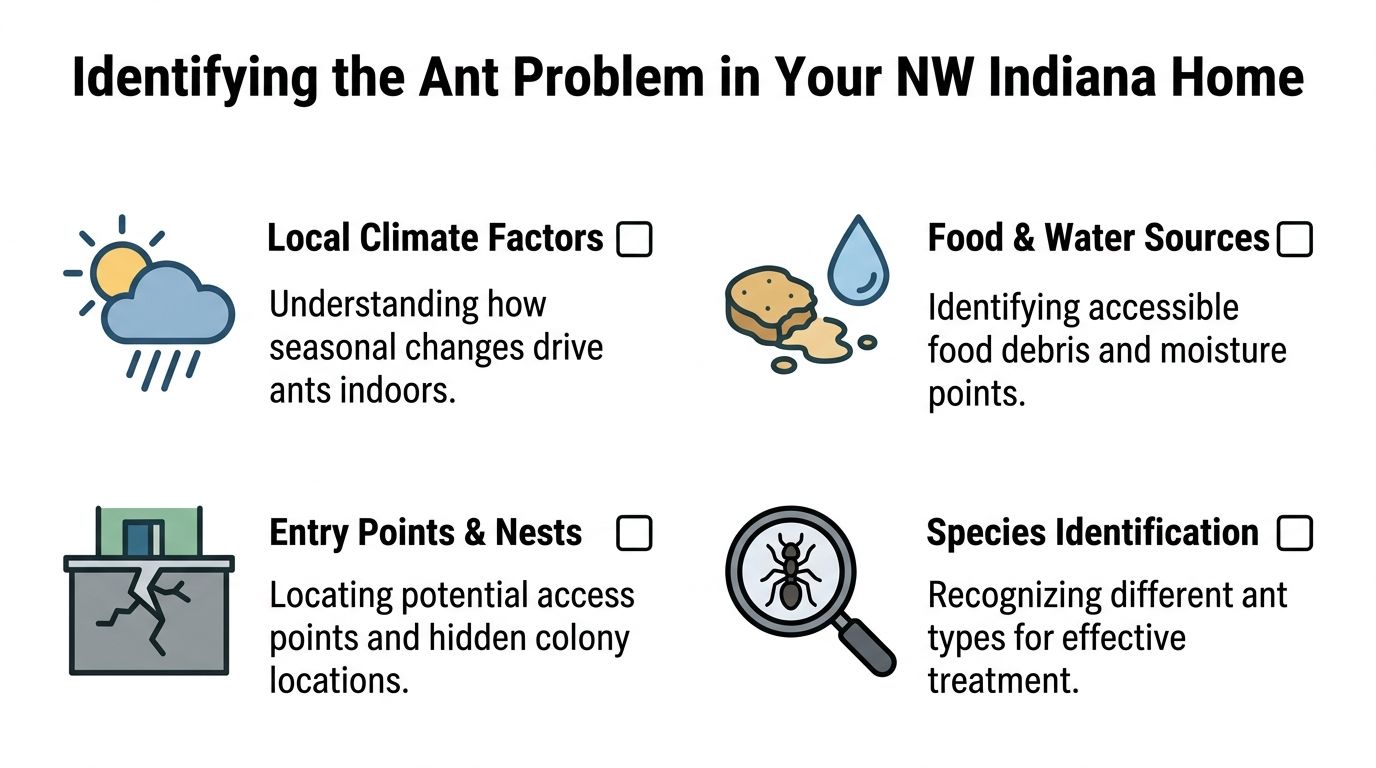
Before you can solve an ant issue for good, you need to identify how the infestation is operating. In this region, ants don't show up randomly. Seasonal shifts push them to forage more aggressively, and homes offer stable shelter compared with the conditions outside.
Why ants stay persistent in Northwest Indiana
Northwest Indiana gives ants a steady mix of moisture, heat, and shelter transitions. Rain drives them off saturated ground. Heat pushes them toward cooler interiors. Dry spells can send them searching for water around sinks, tubs, and condensate lines.
That's why ant activity in Crown Point often seems to flare up around ordinary living patterns. Running the dishwasher, leaving pet bowls down, storing snacks in a lower cabinet, or having mulch and landscaping close to the foundation can all help sustain indoor activity.
A few ant species can look similar to a homeowner, but their nesting habits don't always match. Small nuisance ants often trail along edges and through minor gaps. Carpenter ants raise a different level of concern because they can be associated with damp or damaged wood. If you hear light rustling in a wall void, see larger ants, or notice activity around wet wood, don't guess.
How to inspect like a technician
Start with the trail, not the pile of dead ants. Watch where the ants are moving from and where they're going. Their line usually tells you more than the insects themselves.
Use this checklist:
- Follow the route: Watch baseboards, countertop seams, cabinet corners, and window trim. Ants prefer edges because they help guide movement.
- Check moisture zones: Look under sinks, around dishwashers, near refrigerators, by floor drains, and around laundry areas.
- Inspect entry points: Focus on foundation cracks, utility penetrations, door thresholds, window seals, and gaps where exterior materials meet.
- Look outside too: Ant hills, mulch beds, outdoor borders, and sandy or loose soil near the home can support nearby colonies.
Research confirms that eliminating ant pheromone trails is a critical step in permanent ant control. A 50/50 vinegar and water mix, or soapy water, can break down those chemical pathways so ants can't easily return to entry points or recruit others along the same path, especially along doorways and window sills, as noted in this natural ant control guidance.
Ants don't need to “remember” your kitchen. They follow chemistry. Remove the trail, and you remove their map.
Clues that change the treatment plan
Some signs point to a simple foraging issue. Others suggest a deeper structural or outdoor nesting problem. When faced with such issues, homeowners often lose time with generic products.
| What you notice | What it may mean |
|---|---|
| Ants only near a food source | A foraging trail linked to crumbs, spills, or accessible pantry items |
| Ants near sinks or tubs | Moisture-seeking behavior and a likely nearby access route |
| Repeated trails in the same area | An established pathway that hasn't been fully disrupted |
| Larger ants near damp wood | A possible carpenter ant issue that needs closer inspection |
| Activity inside and outside | A connected indoor-outdoor problem, not just an interior cleanup issue |
If you're looking for exterminator in Crown Point, IN, this diagnostic step is where a real service starts. Good ant control isn't guessing which spray to buy. It's identifying species pressure, route patterns, and the conditions that let the colony keep winning.
The Limits of DIY and Natural Ant Remedies
It's common to try DIY first, and that makes sense. If ants suddenly show up across the counter, you want them gone right now. The problem is that fast relief and permanent relief are not the same thing.
What DIY does well
Some home remedies have real value when used for the right purpose. If ants are actively trailing on a surface, you can spray them directly with a dishwashing liquid solution mixed at 1 part soap to 3 parts water, and the soap breaks down their exoskeletons instantly. Wiping the area with detergent also helps remove residual pheromones that create trails, as described in this dish soap ant removal tip.
That's useful for immediate cleanup. It's not colony elimination.
A similar idea shows up with other small pests. If you've dealt with moisture-loving insects indoors, this practical post on how to eliminate gnats effectively is a good example of how household ingredients can help with short-term control while still leaving the broader source issue to solve.
Where big-box products fall short in NW Indiana
In Crown Point and nearby Northwest Indiana communities, generic ant products often fail because they're made for a broad consumer market, not for the exact species pressure, weather pattern, entry conditions, and nesting setup at your property.
Common DIY limitations include:
- Repellent sprays: They may clear the visible line, but they can push ants to reroute through another crack, wall void, or room.
- Chalk, powders, and scent barriers: These can help discourage crossing at one point, but they don't remove the nest.
- One-size-fits-all bait stations: Some colonies won't touch the first bait you put down because food preference varies.
- Indoor-only treatment: If the colony pressure is coming from exterior nesting close to the home, interior cleanup alone won't hold.
If ants vanish for a day and return from a different direction, the colony didn't lose. It adjusted.
Natural remedies have a place, but it's a narrow one
Vinegar, soapy water, and strong scents can help with cleanup, trail disruption, and short-term deterrence. They're best used as support tools. They are not a complete answer for an established infestation that already has a functioning nest and foraging line.
That distinction matters. Homeowners often think a remedy failed because it was “natural.” Usually it failed because it was being asked to do the wrong job. Cleaning agents help erase trails. Direct sprays help knock down visible ants. Neither one reliably solves the source by itself.
That's why many repeat infestations end up needing a more complete plan. If you want the plain version of why repeated DIY often costs more in time and frustration, this article on why DIY pest control is a false economy lays it out clearly.
After several failed attempts, seeking residential pest control or pest control near me usually signals a turning point. The question stops being “How do I kill these ants today?” and becomes “How do I stop the colony from sending more?”
The Green Advantage Professional Ant Control Process
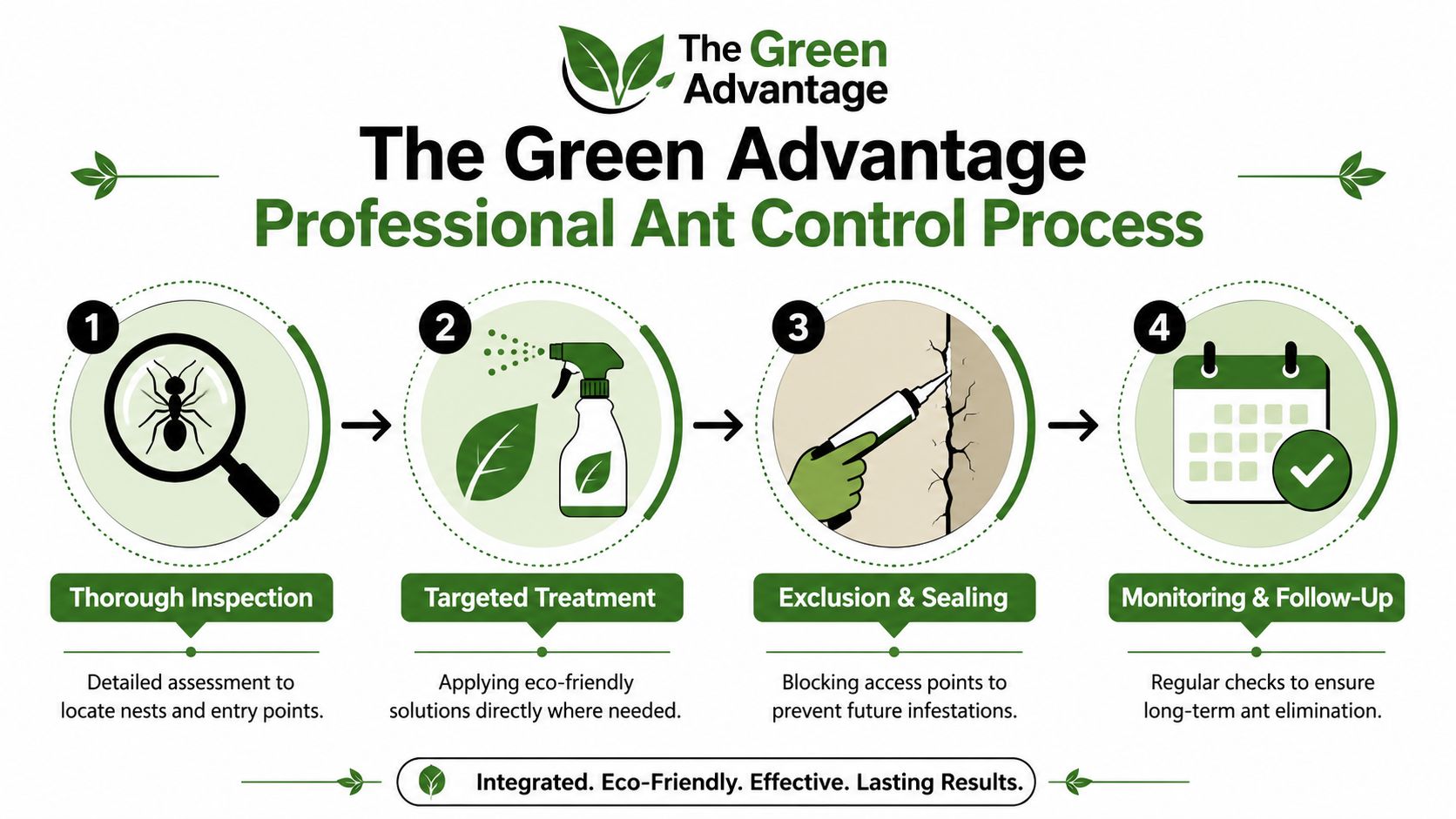
Professional ant control works because it treats the colony, the route, and the conditions around the home as one connected problem. That's the difference between a temporary reduction and learning how to get rid of ants permanently.
Step one is inspection, not guessing
A technician starts by identifying where ants are active, where they're likely entering, and what conditions are helping them stay. Indoors, that usually means checking kitchens, baths, baseboards, utility lines, and window areas. Outside, the inspection often focuses on the foundation edge, landscaping, visible hills, and places where soil meets structure.
This is also where species clues matter. Small nuisance ants, carpenter ants, and yard-related infestations don't all get managed the same way. A proper inspection shapes the treatment choice instead of relying on a one-product answer.
Step two is targeted colony control
One of the most effective and permanent methods is the strategic use of ant baits containing slow-acting toxins. Ants carry the bait back to the nest, which ultimately poisons the queen and the entire colony. This approach is considered the gold standard because it addresses the source of the infestation, unlike surface sprays that only kill visible ants, according to this Consumer Reports overview of ant bait strategy.
That slow action is the part many homeowners misunderstand. If ants are feeding at the bait, that can be a good sign. You don't want to interrupt the transfer process too early.
Field insight: When a colony accepts bait, patience matters. Stopping too soon can let the remaining nest recover.
The Green Advantage fits as one local option for pest control in Crown Point, IN. Their general pest service uses low-toxicity products and exclusion methods to address recurring ant issues with a site-specific plan rather than a broad spray-and-go approach.
Here's a quick look at the process in action:
Step three is exclusion and environmental correction
After treatment begins, the physical access points still need attention. Otherwise, a new colony can use the same gaps later. Sealing and correction may involve:
- Foundation and trim gaps: Small cracks and separations around the structure can become repeat entry routes.
- Utility penetrations: Openings around pipes, cables, and service lines often go unnoticed behind appliances or under sinks.
- Door and window vulnerabilities: Worn sweeps, loose seals, and damaged screens invite ants and other pests.
- Moisture correction: Leaks, condensation, and poor drainage create favorable conditions not only for ants but also for spiders and some rodent activity.
This is one reason a solid ant program can support broader pest prevention. Entry points that let ants in can also help with future spider control, rodent control, or seasonal invaders. For some properties, the same inspection may also reveal conditions that warrant attention for wasp removal, mosquito control, or even termite control if wood contact and moisture are present.
Step four is follow-up and adjustment
Not every colony responds the same way. Food preference can differ, and some infestations involve more than one pressure point. Good professional service includes monitoring what the ants are doing after treatment starts and adjusting placement, product selection, or exclusion work as needed.
A practical ant program often looks like this:
- Inspect the full pattern indoors and outdoors.
- Use targeted baiting to reach the colony instead of just the trail.
- Seal and correct the routes and conditions helping ants persist.
- Monitor results so the solution holds, not just the first visit.
That's the integrated difference between a retail quick fix and a real ant control plan.
Long-Term Benefits of Professional Pest Management
Getting rid of ants is the immediate goal. Protecting the property is the bigger one.
Why the investment pays off beyond ant control
When ant activity keeps returning, the cost isn't just the product you bought at the store. It's the repeat cleanup, contaminated pantry items, the stress of seeing insects around food prep areas, and the risk of ignoring a species that points to moisture-damaged wood.
For homeowners, professional pest management protects three things at once:
- Your home: Persistent ant activity can signal conditions around wood, trim, soil, and moisture that need attention.
- Your routine: You stop living around trails on counters, pet areas, bathrooms, and entry points.
- Your peace of mind: You don't have to keep guessing whether the problem is gone or just quiet for the moment.
For businesses in Crown Point and Northwest Indiana, ant infestations present a more serious concern. Ants in break rooms, offices, common areas, or customer-facing spaces can affect sanitation expectations and employee comfort. That's why commercial pest control focuses on prevention just as much as treatment.
Permanent control needs more than one move
A permanent solution requires a three-phase methodology: defensive barriers using insect-killing granules to discourage entry, offensive tactics by placing granules near ant hills, and long-term cultural transformation by removing sandy soil and other favorable nesting substrates from the property perimeter, as described in this three-phase ant control method.
That idea matters because it reflects what professionals see every day. Lasting results usually come from combining barrier work, direct colony pressure, and environmental changes that make the property less attractive over time.
When the yard, foundation edge, and indoor access points all support ant activity, one treatment alone rarely stays ahead of the problem.
This is also why homeowners searching for exterminator near me often end up choosing an ongoing service plan instead of one isolated visit. Preventative pest treatments help with current ants and can reduce the conditions that contribute to other Northwest Indiana seasonal pests later in the year.
Working With Your Crown Point Pest Control Partner
Most homeowners wait longer than they should because they expect the process to be complicated or high-pressure. It shouldn't be. A good pest control experience starts with a straightforward conversation about what you're seeing, where you've seen it, and how long it's been happening.
What to expect from the first call
When you reach out for pest control in Crown Point, IN, the first step is simple scheduling and basic intake. Be ready to describe where ants are active, whether they're only indoors or also outside, and whether you've already tried sprays, bait stations, or cleaning treatments.
A technician visit typically includes:
- A site review: Indoor and outdoor inspection of activity zones, entry points, and likely nesting conditions.
- A plain-language explanation: What kind of ant issue is most likely happening and why it's recurring.
- A treatment recommendation: A practical plan for elimination, exclusion, and follow-up if needed.
- A quote for service: Clear next steps without confusion about what's included.

What good service feels like
You should know who's coming, what they're looking for, and what the treatment is designed to accomplish. You should also get realistic expectations. Some ant issues resolve quickly once the right bait is accepted and the route is sealed. Others need a little monitoring, especially if outdoor pressure remains high.
The right local partner also understands that ants are rarely the only concern on a property. A thorough visit may uncover conditions tied to eco-friendly pest control, preventative pest treatments, residential pest control, or related needs like mosquitoes, rodents, spiders, or wasps depending on the season.
If you've been typing exterminator in Crown Point, IN or pest control near me into a search bar because the ants keep returning, the next move is to stop chasing the trail and start solving the source.
If ants keep coming back, it's time for a full inspection and a treatment plan that addresses the colony, the entry points, and the conditions drawing them in. Contact The Green Advantage to schedule service, request a quote, and get practical help for your Crown Point, IN home or business.