
You hear it at night first. A faint scratching in the wall. Then a line of ants shows up by the sink. A few days later, you're swatting mosquitoes in your own backyard and wondering whether you need a spray from the hardware store or a real exterminator near you.
That moment is stressful because most homeowners don't know if they have a small nuisance or the start of a bigger problem. In Crown Point, IN, that uncertainty gets worse because our pest pressure isn't generic. Moisture, changing seasons, dense vegetation, and the way many homes sit against mulch beds, leaf litter, and damp soil all affect what shows up and how fast it spreads.
Good pest control starts with calm, local judgment. You need to know what pest you're dealing with, why it's there, and what will hold up in a Northwest Indiana home after the first treatment wears off.
That same thinking applies to the house itself. Small gaps that let outside air leak in can also give pests a route indoors, which is why practical home-shell fixes matter. If you want a solid homeowner overview of that side of the problem, this guide on air sealing for Tucson homeowners is useful because the core principle is the same. Tighten the home, reduce access, and make the structure less inviting.
Your Guide to a Pest-Free Home in Northwest Indiana
In Crown Point and nearby Northwest Indiana communities, the best pest control for home isn't just about killing what you see. It's about fixing the conditions that brought pests in to begin with.
A lot of people assume pest issues mean a house is dirty. Usually, that's not the full story. I've seen clean, well-kept homes deal with ants because mulch stayed too wet against the foundation, spiders because insects were gathering around entry lights, and rodents because one small utility gap stayed open all winter.
Practical rule: If pests keep coming back after store-bought products, the problem usually isn't the product alone. It's the combination of entry points, moisture, shelter, and missed nesting areas.
The right residential pest control plan should answer four questions:
- What pest is active: Ants, spiders, wasps, rodents, mosquitoes, termites, and bed bugs all behave differently.
- Where it's coming from: Foundation gaps, attic vents, crawl spaces, landscaping, standing water, or wall voids.
- What conditions support it: Excess moisture, clutter, food sources, overgrown plants, or untreated exterior zones.
- What treatment fits the risk: Light prevention, targeted baiting, exclusion work, mosquito reduction, or more intensive treatment.
That matters whether you're searching for pest control near me, pest control in Crown Point, IN, or a local exterminator near me because the quality gap between providers often comes down to diagnosis. A generic spray can make activity look better for a short time. A smarter plan keeps the problem from rebuilding.
Identifying Common Pests in Crown Point and Beyond
Northwest Indiana has its own pest patterns. Lake-effect humidity, wet periods, shaded lots, and soil that holds moisture can all push insects and rodents toward the structure.
Ants, spiders, and crawling pests around the foundation
Ants often show up first in kitchens, around windows, or where plumbing lines enter. If you see a steady trail rather than a random few scouts, they're usually tracking between a food source and a nesting area. Spiders are different. They follow insect activity, so webs in corners, basements, garages, and around exterior lights usually mean the home is feeding their food supply.
Millipedes and similar moisture-loving pests are also common around damp foundations. They don't usually signal structural damage, but they do signal a perimeter condition that needs correction.
In Indiana, 65% of homeowner complaints involve perimeter breaches due to poor drainage and leaf litter buildup, according to regional pest vector reporting tied to Purdue Extension findings. That's why a good exterminator in Crown Point, IN won't stop at the bug itself. They'll look at grading, gutter discharge, mulch depth, damp corners, and the vegetation touching the house.
Mosquitoes, wasps, and stinging pests in the yard
Mosquito pressure rises fast when water sits in gutters, planters, toys, low spots, or dense shaded landscaping. If your family gets bitten in the same areas of the yard every evening, that's usually a pattern, not bad luck.
Wasps and hornets tend to build where they get shelter and low disturbance. Watch eaves, soffits, playsets, deck framing, sheds, and fence lines. Early nests are easier to address than mature ones.
Look for these signs:
- Mosquito activity at dusk: Bites cluster around ankles, legs, and shaded seating areas.
- Wasp traffic in one direction: Repeated flight to the same roofline, post, or overhang often points to a nest site.
- Spider web buildup outdoors: Heavy webbing around lights and entryways means prey insects are gathering there first.
Rodents, termites, and hidden interior pests
Rodents leave clues before you see them. Listen for scratching, look for droppings, and check for gnawing around stored food, garage corners, utility penetrations, and attic access points. They don't need a large opening.
Termites and bed bugs are harder because both stay hidden early. Soft wood, damaged trim, or unexplained insect wings around windows deserve attention. Bed bug activity often starts with bite concerns, mattress seam spotting, or bugs hiding near sleeping areas and upholstered furniture.
If you notice pests in more than one room, or both inside and outside, it's usually no longer just a spot-treatment issue.
Assessing the Severity of Your Pest Infestation
Not every pest sighting means you need a full treatment plan. But some signs tell you right away that the problem has moved past DIY.
When it's a nuisance and when it's an infestation
A few ants near a door on a rainy day may only mean temporary activity. One spider in the basement isn't unusual. A single wasp near the deck doesn't mean a nest is established.
The situation changes when patterns repeat. Daily ant trails, fresh droppings, multiple rooms with activity, new bites overnight, damaged wood, or recurring insects after repeated sprays all point to an established source.
Use this quick self-check:
- Minor issue: Isolated sightings, no repeated trail, no visible nesting, no signs in multiple rooms.
- Moderate issue: Repeat sightings in the same area, visible exterior activity, attractants present, DIY gives only short relief.
- Serious issue: Rodent evidence, stinging insect nesting near living areas, suspected termites, bed bugs, or pests spreading through the house.
Why DIY often stalls out
DIY products can knock down visible pests. They often don't reach the nest, void, harboring area, or colony core. That's the main reason homeowners feel like they're treating the same problem over and over.
One-time professional treatments average $300-$550, while annual plans range $660-$1,220, and professionals can eliminate entire colonies in 24-48 hours in situations where DIY sprays with a 20-foot limit fall short, according to This Old House's pest control cost and treatment review. A key trade-off isn't just upfront price. It's whether the treatment reaches the source.
Short-term relief can be expensive if you keep buying products that never touch the nesting zone.
Signs you should call for residential pest control now
Some situations shouldn't wait.
- Rodent evidence indoors: Droppings, gnaw marks, or scratching in walls usually mean hidden activity.
- Stinging insects near doors or play areas: Nesting close to family traffic raises the risk quickly.
- Possible termite damage: Soft or hollow-sounding wood needs inspection, not guesswork.
- Bed bug indicators: Repeated overnight bites or spotting near beds should be handled with a defined treatment plan.
- Recurring perimeter invasions: If pests return after each weather change, the exterior conditions need a broader fix.
If you're searching pest control near me because the problem keeps returning, that's usually your answer already. You don't need more spray. You need a better diagnosis.
Comparing Pest Control Treatments Nature-Based vs Chemical
Most homeowners in Crown Point aren't asking whether pest control should work. They're asking how to make it work without creating a new safety concern for kids, pets, pollinators, or the yard.
A March 2026 survey of 991 homeowners found that 81% prefer eco-friendly pest control methods, reflecting a clear move toward sustainable solutions and supporting Integrated Pest Management (IPM), which blends prevention, non-chemical controls, and targeted treatment for longer-term results, as summarized by Modern Pest's homeowner statistics review.
What conventional chemical control does well
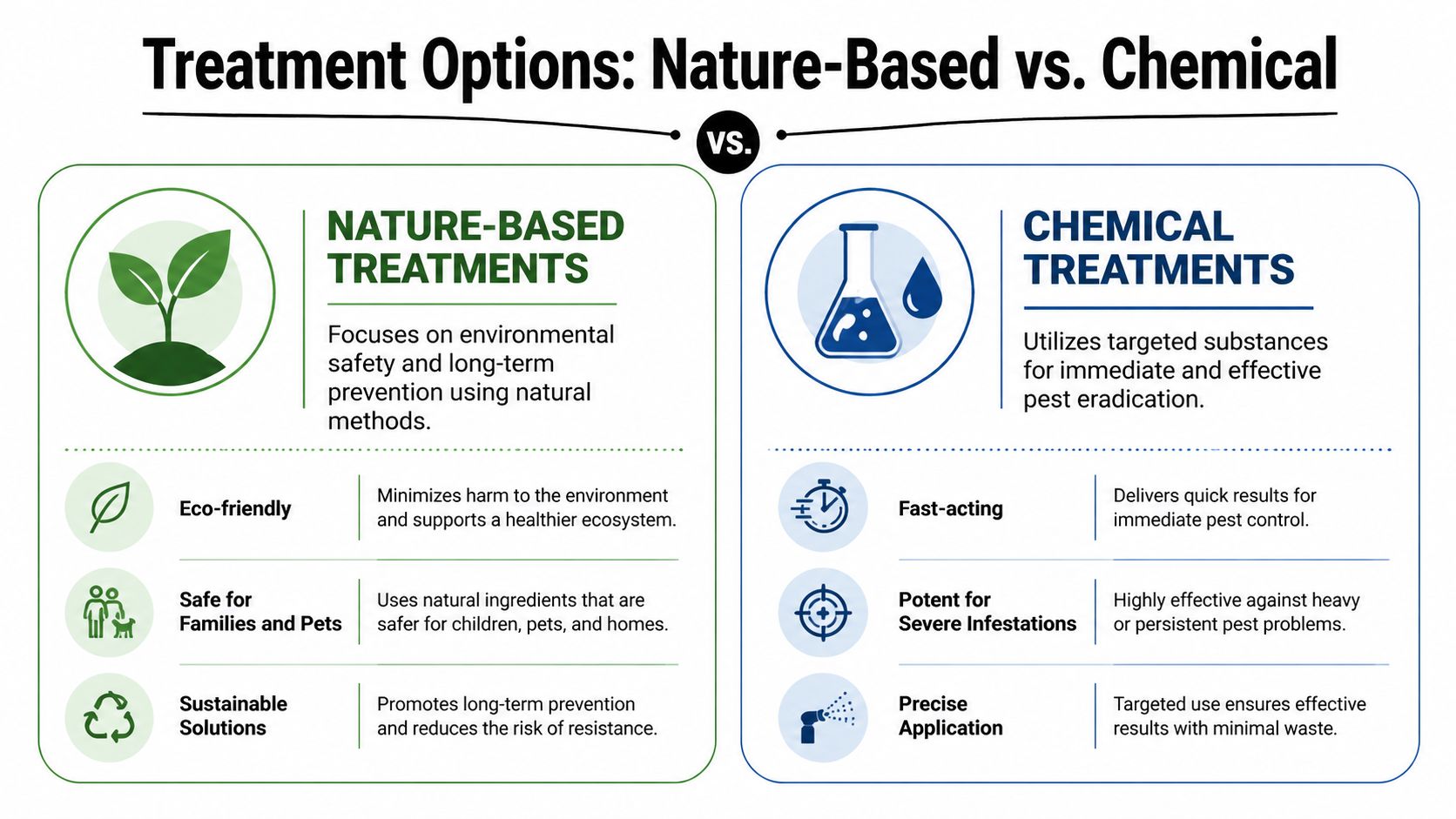
Chemical treatments have a place. For severe or fast-moving infestations, a targeted product can reduce active pressure quickly. That's useful when stinging insects are nesting close to a doorway, when roaches are established, or when a colony has to be hit in a specific area.
The downside is that chemical-only service often treats the symptom better than the cause. If moisture, access points, clutter, or harborage stay the same, the pests can cycle back.
Why nature-based IPM holds up better over time
IPM starts with inspection and monitoring. Then it moves into sanitation, sealing, habitat correction, trapping, baiting, and carefully limited product use only where needed. That approach makes sense in Northwest Indiana because so many pest issues start at the edge of the property. Wet mulch, leaf litter, clogged gutters, low spots, and dense plantings all contribute.
If you want a closer look at that style of service, this page on environmentally friendly pest control methods outlines how lower-impact strategies fit into practical home protection.
One local option homeowners use for this kind of work is The Green Advantage, which provides residential pest control, inspections, mosquito reduction programs, and treatments built around nature-based practices in Crown Point and nearby Northwest Indiana communities.
Pest Control Method Comparison
| Feature | Conventional Chemical Control | Nature-Based IPM (The Green Advantage Approach) |
|---|---|---|
| Primary goal | Fast knockdown of active pests | Long-term control through prevention and targeted action |
| First step | Apply product to affected areas | Inspect, identify, monitor, then treat |
| Chemical use | More central to the service | Minimized and used only when needed |
| Best fit | Acute infestations and immediate pressure | Ongoing residential pest control and prevention |
| Risk of rebound | Higher if conditions stay the same | Lower when moisture, access, and harborage are corrected |
| Homeowner role | Usually limited after treatment | Important for sanitation, drainage, and exclusion follow-through |
The smartest home pest control plan usually isn't all-natural or all-chemical. It's selective, measured, and built around the pest's behavior.
How to Choose the Best Pest Control Company Near You
If you're comparing pest control in Crown Point, IN, the easiest mistake is picking the company that promises the fastest spray and the lowest first visit. That's not how you judge long-term value.

Look for a real process, not a generic promise
A quality provider uses IPM, and that matters because it can reduce pesticide use by 50-75% while producing lower pest counts at 3 and 6 months, with 89% of residents in one cited study shifting to lower-toxicity products, according to FieldRoutes' summary of IPM methods and outcomes.
That should shape what you ask during your estimate or inspection call.
Here are the right questions:
- How do you identify the source: If the answer is just "we spray the baseboards," keep looking.
- What does your inspection include: You want interior, exterior, entry points, moisture zones, and nesting conditions.
- How do you handle prevention: Good service includes exclusion, sanitation advice, and monitoring.
- What happens if activity returns: Clear follow-up policies matter.
- Do you tailor treatment by pest type: Ant control, mosquito control, rodent control, wasp removal, and termite concerns shouldn't all get the same plan.
Favor local knowledge over broad scripts
A provider serving Northwest Indiana should understand how our seasonal swings affect ant movement, spider pressure, mosquito breeding, and rodent entry. Local experience shows up in the details. They notice the wet back corner by the downspout, the flower bed piled too high against the siding, and the garage sweep that doesn't seal anymore.
That kind of judgment is hard to fake. It's one reason many homeowners read through a company's values and service approach before booking. If you want to see what that looks like in practice, review why homeowners choose The Green Advantage for pest control needs.
Use this short checklist before you hire
A reliable exterminator near me search should end with a few hard filters, not guesswork.
- Licensed and insured: Basic, but absolutely essential.
- Clear communication: You should know what they're treating and why.
- Local service area focus: Crown Point and nearby Northwest Indiana homes have different patterns than generic national scripts assume.
- Written scope of service: You need to know if the plan covers one-time work, recurring prevention, or both.
- Practical prevention advice: The company should help you reduce future activity, not just sell the visit.
A pest control company earns trust by explaining why a treatment fits your home, not by pushing the largest package first.
What to Expect When You Work With The Green Advantage
A good service visit should feel organized from the first phone call. You shouldn't be left guessing what the technician will do, whether you need to move furniture, or how long results will take.

Before the visit
Be ready to describe what you've seen, where you saw it, and when activity is worst. That helps narrow down the likely pest and the likely entry or nesting zone.
It also helps to do a few simple prep steps:
- Clear access to problem areas: Under sinks, along baseboards, utility rooms, garage edges, and attic access if relevant.
- Reduce clutter where pests hide: Especially in storage rooms, basements, and closets.
- Note moisture issues: Leaks, damp spots, gutter overflow areas, and condensation matter.
- Keep pets and kids away from active work areas: Your technician can give specific guidance for the service being performed.
During and after treatment
Expect a full inspection first, not just immediate spraying. The most useful visits involve identifying the pest, locating likely access points, checking the perimeter, and matching treatment to the actual problem. That may include baiting, dusting, liquid treatment, exclusion recommendations, mosquito reduction steps, or follow-up monitoring.
After service, you should know what was found, what was treated, and what changes at home will help the result last. In practical terms, that often means adjusting drainage, trimming back vegetation, cleaning up leaf litter, repairing screens, sealing gaps, and changing how food or pet items are stored.
The goal is simple. Make the house less available to pests next week, not just less active today.
Frequently Asked Questions About Home Pest Control
Are eco-friendly treatments always safer?
Not automatically. Some homeowners assume "natural" means harmless, but that's too simple. According to University of Florida IFAS guidance on natural pest control options, some essential oils can be toxic to pets, while professional-grade biological controls can be effective and safe when used properly. That's one reason a professional evaluation matters.
Is natural pest control strong enough for a real infestation?
Sometimes yes, sometimes no by itself. For light or moderate pest pressure, prevention, trapping, habitat correction, exclusion, and lower-impact materials can do a lot. For heavier infestations, targeted chemical use may still be the right tool inside a broader IPM plan.
How do I know if I need one-time or ongoing service?
If the issue was isolated and tied to a single event, a one-time service may be enough. If your home has recurring ant activity, seasonal spiders, mosquito pressure, rodent risk, or repeated perimeter issues, ongoing residential pest control usually makes more sense because it keeps the exterior conditions from rebuilding pest pressure.
What pests should Crown Point homeowners take most seriously?
Any pest can become disruptive if ignored, but hidden pests deserve the quickest response. Rodents, termites, bed bugs, and stinging insects near entry areas move into the urgent category faster than an occasional spider or a few stray ants.
What's the best first step if I'm unsure?
Start with an inspection. That's the fastest way to separate a nuisance from a structural or recurring problem. It also keeps you from spending money on products that don't match the pest.
If you're looking for practical, local help with pest control in Crown Point, IN, the next step is simple. Contact The Green Advantage to schedule a pest inspection, request a quote, and get a treatment plan built for your home, your family, and the conditions that drive pest problems in Northwest Indiana.