
A calm summer evening in Crown Point should end with dessert on the patio, not a rush back indoors swatting at ankles and elbows. Yet that’s how mosquito problems usually show up around Northwest Indiana homes. The grill is still warm, the kids are still outside, and within minutes everyone is reaching for a candle, a spray, or whatever “alternative mosquito repellent” happened to be in the garage.
That search makes sense. Many homeowners want something that feels safer, less harsh, and easier to live with than old-school bug spray. The trouble is that most advice online treats every yard the same. Crown Point isn’t every yard. Our standing water, humid stretches, shaded landscaping, drainage areas, and nearby wetlands create very specific mosquito pressure, and what helps a little on a travel blog often falls short in a Northwest Indiana backyard.
Good mosquito control starts with honest trade-offs. Some alternatives work well for personal protection. Some help around a patio table. Some barely move the needle. If you want your yard back, it helps to know which is which.
Your Guide to Mosquito Control in Crown Point IN
One of the most common scenes around Crown Point goes like this. Dinner gets moved outside because the weather is finally nice. Someone lights a candle. Someone else sprays their legs. Ten minutes later, the conversation turns into swatting, scratching, and asking who left water in the flowerpots.

That pattern isn’t random. Northwest Indiana gives mosquitoes what they want. Rain collects in low spots. Gutters hold debris. Kids’ toys, plant saucers, tarps, and wheelbarrows trap water. Dense shrubs hold moisture and shade through the day, then release hungry mosquitoes at dusk.
Why Crown Point yards stay active
Mosquitoes don’t need a pond to become a problem. Small, overlooked water sources are often enough to support breeding. Add summer humidity and thick landscaping, and your yard becomes a resting area plus a launch point.
A few of the local pressure points include:
- Low-lying lawn areas: Water sits longer after rain, especially where grading isn’t ideal.
- Decorative features: Birdbaths, rain barrels, and planters collect water faster than most homeowners realize.
- Dense plant cover: Mosquitoes hide in cool, shaded leaves during the heat of the day.
- Wetland influence: Properties near natural water or drainage corridors often see heavier mosquito activity.
The local species matter too. Local mosquito species resistance patterns in Northwest Indiana are a growing concern. While some oils like clove show temporary repellency, they’re often ineffective against species like Aedes vexans and Aedes triseriatus prevalent in Indiana wetlands, which is why generic advice often misses the mark in this region, as noted by GoodRx’s overview of natural mosquito repellents.
Why one-size-fits-all advice falls short
A lot of “natural mosquito repellent” advice assumes a mosquito is a mosquito. In practice, behavior changes by species, weather, and habitat. A product that seems acceptable for a short evening walk might disappoint fast in a yard with standing water nearby and heavy dusk activity.
Local reality: The same repellent can feel effective on a breezy driveway and almost useless beside dense shrubs and damp mulch.
That’s why homeowners often feel like they’re doing everything right and still getting bitten. They may be using a product that works only on skin, only at close range, or only for a short window. Meanwhile, mosquitoes are still breeding on the property.
What’s happening before you notice bites
By the time adults are buzzing around your patio, the problem started earlier. Mosquitoes lay eggs where water remains long enough for development. After that, adult mosquitoes rest in protected areas until it’s time to feed.
That’s why the problem keeps coming back when people rely only on repellents. Personal repellents can help reduce bites. They do not remove breeding sites. They do not reduce resting populations in shrubs. They do not solve the part of the problem you can’t see.
A smarter approach for Crown Point homes starts with two questions:
- What protects people right now?
- What reduces mosquito pressure across the property?
Those are related, but they aren’t the same thing. That distinction is where many homeowners finally stop wasting money on products that only help a little.
Evaluating Natural and DIY Mosquito Repellents
Homeowners usually start with plant-based products first, and that’s understandable. They’re easy to buy, easy to apply, and they fit the goal of reducing reliance on harsher-feeling ingredients. Some are worth keeping around. Some are best treated as backup tools.
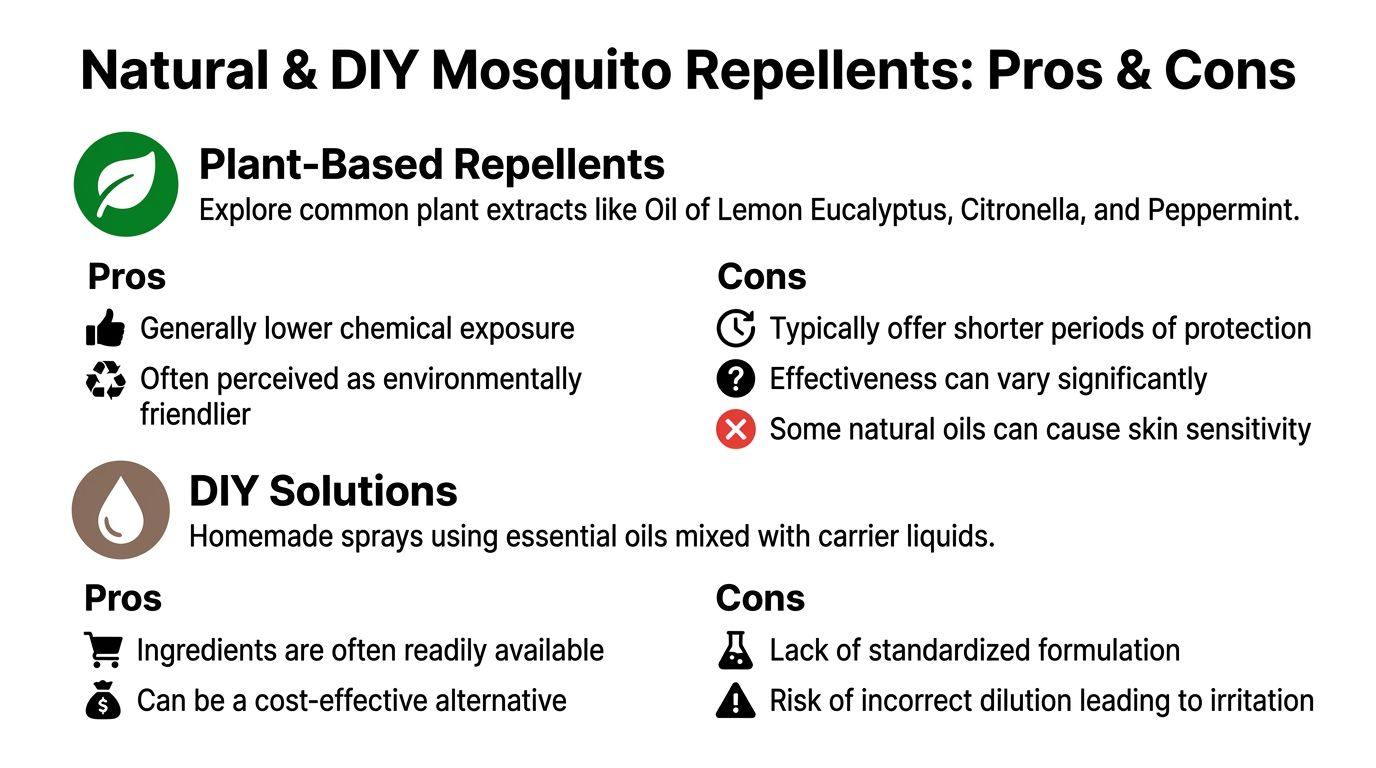
What performs best among plant-based options
If you want the strongest natural-leaning option for personal use, Oil of Lemon Eucalyptus (OLE) is the standout. Scientific comparisons show that 30% OLE can provide 96.88% protection for up to 4 hours, while a 5% citronella solution may only last about 10 to 15 minutes, which is why many natural repellents need frequent reapplication, according to Consumer Reports on natural insect repellent effectiveness.
That gap matters in real life. Four hours can cover a soccer game, an evening on the deck, or mowing the lawn. Ten to fifteen minutes is closer to “better than nothing” than dependable protection.
Here’s a practical side-by-side look:
| Option | Best use | Main strength | Main limitation |
|---|---|---|---|
| OLE products | Personal outdoor use | Strongest plant-based performance in common retail options | Doesn’t protect the whole yard |
| Citronella | Very short stationary use | Familiar, easy to find | Short-lived |
| Lavender or peppermint blends | Light personal use | Pleasant scent for some users | Results vary |
| Neem-based products | Occasional personal use | Appeals to natural-minded buyers | Can be inconsistent and may have a strong odor |
| DIY essential oil sprays | Casual, short exposure | Flexible and inexpensive to mix | No standardized strength or staying power |
Citronella, candles, and the comfort factor
Citronella is probably the most recognized alternative mosquito repellent. It has a place, but that place is narrow. It works best as a comfort-layer product for a short, calm, stationary setting.
Candles and torches can help create a more pleasant patio environment. They should not be mistaken for full protection. In field use, citronella-based options reduce nuisance more than they eliminate it.
A citronella candle can make a patio feel more comfortable. It usually won’t make a mosquito-heavy yard feel solved.
That’s the difference many families notice after buying several candles and still ending the night with bites.
DIY sprays and lotions
DIY recipes are popular because they feel simple and customizable. A typical homemade spray uses essential oils in a carrier like witch hazel, alcohol, or another skin-safe base. The biggest drawback is consistency. You don’t know if the final concentration is effective, mild, or irritating.
Common DIY issues include:
- Weak dilution: The scent is noticeable, but the repellency is poor.
- Short residual life: Essential oils evaporate fast outdoors.
- Skin sensitivity: “Natural” doesn’t automatically mean gentle on all skin types.
- Patchy application: Homemade formulas often don’t spread or hold evenly.
If you want ideas focused specifically on plant-based options, this guide to natural mosquito repellent essential oils is a useful starting point. The key is to treat DIY blends as limited personal protection, not yard control.
When natural options make sense
Natural repellents fit best when the goal is temporary personal protection, not property-wide relief. They’re reasonable for:
- Short patio sits: A little help during a quiet evening.
- Gardening or light yard work: Especially when reapplication is easy.
- Parents looking for options: Many families want to compare lower-odor alternatives first.
- Layered protection: Used alongside screens, fans, and habitat reduction.
Where they disappoint most often
The usual frustration points are predictable. People expect a spray or candle to do the job of a control program. It won’t.
Natural products struggle most when:
- mosquito pressure is already heavy,
- the yard has multiple breeding sources,
- people are active and sweating,
- there’s even mild breeze,
- coverage needs to extend beyond one person.
That doesn’t make them useless. It just means expectations need to match the tool. A well-chosen OLE product can be a smart item in the cabinet. A random homemade spray with citronella and lavender might smell nice and still leave you swatting before the burgers are off the grill.
Mosquito Repellent Devices and Physical Barriers
When homeowners get tired of spraying skin, they usually start looking at devices. That’s often a good move, especially for patios, decks, and other spots where people stay put.
Spatial repellents like clip-ons and diffusers can be more practical than topicals when the goal is protecting a table, a seating area, or a grill station. For static activities, they can outperform many topical repellents, with products like the OFF! Clip-On doing well in limited-movement situations, according to Lab Muffin’s review of natural mosquito repellents and spatial devices.
Where devices help most
These tools work best when people aren’t moving around much. A patio dinner, a card game on the deck, or sitting around a fire pit are the ideal situations.
Good uses include:
- Patio tables
- Small deck seating areas
- Porch corners with light air movement
- Outdoor events where guests stay in one zone
They’re less dependable when kids are running across the yard, people are doing lawn work, or wind keeps pushing the protective zone around.
Fans and airflow matter more than people think
A simple oscillating fan is one of the most underrated mosquito deterrents for a porch or patio. Mosquitoes are weak fliers, and moving air makes it harder for them to land and track people by scent.
That’s especially helpful in sticky Northwest Indiana evenings, where still air lets mosquitoes settle in. A fan won’t solve the whole property, but near a table or seating area, it often improves comfort fast.
Practical rule: If your goal is to protect one dinner table, think in terms of a protected pocket, not the whole yard.
That same rule applies to diffusers and clip-on devices. The smaller and more defined the activity zone, the better they tend to perform.
Screens, clothing, and physical exclusion
Not every alternative mosquito repellent comes in a bottle or a gadget. Physical barriers are often the most dependable low-maintenance upgrade because they don’t evaporate, wash off, or rely on scent.
For homeowners trying to tighten up porches, screen rooms, and openings where tiny biting insects slip through, upgraded no see um screen mesh can be a valuable resource. Standard screens may be enough for larger insects but still allow very small pests through.
Other strong barrier options include:
- Repairing torn window and door screens
- Using long sleeves and long pants for yard work
- Choosing treated clothing for hiking or brush-heavy tasks
- Closing gaps around screen doors and porch enclosures
A lot of frustration comes from overlooking these simple barriers while chasing one more spray.
Traps and device expectations
Homeowners also ask about traps. Some can play a useful support role, especially when they’re placed correctly and paired with source reduction. They tend to work better as part of a wider strategy than as a standalone answer. If you’re comparing setups, this overview of the best outdoor mosquito traps can help sort through what belongs near a patio versus what belongs farther out in the yard.
For a quick visual on device use and setup, this short video is helpful:
The bottom line is simple. Devices and barriers can improve a specific area. They rarely provide dependable, round-the-clock relief across an entire Crown Point property.
DIY Mosquito Control Limitations
Most DIY mosquito plans fail for the same reason. They stack several partial solutions and hope the combination adds up to full control.
A candle on the table. A natural spray by the back door. A diffuser near the chairs. Maybe a homemade essential oil mix for the kids before they head outside. Each item may help a little. The yard still feels mosquito-heavy because the underlying population is untouched.
The weak spots in patchwork control
Homeowners usually run into four practical limits.
First, many alternative products don’t last long enough outdoors. Wind, sweat, humidity, and movement all work against them.
Second, coverage is too small. A product can protect skin, or maybe a table, but not the lawn, landscaping, and shady resting sites around the property.
Third, results are inconsistent. Conditions change from one evening to the next. What felt acceptable on a calm night can feel useless after rain or during a humid dusk.
Fourth, DIY methods don’t stop breeding. That’s the biggest gap of all.
The problem is especially clear with top botanical choices. The CDC-endorsed Oil of Lemon Eucalyptus is one of the better alternatives, but its effectiveness decays over time, with a half-life of about 2 hours in a light breeze, and its performance can drop by 40% after exposure to water or sweat, as described by the San Gabriel Valley Mosquito and Vector Control District’s repellent guide.
Why the yard still feels “full of mosquitoes”
People often assume the repellent failed because they picked the wrong brand. Sometimes that’s true. More often, the product was being asked to do a job it was never meant to do.
A repellent’s job is to discourage bites. A control program’s job is to reduce mosquito pressure on the property.
Those are different jobs.
If mosquitoes are breeding around the home, personal repellents become maintenance tools, not solutions.
That’s why families in Crown Point often say they’ve “tried everything” when what they’ve really tried is a series of bite-reduction products. The source population is still developing in water-holding areas and resting in shaded cover.
What reliable control requires
A dependable mosquito strategy needs to do more than create a temporary bubble around people. It has to account for:
- Breeding water
- Dense foliage and damp shade
- Changing weather
- Repeated reinfestation from nearby areas
- The need for ongoing monitoring
DIY methods still have a place. They’re useful as personal layers. They just shouldn’t carry the whole burden. Once a property has active mosquito pressure, piecemeal control usually turns into repeated spending, repeated bites, and repeated disappointment.
The Green Advantage Solution Professional Mosquito Control
Homeowners looking for a safer-feeling alternative usually aren’t asking for less effective service. They’re asking for something more thoughtful. That shift is one reason the natural insect repellent market is projected to reach $4.37 billion by 2030, driven by demand for safer options, according to Grand View Research’s natural insect repellent market report.

That demand makes sense in Crown Point. Families want relief, but they also want treatments that are practical for homes with kids, pets, outdoor living spaces, and pollinator concerns. Professional mosquito control works best when it combines effectiveness with a careful site-specific plan instead of a one-size-fits-all spray routine.
What a professional mosquito program should include
A program starts with inspection, not guessing. Every property has its own pressure points. One yard may struggle because of clogged gutters and dense arborvitae. Another may have standing water under a deck, poor drainage along the fence, or heavy activity near a shaded play area.
A strong service approach includes:
- Property inspection: Identifying likely breeding zones, resting sites, and activity pockets.
- Source reduction guidance: Calling out containers, drainage issues, and yard habits that contribute to recurring pressure.
- Targeted treatment: Focusing where mosquitoes rest and develop.
- Ongoing visits: Because mosquito pressure changes through the season.
- Clear communication: Homeowners should know what was found, what was treated, and what to watch next.
Why inspection changes everything
Inspection is where professional service separates itself from retail products. A technician can spot patterns homeowners miss because mosquito issues are often hidden in ordinary objects and overlooked corners.
Common trouble spots include:
| Area | Why it matters |
|---|---|
| Gutters and downspouts | Debris holds water and supports breeding |
| Plant saucers and containers | Small water volumes are enough |
| Dense shrubs | Adult mosquitoes rest in cool, shaded foliage |
| Tarps and stored items | Water collects in folds and low points |
| Drainage edges | Moist areas keep activity going after rain |
That kind of property reading matters more than any single alternative mosquito repellent product. You can buy a better spray. You can’t buy a trained inspection with a shelf item.
Treatment that works with the property, not against it
Good mosquito service isn’t about blanketing everything. It’s about targeting the places mosquitoes use. That usually means treating resting zones in vegetation, addressing water-holding areas where appropriate, and reducing adult activity around the spaces people use.
For homeowners who prefer environmentally mindful service, the best programs are transparent about where treatments go and why. The goal is to reduce mosquito pressure while staying thoughtful about families, pets, and beneficial activity around the yard.
The most effective mosquito treatment is the one matched to the property’s layout, moisture patterns, and use of outdoor space.
That’s especially important in Crown Point neighborhoods where one block may have open sun and another has dense tree cover, drainage swales, and far heavier dusk activity.
What homeowners can expect from professional support
The right provider should make the process feel straightforward, not mysterious. You should expect clear scheduling, practical recommendations, and honest answers about what a service can and can’t do.
A well-run program usually means:
- A technician evaluates the yard and identifies mosquito-friendly conditions.
- The treatment plan is adapted to those conditions.
- You get guidance on what to empty, trim, repair, or monitor between visits.
- Service continues through the season so the population doesn’t rebound unchecked.
Professional mosquito control doesn’t replace homeowner effort. It makes that effort far more effective. Instead of throwing candles, sprays, and gadgets at a yard-wide problem, you get a plan that targets mosquitoes where they live, rest, and reproduce.
Your Local Partner for Pest Control in Crown Point
When homeowners search for pest control near me, exterminator near me, or pest control in Crown Point, IN, they’re usually looking for one thing. Confidence that someone local can solve the problem without making the process harder than it needs to be.
That’s where local experience matters. Mosquitoes in Northwest Indiana don’t show up in isolation. The same property conditions that support mosquitoes often overlap with other pest issues, from ants around foundations to spiders in shaded corners and wasps around eaves and outdoor living spaces.
Why local service beats generic advice
A national article can tell you what citronella is. It can’t tell you why your specific side yard stays active after every rain or why the back fence line turns into a mosquito resting zone by dusk.
Local pest control means someone understands the patterns common to Crown Point and nearby service areas, including:
- Residential mosquito pressure near drainage and wooded edges
- Commercial pest control needs for outdoor seating and entry areas
- Seasonal ant and spider activity around landscaping and foundations
- Wasp removal concerns near rooflines, play areas, and patios
- Broader residential pest control needs that call for prevention, not just reaction
That broader view matters because homeowners rarely want five separate service companies. They want one trusted team that can help protect the property as a whole.
What the right experience should feel like
Good pest control should feel organized and personal. You shouldn’t have to chase answers, guess what the technician is doing, or wonder whether anyone noticed the standing water behind the shed.
A dependable provider should offer:
- Friendly scheduling support: Help when you call with questions.
- Clear explanations: Plain-language answers instead of vague promises.
- Specific recommendations: Advice based on your yard, not a script.
- Reliable follow-through: Service that matches what was discussed.
Peace of mind comes from knowing the problem is being managed by someone who understands the property and the local pest pressure around it.
That standard matters whether you need mosquito control, ant control, rodent control, spider control, or help protecting a commercial property from recurring pest issues.
Benefit of Professional Pest Control
The best outcome isn’t just fewer bites or fewer sightings. It’s using your home normally again. Kids play outside longer. You stop dreading dusk on the patio. Guests don’t leave scratching. You spend less time experimenting and more time enjoying the yard.
For Crown Point homeowners and businesses, that’s what professional service is supposed to deliver. Not gimmicks. Not guesswork. Reliable protection that fits the property and the season.
Frequently Asked Questions About Mosquitoes
Do bug zappers work against mosquitoes
Usually not in the way homeowners hope. Bug zappers kill some flying insects, but they’re not a dependable answer for mosquito-heavy yards. They don’t address breeding sites, and they don’t create reliable relief where people sit and gather.
Are ultrasonic mosquito repellents worth buying
In most cases, no. They’re a common example of a product that sounds convenient but doesn’t solve the problem outdoors. Homeowners generally get better results from proven physical barriers, effective personal repellents, and targeted mosquito reduction service.
What can I do in my yard today to reduce mosquitoes
Start with the basics and be thorough:
- Dump standing water: Check pots, toys, buckets, tarps, and plant saucers.
- Clean gutters: Debris and trapped water are common mosquito sources.
- Trim dense vegetation: Open up shaded, damp areas where adults rest.
These steps won’t eliminate mosquitoes on their own, but they cut down the conditions mosquitoes rely on.
What’s the best alternative mosquito repellent for personal use
For many homeowners, a properly formulated Oil of Lemon Eucalyptus product is the strongest plant-based option for personal protection. It’s a better choice for skin-level protection than relying on candles alone. It still won’t replace yard-wide control when mosquito pressure is heavy.
Are patio diffusers and clip-on repellents useful
Yes, when people stay in a defined area. They tend to work best for dinner tables, porches, and small seating zones. They’re far less effective when people are moving all over the yard or when wind disrupts the protective area.
Why do mosquitoes keep coming back after I spray myself
Because spraying yourself only protects you for a while. It doesn’t remove breeding water, reduce resting adults in landscaping, or lower the property-wide population. If the yard keeps producing or harboring mosquitoes, bites return as soon as the personal barrier weakens.
When should I call for professional help
Call when the problem keeps interrupting normal use of the yard, when DIY efforts haven’t held up, or when you want a plan that addresses the source of the issue instead of one more temporary fix. That’s especially true for homes with recurring dusk activity, standing water challenges, or outdoor spaces your family uses often.
If you're tired of testing one temporary fix after another, contact The Green Advantage for mosquito control and full-service pest control in Crown Point, IN and nearby Northwest Indiana communities. Whether you need help with a backyard mosquito problem, residential pest control, or commercial pest control, their team can inspect the property, explain your options clearly, and build a treatment plan that helps you enjoy your space again.