
You walk out onto the porch with coffee in hand, and before you sit down, a wasp cuts across the railing. Then another circles the light fixture by the front door. That is usually the moment homeowners in Crown Point start asking the right question. Not how to swat them, but how to keep wasps away from porch areas without turning the whole space into a hazard.
Porches in Northwest Indiana give wasps exactly what they want. Shelter from rain, protected corners, easy access to food, and steady human activity they learn to work around until a nest gets too close for comfort. A small scouting problem can stay small if you catch it early. If you miss that window, it becomes a removal job.
Homeowners looking for pest control in Crown Point, IN, or typing exterminator near me into a search bar, are usually dealing with one of two situations. Either they want to stop wasps before a nest goes up, or they already have activity around the porch and need to know whether DIY is still safe. Both matter. The trick is knowing which problem you face.
Identifying Common Wasps in Northwest Indiana
Before you pick a deterrent or call for wasp removal, identify what is flying around your porch. Different wasps build in different places, react differently when disturbed, and require different levels of caution.
A homeowner in Crown Point might call every stinging insect a hornet. That is understandable, but it is not helpful. The nest location often tells you more than the insect does at first glance.
Common wasps of Crown Point, IN at a glance
| Wasp Type | Appearance | Nest Location | Aggression Level |
|---|---|---|---|
| Yellow jackets | Bright yellow and black, compact body, fast flight | Often hidden in ground voids, wall voids, or sheltered structural spaces | High when nest is disturbed |
| Paper wasps | Slimmer body, long legs visible in flight, brownish or reddish tones with markings | Open umbrella-style nests under eaves, railings, porch ceilings, and frames | Moderate, but defensive near nest |
| Hornets | Larger, heavier-bodied wasps with a more imposing look | Large enclosed nests in sheltered elevated areas, trees, or structures | High around active nests |
What paper wasps usually look like on a porch
Paper wasps are the species many homeowners notice first because they like visible overhangs. If you see a small open nest attached under an eave or tucked above a door frame, that is often the culprit.
They tend to be less chaotic in flight than yellow jackets. You may see them landing deliberately on trim, soffits, or porch ceilings as they build. The nest itself is usually the giveaway. It looks exposed rather than enclosed.
If you want a closer look at nest patterns and porch problem areas, this guide on the buzzing menace around the home is a useful companion.
Why yellow jackets change the risk level
Yellow jackets create more trouble because homeowners often do not see the nest right away. You may just notice repeated traffic around a foundation gap, siding seam, or a spot in the yard near the porch.
That hidden nesting habit changes everything. A visible paper wasp starter nest is one kind of decision. A concealed yellow jacket colony is another. When people get stung multiple times, yellow jackets are often involved because someone unknowingly got too close to the nest opening.
Practical rule: If wasps seem to appear from nowhere and then disappear into a crack, void, or ground opening, treat that as a higher-risk situation.
Hornets demand more distance
Hornets are less common around a porch ceiling than paper wasps, but when they settle near the home, they get your attention quickly. Their nests are larger, enclosed, and usually easier to spot once established.
The mistake homeowners make is waiting too long because the nest is “up high” and seems out of the way. Height does not make it harmless. If the nest is near a walkway, driveway, front entry, or outdoor seating area, it is still a problem.
A simple way to assess what you are seeing
Ask these questions in order:
Is the nest visible or hidden?
Visible open comb usually points toward paper wasps. Hidden traffic often suggests yellow jackets.Are the wasps patrolling one area or coming and going from a hole?
A repeated flight path to one opening is a warning sign.How close is the activity to people?
Near doors, porch swings, railings, mailboxes, and play areas means lower margin for error.
Correct identification does not solve the issue by itself. It tells you whether prevention is still enough, whether a trap may help, or whether the risk has already moved into professional territory.
Proactive Prevention to Wasp-Proof Your Porch
If you want fewer wasps in summer, start in spring. Prevention works best before a queen settles on your porch and turns a quiet corner into an active nest site.
A porch attracts wasps for the same reasons it appeals to people. It is dry, shaded, protected, and close to food and water. The job is to make that space less useful to them without making it miserable for you.
Start with the structure
Most porch wasp issues begin with overlooked shelter points. Wasps look for protected angles, overhangs, and small gaps where they can anchor or enter.
Walk the porch slowly and check:
- Light fixtures: Look behind and above mounting plates.
- Soffits and trim seams: Tiny gaps matter.
- Rail caps and decorative woodwork: Wasps favor sheltered underside surfaces.
- Ceiling corners and beam joints: These are classic paper wasp starting points.
- Door and window frames: Especially on less-used side entrances.
Seal cracks where practical and repair loose trim. If you have torn screens or poorly fitted porch enclosures, fix those too. Good screening does more than improve comfort. It reduces insect access and keeps scouting activity from turning into indoor nuisance calls. If you are comparing materials, this breakdown of types of screens best to keep out bugs is worth reviewing before you replace damaged panels.
Remove the reasons they stay
A porch can become a feeding station without the homeowner noticing. Wasps are opportunists. If they find food, moisture, and cover in one tight area, they come back.
Focus on the basics:
- Clean up drink residue: Sweet spills on side tables, railings, and concrete draw attention fast.
- Keep trash sealed: Especially bins near the garage, patio, or front entry.
- Limit outdoor food exposure: Covered serving trays beat open plates.
- Dump standing water: Saucers, buckets, decorative containers, and clogged edges all help insects.
- Watch plant placement: Flowering containers right beside seating can increase insect traffic.
These are not glamorous fixes, but they do considerable work.
Use decoy nests the right way
Decoy nests can help when used early and placed correctly. They work by exploiting territorial behavior in certain wasp species. Wasps scouting for nest sites may avoid areas that appear already occupied by a competing colony. According to Gardening Know How, decoys are most effective during the early spring scouting season, with placement 6-8 feet above the ground and 15-20 feet from seating areas, and April through May is the ideal deployment window. The same guidance notes that commercial decoys offer better weather durability than DIY alternatives and can serve as a reusable multi-season tool (Gardening Know How).
That timing matters. A decoy is a prevention tool, not a fix for an active nest population that has already claimed the porch.
Tip: Hang decoys where scouting wasps can see them during approach, not buried behind décor or tucked into a dark corner.
Build a spring routine
Homeowners who stay ahead of wasps usually do a few small things consistently instead of one dramatic thing too late.
A solid porch routine looks like this:
- Inspect early in the season for fresh nest starts under eaves and fixtures.
- Correct easy structural issues before warm weather settles in.
- Reduce attractants before outdoor gatherings increase.
- Use decoys during the scout phase, not after heavy activity begins.
- Monitor weekly so a small issue stays small.
That approach also supports broader residential pest control goals. The same entry points and moisture conditions that appeal to wasps often contribute to spider and ant activity around porches and foundations.
Effective DIY Wasp Deterrents and Natural Traps
Once wasps are actively foraging around the porch, prevention shifts into management. Homeowners then start trying sprays, homemade mixes, and natural repellents. Some options are useful. Some only make the porch smell different while the wasps keep flying.
The right DIY approach depends on one question. Are you dealing with foraging wasps or an established nest? Traps and deterrents can help with the first. They are not a reliable answer for the second.

A practical trap with a clear purpose
For light wasp pressure, a sugar-vinegar trap is one of the few DIY options with a clear purpose. A verified formula from Tom’s Guide uses 1/2 cup water, 1/2 cup sugar, 1/2 cup apple cider vinegar, and a few drops of dish soap. The same source explains that the soap matters because it reduces surface tension, causing wasps to sink and drown rather than escape. Traps should be placed 10-15 feet away from your porch so they pull foraging wasps away from the space you use (Tom’s Guide).
That placement is where many DIY attempts fail. People put the trap right beside the door and then wonder why wasps are suddenly gathering at eye level.
How to set it up without creating a bigger nuisance
Use an open container or a bottle-style trap if you want a more contained setup. Put it away from seating, entry points, and children’s play areas.
A few practical notes matter here:
- Shade helps: Direct sun can make the trap less pleasant to manage.
- Distance matters: Keep it away from the zone you want to protect.
- Maintenance counts: Old, full, or dried-out traps stop doing useful work.
- One trap is not a cure-all: If wasps are coming from an active nest on the structure, the trap is only reducing some traffic.
Natural deterrents have limits
Homeowners often ask about peppermint oils or porch sprays. In practice, those products can sometimes help make surfaces less appealing for casual hovering or scouting, especially on furniture, railings, and small non-food-contact areas. They are best treated as light-pressure deterrents, not stand-alone control.
That is where expectations need to be realistic. Essential oils do not remove nests in wall voids. They do not solve hidden yellow jacket activity. They do not replace inspection.
Key takeaway: Use natural deterrents to support a clean porch routine. Do not rely on them to solve aggressive or structural nest activity.
A short visual walkthrough can help if you want to see how homeowners typically stage deterrents and traps around a porch:
What works poorly
A lot of internet advice sounds handy and wastes time.
Usually ineffective or inconsistent approaches include:
- Spraying random surfaces without identifying the nest source
- Putting bait too close to the porch
- Using scented products as if smell alone solves nesting behavior
- Knocking down a nest without confirming it is inactive
- Treating repeated wasp traffic as a “few strays” when it is colony activity
If you are only seeing occasional scouts, DIY may be enough for now. If the same corner, fixture, or siding gap keeps producing activity every day, you are probably beyond deterrence and into removal territory.
When to Call a Pest Control Professional for Wasp Removal
This is the line homeowners need to draw clearly. If you are managing a few foraging wasps away from the porch, DIY tools can make sense. If you are dealing with an active nest, hidden colony, aggressive species, or a sting risk to children, guests, or anyone with an allergy, the cost of guessing wrong goes up fast.
Most bad outcomes happen because someone underestimates the nest. They see one visible cluster, spray from a ladder, miss the entry point, and suddenly have defensive wasps pouring out from a void they never noticed.
Situations where DIY should stop
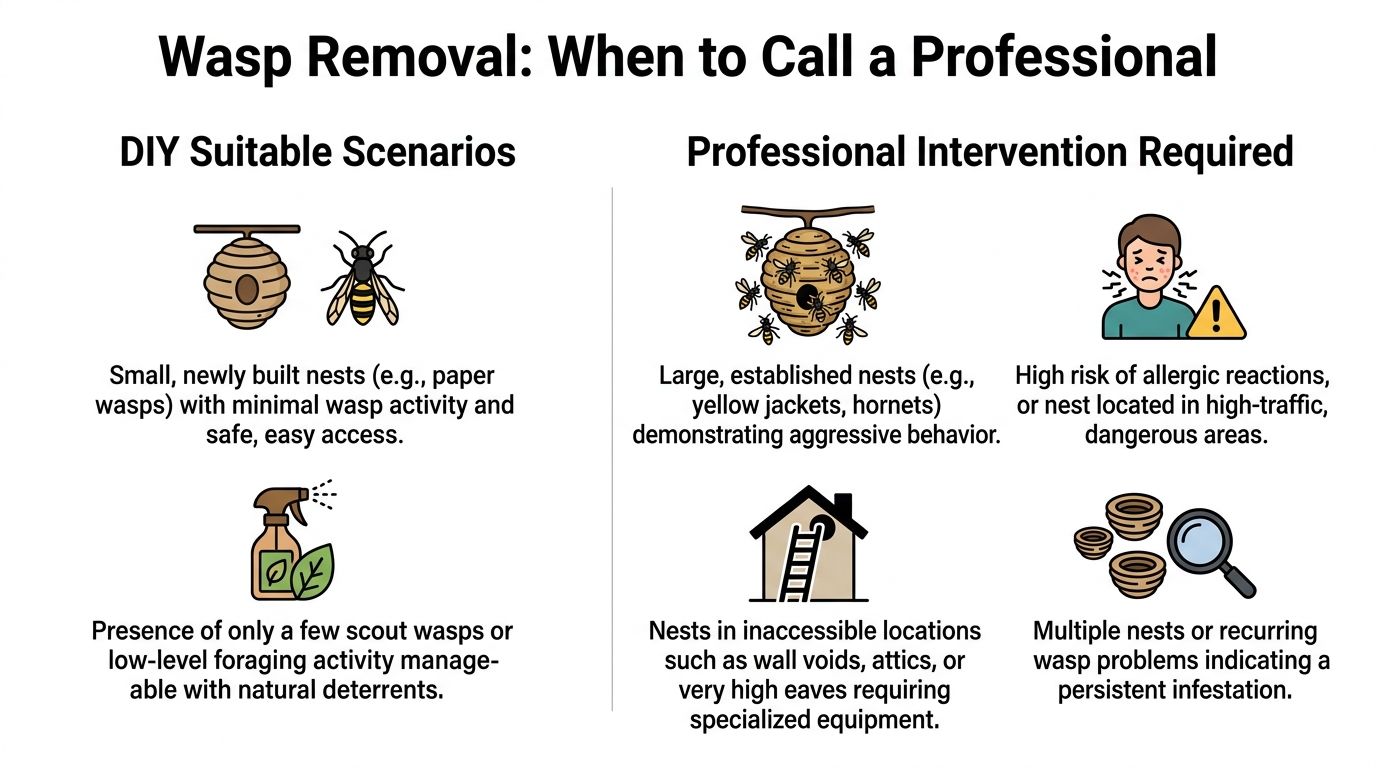
Some scenarios are manageable. Others are not worth the gamble.
DIY may still be reasonable when:
- You have a very small, newly started visible nest with low activity.
- The nest is easy to access safely from the ground.
- You are not dealing with hidden entry points or repeated aggressive behavior.
- No one in the home has a known sting allergy.
Professional help is the safer choice when:
- Wasps are entering siding, soffits, wall voids, or attic areas.
- The nest is large, elevated, concealed, or near a front door.
- You are seeing yellow jackets or hornet-type activity.
- The colony reacts defensively when anyone walks nearby.
- Multiple nest sites appear on one property.
- Anyone at the home is medically vulnerable to stings.
The key issue is not bravery. It is control. A professional can identify where the colony is centered, how the insects are moving, and whether the visible nest is the primary source or just one sign of a bigger problem.
Hidden nests create expensive mistakes
Porches make hidden infestations tricky because trim, columns, ceilings, and decorative finishes conceal entry routes. Homeowners often seal an opening before treatment or knock down the wrong nest material first. That can force wasps deeper into the structure or scatter surviving activity across another part of the home.
If you are searching for an exterminator in Crown Point, IN because the porch problem seems to be coming from inside a wall, trust that instinct. Once activity becomes structural, DIY usually turns into repeat work.
Safety changes the equation
Ladders, dusk treatments, aerosols, and defensive wasps are a bad combination. Add children, pets, or an allergy concern, and the decision gets simple.
One more practical trigger for calling a pro comes from the verified decoy guidance. When pressure is high and there are more than 3-5 active nests on a single property, deterrence methods lose value and an integrated pest management approach is needed, as noted in the same Gardening Know How guidance referenced earlier. That is not a porch nuisance anymore. That is a property-wide pest issue.
If you need a deeper look at removal decisions and common homeowner mistakes, this page on how to get rid of a wasps nest lays out the risk factors clearly.
Bottom line: If the nest is hidden, high, active, or close to daily foot traffic, the safer move is professional wasp removal.
The Green Advantage Solution for Wasp Control in Crown Point
When porch wasp activity moves beyond basic prevention, the work changes from “keeping them away” to diagnosing exactly why they chose that spot and how to remove the problem without making it worse.
That is the difference between buying a can at the hardware store and using a full residential pest control process. The porch is only the visible part. The primary job is identifying species, nest placement, access points, and recurring conditions around the structure.

What a proper service visit should include
A solid wasp service is not just a quick spray at the first nest someone can see.
It should include:
- Species identification: Yellow jackets, paper wasps, and hornets do not behave the same way.
- Full exterior inspection: Eaves, soffits, fixture mounts, railings, siding gaps, and nearby outbuildings all matter.
- Nest location review: Visible nests are checked, but hidden movement patterns matter just as much.
- Targeted treatment: The goal is colony control, not random chemical use.
- Follow-up guidance: Homeowners need to know what to watch, what to fix, and what activity is normal after treatment.
A provider that also handles broader pest issues can connect the porch problem to other conditions around the property. That matters in Northwest Indiana, where seasonal insect pressure often overlaps.
Why local experience matters in Crown Point
Wasp behavior is not abstract when you have seen the same porch layouts, soffit details, detached garages, and yard conditions across Crown Point neighborhoods. Local technicians learn where insects repeatedly exploit construction gaps and where homeowners tend to overlook early nest starts.
That local pattern recognition helps with more than wasps. The same property inspection often reveals spider harborage, ant entry routes, moisture issues, or conditions that support mosquito activity near entry areas.
The Green Advantage provides stinging insect control for interior and exterior activity, including nest removal where feasible, as part of its broader service offering in Northwest Indiana. For a homeowner comparing options for pest control near me or pest control in Crown Point, IN, that type of targeted service is relevant when porch activity has already crossed into removal.
What homeowners should expect from the process
The process should feel straightforward, not confusing.
A good customer experience usually includes:
- An initial conversation about where the wasps are active and how long the problem has been building.
- A site inspection focused on nest zones, entry points, and human traffic areas.
- A treatment plan matched to the species and location.
- Clear post-service instructions so you know what to monitor.
- Recommendations for prevention to lower the odds of another porch problem later in the season.
That same service mindset matters for commercial pest control too. Restaurants, offices, and multi-unit properties in Crown Point do not just need a nest removed. They need the entry and recurrence issue handled so staff and visitors are not dealing with the same problem again.
Protecting Your Home with Year-Round Pest Prevention
A wasp-free porch is good. A porch that stays low-risk season after season is better.
That is where homeowners often shift from a one-time exterminator near me search to a broader home protection mindset. Wasps rarely exist in isolation. If a property consistently supports porch nesting, there are often other conditions inviting pests too.
One pest problem usually points to another
The same exterior features that attract wasps can support a wider pest pattern:
- Gaps and voids let in ants, spiders, and stinging insects.
- Moisture around entry points draws insect activity close to the structure.
- Dense landscaping near the porch creates cover for crawling pests.
- Outdoor food and trash issues do not just attract wasps.
That is why one-off treatment can solve the immediate sting risk while leaving the property vulnerable to the next seasonal issue. In Crown Point, homeowners often deal with overlapping pest pressure across warm months and then transition into fall invaders and rodent concerns later on.
Prevention protects more than comfort
A lot of people first call because they are tired of dodging wasps on the way to the mailbox or hearing kids complain about bugs on the porch swing. That is valid. But the value of ongoing prevention goes beyond convenience.
Long-term pest management helps protect:
- Family safety: Fewer surprise encounters at doors, patios, and play areas.
- Property condition: Less chance of pests exploiting structural gaps over time.
- Routine use of outdoor spaces: Porches, decks, and entryways stay usable.
- Peace of mind: You stop wondering what is tucked behind every light fixture.
That bigger picture matters for homeowners, landlords, and property managers. It matters for homebuyers too. A property that shows repeated exterior pest pressure often needs more than a single treatment visit.
Practical takeaway: If pests keep returning to the same exterior zones, the issue is usually not just the insect. It is the environment that keeps welcoming it back.
A broader service plan fits Northwest Indiana homes
A true year-round approach usually combines seasonal inspection with targeted treatment and prevention advice customized for the property. That often means wasp prevention in spring and summer, plus attention to spiders, ants, mosquitoes, rodents, and other common Northwest Indiana issues as the year changes.
For many homes, that is the smarter path than waiting for each pest to become urgent. It turns pest control from a reaction into maintenance. The porch stays usable. The home stays better protected. You spend less time chasing one issue after another.
If you are comparing pest control in Crown Point, IN options, ask whether the service only addresses the nest in front of you or whether it also accounts for recurring seasonal pests around the whole property. That answer tells you a lot about whether you are buying a temporary fix or a prevention strategy.
Get Your Wasp-Free Porch Back Today
If wasps are taking over the porch, you do not need to wait until somebody gets stung to deal with it. Small scouting activity can often be managed with cleanup, exclusion, and careful trap placement. Once you see repeated traffic, hidden entry points, nest growth, or aggressive behavior, the smart move is to stop experimenting and get the situation assessed properly.
Homeowners and businesses in Crown Point and Northwest Indiana deal with seasonal pest pressure every year. The difference is whether you catch it early or let it turn your front porch into a place nobody wants to use. If you have been searching for pest control near me, exterminator in Crown Point, IN, or help with wasp removal, this is the point where action pays off.
A good inspection can tell you what species you are dealing with, where they are nesting, and whether the issue is limited to the porch or tied to bigger conditions around the property. That gives you a safer path forward and a better chance of keeping the problem from coming back.
If wasps are hovering around your porch, building under the eaves, or slipping into hidden gaps around the house, contact The Green Advantage to schedule an inspection, request a quote, and get clear next steps for safe wasp control in Crown Point and Northwest Indiana.