
You hear a faint scratching in the wall after dark. The dog stares at the pantry. In the morning, there are a few tiny droppings under the sink, and suddenly your home does not feel quite as settled as it did the day before.
That worry is common in Crown Point and across Northwest Indiana. Mice do not need much to move in, and once they find what they want, they tend to stay close.
The good news is that mouse problems are usually very understandable when you know what to look for. If you know what attracts mice to your home, where they slip inside, and how local weather changes their behavior, the problem stops feeling mysterious. It becomes something you can act on with confidence.
Your Trusted Partner for Pest Control in Crown Point IN
When homeowners search for pest control in Crown Point, IN, they are usually not looking for theory. They want answers. They want to know why mice picked their house, whether the problem is getting worse, and what solution will work.
That is a fair concern. Mice are not drawn to dirty homes only. They are drawn to opportunity. A neat house with one plumbing gap, a little pet food, and a damp crawlspace can be just as appealing as a cluttered one.
Why mouse problems feel so sudden
Most infestations seem to appear out of nowhere because mice stay hidden well. They move through wall voids, behind appliances, inside garage corners, and above ceilings. By the time a homeowner sees one in the open, mice have often already found food, shelter, or moisture.
In Crown Point, that pattern gets worse because our seasons push pressure onto homes for much of the year. Cold snaps send mice toward warmth. Humid stretches create damp conditions around basements, garages, crawlspaces, and AC areas that many homeowners do not think of as rodent attractants.
Key takeaway: Mouse activity usually starts with a simple combination of access plus resources. If a home offers both, traps alone rarely solve the full problem.
What local homeowners need from an exterminator near me
A homeowner looking for an exterminator near me is usually balancing several priorities at once:
- Fast clarity: They want to know if the noises and droppings really point to mice.
- A complete fix: They do not want to catch one mouse only to find more a week later.
- Safe treatment: They want rodent control handled responsibly around children, pets, and daily life.
- Prevention: They want to stop the next entry, not just remove the current intruder.
That is why understanding attractants matters so much. Rodent control works best when it addresses the reason mice stayed in the first place. In practical terms, that means looking at food sources, water sources, shelter conditions, and the structural weak points that let mice move indoors.
Homeowners in Northwest Indiana often assume a mouse problem starts in winter. Sometimes it does. But local conditions make the pressure more year-round than many people realize. That local reality changes what effective prevention looks like.
The Top 3 Things That Attract Mice to Your Home
You hear a scratch in the wall on a cold Crown Point night, set a couple of traps in the kitchen, and hope that handles it. Sometimes it catches one. The activity comes back because the house is still giving mice what they came for in the first place.
Mice stay where they can reliably find food, water, and shelter. In Northwest Indiana, that combination shows up in every season. Winter pushes mice toward heated interiors. Summer humidity keeps crawlspaces, basements, garages, and utility areas more mouse-friendly than many homeowners realize.
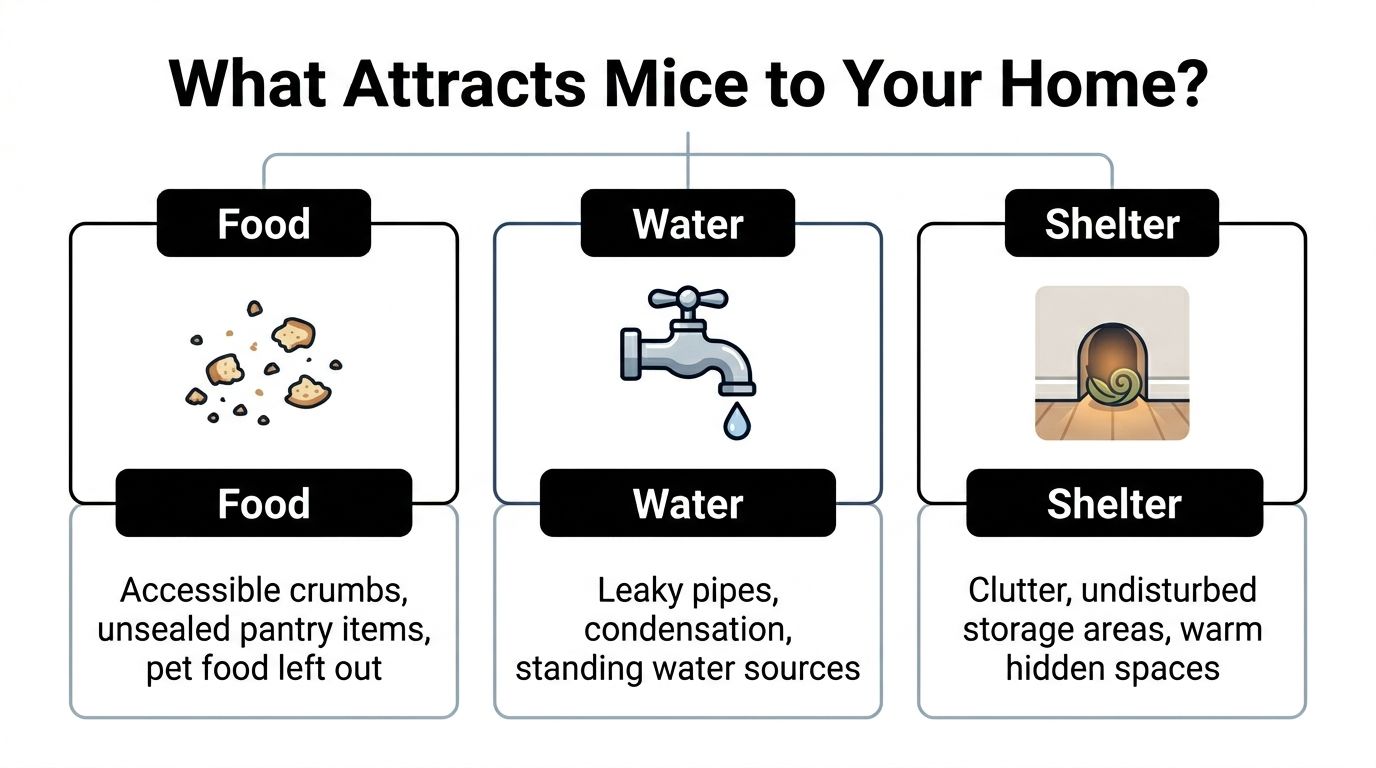
1. Food sources they can count on
A mouse does not need a major mess. It needs repeat access.
In real homes, I see the same patterns over and over. Crumbs under the stove, snack pieces under living room furniture, grease buildup beside a range, bird seed in the garage, and dry pet food left out overnight all give mice a reason to keep returning. Boxed goods and thin plastic packaging are not much protection either. If food odor gets out, mice will work at the package until they get in.
The trade-off is simple. Convenience for the household often creates consistency for mice. A bag of seed stored in the garage is easy for you to reach. It is also easy for mice to find. Pet food left out helps a busy evening routine. It also gives nighttime feeders a dependable meal.
2. Moisture that helps them stay
Food gets attention first. Water and damp conditions often explain why mice settle in instead of just passing through.
That matters in Crown Point because our climate creates moisture trouble in places homeowners often overlook. Condensation around HVAC lines, damp basement corners, crawlspace humidity, utility room drips, and moisture near sump areas all help support rodent activity. Harris Pest Control's overview of what attracts mice notes that even a small, steady water source such as a dripping faucet can support multiple mice.
Watch these areas closely:
- Under sinks: slow leaks hidden behind stored supplies
- Basements: damp walls, condensation, and musty corners
- Laundry rooms: appliance hoses, floor drains, and utility hookups
- Garages: humidity, minor leaks, and poor airflow
- Near HVAC equipment: condensation lines and pooled moisture
A house can look clean and still feel comfortable to mice if moisture is left in place.
3. Shelter that stays quiet and undisturbed
Once mice find food and moisture, they look for protected nesting spots. Most homes offer more of them than homeowners expect.
Cardboard boxes in the garage, holiday bins packed with fabric, paper storage in the basement, attic insulation, cluttered utility shelves, and dense shrubs near the foundation all give mice cover. They use soft materials for nesting and prefer areas that stay dark, warm, and undisturbed for long stretches.
Outdoor cover matters too. In Northwest Indiana, summer growth around the home can hide low entry areas and give mice safer movement along the foundation. Then fall and winter weather push that pressure closer to the house.
If you are already noticing scratching sounds, droppings, or gnaw marks, our guide to the common signs of rodent infestation can help you confirm whether mice are active.
Why these attractants matter together
One crumb usually is not the whole problem. One leak usually is not either.
What keeps an infestation going is the combination. Food gives mice a reason to return. Moisture helps them remain active inside. Shelter gives them a place to nest where they are hard to notice and harder to remove.
That is why quick trap-only fixes often fall short. Lasting rodent control means cutting off the resources that made the home worth using in the first place. At The Green Advantage, that is the part we pay close attention to because it is what turns a short-term catch into a long-term fix.
Unseen Entry Points and Telltale Signs of Mice
A Crown Point homeowner can keep a tidy house and still end up with mice in the walls by the first hard cold snap. In this area, the problem often starts outside long before anyone sees a droppings trail in the pantry.

Mice get in through openings homeowners pass every day without noticing. Small gaps around a pipe, a worn garage door corner, or a foundation crack can be enough. In Northwest Indiana, freeze-thaw movement, wet springs, and humid summers slowly open those weak spots, then fall and winter weather push mice to use them.
Where mice usually get in
A proper inspection is less about finding one big hole and more about spotting several small failures around the exterior shell.
Common trouble spots include:
- Foundation cracks: Especially where mortar has separated or settling has opened a seam.
- Utility penetrations: Gaps around water lines, gas lines, AC lines, and cable entry points.
- Door sweep failures: Side doors, service doors, and garage doors often leave just enough clearance at the bottom corners.
- Roof and vent gaps: Loose vent screens, soffit gaps, and openings near rooflines can give mice access to attics and wall voids.
- Garage corners: Garages collect clutter, stay quieter than main living areas, and often have more construction gaps than homeowners expect.
One reliable route is all it takes.
Why homeowners miss the first signs
Mice do most of their movement at night and usually travel along edges, not across open floors. That is why the first evidence often shows up in tucked-away spots instead of the middle of a room.
Watch for these signs early:
| Sign | What it often means |
|---|---|
| Small droppings | Regular travel routes near food storage, cabinets, or hidden nesting areas |
| Gnaw marks | Active feeding or attempts to widen access around wood, packaging, or drywall edges |
| Shredded material | Nest building with paper, insulation, fabric, or cardboard |
| Scratching sounds | Movement inside walls, above ceilings, or behind cabinets |
| Musty odor | Repeated activity in a concealed space, often with nesting nearby |
If you want to compare what you are seeing with common household warning signs, our page on common signs of rodent infestation gives a clear homeowner reference.
What a quick inspection should include
Start outside. Check the foundation line, door bottoms, garage perimeter, hose bibs, AC line entries, and any place one material meets another. Brick to siding transitions and pipe-to-wall gaps are frequent problem areas in homes around Crown Point.
Then move inside and inspect the places mice use first because they offer cover and steady access:
- Under sinks
- Behind the stove and refrigerator
- Inside pantry corners
- Basement rim areas
- Garage shelving edges
- Attic access points
This video gives a useful visual sense of the kinds of areas that deserve attention.
When signs point to a bigger issue
A single mouse caught in a trap does not rule out more activity elsewhere in the home. If droppings show up in multiple rooms, scratching continues after a catch, or fresh signs return after cleanup, there is usually an active entry route and a hidden nesting area that still need attention.
Homeowners often lose time focusing on the mouse they can see instead of the gap it used and the space where it settled. That trade-off matters. Catching one or two mice may bring short-term relief, but it rarely solves a Northwest Indiana mouse problem if seasonal pressure around the house is still in place.
Identifying entry points and hidden signs early makes it much easier to stop a mouse issue before it spreads.
Why Mouse Behavior Changes with Northwest Indiana Seasons
A lot of Crown Point homeowners call after the first hard cold snap. They hear scratching in a wall or find droppings that were not there a week earlier and assume the problem started overnight.
Usually, it started earlier.
Northwest Indiana gives mice two different kinds of opportunity through the year. Winter pushes them toward indoor warmth. Our humid summers and wet stretches help maintain the damp, protected conditions mice can use around basements, crawlspaces, garages, and utility areas. Generic national advice often focuses on cold weather alone. Around here, that misses half the pattern.
Fall and winter change how mice use a home
Once temperatures drop, homes in Crown Point become steady shelter. Attics stay warmer than the outdoors. Wall voids block wind. Utility areas hold residual heat. Mice respond fast to that shift, especially when fields are harvested and outdoor cover changes.
That is why activity often seems to surge in late fall. The route may have been there for weeks, but the weather finally gave mice a reason to use it heavily.

Summer brings pressure too, for different reasons
Summer mouse pressure looks different. It is quieter, and homeowners often misread it.
In Northwest Indiana, long humid stretches can keep certain parts of a property damp even without a plumbing leak. Basements can feel heavy. Crawlspaces can stay moist. Condensation around HVAC components and AC lines can keep small areas usable for longer than people expect. Purdue Extension's rodent control guidance emphasizes that mice need food, water, and shelter, and those conditions do not disappear just because it is warm outside. See Purdue Extension's house mouse management guidance.
Around Crown Point, I see the same summer conditions over and over:
- garages that stay damp after storms
- muggy basement corners with little airflow
- crawlspaces with persistent humidity
- utility and HVAC areas where condensation forms
- quiet storage areas that stay undisturbed for weeks
Those spaces may not draw attention the way a winter pantry issue does, but they still support mouse activity.
Why generic advice misses the Northwest Indiana pattern
A national article can tell you to seal gaps before winter, and that is good advice. It is incomplete for this area.
Our seasonal pressure is layered. Winter increases indoor movement toward heat and cover. Spring and fall often bring exploration and route-setting. Summer can support nesting and survival in damp, protected areas that stay stable during humid weather. The trade-off for homeowners is simple. If prevention starts only when frost shows up, mice may already be established in lower-traffic parts of the home.
That is one reason a local plan usually performs better than a one-size-fits-all checklist. A Crown Point home has to be evaluated for cold-weather entry pressure and warm-weather moisture pressure.
A seasonal plan works better than a one-season fix
The practical response changes with the calendar:
- In fall and winter, focus on heat-seeking activity and protected indoor nesting areas.
- In spring, watch for renewed movement as mice test routes and expand travel paths.
- In summer, correct humidity, condensation, and damp storage conditions.
- Year-round, keep the exterior less inviting so mice stay farther from the structure.
Homeowners who want to weigh short-term trap-and-seal work against a more durable treatment plan can compare both approaches in this guide on DIY mouse control vs hiring a professional.
Mouse behavior changes here because Northwest Indiana weather changes hard and often. The best results come from handling the problem the same way. Season by season, with a plan that fits Crown Point homes.
Your Rodent Control Options DIY Fixes vs Professional Treatment
A lot of Crown Point homeowners start the same way. They hear scratching at night, spot droppings near the pantry or garage wall, and pick up a few traps on the way home.
That first step can help. It just has limits, especially in Northwest Indiana, where mice keep shifting with the weather. In cold months, they push hard toward indoor warmth. In humid stretches, they often stay active around damp basements, crawl spaces, garages, and cluttered storage. A trap can remove a mouse. It does not tell you why the house keeps drawing them back.

What DIY does well
DIY control has a place.
If activity started recently, is limited to one area, and you can clearly identify where mice are getting in, traps and basic exclusion may be enough to get ahead of it. Good cleanup helps too, especially in kitchens, pet food areas, and storage spaces where crumbs or nesting material have built up.
DIY usually makes sense when:
- activity appears light and recent
- signs are limited to one room or one side of the home
- the gap or hole is easy to reach and seal correctly
- there is no strong odor, repeated droppings, or evidence of nesting
That is the honest trade-off. DIY can be a reasonable first response for a small, early problem.
Where DIY usually misses the core problem
The trouble starts when homeowners treat sightings instead of pressure points.
Mice rarely use just one opening. In Crown Point homes, I often find multiple access spots around utility lines, garage door corners, siding gaps, foundation joints, attic edges, and areas where cold-weather settling has opened small seams. Outside conditions matter too. Dense vegetation, stacked firewood, and stored items against the house give mice cover close to the structure. Once that pattern is established, catching one or two mice indoors does not break it.
Here is a practical comparison:
| DIY approach | What it can do | What it often misses |
|---|---|---|
| Traps | Reduce visible activity | Hidden travel routes, nests, and secondary entry points |
| Store-bought bait | Knock down some pressure | Safe placement, monitoring, and full-property strategy |
| Sealing one obvious hole | Blocks one access point | Small gaps in other parts of the structure |
| Extra cleaning | Lowers food availability | Shelter, moisture, and exterior harborage |
One of the most common mistakes is sealing only the spot where a mouse was seen. Another is putting traps indoors while ignoring the outside conditions that keep feeding the problem.
What professional treatment changes
Professional rodent control works best as a process, not a product.
A solid service starts with inspection. The goal is to find how mice are entering, where they are traveling, what conditions are supporting them, and whether the issue is isolated or established. From there, treatment is built around the house itself, not a generic setup.
A professional plan usually includes:
- Detailed inspection: interior signs, exterior gaps, nesting areas, and pressure zones
- Targeted trapping or control: placed where mice are moving
- Exclusion recommendations or repairs: to shut down repeat access
- Exterior evaluation: cover, moisture, storage habits, and structural conditions near the home
- Follow-up: to confirm activity has dropped and the plan worked
That matters here because our local weather creates repeat pressure. A home can seem quiet for a while, then mouse activity picks up again with the next hard temperature swing or damp spell. Lasting control usually comes from handling the whole pattern, not just the mouse you saw this week.
If you are comparing short-term fixes with a longer-lasting plan, this guide on DIY mouse control versus hiring a professional lays out the decision clearly.
What usually gives longer control: inspection, exclusion, and targeted treatment used together
What often falls short: traps alone, without fixing access and shelter conditions
Safety matters
Homeowners are right to ask about kids, pets, and treatment safety.
A good rodent service should explain what is being used, where it is being placed, and why that approach fits the home. It should also account for how the family uses the space. That includes kitchens, mudrooms, attached garages, basements, and utility areas where mouse activity often overlaps with daily routines.
Professional help offers clarity. You get a defined plan, you know what is being corrected, and you are not left guessing whether the scratching will start up again next week.
The Green Advantage Promise for Crown Point Homeowners
When mice get inside, the problem affects more than one corner of the house. It affects how comfortable people feel in their own kitchen, basement, garage, and bedrooms. That is why homeowners usually want more than a quick removal. They want confidence that the issue is being handled correctly.
For Crown Point homeowners, that means choosing a pest control company that understands both the pest and the local conditions that support it.
What professional rodent control protects
A proper mouse control plan helps protect several things at once:
- Your property: Mice chew, shred, and contaminate stored materials.
- Your living spaces: Kitchens, pantries, utility rooms, and attics are hard to enjoy when signs of rodents keep returning.
- Your routines: Ongoing trap checks and repeated cleanups wear people down quickly.
- Your peace of mind: The biggest relief often comes from knowing someone has found the root of the problem.
Professional service is especially valuable when mouse activity overlaps with other seasonal pest issues in Northwest Indiana. Homes dealing with rodents may also need broader support with preventative pest treatments, spider control, ant control, wasp removal, termite concerns, or mosquito control around the yard. A company that sees the full property picture can help homeowners protect the home more completely.
What homeowners should expect from a good service experience
A strong pest control experience should feel straightforward, not confusing.
It should usually include:
A clear first conversation
You should be able to describe what you are hearing or seeing and get practical guidance on next steps.An on-site inspection
The technician should inspect likely entry points, activity zones, and conditions that support mice.A site-specific plan
The home should be treated based on its layout, pressure points, and risk areas.Plain communication
You should know what was found, what was done, and what changes at home will help.Follow-through
Lasting control depends on confirming results, not just performing one visit and disappearing.
Why local experience matters in Crown Point IN
A company serving Crown Point, IN, and nearby Northwest Indiana communities should understand how local weather, construction styles, yard layouts, garages, crawlspaces, and seasonal moisture patterns shape pest activity. That local familiarity leads to better inspections and more practical recommendations.
Homeowner reassurance: The best pest control is not just about removing mice. It is about restoring normal life in the house without confusion, pressure, or guesswork.
If you are comparing providers after searching for exterminator in Crown Point, IN or pest control near me, look for direct communication, licensed and certified service, realistic prevention advice, and a process that addresses entry points as seriously as sightings.
Your Simple Home Maintenance Checklist for Mouse Prevention
Preventing mice is easier when small tasks become routine. The checklist below focuses on the parts of the home where mouse pressure builds fastest.
Kitchen and pantry
- Store dry goods securely: Move cereals, grains, snacks, and pet food into durable sealed containers.
- Clean low and hidden areas: Sweep under appliances and wipe crumbs from cabinet corners, not just countertops.
- Manage trash tightly: Keep garbage closed and avoid letting food waste sit overnight.
- Pick up pet bowls: Do not leave food and water out longer than necessary.
Basement attic and storage spaces
- Reduce soft nesting material: Limit loose paper, fabric, cardboard, and clutter in quiet areas.
- Use plastic totes: Long-term storage holds up better in lidded bins than in boxes.
- Watch for dampness: Check utility areas, under-sink zones, and corners that feel humid or musty.
- Inspect insulation and hidden edges: Look for shredding, droppings, or disturbed materials.
Home exterior and yard
- Trim back vegetation: Keep shrubs and growth from pressing against siding or foundation lines.
- Maintain perimeter clearance: Adequate clearance around the house helps reduce cover and climbing access, as noted earlier.
- Move wood and debris away from the house: Keep outdoor shelter spots from building pressure near the structure.
- Check doors and gaps: Pay attention to garage edges, side doors, vents, and utility penetrations.
A checklist like this does not replace treatment when mice are already active. It does make the property much less inviting.
Frequently Asked Questions About Mouse Control
Are mouse treatments safe for children and pets
They should be handled with safety in mind from the start. A responsible pest control company explains where products are placed, why they are used, and what precautions matter for your household. If you have children, pets, or specific concerns, ask for that conversation up front.
Can a clean home still get mice
Yes. Clean homes can still get mice if the structure has accessible gaps, moisture issues, or quiet nesting areas. Cleanliness helps, but it does not replace exclusion and inspection.
How long does it take to get rid of mice completely
That depends on how established the activity is, how many access points exist, and whether nesting areas are present. Some problems are resolved quickly. Others take a more involved plan with follow-up to make sure activity has fully stopped.
Do new homes in Crown Point get mice too
Yes. Newer homes can still have gaps around utility lines, garage doors, foundation transitions, roof vents, or landscaping that creates cover near the structure. Age alone does not prevent mouse pressure.
Should I call if I have only seen one mouse
If you have seen one mouse indoors, heard scratching, or found fresh droppings, it is worth taking seriously. Mice stay hidden well. One visible sign can mean there is already a route or nesting area somewhere out of sight.
If you are dealing with scratching in the walls, droppings in the pantry, or repeat mouse activity around your Crown Point home, The Green Advantage can help you get clear answers and a lasting solution. Our local team serves Crown Point and nearby Northwest Indiana communities with thoughtful, environmentally mindful pest control for homes and businesses. Reach out today to schedule an inspection, request a quote, and take the next step toward a home that feels settled again.