
It’s a question we hear all the time from concerned homeowners in Crown Point: how long can a tick actually live? The answer is often surprising and unsettling. Depending on the species and the conditions in your yard, a single tick can survive for several months up to over two years.
This incredible staying power is exactly why a small tick problem can quickly become a multi-year battle for your family's safety. When you're looking for an exterminator in Crown Point, IN, you need a team that understands this persistent threat. At The Green Advantage, we provide trusted residential pest control to protect your home and give you back your peace of mind.
Understanding Tick Longevity and Why It Matters for Your Home
When homeowners ask about a tick's lifespan, what they're really trying to grasp is the true risk they pose to their family and pets. Unlike a mosquito with a fleeting existence, ticks are built for the long haul. They are patient predators, capable of waiting months for their next meal—your dog, your child, or you—to wander by.
This longevity makes them a serious threat. A longer life means more opportunities to transmit dangerous diseases like Lyme disease. And because they can survive our tough Northwest Indiana winters, the danger doesn't just vanish with the first frost. This is why professional pest control in Crown Point, IN is not a luxury, but a necessity for protecting your property.
The Resilient Nature of Ticks
A tick’s ability to survive is a lesson in patience and endurance. They can enter a state of near-dormancy, allowing them to ride out harsh weather and long periods without a host. It’s this toughness that makes them such a formidable pest in our local environment.
While the common ticks we see in the Crown Point area typically live for about two years, some species take resilience to a whole new level. In one lab study, researchers documented certain soft ticks surviving for an unbelievable 27 years, with one going a full eight years without a single blood meal. While that's an extreme case, it perfectly illustrates why a casual, wait-and-see approach to tick control is never a good idea.
Ticks aren't just a fleeting summer nuisance; they are a persistent, year-round threat. Once they establish a population in your yard, they are there to stay unless you take decisive action.
Here at The Green Advantage, we've seen firsthand the challenges ticks create for homeowners in Crown Point. Our local expertise means we know exactly how to disrupt their long and complex lifecycle. Our mosquito control and tick services are designed to give you back your yard and your peace of mind.
Of course, their survival isn't just about time—it's also about withstanding different environments. If you've ever wondered about their limits, you might be interested in our guide that explores whether ticks can live in water.
The Tick Life Cycle: A Multi-Year Threat
To really get a handle on how long ticks can live, you have to stop thinking of their life as a short sprint. It's more of a patient, multi-year marathon. The entire journey from a single egg to a reproducing adult can take up to three years to complete, which is exactly why a few ticks in your Crown Point yard can quickly become a stubborn, long-term infestation.
A tick has to pass through four distinct life stages: egg, larva, nymph, and adult. Here’s the catch—to graduate from one stage to the next, it absolutely must find and take a blood meal from a host. This constant need to feed is what makes them a persistent danger at every phase of their life, requiring a professional exterminator near me to break the cycle.
The Four Stages of a Tick's Life
It all starts when a female tick lays thousands of eggs, usually tucked away in a patch of moist, leafy debris in your yard. Once hatched, you have six-legged larvae that are incredibly tiny, about the size of a grain of sand. They’ll wait for their first host, often a small mammal like a mouse, and after feeding, they molt into the next stage.
This next phase, the nymph stage, is arguably the most dangerous one for people and our pets. Nymphs are only about the size of a poppy seed, making them incredibly difficult to see. After they secure their second blood meal, they finally transform into full-sized adults, ready to find a mate and start the whole cycle over again.
The blacklegged tick's full life cycle spans up to three years in the wild, a critical fact for Northwest Indiana residents battling Lyme disease. Progressing through four stages, each requires a multi-day blood meal from hosts like deer, mice, or humans. You can discover more insights about their journey at the Johns Hopkins Lyme Disease Research Center.
This timeline shows just how resilient these pests are, from their average lifespan to the surprising records set in laboratory conditions.
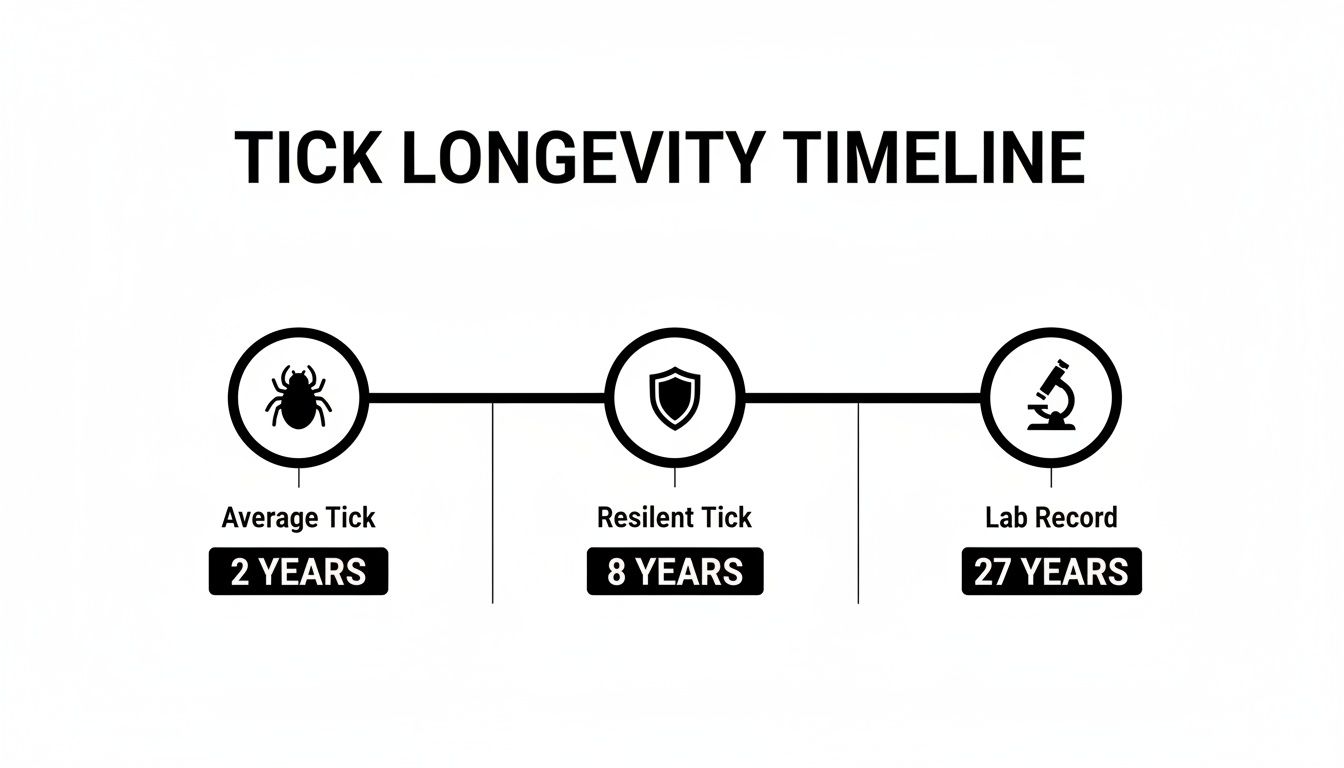
Their incredible longevity proves that just "waiting out" a tick problem in your yard isn't a realistic strategy for keeping your family safe.
A Year-Round Concern in Northwest Indiana
That multi-year life cycle means that different tick stages are active at different times of the year right here in Crown Point. While you might see more adult ticks during the cooler months of spring and fall, the tiny, dangerous nymphs are most active in the summer—just when your family wants to be outside the most. This staggered timing ensures that ticks are a constant threat.
Because a single tick can take years to mature, an infestation can easily sustain itself for a very long time. The larvae that hatch one spring can still be hanging around as a threat two summers later. This is why professional tick control is so vital; it’s designed to target ticks at every stage, effectively breaking the cycle and giving your property lasting protection. This is also why our preventative pest treatments are a popular choice for local homeowners.
The Top 3 Ticks We See in Northwest Indiana Yards
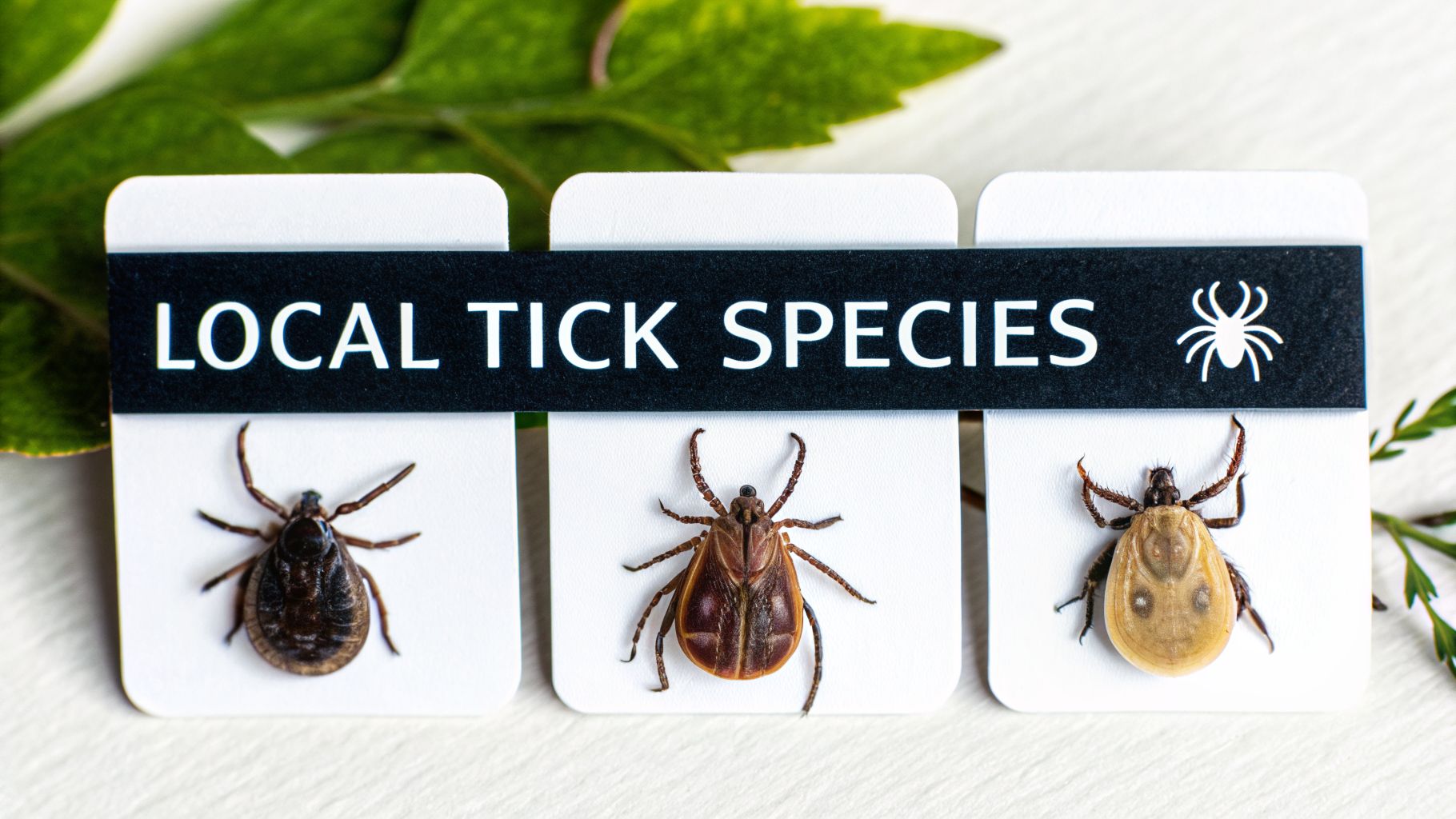
When it comes to ticks, what you don't know can absolutely hurt you. In our experience providing pest control in Crown Point, IN, we've found that most local tick problems boil down to three main culprits.
It’s easy to think of a tick as just a tick, but that's a mistake. Each species has its own rulebook for survival, from where it likes to hide to how long it can wait for its next meal. Knowing who you're up against is the first step toward taking back your yard.
The American Dog Tick
As the name suggests, the American dog tick is the one we're constantly pulling off our dogs after a walk. But don't be fooled—they’re just as happy to feed on people. We see them most often in spring and summer, hanging out in the tall grass of open fields and along trails, which describes plenty of outdoor spaces in our community.
What's truly incredible about this species is its patience. An unfed adult American dog tick can survive for a staggering 2-3 years—that's up to 1,053 days—without a single blood meal. Think about that. A tick can be waiting in your lawn for years. This is why you can't just assume ticks are gone during the off-season. You can dig deeper into how long ticks can survive without food and see just how resilient they are.
The Blacklegged Tick (Deer Tick)
This is the one that gets the most attention, and for good reason. The blacklegged tick, better known as the deer tick, is the main carrier of Lyme disease. It loves the woods and the shady, overgrown edges where your lawn meets a tree line—a perfect hiding spot on many local properties.
Their two-year life cycle means they’re a persistent threat, and they’ll be active any time temperatures climb above freezing, even on a surprisingly warm day in January. This is a common cause for spider control calls as well, as many insects seek shelter indoors.
Because blacklegged nymphs are so tiny—about the size of a poppy seed—they often go unnoticed, allowing them to transmit diseases before they are ever discovered.
The Lone Star Tick
You can spot a female lone star tick by the distinct white dot on her back. These ticks are becoming more and more of a problem in Northwest Indiana. Unlike other ticks that sit and wait for a host to brush by, lone star ticks are aggressive hunters that will actively move toward you.
They prefer shady, wooded spots and are infamous for their link to alpha-gal syndrome, a frightening allergy to red meat caused by their bite.
At The Green Advantage, our exterminators in Crown Point, IN, have seen it all. We bring that specific, local knowledge to your property. We don't just show up and spray; we identify the exact species you're dealing with and build a plan that targets their unique habits and life cycles to keep your family safe.
How Your Yard Helps Ticks Survive Longer
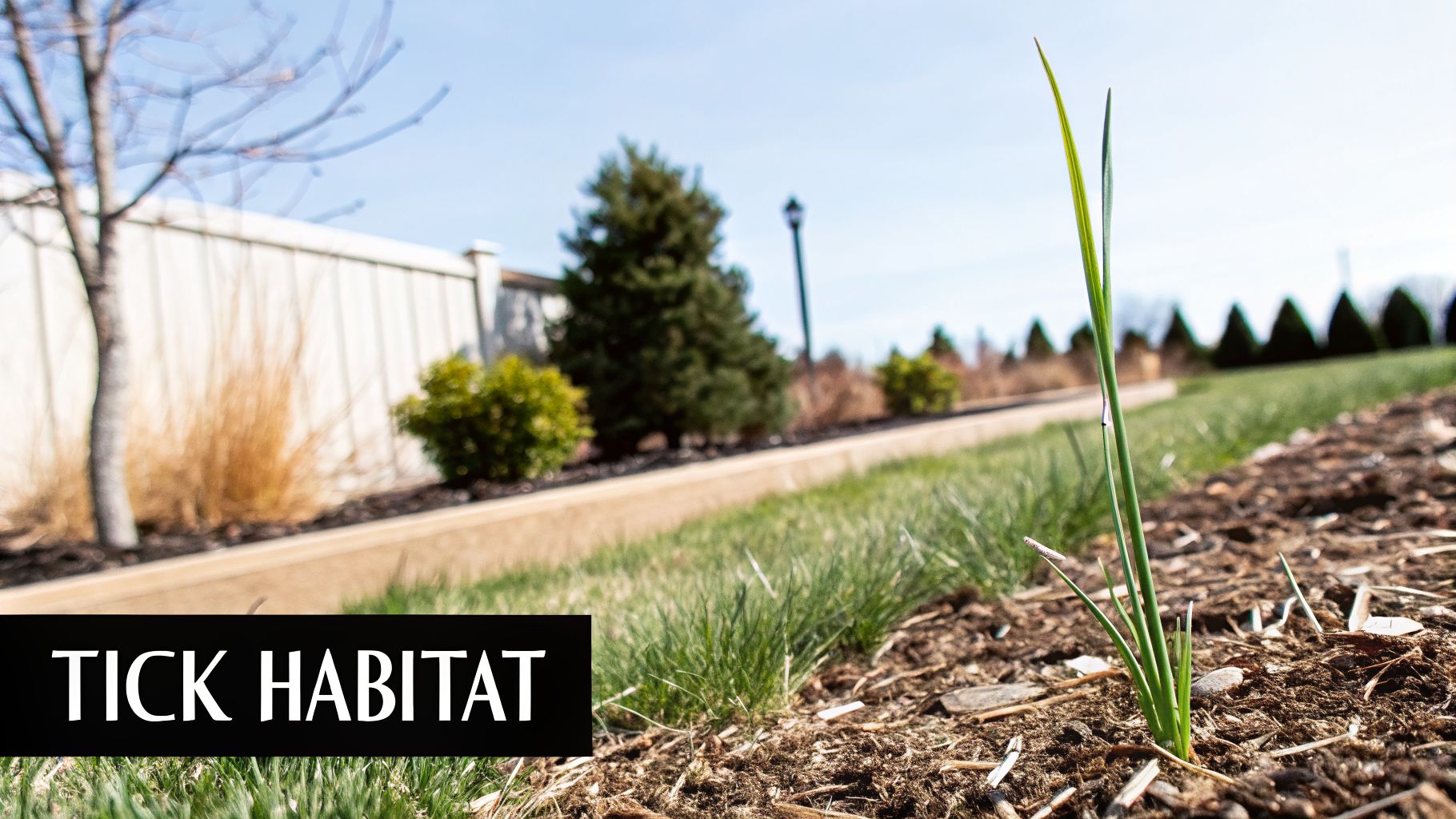
Without even realizing it, you could be rolling out the welcome mat for ticks. Your yard might have the exact conditions they need not just to survive, but to live far longer than they would otherwise. It all boils down to a single, critical need: moisture. Ticks are incredibly prone to drying out, a fatal weakness for them. To combat this, they spend most of their lives hiding in damp, shady spots to conserve water while waiting for their next blood meal.
This is why you'll rarely find a tick hanging out in the middle of a sun-drenched, well-kept lawn. They instinctively know it’s a death trap. Instead, they’re drawn to the unkempt edges and shady corners of your property where they can stay hydrated and patiently wait for a host.
This patient waiting game has a name: questing. When a tick is ready for a meal, it crawls up to the top of a blade of grass or the edge of a leaf, holds out its front legs, and simply waits. It isn't actively hunting you down; it’s just ambushing, hoping you, your child, or your dog will brush past and give it a ride.
Creating a Tick-Friendly Paradise
Many common yard features, especially here in Northwest Indiana, can accidentally create the perfect tick habitat. These hotspots are where moisture lingers, the ground stays cool, and ticks get everything they need to extend their lifespan.
Ticks absolutely love these spots:
- Leaf Litter: That thick blanket of leaves left over from the fall? It’s a dark, damp paradise for ticks, shielding them from the sun and locking in humidity.
- Tall Grass and Overgrowth: Unmowed sections of your yard and dense, brushy areas offer both shade and moisture. They also double as the perfect launchpad for questing ticks.
- Shady Areas: The ground under large trees, behind thick bushes, or along the north-facing side of your house stays cool and damp, making it prime real estate for ticks trying to avoid dehydration.
- Wood Piles: A stack of firewood is full of dark, moist gaps that offer shelter. It’s an ideal place for ticks to hide and even survive a harsh winter, and can also attract termites, requiring termite control.
Think of it this way: every pile of leaves, overgrown patch of grass, or unkempt garden bed is a safe house for ticks. By providing these shelters, you’re helping them live long enough to find their next meal right on your property.
Once you start seeing your yard through the eyes of an exterminator in Crown Point, IN, these problem areas become glaringly obvious. This is exactly why our professional tick and mosquito control service is so effective. We don’t just spray your lawn and call it a day; we focus on these high-risk hiding spots. By disrupting the tick life cycle where it begins, we can provide meaningful, long-term protection for your family and pets.
Why DIY Tick Control Often Fails
When you understand just how resilient ticks are and how long they can survive in your Crown Point yard, it becomes clear why store-bought sprays and granules so often miss the mark. Tackling a tick problem yourself is a bit like putting a small bandage on a serious wound—it might cover the issue for a moment, but it does little to solve the underlying problem.
Most over-the-counter products are contact killers, meaning they only eliminate the adult ticks you happen to spray directly. While there's a certain satisfaction in that, it’s a false sense of security. This approach completely ignores the thousands of eggs, nearly invisible larvae, and pinhead-sized nymphs lurking in the leaf litter, just waiting for their turn.
The Problem with a One-Size-Fits-All Approach
The tick life cycle is a slow-burn, multi-year process. A generic bottle from the hardware store simply isn’t built to interrupt something that complex. These products usually have little to no residual effect; once they dry, they stop working. A fresh batch of nymphs can hatch the very next day, putting your yard right back in the high-risk zone.
DIY methods are stuck treating the symptoms—the adult ticks you see. A real solution has to target the source of the problem: the next generation of larvae and nymphs that guarantee the infestation continues for years.
On top of that, a DIY spray doesn't know your yard. A trained professional from The Green Advantage does. We’re taught to spot and treat the specific micro-environments where ticks thrive, from that damp, shady spot behind the shed to the overgrown border with the woods. Some homeowners wonder about using harsh household chemicals, but that can be ineffective and unsafe. You can read our guide that explains if bleach is an effective way to kill ticks to see why that's not the answer.
Our residential pest control programs are designed for the long game. We don’t just knock down the current adults; we systematically break the entire tick life cycle. This is the only way to move beyond temporary fixes and give your family lasting protection and genuine peace of mind.
What to Expect From Your Crown Point, IN Exterminator
Dealing with a tick problem can feel overwhelming, but getting professional help shouldn't be. Here in Crown Point, we've built our entire approach at The Green Advantage around making the process straightforward and effective, so you can feel confident in your yard again.
When you first reach out to us, you'll talk to a friendly expert who genuinely understands the local pest pressures we face in Northwest Indiana. We’re here to listen to your concerns, answer your immediate questions, and schedule a convenient time for one of our technicians to conduct a thorough inspection of your property.
Our Process for Effective Pest Control
When our certified and licensed technician arrives at your home, they do more than just a quick walk-through. They conduct a detailed inspection to identify the specific tick species on your property and pinpoint those high-risk zones where they hide and breed—think shady fence lines, dense ground cover, and piles of leaf litter.
From that assessment, we build a customized treatment plan for your yard. The key is to break their lifecycle, so we target ticks at every stage, from eggs and nymphs to adults. We apply treatments precisely where ticks thrive, which makes the application both more effective and more responsible. We also offer eco-friendly pest control options for families who prefer them.
Our goal is simple: we want you to feel completely cared for and in the loop. We'll show you exactly what we found, explain the 'why' behind our plan, and walk you through how it will protect your family and pets. That transparency and commitment are why so many people trust us as their exterminator in Crown Point, IN.
Your technician will explain the entire treatment process and even give you practical tips on how to make your yard less inviting to ticks in the future. From your first call to our final follow-up, you can count on the reliable residential pest control that your neighbors depend on.
Answering Your Top Tick Control Questions
When you start learning just how long ticks can stick around, a lot of questions naturally come up. As the trusted local pest control near me for many in Crown Point, IN, we hear these concerns from homeowners every single day. We've put together some straight answers to the most common questions we get, so you can feel confident about protecting your family.
How Quickly Do I Need to Remove an Attached Tick?
The short answer? Immediately. As soon as you spot an attached tick, it's time to act. A tick's ability to transmit diseases goes up the longer it's attached and feeding.
Grab a clean pair of fine-tipped tweezers, get as close to the skin as you possibly can, and pull straight up with steady, even pressure. Don't twist or jerk it. Once it's out, wash the bite area and your hands thoroughly with soap and water or some rubbing alcohol.
Do Ticks Actually Survive a Crown Point Winter?
Yes, they absolutely do. It's a dangerous myth that ticks die off after the first hard frost. Here in Northwest Indiana, tough species like the blacklegged tick are pros at surviving the cold.
They find shelter by burrowing under leaf litter, hiding in woodpiles, or nestling into other protected spots. The moment the temperature inches above freezing, they can become active again. This makes them a potential threat almost year-round, similar to overwintering pests like rodents that require rodent control.
Is It Worth Getting a Tick Tested for Diseases?
This is a question we get a lot. While it seems like a logical step, public health officials generally don't recommend sending individual ticks for testing. The results can be unreliable, and a positive test on the tick doesn't automatically mean the disease was transmitted to you.
The better approach is to remove the tick properly and then simply keep an eye on yourself for any unusual symptoms like a fever or rash. If anything pops up, call your doctor, and be sure to tell them you had a recent tick bite.
The best strategy for real peace of mind isn't about testing one tick—it's about drastically reducing the number of ticks in your yard to begin with. The most reliable way to lower your family's risk is to control the entire population.
I Treated My Yard Myself, So Why Do I Still Have Ticks?
DIY yard treatments often feel like a losing battle because they usually only target the adult ticks you can see. The real problem is that they miss the thousands of tiny eggs, larvae, and nymphs hiding in the environment, just waiting for their turn to mature.
Professional pest control works because it’s designed to break this cycle. We use targeted applications and products that disrupt every stage of a tick's life, delivering a level of protection that’s far more complete and lasts much longer.
If you're looking for more information on ticks and other common pests, our comprehensive parasites guide is a great resource.
Ready to take back your yard and stop worrying about ticks? The team at The Green Advantage has the expertise to give you the reliable protection you need. Contact us today to schedule your professional pest inspection in Crown Point, IN.